Key takeaways
- A $100 increase on a $2,000 rental earns $1,200 in a year. One turnover in our illustrative example costs about $3,385.
- The test: multiply the turnover cost by the chance the increase makes the tenant leave, and compare it with twelve months of the increase.
- Flat rent is not free. Left flat for years, it quietly costs as much as a turnover, so small regular adjustments usually beat rare painful ones.
- Texas does not cap a renewal increase on a private rental, but Property Code 92.331 bars raising rent to retaliate against a tenant who asked for repairs.
- Decide from the ledger and the inspection reports, not from how pleasant the tenant is on the phone.
Keep the good tenant. Unless the rent has fallen far behind the market, the money you would gain from a full increase is usually smaller than the money you would lose if that tenant moved out and you had to find another one. A good tenant pays on time, reports problems early and keeps the house in shape, and you cannot buy that with a listing.
That does not mean the rent must stay flat forever. It means the decision is a calculation, not a reflex. Here is how to run it for a house in Keller, North Richland Hills or Fort Worth, with the math, the Texas rules that apply and the way to ask.
Keep or raise: the break-even math on a $2,000 rental
Here is what each size of increase earns in a year on a $2,000 rental, and how likely a move-out has to be before the increase loses money (illustrative only, not a quote or a forecast):
| Renewal increase | Extra rent over 12 months | Illustrative turnover cost if the tenant leaves | Break-even chance of losing the tenant |
|---|---|---|---|
| $0 (same rent) | $0 | No added risk from the rent | Not applicable |
| $50 a month | $600 | $3,385 | About 18% |
| $100 a month | $1,200 | $3,385 | About 35% |
| $150 a month | $1,800 | $3,385 | About 53% |
How to read this table: if you think the chance that the increase pushes the tenant out is higher than the last column, the increase is expected to lose money. The $3,385 is three weeks of vacancy ($1,385), tenant placement at 50% of one month's rent ($1,000) and an assumed $1,000 make-ready. Put your own numbers in. It leaves out one thing in your favor: a new tenant would pay today's market rent.
What you actually risk when a good tenant leaves
A move-out is not just an empty month. It is the empty weeks while the house is cleaned, painted and listed, the make-ready work the deposit does not cover, the leasing fee on the new tenant, and the chance that the new tenant is not as good as the old one. Each of those is a real cost, and they stack.
Say rent is $2,000 a month. Three weeks of vacancy is about $1,385. Tenant placement on our Full Service plan is 50% of one month's rent, $1,000 here, and 75% on Standard. Add the make-ready. By comparison, a renewal costs our lease renewal fee of $150 on Full Service, $200 on Standard or $149 on Investor Special, and a $75 increase earns $900 over a year.
Our renewals page puts a typical turnover at one to two months of rent once vacancy, make-ready and leasing are counted. The guide on what a vacant month really costs walks through the full list.
When holding the rent flat is the right call
Hold the rent when the tenant is genuinely good and the gap to market is small. A tenant who has paid on time for a year, kept the yard up, and called about the water heater before it flooded the garage is the tenant you want to keep for three or four years, and a flat renewal is a cheap way to do that.
Hold it too when the market is soft or the lease ends in a slow part of the year; seasonality in the DFW rental market explains why timing matters. If the house would sit, a flat renewal protects the income more than a few dollars of increase would add to it.
Hold it when the house has a known weakness, such as an older kitchen or no garage, that the current tenant has accepted. The next applicant will price that weakness into the offer.
When a modest increase is still the right call
Raise the rent when the gap to market has grown large enough that flat rent is costing you real money every year, and the tenant's own alternatives have gotten more expensive too. If comparable homes nearby lease for noticeably more, a tenant who shops around will find that out quickly and will usually accept a fair increase rather than pay moving costs.
Raise it also when your own costs, such as property taxes and insurance, have moved. A tenant who understands that a modest increase keeps the house maintained will often accept it. Modest means an amount the tenant can absorb without re-shopping the market. How to size the number and give proper notice is covered in raising the rent: how much, when and how to tell the tenant.
What Texas law says about raising rent at renewal
Texas law leaves the amount to you and the market, with three limits worth knowing.
- No cap on a private rental. Under Local Government Code 214.902, a city may establish rent control only if it finds a housing emergency caused by a disaster and the governor approves the ordinance. Outside that, we found no section in Property Code chapter 92 that limits the size of a renewal increase.
- The lease fixes the rent for its term. An increase takes effect with a new lease or renewal, or as the current lease allows, so check its renewal and notice clauses before you send a number.
- No retaliation. Property Code 92.331 bars a landlord from raising the rent or terminating the lease, within six months after a tenant in good faith asks for a repair or exercises a legal right, as retaliation for it. Property Code 92.332 says the landlord is not liable if the landlord proves the action was not retaliation, which is why the leased comparables behind the number belong in the file.
This is general information, not legal advice.
A simple break-even test you can run today
Write down three numbers: the increase you are considering, your honest estimate of turnover cost, and the chance the tenant leaves because of the increase.
- Multiply the increase by twelve. That is the most you gain in a year.
- Estimate the turnover cost: vacancy, make-ready, leasing fee, and a buffer for surprises.
- Multiply the turnover cost by the chance the tenant walks. A tenant who has mentioned buying a house, or whose job moved to the other side of Fort Worth, is a higher number.
If the expected turnover cost is bigger than the annual gain, keep the rent flat or make the increase small. If the gain is bigger, raise it, with a renewal offer that gives the tenant a reason to stay.
Worked through with the table's numbers: a $100 increase gains $1,200 a year. If a turnover would cost $3,385 and you think there is a one-in-three chance the tenant leaves over the increase, the expected cost is about $1,130, nearly the whole gain, for a year of risk. At $50, if the chance falls to one in ten, the expected cost is about $340 against a $600 gain. The point is not precision. Most owners only look at the increase side, and the other side has a number too.
How to offer a renewal so a good tenant stays
Start early, two to three months before the lease ends, so the tenant is not making the decision under pressure; when renewal discussions should start has the full timeline. Lead with the offer, not the increase: a renewal at a specific rent for a specific term, with a clear date to reply.
Give the tenant something in return where it costs you little. A carpet clean, a longer term at a set rent, or fixing the one thing they have mentioned twice. Those gestures cost a fraction of a turnover and signal that you want them there. The full playbook is in how to keep good tenants longer.
If you want a second opinion on where the rent sits against the market before you decide, a free rental analysis gives you the comparables without the guesswork.
Be honest about whether the tenant is actually good
The whole argument rests on the tenant being worth keeping. Good means rent paid on time nearly every month, the house inspected and found in reasonable shape, the utilities the lease assigns to the tenant kept on and paid, no neighbor or HOA complaints, and problems reported early instead of hidden. A tenant who pays late every other month or who has let the yard go is not a good tenant, and a flat renewal just locks in the problem.
Look at the rent ledger and the last two inspection reports before you decide, not your memory of the tenant. Owners tend to remember the friendly conversations and forget the late fees, and a renewal made on a feeling rather than a record is how a mediocre tenant becomes a five-year tenant.
For a tenant like that, the renewal is the moment to tighten terms or decline to renew, and the renewal process should be run on the evidence from inspections and the rent ledger, not on how pleasant the tenant is on the phone.
How Perpetual handles this
Perpetual Property Management is broker-owned, with our office at 5755 Rufe Snow Dr in North Richland Hills, and we manage homes in Keller, North Richland Hills, Fort Worth and nearby. We treat every renewal as a math problem, not a default increase. Renewal work begins 120 days before lease expiration with a market check against current leased comparables, the same discipline as initial pricing.
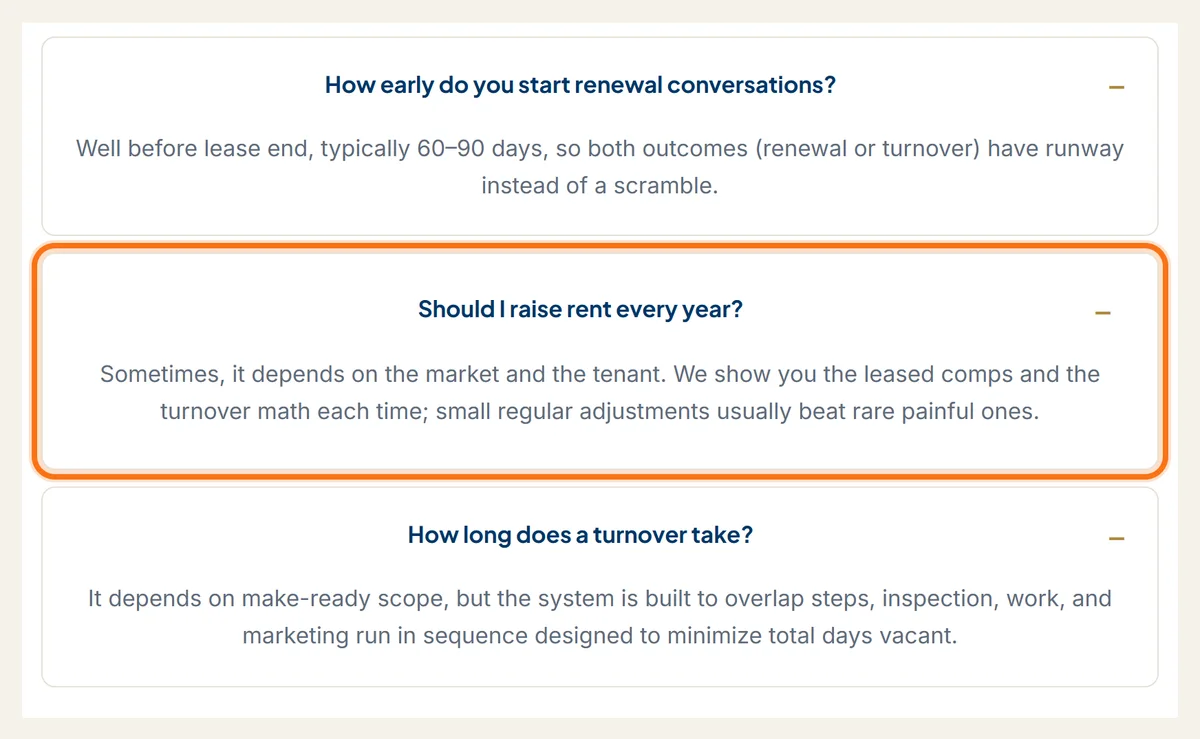
You then get a recommendation with reasoning: keep at market, adjust moderately, or let the tenant go, with the turnover math shown. The decision is always yours. We show you the leased comps and the turnover math each time, because small regular adjustments usually beat rare painful ones.
The lease renewal fee is $150 on Full Service, $200 on Standard and $149 on Investor Special. Tenant placement, if the tenant does leave, is 50% of one month's rent on Full Service and Investor Special and 75% on Standard. What else applies on your home is confirmed in writing before you sign. See renewals and turnovers and the price sheet.
If you are weighing a renewal right now and want the comparables and the math for your house, call 682-593-7033.
The takeaway: A good tenant at a slightly below-market rent is often the most profitable tenant you will have, so run the turnover math before you raise the rent, and do not leave it flat for years either.
Questions owners ask
How much can I raise rent on a renewal in Texas?
Texas does not cap it on a private rental. Local Government Code 214.902 allows a city to adopt rent control only in a housing emergency caused by a disaster, with the governor's approval. The limits are the lease, which fixes the rent until its term ends, Property Code 92.331 on retaliation, and the market: an increase above what comparable homes lease for invites the tenant to move. This is general information, not legal advice.
Should I offer a longer lease to a good tenant?
Often yes. A longer lease at a set or lightly stepped rent gives the tenant stability and gives you a longer stretch without a turnover. The trade-off is less room to adjust the rent or change plans during the term, so read the lease's terms on inspections and on a sale before you offer it.
What if the tenant asks for a rent reduction at renewal?
Check the comparables first. If the market has softened and the house would lease for less today, a small reduction or a flat renewal with a small concession can still beat a vacancy. If the market supports the current rent, hold it and explain why, politely and with the data.
Does a property manager decide the renewal rent or do I?
The owner decides. A good manager brings the leased comparables, the tenant's record and a recommendation, then carries out whatever the owner chooses and handles the notice and paperwork. At Perpetual the recommendation comes with the turnover math, and the decision is always yours.
How much does a renewal cost compared with finding a new tenant?
On our plans a lease renewal is $150 on Full Service, $200 on Standard and $149 on Investor Special. Placing a new tenant is 50% of one month's rent on Full Service and Investor Special and 75% on Standard, so $1,000 or $1,500 on a $2,000 rental, before any vacancy or make-ready. That gap is why the renewal decision deserves the math.
How to check if a tenant is paying utilities before you renew?
Start with the lease, which says which utilities are the tenant's. Ask the tenant for a recent bill or account confirmation, and confirm at the inspection that power, water and gas are on. For any utility billed in your name, you already receive the bill. An account that keeps lapsing is worth knowing about before you offer another term.
Is it bad to never raise the rent on a good tenant?
It can be. Rent left flat for years falls behind the market, and the gap eventually forces a large increase that is more likely to end the tenancy than several small ones would have been. Small regular adjustments, checked against leased comparables each year, usually keep both the tenant and the income.
Property management in Keller, North Richland Hills and Fort Worth. How full-service management works in Tarrant County →