Key takeaways
- DFW management is priced as a monthly percentage of rent plus leasing, renewal and maintenance fees; compare yearly totals, not headline rates.
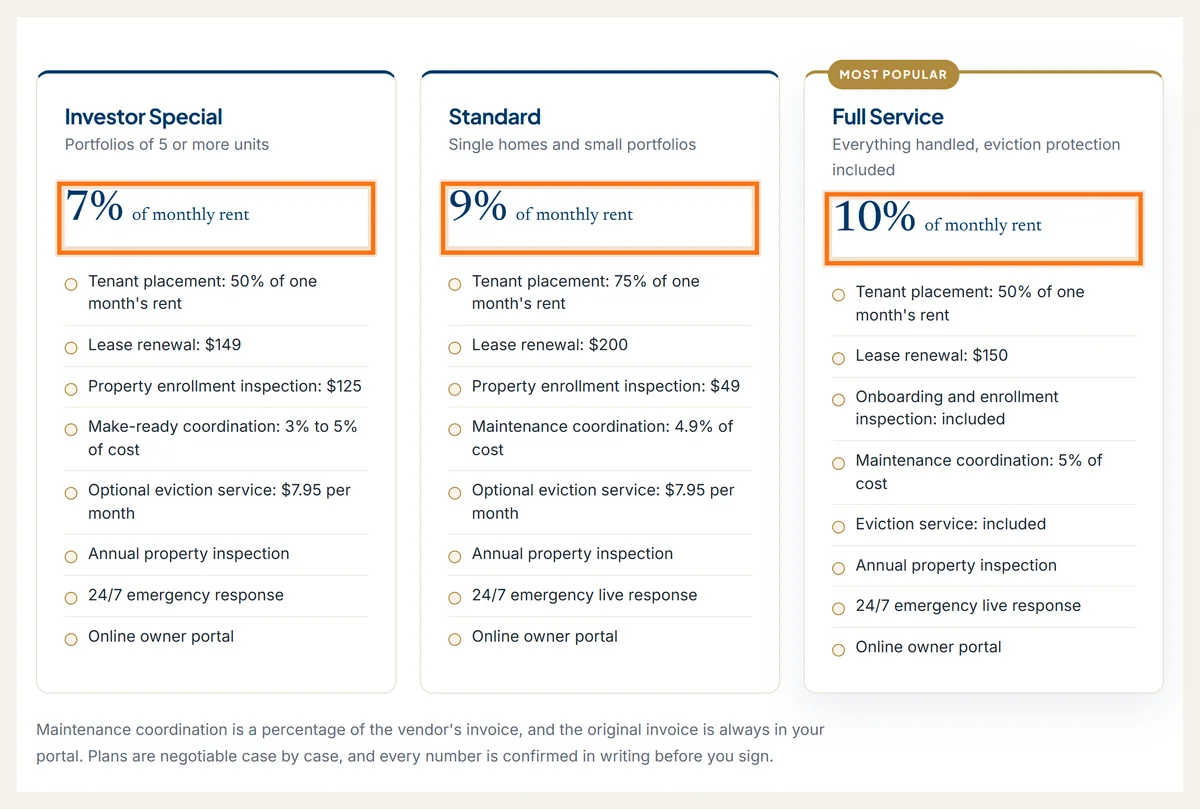
- Our published plans: 9% Standard for single homes, 10% Full Service, 7% Investor Special for 5+ units.
- On a $2,000 home in a year a new tenant is placed: about $3,709 on Standard, $3,400 on Full Service.
- Maintenance coordination is 3% to 5% of the vendor invoice by plan, and the original invoice is always in the owner portal.
- If a fee is not in the written agreement, you do not pay it.
How much does property management cost in Dallas-Fort Worth? Expect a monthly management fee, usually a percentage of rent, plus a leasing fee when a tenant is placed, a renewal fee and maintenance billing. Our published price sheet for Dallas, Fort Worth and Tarrant County homes: 9% of monthly rent for single homes, 10% for Full Service with eviction service included, and 7% for portfolios of five or more units. On a $2,000 home that is $140 to $200 a month before leasing fees.
The exact figure depends on the property, its condition and how many doors you own. This guide lays out the whole cost structure, puts our own numbers on the table, shows where the hidden costs hide, and runs one home through a full year.
The standard fee components
Nearly every DFW management quote is assembled from the same pieces:
- Monthly management fee. The core fee for day-to-day management, typically charged as a percentage of rent or a flat monthly amount. The critical distinction: is it charged on collected rent, or billed regardless? A fee on collected rent means the manager earns nothing while your property sits vacant, which keeps the incentives aligned with yours. How to read the percentage itself is covered in what percentage of rent DFW managers charge. A fee billed during vacancy is a very different deal.
- Leasing fee (tenant placement). Charged when a new tenant is placed, covering marketing and showings, screening, and lease preparation. Often quoted as a portion of one month's rent.
- Renewal fee. Some companies charge a smaller fee when an existing tenant renews, reasonable if real market analysis and negotiation happen (see how renewals should work on the service pages), less so if it's an auto-generated form.
- Maintenance billing. The component that varies most. Some companies pass vendor invoices through at cost; others add a coordination markup. Neither is automatically wrong, but you deserve to know which model you're signing, in writing.
- Occasional extras. Additional inspections, eviction coordination, technology or statement fees, special projects. Ask for the complete fee schedule, not the headline number.
Our DFW price sheet, side by side
These are our standard numbers, as published on our pricing page. The final fee is set after the rental analysis, and every number is confirmed in writing before you sign:
| Fee | Investor Special (5+ units) | Standard (single homes) | Full Service |
|---|---|---|---|
| Monthly management fee | 7% of monthly rent | 9% of monthly rent | 10% of monthly rent |
| Tenant placement | 50% of one month's rent | 75% of one month's rent | 50% of one month's rent |
| Lease renewal | $149 | $200 | $150 |
| Property enrollment inspection | $125 | $49 | Included |
| Maintenance or make-ready coordination | 3% to 5% of cost | 4.9% of cost | 5% of cost |
| Eviction service | Optional, $7.95 a month | Optional, $7.95 a month | Included |
How to read this table: the first row is what you pay every month; the rest are paid only when that event happens. Every plan includes an annual property inspection, 24/7 emergency response and the online owner portal. A newer home that needs no turn work can come in lower, and an older home that needs permits and repairs at every turn can carry a premium.
What determines your specific quote
- Property type and condition. A newer single-family home is a different management workload than an older fourplex with aging systems.
- Number of doors. Portfolio owners typically receive portfolio pricing; if you own several properties, say so.
- Occupied vs. vacant. Taking over a property with a paying tenant in place is a different job than a full make-ready and placement.
- Location and rent level. Percentage fees scale with rent; some companies adjust for distance or market.
Where hidden costs actually live
The headline percentage is rarely where owners get hurt. The real spread between companies hides in four places:
- Maintenance markups. A percentage added to every invoice, across every repair, for years, can quietly exceed the management fee itself.
- Vacancy incentives. Fees billed during vacancy remove the manager's urgency to fill it. Watch for this above everything.
- Lease-up churn. A company that earns most of its money on leasing fees has a structural incentive toward turnover, not renewals. Ask how they decide renewal recommendations.
- Exit penalties. Long lock-ins with early-termination fees tell you how confident a company is in its own service. Reasonable agreements let unhappy owners leave.
The full list of add-ons that tend to surface only after signing is in hidden property management fees.
Our written guarantees close two of these: every fee you pay is listed in your written agreement, and if a fee is not in the agreement you do not pay it; every completed repair over $500 gets photo or video proof in your portal. Both are on our guarantees page.
The questions that expose them
Ask any manager, including us, these five, and require written answers:
- Is the management fee charged on collected rent or billed during vacancy?
- Are maintenance invoices passed through at cost, or marked up, and will I see the actual invoices?
- What exactly does the leasing fee include, and is any of it refunded if the tenant fails in the first months?
- What does it cost to leave if I'm unhappy?
- What fees exist beyond the ones we've just discussed? (The silence after this one is informative.)
The ROI math: what management is actually buying
Compare the annual cost of management against what it's built to prevent. Take, as an illustration only, a $2,000-a-month Tarrant County rental; the big four risks look like this:
- Extended vacancy from mispricing or weak marketing: one avoidable month = $2,000. Professional pricing and marketing exist to shrink exactly this.
- One bad placement: months of unpaid rent plus turnover damage, often several months of rent in total. Prevented by screening discipline.
- Emergency-priced repairs from missed early warnings: the small caulk job that became a drywall and flooring repair. Prevented by inspections and responsive maintenance.
- A deposit or compliance dispute without documentation: unpredictable, occasionally severe. Prevented by boring, professional paperwork.
For most owners, avoiding a single vacant month covers a large share of a year's management cost, and that's before valuing your evenings back. That's the honest frame: management isn't an expense next to zero; it's an expense next to the cost of the mistakes it prevents.
What one $2,000 home costs in a year on each plan
Here is a full year on a home renting at $2,000 a month in which a new tenant is placed, using the published rates above and leaving out repairs:
| Line | Investor Special | Standard | Full Service |
|---|---|---|---|
| Management fee, 12 months | $1,680 | $2,160 | $2,400 |
| Tenant placement | $1,000 | $1,500 | $1,000 |
| Enrollment inspection | $125 | $49 | Included |
| Eviction service | Optional ($95.40 a year) | Optional ($95.40 a year) | Included |
| Total without the optional eviction service | $2,805 | $3,709 | $3,400 |
How to read this table: Investor Special applies only to portfolios of five or more units, so a one-home owner is choosing between the last two columns. In a year a tenant is placed, Full Service costs less than Standard and includes eviction service; in a year the tenant renews, Standard costs $2,360 against $2,550. Run the same table for your rent before you compare anyone's quote.
Why the cheapest quote is often the most expensive
A rock-bottom management fee has to be subsidized somewhere: maintenance markups, vacancy-billed fees, churn-driven leasing income, or simply doing less, fewer inspections, slower responses, rubber-stamp screening. The expensive failures above dwarf a one-point difference in management fee. Choose on alignment and transparency, not on the headline number.
Want your exact numbers instead of theory? Request a free rental analysis; the written quote that comes with it lists every fee in plain English, answers all five questions above, and is yours to compare against anyone.
A worked example: one property, one year, both paths
Numbers make this concrete. Take an illustrative North Richland Hills 3/2 renting at $2,000 a month and walk a year down both paths; every figure below is an example, not market data.
Self-managed, good year: stable tenant, two routine repairs at retail vendor pricing, no vacancy. Out-of-pocket management cost: $0. This is the year self-management advocates describe, and it genuinely happens, often several years running.
Self-managed, cycle year: tenant leaves in November (weak season). Three weeks of make-ready stretched to five (vendor scheduling), four more weeks on market at an optimistic price, then a $100 reduction and two more weeks: ten weeks vacant is roughly $4,600 at that rent. Add retail-priced turnover work and a placement made slightly fast because the vacancy hurt, the tenant who pays late four times the next year. None of this is a disaster; all of it is ordinary. Total cost of the "free" year: several thousand dollars.
Managed, same cycle year: renewal conversation started in September with comps; tenant stays at a modest adjustment, the turnover never happens. Or they leave anyway: make-ready sequenced tight, priced from leased comps, marketed with instant showings, vacancy measured in weeks, not months, screening uncompromised because nobody's bleeding. In this example the management fees for the whole year total less than the vacancy weeks they removed. The arithmetic behind an empty month is in what a vacant month really costs.
That's the honest shape of it: management looks expensive against a good year and cheap against a cycle year, and every property eventually has cycle years.
The owner's comparison checklist (print this)
When you're comparing two or three management quotes side by side, the headline percentage will try to make the decision for you. Resist it. Score each company on the items below; they predict your actual annual cost and your actual experience far better than the rate does:
- Fee basis: collected rent only? (Yes = aligned. Billed during vacancy = walk.)
- Complete fee schedule in writing, including renewals, inspections, technology fees, and anything charged to tenants that affects your competitiveness.
- Maintenance billing model stated in the agreement: at cost with visible invoices, or a disclosed markup. Undisclosed is the only wrong answer.
- Leasing fee terms: what's included, and whether any portion is refunded or re-earned if the placed tenant fails within the first months.
- Exit terms: notice period, termination fee, and what happens to leases they signed.
- Sample owner statement: can your CPA read it? Ask for a real (redacted) example.
- Sample inspection report: photos and findings, or a checkbox form?
- Screening criteria: written and shown to you, or "we have a good feel for people"?
- References: two owners who have been clients for more than two years, ideally with properties like yours.
A company that scores well here at a standard rate will almost always cost you less across a full ownership cycle than a discounter that scores poorly, because the expensive events in landlording (vacancy, bad placements, surprise invoices, disputes) are exactly what these items control. Our own answers to every line are in the written quote that comes with the free rental analysis; we're happy to be scored. If you want the same rows laid out as a table, use the fee comparison worksheet.
The takeaway: Property management cost is the sum of every fee on the schedule, not the headline percentage; compare annual totals in writing and weigh them against the vacancy, bad placements and emergency repairs the service exists to prevent.
Questions owners ask
Is a percentage or flat fee better?
Neither inherently; alignment matters more than structure. A percentage of collected rent scales with your success and stops during vacancy; a fair flat fee is predictable. The red flag isn't the structure; it's fees that flow regardless of your outcomes.
Why do leasing fees exist on top of management fees?
Because placement is a discrete project (marketing, showings, screening, lease-up) with real costs concentrated in a few weeks. Bundled-fee models exist too; they just spread the same costs differently. Compare total annual cost across a realistic year, not headline rates.
Can I negotiate?
Portfolio owners usually can. Single-property owners get further asking for transparency than for discounts: the company that cheerfully answers the five questions above at its standard rate typically beats the one that discounts its way past them.
What does Perpetual charge?
Our published price sheet: Standard is 9% of monthly rent for single homes and small portfolios, with tenant placement at 75% of one month's rent and a $200 renewal. Full Service is 10%, with 50% placement, a $150 renewal and eviction service included. Investor Special is 7% for portfolios of five or more units. The final fee is set after the free rental analysis and confirmed in writing before you sign.
How much does property management cost in Fort Worth?
Fort Worth quotes are built from the same pieces as the rest of DFW: a monthly management fee as a percentage of rent or a flat amount, a leasing fee when a tenant is placed, often a renewal fee, and maintenance billing. For a single home in Fort Worth, our Standard plan is 9% of monthly rent, our Full Service plan 10%, and portfolios of five or more units qualify for Investor Special at 7%. The headline percentage matters less than what it is charged on, whether maintenance invoices are visible, and what it costs to leave.
What percentage of rent do property managers charge in DFW?
Most DFW companies quote the monthly management fee as a percentage of rent, though some use a flat amount, and the figure varies by company, property and portfolio size. The more important question is what it is charged on: a fee on collected rent means the manager earns nothing while the home is vacant, while a fee billed regardless removes that incentive. The percentage says little on its own, because a low headline rate is often balanced by leasing fees, renewal fees or maintenance markups. Convert every quote to an annual dollar total before comparing. Perpetual's written quote lists every fee so the percentage can be read in context.
If my house rents for $2,500, how much would I receive after management fees?
Your monthly disbursement is the rent collected minus the management fee and any repairs paid that month. On our Standard plan at 9%, a $2,500 rent leaves $2,275 before repairs; on Full Service at 10%, $2,250. In a month a new tenant is placed, the placement fee also comes out: $1,875 on Standard or $1,250 on Full Service at that rent. The owner portal shows rent, fees, repairs and disbursement on one statement, paid by the 10th.
How much does property management cost in Dallas?
Most Dallas quotes combine a monthly management fee charged as a percentage of rent with a leasing fee for each new tenant, a renewal fee and maintenance billing. Our published rates are 9% of monthly rent for a single home, 10% for Full Service with eviction service included, and 7% for portfolios of five or more units. Ask every company for the complete fee schedule in writing and compare yearly totals.
Related services
Property management in Keller, North Richland Hills and Fort Worth. How full-service management works in Tarrant County →