
Key takeaways
- Compare the fee with five lines, never with zero: vacancy days, turnover, repairs, legal mistakes and your hours.
- Illustrative only, not a quote: on our Standard plan a $2,000 rental pays $2,360 in fees in a renewal year and $3,709 in a year with a new tenant.
- At $2,000 a month, a week of avoidable vacancy is about $460, so a renewal year of fees equals roughly five weeks of rent.
- Lost rent is income you never receive. Fees are cash paid out of rent you did receive. Keep them in separate columns.
- Self-managing makes sense if you live close, have flexible hours, know Texas landlord-tenant law and have vendors who answer.
Is property management worth it? It is when the fee is smaller than what you lose doing the job yourself: extra vacancy days, expensive turnovers, repairs handled badly, legal mistakes and your own hours. For many owners of one rental in Keller, North Richland Hills or Fort Worth, that is the case. For some it is not, and I would rather tell you which group you are in than sign you up.
Here is the math the way I walk through it with owners who call me. The example numbers are round so the logic is easy to follow. Plug in your own.
The five lines to price against the fee
Before any numbers, here is the whole comparison on one page. These are the five places self-managing costs money, how to put your own figure on each, and what our site states we do about it:
| Line | What it costs when you self-manage | How to put your number on it | What our site states |
|---|---|---|---|
| Vacancy days | Rent that never arrives while the house sits empty | Monthly rent x 12, divided by 365, times the extra days | Listed on every major rental platform within 5 business days of market-ready, or the first month's management fee is waived |
| Turnover | Make-ready work plus the vacant days around it | Your last make-ready invoices, plus the days it took | Renewal work starts 120 days before the lease ends; the decision is always yours |
| Repairs | Late-night calls, finding a vendor, checking the work | Last year's repair receipts and the hours you spent on them | Repairs under your pre-approved limit go ahead; larger ones come with a description, photos and a recommendation |
| Legal mistakes | Zero in most years, large in one | The statutory penalties in the section below | Written rental criteria applied to every applicant; 360-degree move-in and move-out inspections |
| Your hours | Evenings and weekends, heaviest in a turnover month | Hours x what an hour of your time is worth | Calls and emails answered within one business day |
How to read this table: fill in the third column for your own house and add it up for a year. If the total is clearly smaller than a manager's annual fees, keep self-managing. If it is larger, or you cannot honestly fill in the legal row, management is paying for itself.
The fee is not competing with zero
Most owners compare the management fee to nothing, as if self-managing were free. The honest comparison is the fee against the cost of doing the work yourself, including the mistakes you have not made yet.
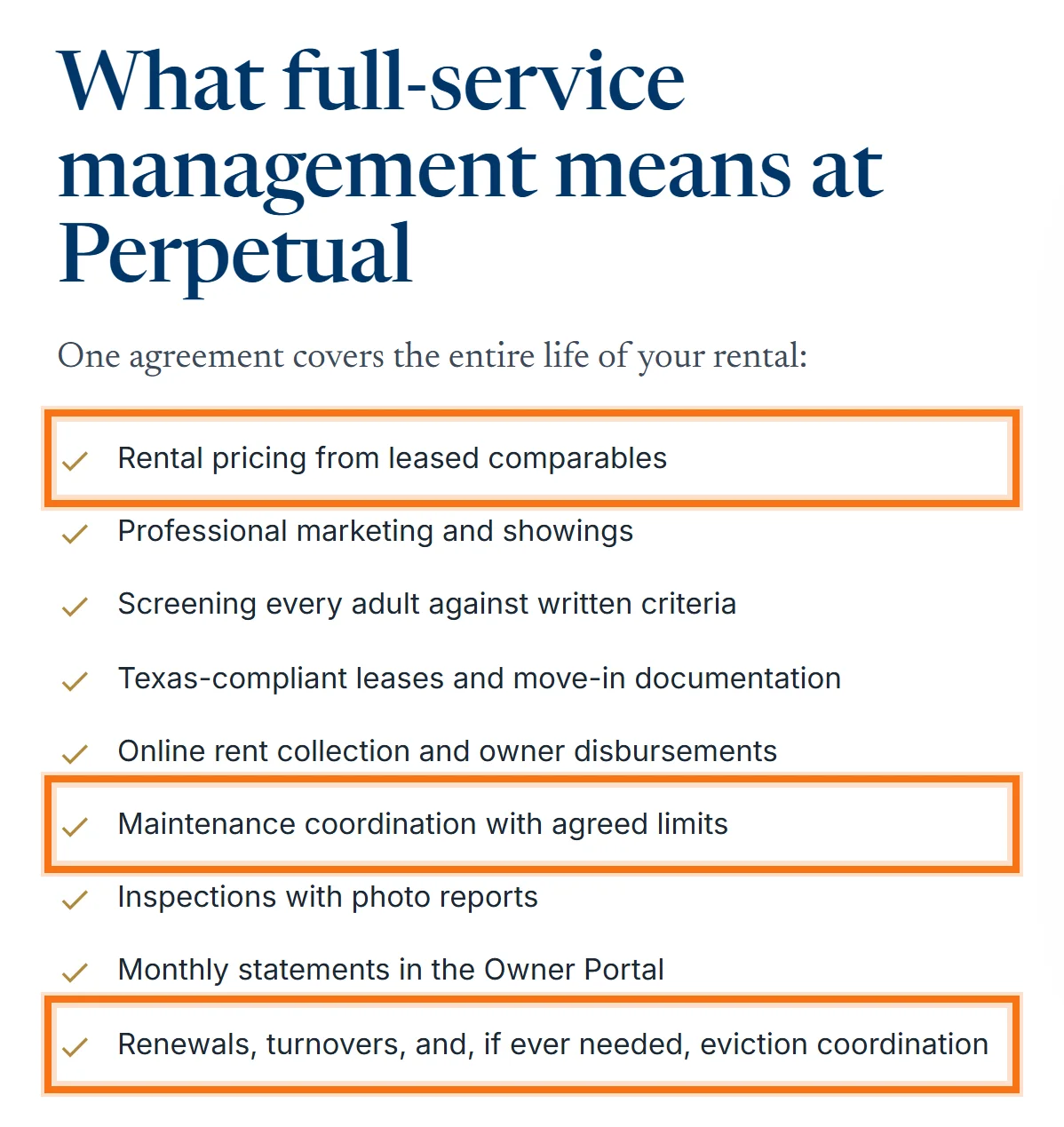
Full-service management covers pricing, marketing, showings, screening, the lease, rent collection, maintenance coordination, inspections, statements, renewals and, when it comes to it, eviction coordination. Each of those has a cost when you do it yourself: in dollars, in time or in risk. The fee is the price of moving all of that to someone who does it every day.
One note on the arithmetic before we start. Vacancy is rent you never receive. A fee is cash paid out of rent you did receive. Both lower the year's net by the same dollar, but they are different kinds of money, so this guide keeps them in separate columns and never adds them into one bill.
Vacancy days are the biggest number, and the easiest to miss
Vacancy is the largest line in this calculation and the one owners underestimate most. Say rent is $2,000 a month, an example figure only. That is $24,000 a year, or about $66 a day. Our marketing page puts a week of avoidable vacancy at about $460 at that rent, so two extra weeks is roughly $920 and a full month is the whole $2,000, while the mortgage, taxes and insurance keep coming.
Self-managing owners lose days in predictable places: pricing a little high and waiting for the market to say so, taking photos with a phone, showing the house only when their own schedule allows, and reading applications between other obligations. Together those add up to weeks.
This is where a manager has the most room to earn the fee: a rent set from leased comparables, professional photos, syndication to the major rental sites and showings a prospect can book right away. Nobody can promise how fast a particular house will rent, and we do not. The full accounting of an empty month is in what a vacant month really costs, and our process is on the marketing and showings page.
Turnover: where the money goes when a tenant leaves
A turnover is the most expensive event in a rental's life because several costs land at once: the make-ready, the vacant days during the make-ready, the marketing and the screening of the next tenant. Our renewals page puts a typical turnover at one to two months of rent once you count all of it, roughly $2,000 to $5,000 on a typical Tarrant County home.
The owner who keeps a good tenant three years instead of one avoids two of those. Retention is a skill: repairs handled promptly, a sensible renewal increase and a fast answer when the tenant calls. It is also a calendar. We start renewal work 120 days before the lease ends, with a market check and a recommendation, so a tenant who is leaving is known early and marketing can start before the house is empty.
More on both halves: how to keep good tenants longer and what a rental turnover costs and how long it takes.
Repairs: what you pay for either way, and what you hand off
The repair itself costs money whoever manages the house. What changes is who takes the call at ten at night, who finds a vendor, who checks the work, and who decides what is urgent.
Be clear about the price of handing that off. Many managers add a coordination charge or a markup to each vendor invoice. Ours is published: maintenance coordination is 4.9% of the vendor's invoice on the Standard plan and 5% on Full Service. On a $400 repair that is $19.60 or $20. The original invoice is always in your owner portal, and every completed repair over $500 gets photo or video proof.
You also keep control of the spending. Routine repairs under the limit you pre-approve are done without waiting. Anything larger comes to you with a description, photos and a recommendation. Before you sign with any manager, read the maintenance markups guide and ask how their invoices work. Our process is on the maintenance page.
Legal risk: zero most years, large in one
This line is zero most years and expensive in one. Texas puts specific duties on a landlord, and several carry a stated penalty. Three that self-managing owners trip over:
- The deposit deadline. Property Code section 92.103 requires the security deposit to be refunded on or before the 30th day after the tenant surrenders the home (section 92.107 ties that duty to the tenant giving a written forwarding address). Under section 92.109, a landlord who misses that date without sending the refund or an itemized list is presumed to have acted in bad faith, and bad-faith retention costs $100, three times the amount wrongfully withheld and the tenant's attorney's fees.
- The rekey. Section 92.156 requires locks to be rekeyed, at the landlord's expense, within seven days after each tenant turnover.
- The eviction notice. Section 24.005 requires a written notice before an eviction suit is filed, and an owner who gets the notice wrong may have to give it again and wait again.
On a $2,000 deposit, a bad-faith finding on the full amount is $100 plus $6,000, before attorney's fees. That one mistake is more than two years of the renewal-year fees in the example below. A manager's job is to make the process identical every time: written criteria, standard notices, documented inspections. The deposit rules are covered in Texas security deposit rules. This is general information, not legal advice.
Your time has a number, even if you have never written it down
Count the hours honestly. A quiet month is a few. A turnover month is many: photographing, listing, fielding calls, showing the house several evenings, reading applications, writing the lease, meeting the cleaner and the painter, doing the move-in walk.
Then put a rate on those hours. Say a turnover month takes you 40 hours and an hour of your time is worth $50. Both figures are assumptions, illustrative only: use your own. That month costs you 40 x $50 = $2,000 of time before a dollar is spent on the house. Most owners who self-manage one rental never run this number, and the evening and weekend calls are not even in it.
A worked year on one $2,000 house
Here is the fee side in dollars. Assumptions: one house renting at $2,000 a month ($24,000 a year), rent collected in all twelve months, and the Standard plan from our price sheet, which is the plan listed for single homes and small portfolios: 9% of monthly rent, tenant placement at 75% of one month's rent, lease renewal $200, enrollment inspection $49. Illustrative only, not a quote:
| Fee | Year with a new tenant placed | Year the tenant renews |
|---|---|---|
| Monthly management, 9% x $2,000 = $180 x 12 | $2,160 | $2,160 |
| Tenant placement, 75% x $2,000 | $1,500 | $0 |
| Enrollment inspection (first year only) | $49 | $0 |
| Lease renewal | $0 | $200 |
| Fees for the year | $3,709 | $2,360 |
| As a share of $24,000 rent | about 15.5% | about 9.8% |
How to read this table: the first year is the expensive one because the placement fee lands in it. If the tenant stays three years, the total is $3,709 + $2,360 + $2,360 = $8,429 on $72,000 of rent, about 11.7%. Maintenance coordination (4.9% of each vendor invoice) is extra and depends on how much repair work the house needs.
Now the other side. At about $460 a week, the renewal-year fees of $2,360 equal roughly five weeks of rent, and the first-year fees of $3,709 equal roughly eight. So the question for your house is concrete: across a year, do vacancy days, one avoided mistake and your own hours come to more than that? For an owner facing a turnover, working full time, or living an hour away, they usually do. For an owner with a settled tenant next door, they may not.
The other plans and their fees are on the pricing page, and the final fee for a specific house is set after the rental analysis. The same numbers for a single home are worked through in is management worth it when you own one rental.
When self-managing actually makes sense
It makes sense when you live close, have flexible hours, enjoy the work, know Texas landlord-tenant law well, have a plumber, an electrician and an HVAC company who answer your calls, and have a tenant you trust. That describes some owners, and I tell them so.
It stops making sense when the house is more than a short drive away, when your job does not allow a Tuesday afternoon showing, when the first late-rent notice has to go out, or when a second property comes along. See self-managing vs. hiring a property manager for the full comparison, is it cheaper to manage my rental myself for the cash side, and what property management costs in DFW for the fees.
How Perpetual handles this
Perpetual Property Management is broker-owned, with our office at 5755 Rufe Snow Dr in North Richland Hills, and we manage homes in Keller, North Richland Hills, Fort Worth and nearby. What our site commits to in writing:
- Every fee on one price sheet. Three percentage plans (7%, 9% and 10% of monthly rent), each with its placement, renewal, inspection and coordination fees listed on the pricing page. If a fee is not in your management agreement, you do not pay it.
- Five written guarantees, each with a stated remedy that comes out of our fee: marketing launch, communication, on-time owner payout by the 10th, tenant placement and documented work. They are on the guarantees page and subject to the Guarantee Addendum.
What the site does not state, such as whether the monthly fee is billed while the home is vacant, the contract term and what it costs to leave, is confirmed in writing before you sign. We do not offer a rent guarantee. To run this math on your own house, request a free rental analysis: a rent range from leased comparables and a written quote, whether or not you hire us. Or call 682-593-7033.
The takeaway: Compare the management fee to what self-managing actually costs you in vacancy, turnover, repairs, risk and hours, never to zero, and keep lost rent and fees paid in separate columns.
Questions owners ask
Is property management worth it for a single rental property?
Often, if you are honest about what self-managing costs you. One rental still has vacancies, turnovers, repairs and legal exposure, and with one house nothing is systematized, so every task is done from scratch. If you live nearby, have flexible hours and know Texas law, self-managing one house can work. Price the five lines in this guide against a written quote before you decide.
How much does property management usually cost?
Most managers charge a monthly fee tied to rent, a leasing fee when a tenant is placed, and sometimes a renewal fee. Our price sheet lists three plans at 7%, 9% and 10% of monthly rent, with tenant placement at 50% or 75% of one month's rent and renewals from $149 to $200. On the Standard plan, a $2,000 house pays $180 a month. The final fee is set after the rental analysis.
Does a property manager really reduce vacancy?
A good one can, mainly by pricing from leased comparables instead of hope, marketing with professional photos, getting the listing live quickly and making showings easy to book. Each of those can save days, and days are the most expensive thing a rental loses. No manager can promise how fast a specific house will rent, and we do not offer a rent guarantee.
Can I hire a property manager if I already have a tenant in place?
Yes. We regularly take over occupied homes: the lease, the security deposit and the records transfer to us, and the tenant gets new payment and maintenance instructions. With a tenant already in place there is no tenant placement to pay for until the home turns over. Ask for the takeover costs in your written quote.
How many weeks of vacancy equal a year of management fees?
In this guide's illustrative example, a $2,000 house on our Standard plan pays $2,360 in fees in a renewal year. A week of rent at that level is about $460, so the year's fees equal roughly five weeks of rent. In a year with a new tenant placed, fees are $3,709, roughly eight weeks. Run it with your own rent and your written quote.
Are property management fees tax deductible?
The IRS instructions for Schedule E list management fees and agents' commissions among the ordinary and necessary rental expenses you can deduct. The value of your own labor is not deductible, which matters when you compare a fee with unpaid hours. Details are in our guide to property management fees and taxes. This is general information, not tax advice.
Is a property manager worth it if I live out of state?
That is the case where it most often is. From a distance you cannot show the house, meet a vendor or walk the property at move-out, so every one of the five lines gets more expensive. What you need then is reporting you can check from anywhere: statements, original invoices and photo or video proof of repairs over $500.
Related services
Property management in Keller, North Richland Hills and Fort Worth. How full-service management works in Tarrant County →