Key takeaways
- The refund is due on or before the 30th day after the tenant surrenders the home (Property Code 92.103).
- The duty to refund or itemize waits for the tenant's written forwarding address (92.107), but the tenant does not lose the deposit without one.
- Deduct only damages and charges the tenant owes under the lease, never normal wear and tear (92.104).
- Miss the 30 days and bad faith is presumed: $100, three times the amount wrongfully withheld and attorney's fees (92.109).
- Texas sets no maximum deposit and does not require a landlord to pay interest on it.
Texas security deposit rules come down to three things: refund the deposit or send a written, itemized list of deductions within 30 days after the tenant surrenders the home, never deduct for normal wear and tear, and back every deduction with a signed move-in record, photos and invoices. The same rules apply to a rental house in Fort Worth, Keller or North Richland Hills as anywhere in the state, because they come from the Texas Property Code, not the city.
This guide covers the landlord security deposit rules section by section, the tenant's rights behind them, who holds the money when a manager is involved, and the mistakes that turn a refund into a penalty. It is general information, not legal advice.
Texas security deposit rules at a glance
Here are the deposit rules in the Texas Property Code, what each one says and what it means when you own the rental:
| Rule | What the Property Code says | What it means for a landlord |
|---|---|---|
| What counts as a deposit (92.102) | Any advance of money, other than an application deposit or prepaid rent, intended primarily to secure performance under the lease | A refundable pet deposit is a security deposit too |
| Maximum amount | No section sets a cap | The amount is a business decision, applied the same way to every applicant |
| Refund deadline (92.103) | On or before the 30th day after the tenant surrenders the premises | Count from surrender, not from the lease end date |
| Forwarding address (92.107) | No obligation to refund or itemize until the tenant gives a written forwarding address | Ask for it in writing at notice; prepare the itemization either way |
| Deductions (92.104) | Damages and charges the tenant is legally liable for under the lease or from breaching it; nothing for normal wear and tear | Every deduction needs a lease clause, a photo and a cost behind it |
| Itemized list (92.104) | If any part is kept, the balance goes back with a written description and itemized list of all deductions | One line per item, not one total |
| Bad faith (92.109) | $100, three times the portion wrongfully withheld and the tenant's reasonable attorney's fees | A late refund can cost more than the deposit |
How to read this table: the middle column is the statute and the right column is the habit that keeps you inside it. Owners lose most often on the 30-day deadline and the itemized list.
Why a deposit dispute costs more than the deposit
The money changes hands at the end of the relationship, the rules are specific, and the law tilts the table. Under Property Code 92.109(c), in a suit over a deposit the landlord has the burden of proving that keeping any part of it was reasonable.
That is why the numbers are lopsided. Illustrative only: a landlord who wrongfully keeps an $1,800 deposit in bad faith is exposed to $100 plus three times $1,800, which is $100 + $5,400 = $5,500, plus the tenant's attorney's fees. The whole defense is documentation and deadlines.
The 30-day rule and the forwarding address
Property Code 92.103(a) requires the landlord to refund the deposit on or before the 30th day after the date the tenant surrenders the premises. If anything is kept, the itemized list goes out in the same window, because a landlord who has neither refunded nor itemized by day 30 is presumed to have acted in bad faith (92.109(d)). The details that decide cases:
- Surrender starts the clock, not the end date printed on the lease. Write down the day the tenant gives up possession and returns the keys.
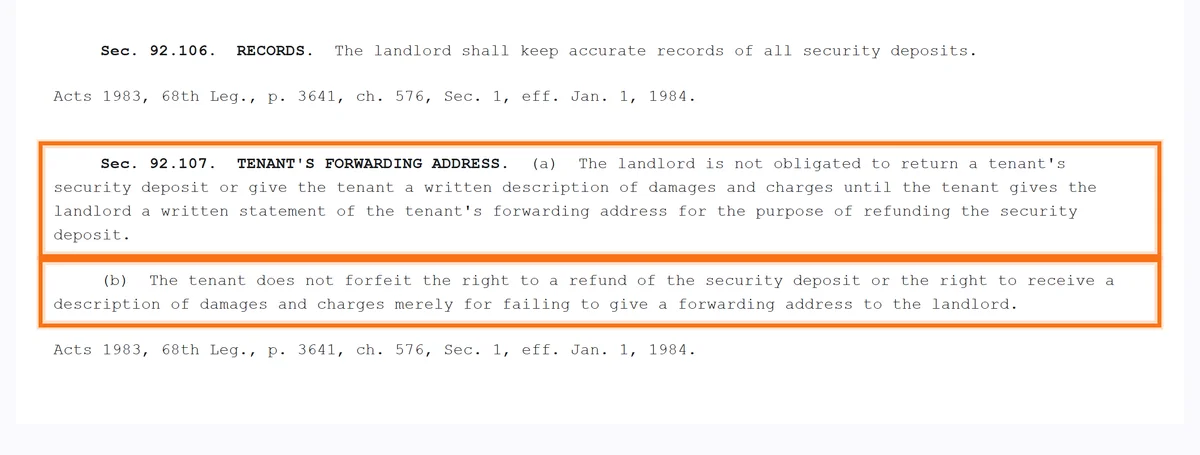
- The forwarding address. Under 92.107 the landlord is not obligated to refund or itemize until the tenant gives a written statement of a forwarding address. The same section says the tenant does not forfeit the refund or the itemization by failing to give one, so prepare both on time and keep them.
- The postmark. A refund or accounting placed in the U.S. mail and postmarked on or before the due date is presumed made on time (92.1041).
- Advance notice of move-out. A lease may make advance notice of surrender a condition of the refund only if that clause is underlined or in conspicuous bold print (92.103(b)).
The day-by-day version of this deadline is in how quickly a security deposit must be returned in Texas, and the wider rules on repairs and notices in Texas landlord-tenant law basics.
Normal wear and tear vs. damage you can deduct
Section 92.104(b) bars keeping any part of a deposit for normal wear and tear. Section 92.001 defines it: deterioration that results from the intended use of the home, not deterioration that results from negligence, carelessness, accident or abuse by the tenant, a member of the household or a guest. The workable line:
- Wear (not deductible): traffic patterns in carpet, minor scuffs, small nail holes, faded paint.
- Damage (deductible): pet stains, burns, holes in doors, broken fixtures, unapproved paint colors, trash left behind.
- The age factor: the statute sets no depreciation schedule, but because you must prove a deduction was reasonable, charge for the value that was left, not for a new replacement. Eight-year-old carpet ruined by a pet does not buy new carpet at the tenant's expense.
Room-by-room examples of where the line falls are in normal wear and tear versus tenant damage.
Move-in documentation: where the dispute is actually won
Every deposit argument reduces to one question: what did it look like when they moved in? If your answer is a timestamped, room-by-room photo record acknowledged by the tenant, the argument is usually over before it starts. If it is memory against memory, remember who carries the burden of proof.
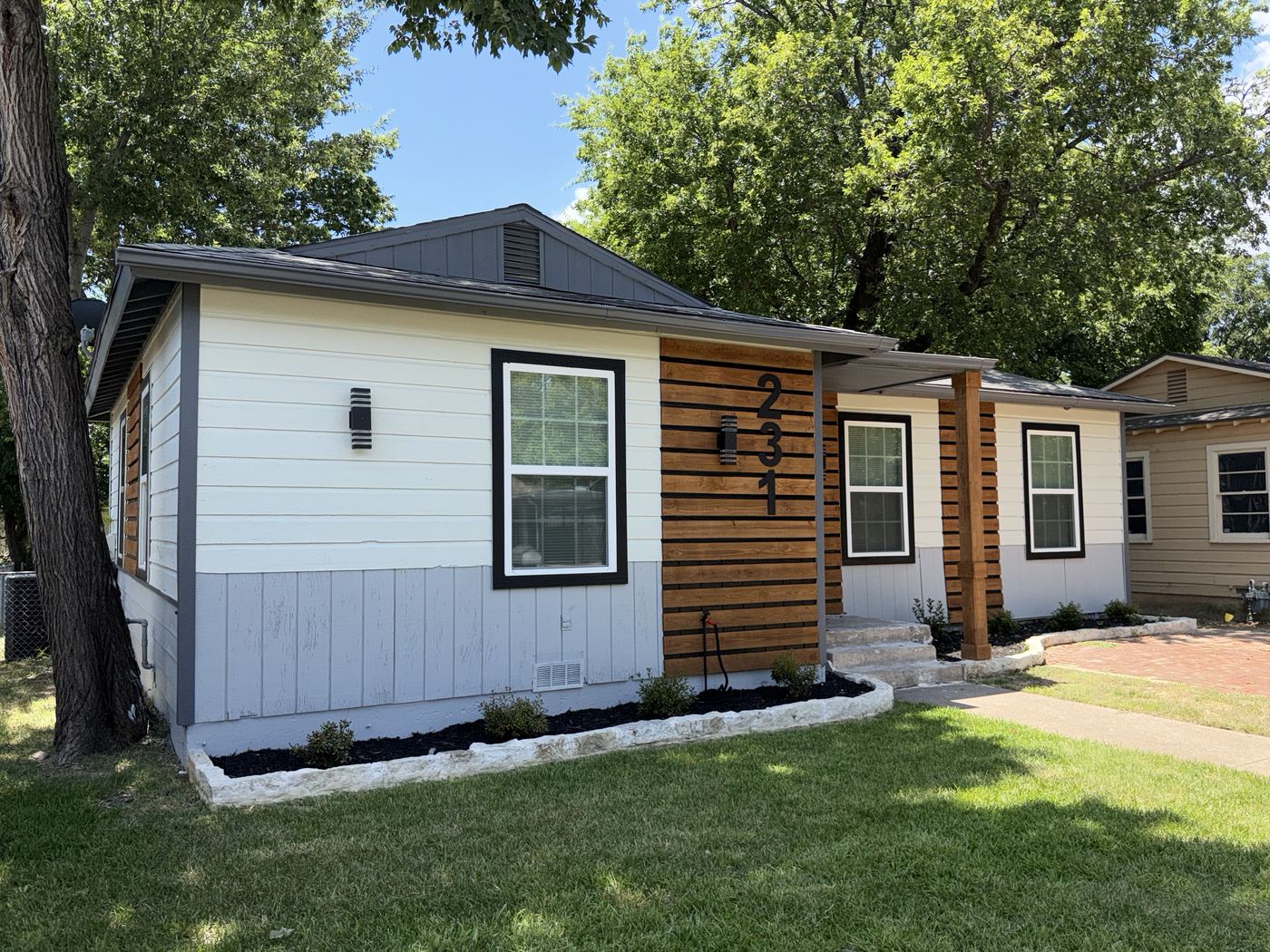
Photograph everything, including the insides of appliances, the flooring up close and the yard, and have the tenant sign the report. The same report is the baseline for the move-out walk, described in the move-out inspection guide.
The itemized list: what Texas requires and what survives a challenge
Section 92.104(c) is short: if the landlord keeps all or part of a deposit, the tenant gets the balance, if any, together with a written description and itemized list of all deductions. The list is excused only when the tenant owes rent at surrender and there is no controversy about the amount of rent owed. You rarely know that in advance, so send the list every time.
The penalty for skipping it is separate from the penalty for keeping the money. Under 92.109(b), a landlord who in bad faith does not provide the list forfeits the right to withhold any portion of the deposit and the right to sue the tenant for damage to the home, and owes the tenant's attorney's fees.
A list that survives a challenge has:
- A specific description for each item ("replace bedroom door damaged by impact, $185", not "repairs, $400").
- The invoice or a reasonable cost basis attached.
- Photos keyed to each item, move-in and move-out.
- Age acknowledged on older items.
- The remaining refund enclosed.
When a tenant disputes the list anyway, who handles disputes over deposit deductions walks through the steps.
Who holds the deposit, and what changes when the house is sold
Under Property Code 92.001 the landlord is the owner, lessor or sublessor of the home. A manager counts as the landlord only if the manager purports to be one in the lease. So the duty to refund stays with the owner, even when a management company holds the money and does the paperwork.
- No separate account is required of a landlord. Sections 92.101 to 92.113 do not make an owner hold deposits in a separate or interest-bearing account. They do require accurate records of every deposit (92.106).
- A licensed broker is different. A broker who holds a tenant's deposit holds trust money under Texas Real Estate Commission Rule 535.146: it goes in a designated trust account and may not be commingled with the broker's own money.
- A sale moves the liability. Under 92.105, a new owner is liable for the deposit from the date title is acquired and must give the tenant a signed statement with the exact dollar amount. The seller stays liable until the buyer has received the deposit or assumed the liability, unless a written contract says otherwise.
Section 92.105 is about a change of owner; changing property managers does not change who the landlord is. Confirming that a manager holds the money properly is covered in how to know your rent and deposit money are protected, and the amount to collect in how much security deposit to collect on a Texas rental.
The five mistakes that cost real money
- Missing the 30 days. Bad faith is presumed (92.109(d)), and the argument stops being about the carpet.
- Charging new for old. You carry the burden of proving the deduction was reasonable, and a full replacement price for a worn item is hard to defend.
- No move-in report. You have given up the biggest argument before it starts.
- Letting the tenant "live out" the deposit. Under 92.108 a tenant may not withhold any part of the last month's rent on the ground that the deposit covers it. A tenant who does so in bad faith is liable for three times the rent wrongfully withheld plus your reasonable attorney's fees.
- Round numbers without paper. A $500 "cleaning" line with no invoice is an invitation, not a deduction.
Three disputes, decided by paper
The dollar figures below are illustrative only, not real cases.
The carpet argument. A tenant of three years leaves the living-room carpet stained by a pet. The move-in report shows the carpet was five years old at move-in, so it is eight years old now. Replacement costs $2,400. If you assume a ten-year life (your assumption; no Texas statute sets one), two-tenths of its value was left: $2,400 x 0.2 = $480. That is a deduction you can explain line by line. Charging the full $2,400 turns a winnable position into a bad-faith argument.
The cleaning bill. A $450 cleaning deduction holds up when the invoice is attached, the photos are keyed to rooms and it is mailed inside 30 days with the remaining refund. The identical deduction is weak for the owner with no move-in photos.
The silent landlord. The owner is busy and the itemization goes out on day 41. The deductions were legitimate; the deadline was not met. Now the conversation is about presumed bad faith, three times the amount withheld and attorney's fees, over a case the owner would otherwise have won.
The deposit checklist, from lease signing to refund
Everything above, reduced to the list that prevents the disputes:
- At lease signing: the deposit and any pet deposit written in the lease; any advance-notice condition underlined or in bold; a record of the amount and where it is held.
- At move-in: the photo report, acknowledged by the tenant in writing and stored in two places.
- During the tenancy: damage documented when it is found, with photos and dates.
- At notice of move-out: ask for the forwarding address in writing, offer a walkthrough before surrender, and calendar the surrender date the day the keys come back.
- Within 30 days of surrender: the move-out inspection from the move-in angles; the refund and the itemized list mailed, with proof of the postmark.
- Afterward: keep the whole file well past the tenancy.
If the tenant leaves owing more than the deposit, see damage or unpaid rent beyond the deposit. This is general information, not legal advice.
How Perpetual handles this
Perpetual Property Management is broker-owned, with our office at 5755 Rufe Snow Dr in North Richland Hills, and we manage rental homes in Keller, North Richland Hills, Fort Worth and nearby. What our site commits to on deposits:
- Leasing and move-in: security deposits handled per the Texas Property Code, held, accounted for, and returned or properly itemized on the statutory timeline.
- A photo-documented move-in report, room by room, timestamped and acknowledged by the tenant.
- A 360-degree condition inspection at every move-in and move-out, one of the five written guarantees, subject to the Guarantee Addendum.
- A move-out inspection measured against the move-in baseline.
- Where pets are allowed at the owner's discretion, our published rental criteria list a one-time non-refundable fee of $350 at move-in plus $25 monthly pet rent per pet.
Whether we or you hold the tenant's deposit during the lease, and in which account, is confirmed in writing before you sign.
If deposit handling is the part of self-managing that worries you, call 682-593-7033 or request a free rental analysis.
The takeaway: Calendar the surrender date, itemize with invoices and photos against a signed move-in report, charge aged items at their remaining value and send it inside 30 days, because the deadline is the rule owners lose on.
Questions owners ask
Can I charge a nonrefundable "cleaning fee" instead?
Property Code 92.102 defines a security deposit by its purpose, not its label: any advance of money, other than an application deposit or prepaid rent, intended primarily to secure performance under the lease. Calling a refundable deposit "nonrefundable" does not take it out of the 30-day and itemization rules. A true one-time fee should be named as a fee in the lease and stated as non-refundable. Have an attorney review the wording.
Can the deposit cover unpaid rent?
Yes. Section 92.104 lets the landlord deduct charges the tenant is legally liable for under the lease, and unpaid rent is one. The tenant cannot decide it alone: under 92.108 a tenant may not withhold the last month's rent on the ground that the deposit covers it.
What about pet deposits and pet rent?
A refundable pet deposit meets the definition of a security deposit in 92.102, so the 30-day and itemization rules apply to it. A one-time pet fee and monthly pet rent are lease charges, not deposits, if the lease says so clearly. Pet damage beyond normal wear can be itemized against the deposit either way. Assistance animals are a separate subject under fair housing law.
Do I owe interest on deposits in Texas?
No. Sections 92.101 to 92.113 of the Property Code contain no requirement that a landlord pay interest on a residential security deposit or hold it in an interest-bearing account. A licensed broker holding the deposit follows Texas Real Estate Commission Rule 535.146: if trust money sits in an interest-bearing account, the interest goes to the parties the money is disbursed to unless a signed agreement says otherwise.
What's normal wear and tear, and what can be charged to the tenant?
Section 92.001 defines normal wear and tear as deterioration from the intended use of the home, and 92.104(b) bars deducting for it: traffic patterns in carpet, minor scuffs, small nail holes, faded paint. Deterioration from negligence, carelessness, accident or abuse can be charged: pet stains, burns, holes in doors, broken fixtures. Even then, charge the value left in an older item, not the price of a new one.
How quickly does a security deposit need to be returned in Texas?
On or before the 30th day after the tenant surrenders the home (Property Code 92.103). The clock starts at surrender, not at the lease end date, and the duty waits for a written forwarding address (92.107). A landlord who has neither refunded nor itemized by day 30 is presumed to have acted in bad faith (92.109).
Can a Texas landlord charge renters for pet-soiled carpet?
Yes, when the soiling is damage and not normal wear. Pet stains are not deterioration from the intended use of the home, so the cost can be deducted from the security deposit under 92.104 and itemized with photos and the invoice. Charge for the carpet's remaining value, not for new carpet, and record its age in the move-in report.
What are a tenant's rights to the security deposit in Texas?
The tenant has a right to the refund or a written, itemized list of deductions within 30 days after surrender, once a written forwarding address is given (92.103, 92.104, 92.107). Nothing may be kept for normal wear and tear. In a suit the landlord must prove a deduction was reasonable (92.109), and the tenant's claim to the deposit takes priority over the landlord's creditors (92.103(c)).
Related services
Property management in Keller, North Richland Hills and Fort Worth. How full-service management works in Tarrant County →