
Key takeaways
- The move-out inspection compares the home with the signed, photographed move-in report, room by room.
- Normal wear and tear can never be deducted (Property Code 92.104); damage and unpaid charges under the lease can.
- Refund the deposit or send an itemized list on or before the 30th day after surrender (92.103), once the tenant gives a written forwarding address (92.107).
- Miss the 30 days and the law presumes bad faith: $100 plus three times the amount withheld plus attorney's fees (92.109).
- Every move-in and move-out we handle gets a 360 degree condition inspection, a written guarantee.
A move-out inspection in Texas compares the surrendered home against the photographed move-in report, separates normal wear from damage, prices each deduction from a real invoice, and sends the itemization within the legal deadline: on or before the 30th day after the tenant surrenders the home, under Property Code Section 92.103. For the homes we manage in Fort Worth, Keller and North Richland Hills, a move-out inspection is only as good as the move-in inspection that came before it. If the condition of the home was documented in photos and a signed report when the tenant moved in, the move-out is a comparison, the deductions are obvious, and the itemization is hard to argue with. If the move-in was a handshake, every deduction becomes a dispute about memory.
Texas law puts a deadline and a form on the deposit accounting, and penalties on landlords who get it wrong in bad faith. Here is how we run the move-out and the itemization, so the owner keeps what they are entitled to and nothing they are not.
It starts at move-in
Before keys are handed over, the home is walked room by room with a written condition report and photos of every wall, floor, fixture, appliance and the yard, including close-ups of anything already worn or marked. The tenant receives the report, has a short window to add anything we missed, and signs it. That signed report, with its photos, is the baseline for everything that follows.
Owners who skip this step have no way to prove that the stained carpet or the cracked tile was not already there. The move-in report is the owner's evidence. Our inspection service produces it in a format that holds up months or years later.
Normal wear and tear versus damage
Texas law does not allow a landlord to keep any part of the deposit for normal wear and tear, which in plain terms is the deterioration that happens when a home is lived in reasonably. Damage is what happens through carelessness, accident or abuse, or by leaving something undone that the lease required. Where the line sits is a judgment call, but the usual pattern is this:
- Normal wear: minor scuffs on walls, small nail holes from hanging pictures, carpet traffic patterns, faded paint, a worn-out faucet washer, loose door handles from use.
- Damage: holes in walls or doors, crayon or large stains on walls, burns, pet urine in carpet or pad, broken blinds, cracked tile from a dropped object, torn screens, missing fixtures, unapproved paint colors.
- Lease obligations left undone: cleaning the home, removing belongings and trash, lawn care, filter changes, pest treatment where a pet was present.
Length of tenancy matters too. Paint and carpet have a useful life, and a wall that was last painted five years ago cannot be charged to the tenant as if it were new.
How the move-out walk-through works
The move-out inspection happens after the tenant has removed everything and returned the keys, so that what is documented is the condition the home was actually surrendered in. We use the same checklist and the same photo pattern as the move-in, room by room, so the two reports line up. The tenant may attend if they wish; many prefer to, and it tends to shorten disputes.
Every item that differs from the move-in report is photographed, noted against the move-in photo, and classified as wear, damage or a lease obligation not met. Items that were already worn or damaged at move-in are marked as such and not charged. Nothing is estimated from memory. If the lease requires professional carpet cleaning or pest treatment, the tenant's receipt is checked against the requirement.
The Texas move-out and deposit timeline
From the day the keys come back to the day the deposit file closes, the steps and the law line up like this:
| When | What happens | Texas Property Code |
|---|---|---|
| Before move-out | Move-out instructions and an offered pre-move-out walk-through, so the tenant can fix what would be deducted | Advance-notice clauses count only if underlined or in bold (92.103(b)) |
| Day 0: tenant surrenders the home | Keys and remotes returned; the 360 degree move-out inspection is done with the move-in report in hand | The 30-day clock starts (92.103(a)) |
| As soon as possible | Tenant gives a written forwarding address | No refund or list is owed until then (92.107) |
| Within 7 days | Locks rekeyed for the next tenant | Owner's expense (92.156) |
| By day 30 | Refund, or the itemized list of deductions with any balance, with photos and invoices | Required (92.103, 92.104) |
| After day 30 without a refund or list | Bad faith is presumed | $100 + 3 times the amount withheld + attorney's fees (92.109) |
How to read this table: the left column is the calendar and the right column is the rule behind each step. The only dates the law fixes are day 0 and day 30; everything in between is how a manager makes sure day 30 is met with evidence attached. If the forwarding address never arrives, the obligation waits, but the itemization should still be ready so it can go out the day it does.
The itemization under Texas law
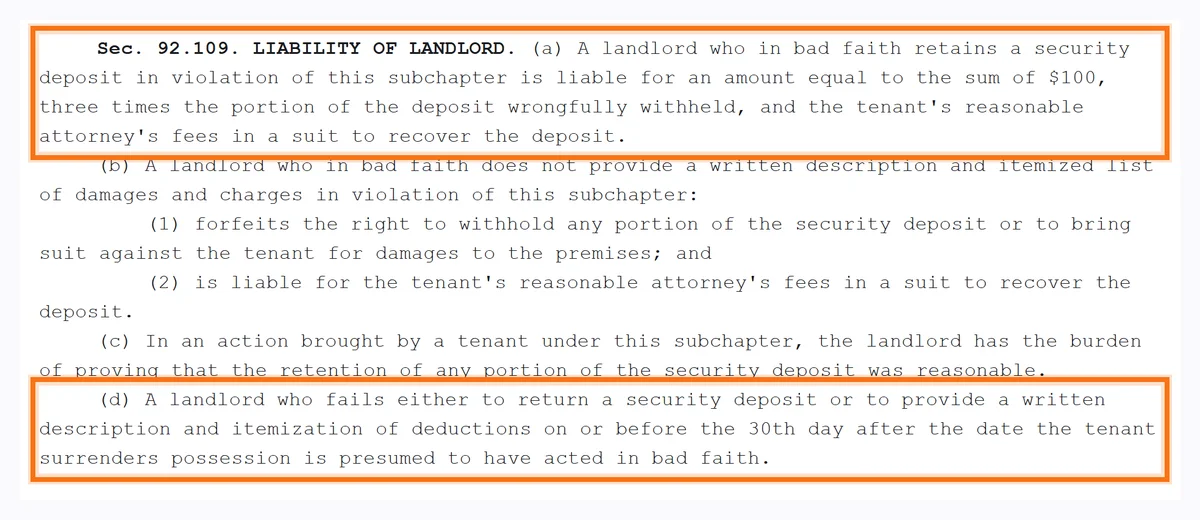
Texas Property Code Section 92.103 requires the landlord to refund the deposit on or before the 30th day after the tenant surrenders the home, and Section 92.104 requires a written description and itemized list of every deduction, with any balance, when part of the deposit is kept. Under Section 92.107 the landlord does not have to refund or itemize until the tenant gives a written forwarding address, but a tenant who is late with the address does not lose the deposit. A lease clause requiring advance notice of move-out as a condition of the refund only works if it is underlined or in conspicuous bold print (Section 92.103(b)).
Several points matter in practice:
- Unpaid rent and other amounts owed under the lease can be deducted, as can the cost of repairing damage beyond normal wear.
- Normal wear and tear can never be deducted.
- Rekeying is the owner's cost: Section 92.156 requires the landlord to rekey at the landlord's expense no later than the seventh day after each tenant turnover.
- A landlord who keeps a deposit in bad faith owes $100, three times the amount wrongfully withheld and the tenant's attorney's fees (Section 92.109(a)); one who fails to itemize in bad faith loses the right to keep any of it or to sue for damage (92.109(b)). Missing the 30-day deadline creates a presumption of bad faith (92.109(d)).
The deadline and the detail are the whole reason to have a system. Texas security deposit rules goes into the rules for holding and returning the deposit.
Pricing the deductions fairly
Every deduction on an itemization we send is backed by an actual vendor invoice or a line-item estimate from the vendor doing the work. Cleaning is charged at what the cleaner charged. A repaint of one damaged wall is charged as one wall, not the whole house. Where an item has a useful life, such as carpet or paint, the charge reflects the remaining life rather than full replacement cost.
What we do not do is charge a flat cleaning fee that the lease never mentioned, round numbers up, or charge the tenant for upgrades the owner wanted anyway. An itemization that would embarrass you in front of a judge is a bad itemization, and it is also the kind that gets challenged. Fair deductions, documented, are almost never disputed.
How to avoid the dispute in the first place
Most deposit fights are avoidable with three habits. First, move-out instructions go to the tenant with the notice period, listing exactly what the lease requires: cleaning standard, carpet, lawn, filters, trash, keys and garage remotes, forwarding address. Second, a pre-move-out walk-through is offered a couple of weeks before the end, so the tenant can fix the things that would otherwise be deducted. Third, the final itemization goes out with the photos, side by side with the move-in photos where there is a deduction.
When a tenant sees the move-in photo next to the move-out photo and the invoice, there is not much to argue about. When they receive a one-line "cleaning and repairs" charge, the argument starts immediately. If you are turning the home over for a new tenant at the same time, the make-ready guide covers what the owner pays for next.
What the owner receives
The owner gets the move-out report with photos, the comparison to move-in, the list of proposed deductions with vendor costs, and a recommendation on each item. The owner approves the itemization before it is sent. Any deposit balance owed to the tenant is returned within the legal window, deductions are applied to the make-ready invoices, and the whole file stays in the owner portal in case it is ever needed. Rental property inspections explains where the move-out fits with the other inspections during a tenancy.
This is general information, not legal advice. The deposit rules have specifics that depend on your lease and the facts, so confirm them with an attorney who practices Texas landlord-tenant law.
The takeaway: Document the move-in, compare it honestly at move-out, back every deduction with an invoice and send the itemization on time, and the deposit takes care of itself.
Questions owners ask
How long does a landlord have to return a security deposit in Texas?
On or before the 30th day after the tenant surrenders the home, under Texas Property Code Section 92.103. Within that window the landlord must refund the deposit or deliver a written, itemized list of deductions with any remaining balance. Under Section 92.107 the clock waits until the tenant gives a written forwarding address, and missing the deadline creates a presumption of bad faith under Section 92.109(d).
Can a landlord charge for painting in Texas?
Only for damage beyond normal wear and tear, such as holes, large stains, crayon or an unapproved color. Faded paint and minor scuffs from ordinary living are normal wear and cannot be deducted. The charge should reflect the wall or area actually damaged and the paint's remaining useful life.
Does the tenant have to be present at the move-out inspection?
No, but it helps. Texas law does not require a joint walk-through. We offer the tenant the chance to attend, and the inspection is documented with photos either way, which is what matters if a deduction is questioned.
What happens if a landlord does not itemize the deposit in Texas?
A landlord who keeps a deposit in bad faith owes the tenant $100, three times the amount wrongfully withheld and the tenant's reasonable attorney's fees (Property Code Section 92.109(a)). A landlord who fails in bad faith to provide the itemized list loses the right to keep any part of the deposit or to sue for damage to the home (92.109(b)). Not refunding or itemizing by the 30th day after surrender is presumed bad faith.
How is the condition of my house documented when a tenant moves out?
With the same checklist and photo pattern used at move-in, so the two reports line up room by room. The inspection happens after the tenant has removed everything and returned the keys, and every item that differs from the move-in report is photographed, noted against the move-in photo and classified as normal wear, damage or a lease obligation not met. Items already worn at move-in are marked as such and not charged. The tenant may attend. Perpetual sends the owner the move-out report with photos, the side-by-side comparison and a list of proposed deductions backed by vendor costs, and the file stays in the owner portal.
Who handles disputes over security deposit deductions?
The manager, with the owner approving the itemization before it goes out. Under Texas law, in general terms, the landlord must refund the deposit or deliver a written itemized list of deductions within thirty days after the tenant surrenders the home and provides a forwarding address, and a landlord who withholds in bad faith faces penalties. Most disputes are avoided by sending the tenant the move-in photo next to the move-out photo and the vendor invoice for each deduction. A one-line cleaning and repairs charge starts the argument; documented, fairly priced deductions rarely get challenged. Perpetual prepares the itemization from its own inspection reports and handles the tenant's questions.
Related services
Property management in Keller, North Richland Hills and Fort Worth. How full-service management works in Tarrant County →