Key takeaways
- Rent and security deposits held by a broker are trust money under Texas Real Estate Commission Rule 535.146.
- Trust money goes in a designated trust account and may not be commingled with the broker's own money or kept in a business account.
- The broker must account to each beneficiary at least monthly if there was activity, and keep trust account records for four years.
- The tenant's deposit stays your legal responsibility as the landlord, whoever holds it (Property Code 92.001, 92.103).
- Mishandling money is a license matter: the Commission takes complaints for four years after the incident, but it cannot order a broker to pay you.
How do you know your rent and security deposit money are protected? Three things have to be true: the company is a licensed Texas brokerage, it holds rent and deposits in a designated trust account that is never mixed with its own funds, and its monthly statements show every dollar in a way you can check. Texas rules require the first two of any broker managing a rental in Fort Worth, Keller or North Richland Hills. The third is how you verify the first two are happening.
This guide covers what the Texas rule says, whose money the deposit is, the questions to ask before you sign, a five-minute check of each monthly statement, the warning signs and what to do if money goes missing.
What Texas requires of a broker holding your money
Here is what Texas Real Estate Commission rules require of a broker who holds rent or deposits for you, and how an owner can check each one:
| Requirement | Where it is written | How you can check it |
|---|---|---|
| Rent and security deposits are trust money | Rule 535.146(a) | The agreement says who holds the deposit and where rent is received |
| Held in a designated trust account, or delivered to an authorized escrow agent | Rule 535.146(b) | Ask for the bank and how the account is titled |
| Deposited by the close of business of the second working day after receipt, unless agreed otherwise in writing | Rule 535.146(b) | Rent the tenant paid this month appears as collected on this month's statement |
| Never commingled with the broker's own money; never in a personal or business account | Rule 535.146(b) | Ask directly; a broker who follows the rule answers in one sentence |
| An accounting to each beneficiary at least monthly if there was activity | Rule 535.146(c) | A statement arrives every month rent is collected |
| Only another license holder may be authorized to withdraw or transfer; the broker stays accountable | Rule 535.146(c) | Ask who can move money out of the account |
| Trust account records kept four years | Rule 535.146(e) | Old statements and invoices can still be produced |
| The broker is responsible for proper handling of trust funds | Rule 535.2 | Look the broker up in the Commission's license holder search |
How to read this table: the first two columns are the state rule and the third is what you can see from the outside. If you cannot confirm a row by asking a question or opening a statement, ask for it in writing before you sign.
The Texas rule: a trust account, and no commingling
Collecting rent for someone else is licensed work in Texas. Occupations Code 1101.002 lists a person who "controls the acceptance or deposit of rent from a resident of a single-family residential real property unit" among the acts of a broker. So the company holding your money should be a licensed broker, and you can confirm that in minutes: see how to verify a property manager's license in Texas.
Once a broker accepts the money, Commission Rule 535.146 applies. It defines trust money as "client's money, earnest money, rent, unearned fees, security deposits, or any money held on behalf of another person," and says trust money accepted by a broker is held in a fiduciary capacity.
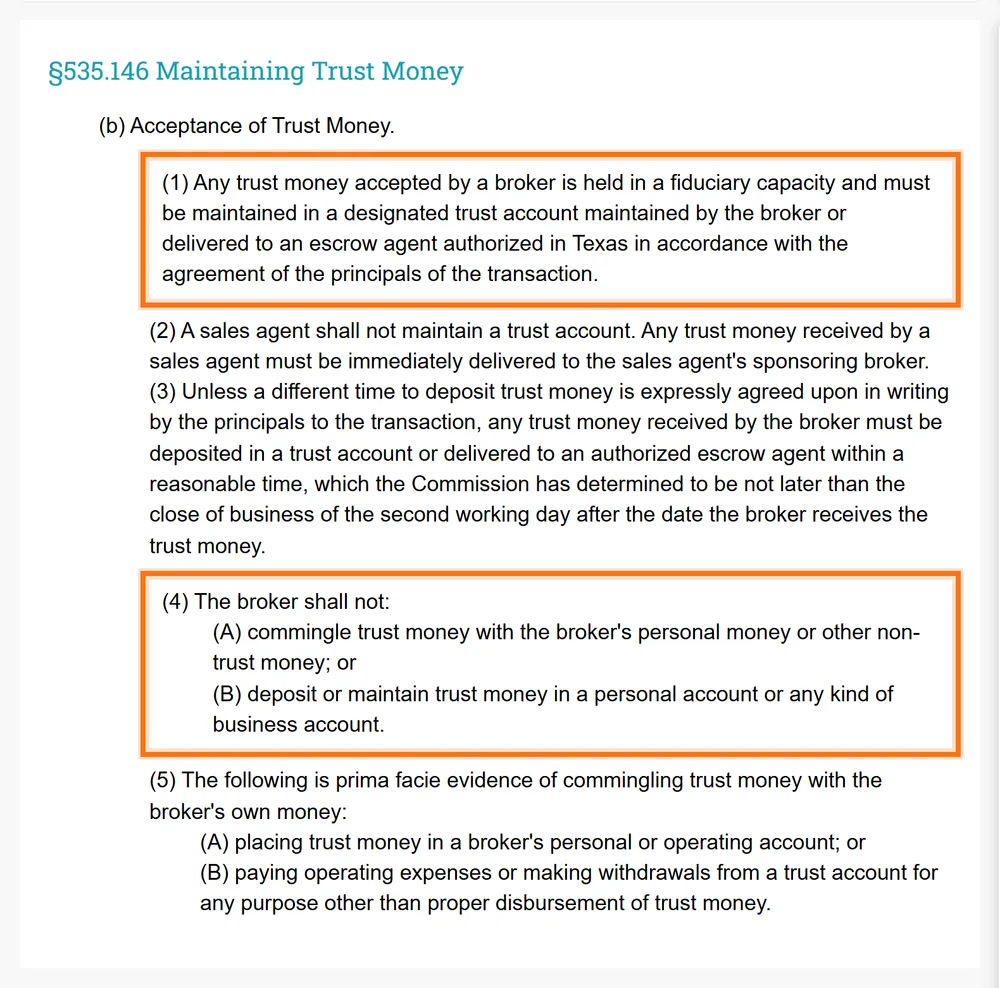
The same rule says placing trust money in an operating account, or paying operating expenses out of a trust account, is prima facie evidence of commingling. Under Occupations Code 1101.652(b), commingling, or failing within a reasonable time to properly account for or remit money that belongs to another person, is a ground for the Commission to suspend or revoke the license.
One thing the rule does not require: a separate account for each owner. A broker may, but is not required to, keep separate trust accounts for each client or type of trust money. What protects you in a shared trust account is the ledger that shows which dollars are yours.
Six questions that show how the money is handled
Ask these before signing, and expect a direct answer to each:
- Who is the broker, and what is the license number? Rule 535.2 makes the broker responsible for the proper handling of trust funds, and for a business entity that person is the designated broker.
- Where is the trust account, and how is it titled? The rule requires the account to be clearly identified as a trust account, at a banking institution authorized to do business in Texas.
- Is the security deposit held there for the whole lease, or passed to me? Either can be lawful, but you need to know which.
- Who can withdraw or transfer money? Under the rule a broker may authorize only another license holder to do it.
- On what date is rent paid out to me, and how much is held back as a reserve? Both belong in the agreement as a date and a dollar amount.
- What does my monthly statement show, and can I see a sample? Asking for a sample owner statement before signing is normal.
A company that answers each in a sentence is doing the work. One that treats the questions as unusual is telling you nobody has asked.
What to check on every statement
The monthly owner statement is your audit, and it takes five minutes. Confirm four things: the rent shown as collected matches the lease; every fee matches your agreement; every repair has an invoice behind it; and the amount paid to you equals rent minus fees, repairs and any reserve change, to the dollar. Then confirm the payout reached your bank on the date the agreement states.
Illustrative only, not a quote. Assume rent of $2,000, a 10% management fee, one $180 plumbing invoice and a 5% coordination charge on that invoice, with no change to the reserve. The fee is $2,000 x 10% = $200. The coordination charge is $180 x 5% = $9. The payout should be $2,000 - $200 - $180 - $9 = $1,611. If your statement shows a different number, one of the lines has something you were not told about.
If the statement shows rent collected but the payout is late, or the numbers do not add up, ask the same day and in writing. The line-by-line walk is in how to read your monthly owner statement, and how a reserve works in owner reserves and disbursements.
The security deposit: the tenant's money, and your liability
The security deposit is not income and it is not the manager's. Property Code 92.102 defines it as money advanced to secure performance under the lease, and three rules follow from that:
- You owe the refund. Under 92.001 the landlord is the owner, lessor or sublessor; a manager is the landlord only if the lease presents the manager as one. The refund or an itemized list of deductions is due within 30 days after the tenant surrenders the home (92.103, 92.104), once the tenant gives a written forwarding address (92.107). If a manager loses the deposit, the tenant can still look to you.
- Records are required. Section 92.106 says the landlord shall keep accurate records of all security deposits.
- The tenant comes first. Under 92.103(c) the tenant's claim to the deposit takes priority over the claim of any creditor of the landlord, including a trustee in bankruptcy.
The Property Code does not make an owner who holds the deposit personally use a separate or interest-bearing account. The trust account rule applies to the broker. Either can hold the deposit; your management agreement should say which.
Ask the manager to confirm in writing, at move-in, the amount received and where it is held, and at move-out to send you a copy of the itemization and photos that went to the tenant. Read the agreement for any clause that lets the company apply the tenant's deposit to amounts you owe the company, and ask an attorney about it before you sign. The statute itself is covered in Texas security deposit rules. This is general information, not legal advice.
Warning signs, and what to do if money is missing
Most trust-account problems announce themselves before they become losses:
- Payouts that slip later each month, or arrive in odd amounts.
- Statements that arrive late, skip a month or do not add up.
- A deposit the company cannot place for you in one answer.
- Reluctance to say which bank holds the trust account.
- A reserve that keeps growing without a stated reason.
- Repair charges with no vendor invoice.
Any one deserves a written question. Two or more deserve a serious look at switching property managers.
If you believe money is missing, do three things in order:
- Send the broker a dated, written demand for a full accounting and keep every reply.
- File a complaint with the Texas Real Estate Commission. Its site says a complaint must be in writing, cannot be anonymous and must be filed within four years of the incident. It also says the Commission has no authority to order a license holder to pay damages.
- Talk to a Texas attorney about recovering the money. The Commission keeps a Real Estate Recovery Trust Account that can pay certain court judgments against a broker, capped at $125,000 per transaction and $250,000 per license holder (Occupations Code 1101.610).
What happens when a company shuts down with owner money in its accounts is covered in what happens if your property manager closes. This is general information, not legal advice.
How Perpetual handles this
Perpetual Property Management is broker-owned (our affiliated brokerage is led by Broker/Owner Justin Brown), and our office is at 5755 Rufe Snow Dr in North Richland Hills. We manage rental homes in Keller, North Richland Hills, Fort Worth and nearby. What our site commits to on your money:
- A payout date with a remedy. Rent we collect is disbursed to you by the 10th of each month, or that month's management fee is waived. It is one of the five written guarantees, subject to the Guarantee Addendum.
- Statements you can check. Monthly statements, documents and disbursement history are in the owner portal, and the original vendor invoice is always there when we coordinate a repair.
- No surprise fees. Every fee is on the price sheet and in your agreement. If a fee is not in the agreement, you do not pay it.
- Deposits by the book. Our leasing page says security deposits are held, accounted for, and returned or properly itemized on the statutory timeline.
Our site does not publish the bank, the title of the trust account, who is authorized on it, the reserve amount or whether we or you hold the tenant's deposit. Those are confirmed in writing before you sign, and the six questions above are the right ones to ask us.
To ask them about your rental, call 682-593-7033.
The takeaway: Your money is safe when a licensed broker holds it in a designated trust account and sends statements that add up every month, so ask where the account is, who can withdraw from it, and check the statement each time it arrives.
Questions owners ask
Who holds the security deposit, the owner or the property manager?
Either can, and the management agreement should say which. The legal duty to refund stays with the landlord, which under Property Code 92.001 is the owner unless the lease presents the manager as the landlord. A broker who holds the deposit must keep it in a designated trust account under Commission Rule 535.146. An owner who holds it has no separate-account rule but must keep accurate records (92.106). Make sure the tenant is told in writing who has it.
Can a property manager use the security deposit to pay for repairs during the lease?
Not as a general fund. A deposit secures the tenant's performance under the lease (Property Code 92.102), deductions are taken when the deposit is returned (92.104), and Rule 535.146 lets a broker disburse trust money only in accordance with the agreement under which it was received. Repairs during the lease are paid from rent, the owner's reserve or by the owner. A manager spending deposits on mid-lease bills or on amounts you owe the company is a reason for a written question at once.
What happens to my rent and deposits if the management company closes?
Trust money belongs to the owner and the tenant, not to the company, so it should be paid out or transferred when the company closes. How cleanly that happens depends on how the account was kept. If money is missing, the routes are a written demand, a complaint to the Texas Real Estate Commission and a court claim; the Commission's Recovery Trust Account can pay certain unpaid judgments against a broker, up to $125,000 per transaction (Occupations Code 1101.610).
Should a property manager have insurance covering client funds?
Ask, and ask for the certificate. Rule 535.146 sets out how trust money must be held and does not mention insurance or a bond, so coverage is something a company chooses. Errors and omissions insurance addresses professional mistakes; a crime or fidelity policy addresses theft of client funds. Either is a backstop, not a substitute for a properly kept trust account and statements you can check. This is general information, not insurance advice.
Does a Texas property manager have to keep each owner's money in a separate account?
No. Rule 535.146 says a broker may, but is not required to, maintain separate trust accounts for each client or type of trust money. What it does require is that trust money stays out of the broker's personal and business accounts, that the trust account is clearly identified as one, that every deposit and withdrawal is documented, and that each beneficiary gets an accounting at least monthly when there is activity.
How fast must a Texas broker deposit rent or a security deposit it receives?
Rule 535.146 says trust money a broker receives must be deposited in a trust account, or delivered to an authorized escrow agent, within a reasonable time, which the Commission has set at no later than the close of business of the second working day after the broker receives it, unless the principals expressly agree in writing to a different time. A sales agent who receives trust money must deliver it immediately to the sponsoring broker.
Can the Texas Real Estate Commission get my money back from a property manager?
Not directly. The Commission's complaint page says it does not have the authority to order a license holder to pay damages to another person, and that a claim for damages belongs in another forum and should be discussed with a private attorney. What a complaint can lead to is discipline: a reprimand, an administrative penalty, or suspension or revocation of the license. You have four years from the incident to file.
Related services
Property management in Keller, North Richland Hills and Fort Worth. How full-service management works in Tarrant County →