Key takeaways
- Three owner steps: read the agreement, choose the new manager, send written notice. The new manager runs the rest.
- The notice period and any early termination fee come from your current agreement; ending on the renewal anniversary can avoid a fee.
- The handover file: lease and addenda, deposit with accounting, tenant ledger, keys, condition reports, open work orders, HOA details.
- The tenant's lease does not change; tenants get new payment and maintenance instructions.
- Download statements and year-end tax documents from the old owner portal before access ends.
Switching property managers takes three steps from you: read your current agreement for the notice period and any termination fee, choose the new company, and send a short written notice. The new manager then collects the leases, deposits, keys and records directly from the old one. For owners in Keller, North Richland Hills and Fort Worth, that is how we take over homes every month, including homes with a tenant in place, and rent does not have to miss a month.
Owners tolerate a bad property manager far longer than a bad tenant, not because the losses are smaller (they are usually bigger), but because switching feels like surgery. In reality, a well-run management transfer is routine: the new company does the heavy lifting, tenants often experience it as an upgrade, and the lease simply carries on. Here is the full playbook.
Signs it's actually time, not just a bad week
- You've become the property manager's manager, chasing them for updates, statements, or answers is a job you're paying someone else to make unnecessary.
- Vacancies drag with no data, weeks on market and nobody can show you pricing comps or showing activity.
- Maintenance surprises, invoices that appear without explanation, or tenant complaints reaching you directly because requests go unanswered.
- Statements you can't reconcile, if you can't tell what you earned and spent last quarter, that's not an accounting quirk; it's the relationship in miniature.
- Tenant turnover with a pattern, good tenants leave managers who ignore them; you pay for it in turnovers.
One bad month happens to every company. A pattern across two or three of these is structural. If you are still deciding whether the problem justifies leaving, can I leave a property management company if I am unhappy answers the narrower question.
Step 1: Read your current agreement before you say a word
Pull out the management agreement and find three things:
- The termination clause, required notice period (30 and 60 days are common) and any early-termination fee.
- Lease ownership language, what happens to leases the manager signed; occasionally agreements claim leasing fees on tenants they placed even after you leave.
- The renewal date, some agreements auto-renew; terminating at the anniversary can avoid fees entirely.
We'll gladly look at your agreement with you before you decide anything, and tell you honestly if waiting out a clause is cheaper than paying to leave now. Sometimes it is, and you should hear that from the company hoping to win your business.
Step 2: Give notice, short, written, professional
A dated letter or email: you're terminating per section X effective date Y, request the file handover per the list below, and where to send it. No essay, no grievances, the relationship is ending; the paper trail is what matters. Your current manager remains responsible for the property until the effective date.
Step 3: The handover, what actually transfers
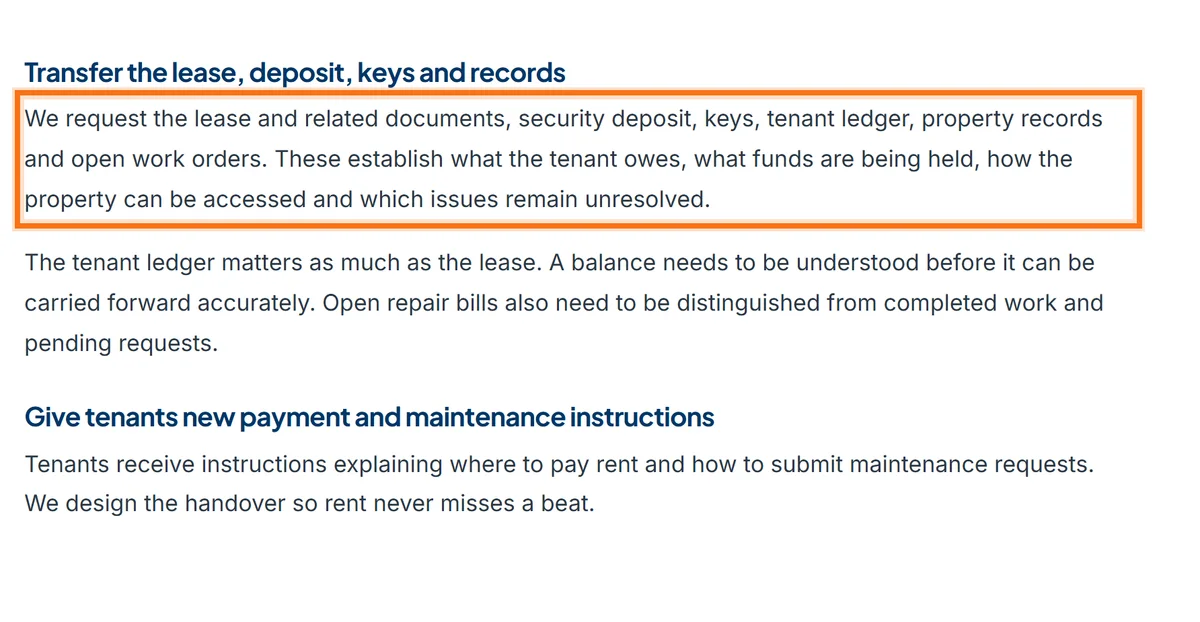
This is the part owners dread and shouldn't: your new manager coordinates it directly with the old one. You shouldn't be the messenger. The complete file includes:
- The active lease and all addenda and amendments
- Security deposits, with accounting; Texas deposit obligations follow the money, so this transfer must be documented properly
- Keys, remotes, garage codes, and access devices
- Tenant contact information and payment ledger
- Maintenance history and any open work orders or warranties
- Move-in condition report and inspection records (these decide future deposit disputes, insist on them)
- HOA information and any pending violations
A checklist-driven takeover catches the gaps early, missing move-in reports, unlogged deposits, while the old company is still obligated to answer.
The handover checklist: what transfers and why it matters
What the new manager requests from the old one, and why each item matters:
| Item | Why it matters | Watch for |
|---|---|---|
| Signed lease, addenda and amendments | The tenant's obligations continue unchanged and must be enforceable | Unsigned pages, missing pet or HOA addenda |
| Security deposit with a written accounting | The deposit has to be refunded and itemized at move-out under Texas law | A deposit amount that differs from the lease |
| Tenant ledger | Shows exactly what the tenant has paid and owes, so balances carry forward correctly | Unexplained charges or credits |
| Keys, remotes, codes and access devices | The new manager can respond to emergencies and showings on day one | Keys that were never re-cut after the last tenant |
| Move-in condition report and inspections | They decide future deposit deductions | No dated photos from move-in |
| Maintenance history, open work orders, warranties | Separates paid work from open bills and pending requests | Repairs promised to the tenant but never ordered |
| HOA details and any pending violations | Fines go to the owner, not the manager | Notices sent only to the old company |
| Owner reserve and final statement | Your money held by the old company comes back to you | No final statement or date for the release |
How to read this table: every row is something the old company holds for you as your agent. The middle column is why the new manager needs it, and the right column is the gap that usually turns up during a takeover. A missing item found during the handover is a request; the same item found at a deposit dispute a year later is a loss, so the checklist is worked while the old company is still obligated to answer.
Step 4: Tenants get a proper introduction
Tenants worry about exactly two things during a management change: where rent goes now, and whether maintenance will finally get handled. A joint or sequenced notice answers both, introduces the portal, and sets expectations. Done right, tenants experience the switch as service improving, which shows up a year later as renewals instead of turnovers. The lease itself doesn't change; it transfers as-is and its terms continue.
What happens to the owner portal and software when you switch
Owners who search for switching property management software are often really asking about this: each management company runs its own system, and your access to the old company's owner portal usually ends when the agreement does. The records do not move from one software to another by themselves; the new manager rebuilds the property file from the documents in the handover table.
Before your access ends, download and keep your own copy of:
- Every monthly owner statement for the current and prior year.
- Year-end tax documents, such as the 1099 and the annual summary your CPA uses.
- Vendor invoices for repairs and improvements, which support depreciation and deductions.
- The lease, inspection reports and photos posted to the portal.
At Perpetual, owners get an AppFolio owner portal with statements, documents and disbursement history, and tenants get their own portal to pay rent and submit maintenance requests with photos. Your first monthly statement with us shows what was carried over and what is new, so the switch can be checked line by line.
When to time the switch
- Mid-lease is fine, steady occupancy makes for a calm handover; the common instinct to "wait until the lease ends" usually just extends the pain.
- Before a renewal decision is ideal, so the renewal analysis (market comps, rate strategy, see renewals done right) is done by the company you actually want.
- During a vacancy, move fast, every week with a manager who couldn't fill it is money; a new team restarts marketing quickly. Our written marketing launch guarantee is that a market-ready home is live on every major rental platform within 5 business days, or the first month's management fee is waived.
- Mid-crisis (nonpaying tenant, needed eviction), switching is still possible and often wise; the file just needs faster attention. See how takeovers of distressed tenancies work.
Choosing better this time
So you never write this letter twice, vet the next company on the things that went wrong: written fees with no surprises (the five questions to ask), screening criteria they'll show you (what good looks like), real inspection reports with photos, statements a CPA could love, and owner references from someone who's been with them two-plus years. The full interview list is in questions to ask a property manager.
Thinking about it? Start with a free rental analysis, it will show you, with comps, whether your current rent and management setup are leaving money behind. If they're not, we'll tell you that too.

The four fears that keep owners stuck, answered honestly
"The tenant will be confused or upset." Tenants care about two things: where rent goes and whether repairs happen. A proper introduction letter answers the first; the following months answer the second. Tenants of bad managers are usually the switch's biggest fans, they've been waiting on unanswered maintenance requests longer than you've been reading statements you can't reconcile.
"It'll disrupt the rent." A checklist handover moves payment instructions cleanly with overlap built in; the ledger transfers, the lease continues unchanged, and the late-fee terms stay enforceable. Rent interruptions come from chaotic managers, not from changing them.
"My current company will make it difficult." As your agent they hold your lease, the deposit, your reserve and your records for you, and their duties under the agreement run until the termination date. Most exits are professional; the rare obstruction mostly confirms the decision, and a new manager who's done this dozens of times knows exactly what to request and when to escalate. This is general information, not legal advice; an attorney can confirm your rights under a specific agreement.
"What if the next one is just as bad?" This is the real fear, and the answer is vetting on mechanics instead of marketing: written fee schedules, visible screening criteria, sample inspection reports and owner statements, and references from multi-year clients. Bad managers survive on owners not knowing what to ask; now you do.
The 10-step switching checklist
The entire process, in order, most steps belong to your new manager, not to you:
- 1. You: re-read the management agreement (termination clause, notice period, fees, auto-renewal date).
- 2. You: pick the successor using the vetting standards above, fee transparency, visible criteria, sample reports, references.
- 3. You: send written notice per the agreement; keep proof of delivery.
- 4. New manager: requests the handover file, lease, addenda, deposit accounting, ledger, keys, move-in report, maintenance history, HOA info.
- 5. New manager: audits what arrives and chases the gaps while the old company is still obligated to respond. Missing move-in reports and unlogged deposits surface here, not in a dispute later.
- 6. Both: deposit funds transfer with documentation, Texas obligations follow the money.
- 7. New manager: tenant introduction, where rent goes, how maintenance works, portal setup. Ideally timed so the first new-system rent cycle has overlap room.
- 8. New manager: baseline property inspection with photos, the condition record restarts clean under new management.
- 9. You: update landlord insurance contacts and any HOA management notices.
- 10. Both: a 30-day review, rent flowing, maintenance channel working, statements arriving. The switch is done; the improvement should already be visible.
Most of the ten steps belong to the new manager; the owner's part is reading the agreement, choosing the successor, the notice letter and a few signatures. If you want step 2 to be a low-risk test, start with the free rental analysis above; you'll see the reporting standard before you commit to anything.
One last reframe for the owners who've read this far and still hesitate: staying with a manager you don't trust isn't the safe option, it's a decision too, renewed silently every month, with your property as the collateral. The switch you're avoiding takes a notice letter, a few signatures and the notice period in your agreement. The relationship you're tolerating has already cost more, and it compounds. Make the decision on the numbers, the way you'd want your manager to make every decision about your property.
The takeaway: Read the agreement, send a short written notice, and let the new manager run the handover checklist; the switch takes a letter and a notice period, and the bad relationship costs more every month you keep it.
Questions owners ask
Can I switch with a nonpaying tenant or mid-eviction?
Yes, distressed takeovers are routine. The file (lease, ledger, notices served) gets assessed first, and the fastest compliant path forward gets mapped. Sometimes the prior manager's notice errors mean restarting a step; better to find that out at takeover than at the courthouse.
Does switching cost anything?
Possibly an early-termination fee under your current agreement (check the clause, and we'll read it with you). Reputable new managers make onboarding itself painless; ask any company what their takeover process includes before signing.
How long does the whole thing take?
Typically your current agreement's notice period (often 30 days) plus a handover measured in days. The owner's active part is small: reading the agreement, the notice letter and a few signatures.
What happens to my owner portal when I switch property managers?
Access to the old company's portal usually ends with the agreement, and its records do not move into the new company's software on their own. Before it ends, download your monthly statements, year-end tax documents, vendor invoices, the lease and inspection reports. The new manager rebuilds the property file from the handover documents.
Can I leave a property management company if I'm unhappy with the service?
Yes, subject to the terms of your management agreement. Find the termination clause, which sets the notice period and any early termination fee, and check whether the agreement auto-renews, because terminating at the anniversary can avoid fees entirely. Then send a short, dated written notice and keep proof of delivery. Your current manager stays responsible for the property until the effective date, and you do not need their permission to leave. Perpetual will read your agreement with you first and say honestly whether waiting out a clause is cheaper than paying to leave now.
My property manager won't respond. How do I switch companies?
Start with the management agreement, not another unanswered call. Find the notice period and termination terms, then send a dated written notice that you are terminating under that clause and requesting the handover file. Pick the successor before the notice goes out, so the new company can request the lease, deposit accounting, ledger, keys and inspection records directly from the old one while it is still obligated to respond. You should not be the messenger between the two. Perpetual runs that handover as a checklist and chases the gaps, so an unresponsive manager's silence does not become your problem.
Is it better to switch managers during a lease or when the tenant moves out?
Mid-lease is usually the better moment, not the worse one. Steady occupancy makes for a calm handover, the lease transfers as-is, and the common instinct to wait until the tenant moves out just extends the problems you are paying for. Switching before a renewal decision is ideal, because the market analysis and the rate strategy are then done by the company you actually want. During a vacancy, move fast, since every week with a manager who could not fill the home is lost rent. Perpetual takes over at any point in a lease, including mid-eviction.
Will the new property manager handle the handover with the old company?
Yes, and that is how it should work. The new manager requests the complete file from the old company: the lease and addenda, security deposit accounting, tenant contacts and payment ledger, keys and access devices, maintenance history, the move-in condition report and any HOA information. The new manager then audits what arrives and chases anything missing while the old company is still obligated to answer. Your part is the written notice, a signature and an update to your insurance contacts. Perpetual coordinates the transfer directly, documents the deposit funds moving over, and introduces the tenant to the portal so rent does not miss a month.
Related services
Property management in Keller, North Richland Hills and Fort Worth. How full-service management works in Tarrant County →