Key takeaways
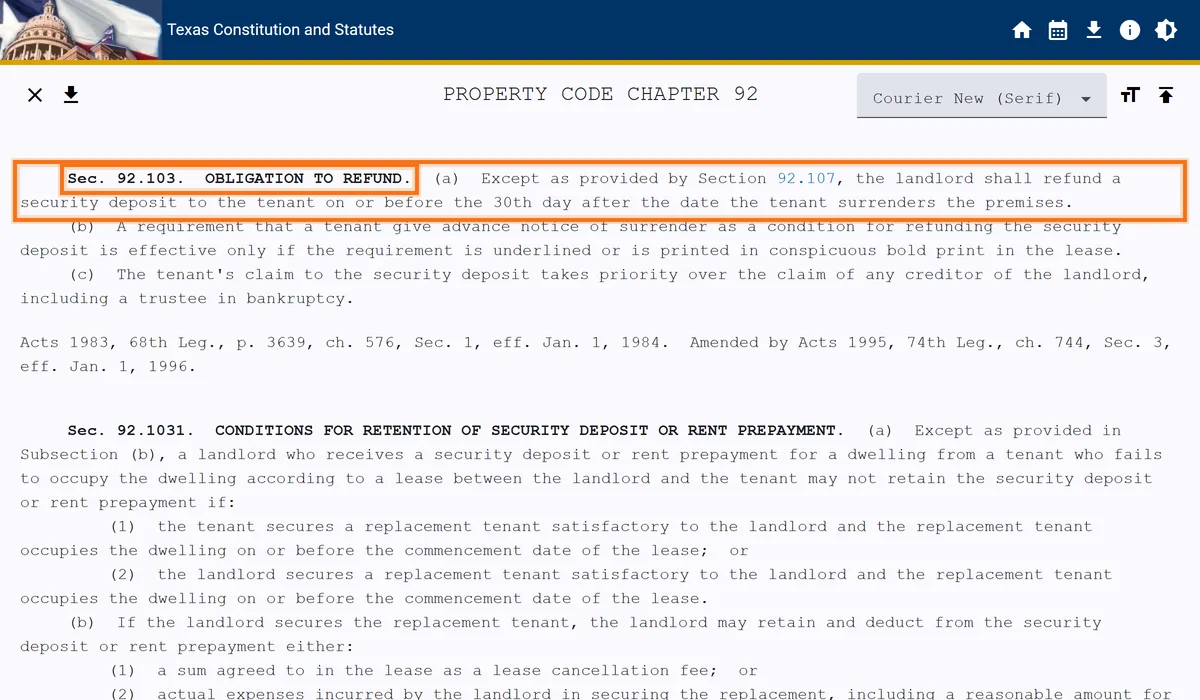
- 30 days after the tenant surrenders the home: refund the deposit or send the balance with an itemized list of deductions (Property Code §92.103 and §92.104).
- The clock runs from surrender, not the lease end date; returned keys are the cleanest proof of the date.
- Without a written forwarding address there is no duty to mail yet, but the tenant keeps the right to the deposit (§92.107).
- Bad-faith retention costs $100 plus three times the amount wrongfully withheld plus attorney's fees; missing the 30 days is presumed bad faith (§92.109).
- No deductions for normal wear and tear, and a tenant may not use the deposit as the last month's rent (§92.108).
Thirty days. Under Texas law, a landlord generally has thirty days after the tenant surrenders the home to either refund the security deposit in full or send the tenant a written, itemized list of deductions along with whatever balance remains. The landlord's obligation is tied to the tenant providing a written forwarding address, and the penalties for ignoring the deadline or keeping the deposit in bad faith are steep enough that no owner should treat it casually.
Here is how the clock actually runs, what counts as surrender, and what a well-run move-out looks like week by week so the deadline is never a scramble.
When the thirty days start
The clock starts at surrender, which in general terms is the point when the tenant has moved out and the landlord has possession again. The clean, provable date is the day the tenant returns all keys. If the tenant leaves without returning keys or communicating, surrender gets murkier, and the lease and the facts decide the date. Document it: a signed key receipt, a dated photo of keys on the counter, or a dated written notice from the tenant.
The deadline is not tied to the lease end date. A tenant who leaves two weeks early has surrendered two weeks early, and the thirty days run from then. Texas security deposit rules covers the surrounding rules on what can and cannot be deducted.
The forwarding address condition
Texas does not require the landlord to send the refund or itemization until the tenant has provided a written forwarding address. That protects the owner from being penalized for not mailing something to an address they never had. It does not let the owner keep the money. Once the address arrives, the obligation applies, and courts look poorly on a landlord who treats a missing address as a reason to spend the deposit.
The practical approach is to ask for the forwarding address before move-out, in writing, and to prepare the itemization within the thirty days regardless. If the address shows up late, the accounting goes out the same day it arrives. Many leases also include a clause on the forwarding address and on advance notice of move-out; read yours, because some conditions on the refund only apply if they were set out in the lease in the way Texas requires.
What has to go out within the window
Either the full deposit, or a written description and itemized list of every deduction plus the remaining balance. An itemization that says only "cleaning and damages" with a single number is not an itemization. Each line should name the item, the reason it is the tenant's responsibility, and the amount, and good practice is to attach the invoice or estimate and the before-and-after photos.
If the deductions exceed the deposit, the itemization shows the balance the tenant owes. If unpaid rent is deducted, the ledger supports it. Deductions for normal wear and tear are not allowed, and the owner cannot deduct for repairs that were never actually made or priced. The move-out inspection guide explains how the itemization is assembled from the inspection.
What happens if the deadline is missed
A landlord who keeps a deposit in bad faith, or who fails to provide the itemization, faces consequences under Texas law that go well beyond refunding the money: $100, three times the portion wrongfully withheld, and the tenant's reasonable attorney's fees (Property Code §92.109). A landlord who misses the deadline also generally loses the right to withhold any part of the deposit and carries the burden of proving the retention was reasonable.
The deadline is therefore not a target; it is a cliff. The itemization should be ready well inside the window, not on the last day. The same rules apply whether you self-manage or hire a manager, because the owner is the landlord either way.
Texas security deposit rules at a glance
The rules that set the deadline and the stakes:
| Rule | What it says | Property Code |
|---|---|---|
| Refund deadline | On or before the 30th day after the tenant surrenders the home | §92.103(a) |
| Advance notice of move-out as a condition | Effective only if underlined or in conspicuous bold print in the lease | §92.103(b) |
| Deductions | Damages and charges the tenant is liable for; never normal wear and tear; balance sent with an itemized list | §92.104 |
| Forwarding address | No duty to refund or itemize until the tenant gives one in writing; the tenant does not lose the deposit for failing to | §92.107 |
| Last month's rent | The tenant may not withhold it against the deposit; bad-faith withholding costs three times the rent withheld plus fees | §92.108 |
| Landlord bad faith | $100 plus three times the amount wrongfully withheld plus attorney's fees; missing the 30 days is presumed bad faith | §92.109 |
How to read this table: the 30-day deadline is the rule everything else hangs on. Miss it, and the law presumes bad faith and puts the burden on the owner to prove each deduction was reasonable, which is why the itemization should go out well inside the window rather than on day 30.
What a well-run move-out looks like, week by week
Here is the timeline a manager should be working to, from the day the keys come back:
- Day of surrender: walk-through with dated photos, meter readings, key count, and a record of anything left behind. Confirm the forwarding address.
- Days one to five: vendor estimates for every chargeable item; the make-ready scope split into tenant charges and owner costs.
- Days five to fifteen: the draft itemization, prorated where items had a limited life, sent to the owner for review and approval.
- Days fifteen to twenty-five: itemization and refund mailed to the forwarding address, with photos and invoices attached, and a copy kept on file.
- Before day thirty: confirmation that it was sent, with proof of mailing.
Leaving the owner's approval to the last week is the usual reason deadlines get missed, so the draft goes to the owner early with a clear reply-by date.
When the tenant leaves owing more than the deposit
The thirty-day accounting still goes out. It shows the deposit applied first to unpaid rent and then to damage and cleaning, with the remaining balance the tenant owes. Sending it on time matters even when there is no refund, because it is the document any later collection effort or justice court claim rests on.
Texas also does not allow a tenant to withhold the last month's rent on the grounds that the deposit covers it, and a tenant who does so can face penalties of their own. The rent collection ledger, kept current through the lease, is what proves what was and was not paid.
This is general information, not legal advice. Texas deposit law has specific requirements and exceptions; confirm them with your lease or an attorney.
How Perpetual handles this
Perpetual Property Management runs every move-out on a calendar that starts the day the keys come back. The walk-through, the vendor pricing, the owner's review and the mailing are each scheduled inside the thirty-day window with room to spare, and the owner sees the draft itemization early with photos and invoices attached. Deposits are held in a trust account, every deduction is supported by the move-in report and the move-out comparison, and anything borderline is flagged to the owner as a judgment call rather than quietly deducted.
We are broker-owned and local to Keller, North Richland Hills and Fort Worth, so the inspection and the paperwork are done by people who know the house. The full move-out file stays in the owner portal, every fee is listed in the written quote before you sign, and the monthly statement shows how the deposit was applied.
The takeaway: Thirty days from surrender, triggered by a forwarding address, with an itemization that proves itself: build the move-out around that and the deadline is never close.
Questions owners ask
Can a landlord charge a fee for returning the security deposit late?
No. The landlord is the one on a deadline, not the tenant. If the landlord misses it, the tenant may be entitled to penalties under Texas law. There is no late fee a landlord can charge a tenant on a deposit refund.
Does the tenant have to give notice to get the deposit back in Texas?
Only if the lease requires advance notice of surrender as a condition of the refund and that requirement is set out in the lease in the conspicuous way Texas law requires. Without that clause, a tenant who leaves without notice may still owe rent, but the landlord must still account for the deposit. Check your lease wording.
Can a security deposit be used as the last month's rent in Texas?
Not by the tenant's choice. Texas law treats withholding the last month's rent on the strength of the deposit as a violation that can expose the tenant to penalties. The deposit is applied after move-out, once damage and unpaid rent are known. If a tenant tries this, send a written notice that rent is due and document it.
What if the tenant moved out early and I do not know the exact date?
Use the best evidence you have: the date keys were returned, the last utility usage, the date the tenant said they were leaving in writing, or the date you regained possession after confirming abandonment. Document your reasoning and work from the earliest plausible date so you are inside the window either way.
How long does it take to get a security deposit back in Texas?
Up to 30 days after you move out and return possession, once you have given the landlord a written forwarding address. By then the landlord must refund the deposit in full or send the balance with a written, itemized list of deductions.
Related services
Property management in Keller, North Richland Hills and Fort Worth. How full-service management works in Tarrant County →