
Key takeaways
- Texas has no maximum security deposit; about one month's rent is the usual starting point in Tarrant County.
- Raise it by a written formula, the same for every applicant: conditional approval, pets, furnished homes, pools.
- For pets we list a $350 one-time nonrefundable fee and $25 a month pet rent per pet when the owner allows pets; a refundable pet deposit is optional on top.
- The tenant may not use the deposit as last month's rent; doing so carries three times the rent withheld plus attorney's fees (Property Code 92.108).
- Refund or itemize within 30 days after surrender; bad-faith withholding costs $100 plus three times the amount withheld (92.103, 92.109).
How much security deposit should you collect on a Texas rental? Texas does not cap residential deposits, so the amount is yours to set, and the right way to set it is by risk, not by habit. The common starting point across Fort Worth, Keller and North Richland Hills is about one month's rent. It goes up for a weaker application, a pet, a furnished home or a pool, by a formula you apply to every applicant the same way.
What it should not do is climb so high that the good applicants, who have options, choose a different house. This guide covers the starting point, the conditions that justify more, how pet deposits and fees fit, the Property Code rules that apply, and a worked example you can adapt.
Texas sets no cap, which makes the deposit a judgment call
Some states limit deposits to one or two months' rent. Texas does not, in general terms, limit the amount at all for residential leases. What Texas regulates is the back end: the deposit must be returned, or an itemized list of deductions sent, within thirty days of the tenant surrendering the home and providing a forwarding address, deductions cannot include normal wear and tear, and an owner who withholds in bad faith faces penalties. The full set of rules is in Texas security deposit rules.
So the question is not what you are allowed to collect. It is what amount protects you against the losses a deposit actually covers, without pricing out the tenants you want. A deposit is insurance against a specific, limited set of risks, and like any insurance it has a cost on the buyer's side, which here is a smaller pool of applicants.
The usual starting point: about one month's rent
One month's rent is the convention in this market for a reason. It is enough to cover a typical move-out shortfall on a well-screened tenant: a cleaning bill, a few repairs beyond wear, perhaps a final utility balance. It is a number applicants expect and can plan for, so it does not slow the leasing process. And it keeps the move-in cash, first month plus deposit, at a level that a qualified household can produce without draining savings they will need for the move itself.
Some owners round the deposit to a clean figure just under or over the rent, which is fine. Setting it meaningfully below a month's rent is a mistake unless the market forces it; a deposit that cannot cover one real repair is not doing its job. For what a deposit can and cannot absorb once the tenant leaves owing more, see when damage or unpaid rent exceeds the deposit.
When to ask for more
The deposit should rise when the risk rises, and the risk comes from two places: the applicant and the house.
On the applicant side, screening criteria usually define a conditional approval tier: income that meets the standard but with a thin or short credit history, a prior late-payment pattern that has since cleared, a short time at the current job, or a prior landlord reference that was neutral rather than good. Many owners approve that tier with an increased deposit, often half a month to a full additional month, rather than declining outright. The tiers belong in written criteria, which is the subject of tenant screening criteria in Texas.
On the house side, the deposit should reflect what a careless tenant can cost you. A furnished home, hardwood floors, high-end appliances, a pool, extensive landscaping or a large square footage all raise the potential bill. A modest additional deposit on those homes is reasonable and most applicants understand it.
What should not move the deposit is anything about who the applicant is as a person rather than what their file shows. That is the fair housing line, and it is covered below.
Deposit by situation: a starting schedule
Here is a schedule an owner can adapt, shown for a home renting at $2,000 a month. The amounts are illustrative except the pet charges, which are the ones we publish in our rental criteria:
| Situation | Deposit approach | Example at $2,000 rent | Why |
|---|---|---|---|
| Strong file: income at least 3x rent, clean history | One month's rent | $2,000 | Covers a typical move-out shortfall without slowing leasing |
| Conditional approval (thin credit, short job history) | Add half to one month, by written criteria | $3,000 to $4,000 | More risk in the file, priced the same way for everyone |
| Pet allowed by the owner | Our published $350 nonrefundable fee plus $25 a month pet rent per pet; refundable pet deposit optional | $350 at move-in, $25 a month | The fee and rent cover wear a deposit cannot be applied to |
| Furnished home, pool or high-end finishes | A set addition stated in the listing | Set per home | The house can cost more to put right |
| First month, last month and a deposit | Legal, but move-in cash triples | $6,000 before move-in | Shrinks the applicant pool; rarely worth it |
How to read this table: start in the first row and move down only when the file or the house gives a written reason. The last row is there to show the cost of the habit, not to recommend it. Whatever schedule you choose, publish it before the listing goes live so every applicant sees the same numbers.
Pet deposits, pet fees and pet rent
Pets are the most common reason to add to the deposit, and there are three tools. A pet deposit is refundable, held with the security deposit and applied to pet damage at move-out. A pet fee is a one-time, non-refundable charge for allowing the animal. Pet rent is a monthly addition. Owners combine them in different ways; a refundable deposit plus modest pet rent is common, because the deposit covers damage and the rent covers the wear a deposit cannot legally touch.
Whatever you choose, the lease has to say which it is. A non-refundable fee that is labeled a deposit becomes refundable in a dispute. The sizing depends on the animal and the house; the considerations are in pets in a Texas rental.
One exception that is not optional: an assistance animal under fair housing law is not a pet, and no pet deposit, fee or rent can be charged for it. The tenant remains responsible for damage the animal causes, through the regular deposit and the lease.
Why an oversized deposit shrinks your applicant pool
Owners who have been burned once often respond by doubling the deposit. The protection is real but the cost is hidden. A deposit of two months' rent means move-in cash of three months' rent. A qualified household with a strong income and clean history can usually produce that, but they can also produce it for the house down the street that asks for one, and they will. The applicants who remain are the ones with fewer options, which is the opposite of the selection you wanted.
The vacancy math makes it concrete. Illustrative example: rent is $2,000. Raising the deposit from $2,000 to $4,000 protects you against an additional $2,000 of move-out loss, which a well-screened tenant rarely produces. If the larger deposit adds two weeks to the vacancy because fewer qualified applicants apply, that is roughly $1,000 of rent gone before the tenant moves in, every time the home turns. Over several turnovers the oversized deposit costs more than it has ever saved.
The better answer to a bad experience is better screening and a deposit that moves with the file, not a larger deposit for everyone.
The deposit is not last month's rent
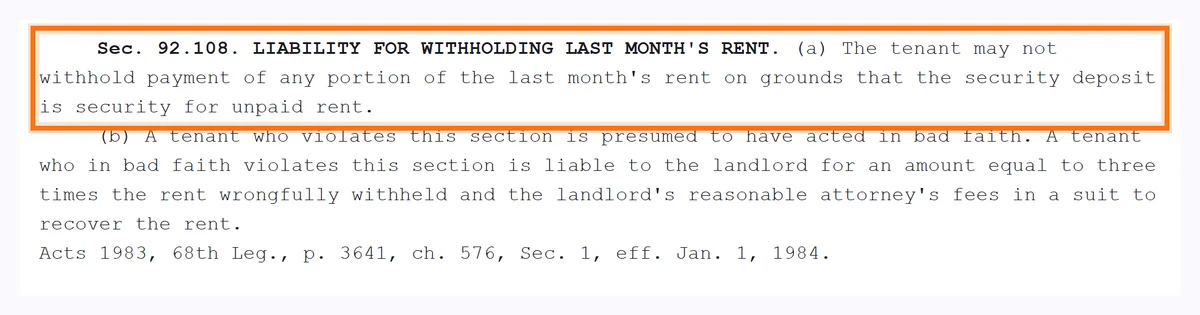
Tenants sometimes ask to apply the deposit to the final month. Texas Property Code Section 92.108 says no: the tenant may not withhold payment of any portion of the last month's rent on the grounds that the deposit is security for unpaid rent. A tenant who does is presumed to have acted in bad faith and can owe three times the rent withheld plus the landlord's reasonable attorney's fees. The lease should say so plainly, and the manager should remind the tenant when they give move-out notice.
Some owners collect first month, last month and a deposit. That is legal in Texas, but it raises move-in cash sharply, with the same pool-shrinking effect as a large deposit, and it creates accounting confusion about what the last-month payment is. For most single-family homes in this market, first month plus a deposit sized to risk is the cleaner structure.
The Texas Property Code rules that apply to every deposit
Texas regulates how a deposit is handled, not how large it is. These are the sections an owner or manager in Tarrant County works with:
| Section | What it says | What it means for you |
|---|---|---|
| 92.102 | A security deposit is money given mainly to secure performance of the lease, not an application deposit or prepaid rent | Label each charge in the lease so a fee is not treated as a deposit |
| 92.103 | Refund on or before the 30th day after the tenant surrenders the home | Put the move-out date on the calendar the day notice arrives |
| 92.104 | Deduct only damages and charges owed; never normal wear and tear; itemize in writing | Move-in photos are your evidence for every deduction |
| 92.107 | No refund or itemization is owed until the tenant gives a written forwarding address | Ask for it in the move-out notice reply |
| 92.108 | The tenant may not withhold last month's rent because of the deposit | Bad-faith withholding: three times the rent withheld plus attorney's fees |
| 92.109 | Bad-faith retention: $100 plus three times the amount wrongly withheld and attorney's fees | Missing the 30-day deadline is presumed bad faith |
How to read this table: the first column is where to look in the Property Code, the last is the action that keeps you on the right side of it. The two rows that cost owners money most often are 92.104, deducting for wear, and 92.109, missing the 30-day deadline. This is general information, not legal advice.
Consistency: the formula, not the feeling
Fair housing law prohibits treating applicants differently on the basis of protected characteristics, and deposits are one of the places where inconsistency shows up without anyone intending it. If one applicant is asked for a month and the next for two, with nothing in the written criteria that explains the difference, the second applicant has a reasonable question and you may not have a good answer.
The fix is a written deposit schedule inside your screening criteria: the standard deposit, the conditional-approval addition, the pet schedule and the property-based adjustments, applied to every applicant by the file. Managers who screen by consistent criteria do exactly this, and it protects the owner as much as the tenant. This is general information, not legal advice; confirm specifics with an attorney.
A worked example
Illustrative only: say the home rents for $2,000 a month and your written schedule reads: standard deposit equal to one month's rent; conditional approval adds half a month; refundable pet deposit per animal plus modest monthly pet rent; furnished homes and pools add a set amount.
An applicant with strong income, clean credit and a good landlord reference, no pets: deposit $2,000. An applicant who meets the income standard but has a thin credit file and one dog: $2,000 plus the conditional addition of $1,000 plus the pet deposit, with pet rent in the lease. Both applicants see the same schedule, both can see why their number is what it is, and if either disputes a deduction later, the deposit terms are in writing.
The pricing of the rent itself, which sets the base for all of this, is a separate exercise; a free rental analysis gives you the market number before you set the deposit against it.
How Perpetual handles this
For the homes we manage in Keller, North Richland Hills and Fort Worth, the deposit is set by a written schedule that is part of our consistent screening criteria, not by how an application feels. The standard deposit, the conditional-approval addition, the pet schedule and any property-based adjustment are all stated before the listing goes live, and every applicant is measured against the same file-based rules. Assistance animals are handled under fair housing law, with no pet charges.
Our Texas-compliant lease states what the deposit is, what it is not, and that it cannot be applied to the last month's rent. At move-in, a documented inspection with photos establishes the condition the deposit will be measured against, and at move-out we prepare the itemized accounting inside the Texas timeline from that record. Deposits are held and accounted for in your owner portal, and every fee tied to leasing is in your written quote before you sign. If you are unsure what deposit your home should carry, ask us; it is a five-minute conversation once we know the house and the market.
The takeaway: Set the deposit by a written formula that moves with the file, not by fear, because the applicants a large deposit scares off are the ones you most wanted.
Questions owners ask
How much security deposit should I collect for my rental?
In Texas there is no legal cap, and the common starting point in North Texas is about one month's rent. Add to it by a written formula when the applicant is approved conditionally, when there is a pet, or when the home carries extra risk such as furnishings or a pool. Avoid going far beyond that for everyone, because a large deposit shrinks the pool of qualified applicants and lengthens vacancy, which usually costs more than the extra protection is worth.
Is there a limit on security deposits in Texas?
No. Texas does not set a maximum residential security deposit. What Texas regulates is the handling: an itemized accounting or refund within thirty days of surrender and a forwarding address, no deductions for normal wear and tear, and penalties for bad-faith withholding. Confirm the current rules with your lease or an attorney.
Can I charge a pet deposit in Texas?
Yes. Texas allows a refundable pet deposit, a non-refundable pet fee, monthly pet rent, or a combination, as long as the lease states clearly which it is. A charge labeled a deposit must be refundable and accounted for like the security deposit. Assistance animals under fair housing law are not pets and cannot carry any pet charge, though the tenant remains responsible for damage.
Can I require first and last month's rent plus a security deposit?
Legally yes in Texas, but it raises move-in cash to three months' rent, which narrows the applicant pool in the same way an oversized deposit does, and it complicates the accounting of what the final-month payment is. Most single-family owners in this market use first month plus a deposit sized to risk. If you do collect last month's rent, the lease should define it separately from the deposit.
Can a tenant use the security deposit as the last month's rent in Texas?
No. Texas Property Code Section 92.108 says a tenant may not withhold any portion of the last month's rent on the grounds that the security deposit covers it. A tenant who does is presumed to act in bad faith and can owe three times the rent withheld plus the landlord's reasonable attorney's fees. The lease should say this plainly, and the manager should remind the tenant when they give move-out notice.
What is a typical pet deposit for a rental in Fort Worth?
Many leases combine a refundable pet deposit with a one-time nonrefundable pet fee and monthly pet rent. For homes we lease, our published rental criteria list a $350 one-time nonrefundable pet fee and $25 a month pet rent per pet, when the owner allows pets. Any refundable pet deposit is set per home and is handled like the security deposit at move-out.
Related services
Property management in Keller, North Richland Hills and Fort Worth. How full-service management works in Tarrant County →