
Key takeaways
- Texas Property Code 92.3515 requires printed notice of your tenant selection criteria when an applicant receives the application, and a signed acknowledgment.
- Reject an applicant without having made that notice available and you must return the application fee and any application deposit (92.3515(e)).
- Common written grounds: criminal history, rental history, current income, credit history and inaccurate or incomplete information (92.3515(a)).
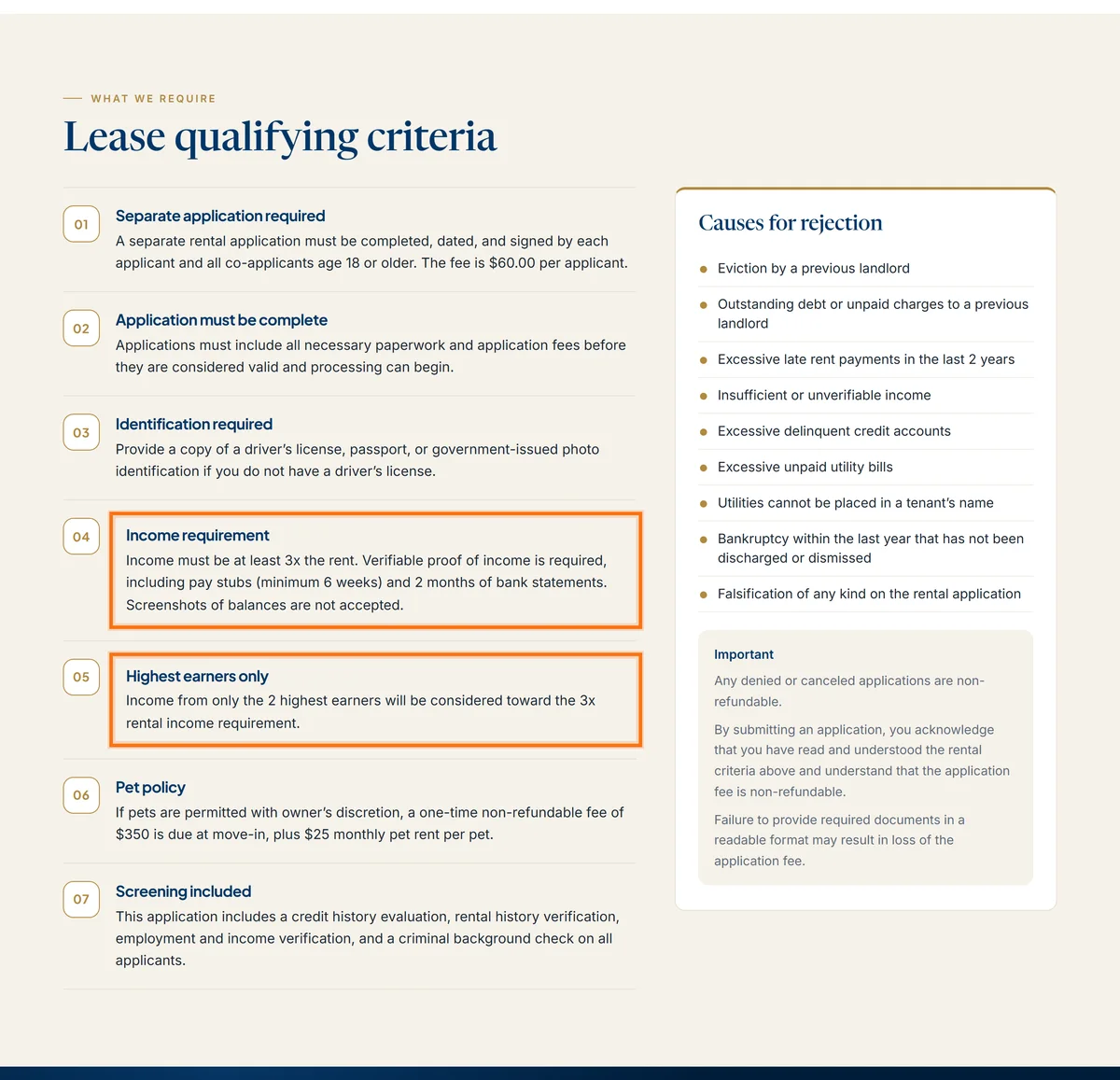
- Our published criteria: income of at least 3x the rent, verified with pay stubs and bank statements, counting the two highest earners; $60 per adult applicant.
- A denial based on a credit or background report comes with the adverse action notice the federal Fair Credit Reporting Act requires.
A fair tenant screening standard in Texas is a written set of criteria, made available before anyone applies, applied the same way to every adult applicant, and documented well enough that you could explain any denial a year later. Texas Property Code 92.3515 makes the written notice a legal requirement, not just good practice. The rest of this guide is how to build criteria that predict a good tenant in Keller, North Richland Hills and Fort Worth and keep you inside fair housing law.
Most screening problems come from the opposite approach: an owner meets an applicant, forms an impression, and then goes looking for reasons. That is how you end up with a tenant who stops paying in month four, or a complaint you cannot defend.
Put the criteria in writing before anyone applies
Property Code 92.3515(a) says that when an applicant is given a rental application, the landlord must make available printed notice of the tenant selection criteria and the grounds for denial, including criminal history, previous rental history, current income, credit history and failure to give accurate or complete information. Under 92.3515(b) the applicant signs an acknowledgment that the notice was available. If the landlord rejects an applicant without having made the notice available, 92.3515(e) requires returning the application fee and any application deposit.
Beyond the legal requirement, written criteria protect you in a practical way. When every applicant receives the same sheet, you are not improvising thresholds in your head, and you are not tempted to loosen them for someone likable. The standard decides, not the conversation.
Your criteria should state, at minimum:
- The minimum income relative to rent, what income you count and how it is verified.
- How credit is evaluated, including what is disqualifying on its own.
- Rental history requirements, including evictions and money owed to prior landlords.
- How criminal history is reviewed.
- Occupancy rules, the pet policy and whether co-signers are accepted.
- What happens if the application contains false information.
Example: the screening criteria we publish for every Fort Worth area rental
Here is what our published criteria say, criterion by criterion, and why each one matters for an owner:
| Criterion | What our published criteria say | Why it matters |
|---|---|---|
| Who applies | Every applicant and co-applicant 18 or older completes, dates and signs a separate application; $60 per applicant | Everyone who will sign the lease is screened, not just the person who toured |
| Complete application | Paperwork and fees must be in before processing begins | Defines when an application counts, which matters when several arrive |
| Income | At least 3x the rent; pay stubs (minimum 6 weeks) and 2 months of bank statements; screenshots of balances not accepted | Verified income, not stated income, is what pays rent |
| Whose income counts | Only the 2 highest earners count toward 3x | Stops a household from qualifying on several small, unstable incomes |
| Screening run | Credit, rental history, employment and income verification, criminal background check on all applicants | The same checks for every adult is what makes the standard defensible |
| Causes for rejection | Eviction by a previous landlord, money owed to a previous landlord, excessive late payments in the last 2 years, unverifiable income, undischarged bankruptcy within the last year, falsification, among others | Written grounds, stated in advance, are what 92.3515 asks for |
How to read this table: the middle column is copied from our public rental criteria page, so it is exactly what an applicant sees before applying. The third column is the owner's side of each rule. You can adopt different numbers for your own rental; what you cannot do is change them from one applicant to the next.
Income: the ratio and what actually counts
Many managers set gross monthly income at a multiple of the rent; our published criteria require at least three times the rent. The number matters less than how you verify it. Pay stubs, an offer letter for a new position, bank statements for self-employed applicants, and award letters for retirement or disability income are all normal documentation. A screenshot of a banking app is not.
Count income that is lawful, verifiable and likely to continue through the lease term. If several adults apply together, decide whose income counts: our criteria count only the two highest earners toward the 3x requirement. Write the rule for how you treat each source of income once, and apply it to every file.
Two things trip owners up here. A high income with a weak credit file is a different risk than a modest income with a clean one, and your criteria should say which you accept. And a job that starts after move-in is a judgment call that has to be the same judgment every time.

Credit: read the pattern, not just the score
A credit score is a summary, and a summary hides the part you care about. What predicts rent payment is the pattern underneath: whether housing-related debts were paid, whether there are recent collections from a utility or an apartment community, and whether the file shows someone climbing out of a bad stretch or sliding into one.
Set a floor score if you want one, but also spell out items that matter on their own: money owed to a prior landlord, unpaid utility accounts, and an open bankruptcy. Medical collections are common and say very little about whether someone will pay rent, so many managers weigh them differently from other collections. Whatever you decide, write it down and apply it to every file.
A thin credit file is not the same as a bad one. Young applicants, people who are new to the country and people who simply avoid credit cards will have little history. Your criteria should say how you handle that: a larger deposit where the lease allows it, a qualified co-signer, or additional rental references.
Rental history: the reference that matters most
Prior landlords are the best predictor you have, and also the easiest reference to fake, so verify that the person you reach actually owned or managed the home. The questions are simple. Did the tenant pay on time? Were there lease violations? Was proper notice given? Would you rent to them again?
A current landlord has a reason to say nice things about a tenant they want gone, so the landlord before that one is often the more honest source. That is how our tenant screening page puts it too: we speak to previous landlords and weigh a current landlord eager to pass along a problem tenant differently from a previous one with nothing to gain.
Eviction filings in Texas are public record. A filing from years ago with an explanation and a clean history since is different from a judgment last year. Your criteria should say how far back you look and whether a filing, as opposed to a judgment, is disqualifying. Our published criteria list eviction by a previous landlord and money owed to a previous landlord as causes for rejection.
Criminal history inside fair housing limits
Property Code 92.3515 names criminal history as one of the grounds a landlord may state in its criteria. What fair housing law adds is how the policy is applied: the federal Fair Housing Act and the Texas Fair Housing Act (Property Code Chapter 301) prohibit decisions based on a protected characteristic, and a criminal history policy that is applied unevenly, or that is broader than the risk it is meant to address, is where complaints start.
In practice that means a written policy, the same background check vendor for every adult, a result documented in the file, and a chance for the applicant to explain an error in the report. Our screening runs the background check within fair housing and HUD guidance. Have a Texas attorney review the criminal history part of your criteria, because it is the part most likely to be challenged.
Consistency, documentation and the denial
Federal fair housing law protects race, color, religion, national origin, sex, familial status and disability, and the Texas Fair Housing Act (Property Code Chapter 301) protects the same classes. The way a landlord most often gets into trouble is not an openly discriminatory statement. It is inconsistent treatment that cannot be explained: one applicant was asked for extra documentation and another was not, or one was told the home was taken while another was shown it the next day.
The cure is a process:
- Applications are processed in the order received, and that order is recorded.
- Every applicant gets the same criteria sheet and the same application.
- Every file holds the credit and background reports, the verification notes and the decision.
- A denial based on a consumer report comes with the adverse action notice the Fair Credit Reporting Act (15 U.S.C. 1681m) requires, naming the reporting agency.
- Nobody on your side discusses an applicant's family, religion, origin or disability, in writing or otherwise, except to process a lawful accommodation request.
This is the part a professional manager earns their fee on. Our screening measures every applicant against the same published criteria and documents approval decisions against them, never gut feel. Our leasing service covers the steps on either side of screening, from the listing to the signed lease.
Mistakes that look harmless until they are not
- Taking the first good-enough applicant to end the vacancy. Another week of vacancy costs far less than a bad tenant. Read how long a house really takes to lease here before you panic.
- Letting the applicant choose which references you call.
- Skipping verification because the credit report looks strong.
- Writing ad copy like "perfect for a young professional" or "no kids," which signals familial status discrimination before anyone applies.
- Taking cash for the application fee without a receipt and a record of the order received.
If an applicant does not meet the written standard, the answer is no, delivered the same way every time. If you are deciding whether to keep doing this yourself, self-managing versus hiring a manager lays out the tradeoff, and how tenant screening works walks through the mechanics from application to approval. The criteria we use are published on our rental criteria page; if you want to talk through how they would apply to your house, ask us.
This is general information, not legal advice. Confirm your criteria against your lease and with an attorney who practices Texas landlord-tenant law.
The takeaway: Decide the standard before the first application, apply it to everyone the same way, and keep the file that proves you did.
Questions owners ask
Can a landlord in Texas deny an applicant for bad credit?
Yes. Credit history is a recognized ground for denial as long as the criteria were disclosed in writing, the same standard is applied to every applicant, and a denial based on a credit report comes with the required adverse action notice. Problems arise when the standard shifts from one applicant to the next.
Does Texas require landlords to give applicants the screening criteria?
Yes. Property Code 92.3515 requires the landlord to make printed notice of the tenant selection criteria and the grounds for denial available when the applicant receives the application, and the applicant signs an acknowledgment. If the landlord rejects an applicant without having made the notice available, it must return the application fee and any application deposit.
Can I refuse to rent to someone with a criminal record?
Not with a policy you cannot explain. Property Code 92.3515 allows criminal history as a written ground for denial, but fair housing law requires the policy to be applied the same way to everyone and not be used as cover for a protected characteristic. Write the policy down, run the same check on every adult, and have a Texas attorney review it.
Is it legal to require income of three times the rent?
An income-to-rent ratio is a common and generally lawful criterion in Texas when it is written down and applied to every applicant the same way. Be careful to treat lawful sources of income consistently and to document how you verified the figures.
What credit score should I require for my rental?
There is no single right number, and a score alone is a weak predictor. What matters more is the pattern underneath it: whether housing-related debts were paid, whether there are recent collections from a landlord or utility, and whether the file shows someone recovering or sliding. If you set a floor score, also write down the items that are disqualifying on their own, such as money owed to a prior landlord, and how a thin file is handled, for example with a qualified co-signer. Whatever you choose must be in writing before the first application and applied to every applicant the same way, which is how Perpetual screens every home.
How much income should a tenant have compared with the rent?
Many managers set gross monthly income at a multiple of the rent; our published criteria require at least three times the rent, verified with pay stubs covering at least six weeks and two months of bank statements, and screenshots of balances are not accepted. Count income that is lawful, verifiable and likely to continue through the lease, and decide in advance whose income counts; we count only the two highest earners. Write the rule once and apply it to every file.
Can I accept a tenant with bad credit but a good rental history?
You can, as long as your written criteria allow it and the same rule is applied to every applicant. Many managers treat a strong, verified rental history as the better predictor, since prior landlords tell you whether rent was actually paid. Decide in advance how a weak credit file with a clean rental record is handled, whether through approval as-is, a qualified co-signer or a larger deposit where the lease allows, and document that decision in the file.
How do property managers evaluate applicants with previous evictions?
Eviction filings in Texas are public record, and a defensible policy states how far back it looks and whether a filing, as opposed to a judgment, is disqualifying. Our published criteria list eviction by a previous landlord and money owed to a previous landlord as causes for rejection. Prior landlord references are verified, because a current landlord may be eager to see a bad tenant leave, and any denial based on a consumer report comes with the required adverse action notice.
Related services
Property management in Keller, North Richland Hills and Fort Worth. How full-service management works in Tarrant County →