Key takeaways
- Step 1 is a written notice to vacate: at least three days before filing unless the lease sets a different period (Property Code §24.005). Since January 1, 2026 it can go by mail, inside the home in a conspicuous place, by hand to a tenant 16 or older, or by email if agreed in writing.
- Step 2 is a sworn petition in the justice court for the precinct; the constable must try to serve it within five business days (§24.0051(f)).
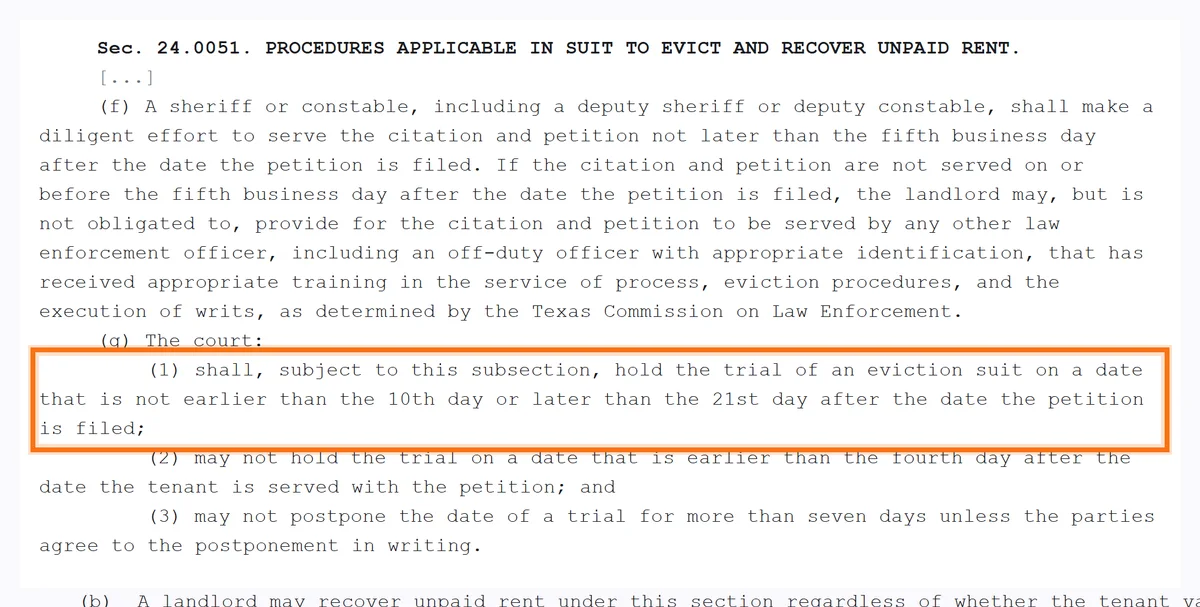
- Step 3 is the trial, set no earlier than the 10th and no later than the 21st day after filing, and not sooner than the 4th day after service (§24.0051(g)).
- Steps 4 and 5: after a judgment for possession, no writ before the sixth day (§24.0061(b)), service of the writ within five business days, and a posted 24-hour warning before removal.
- Changing locks or cutting utilities instead of going to court is unlawful in Texas; the court and the constable are the only way to remove a tenant who will not leave.
The eviction process in Texas runs in five fixed steps: notice to vacate, sworn petition, trial, judgment and writ of possession. With every step done promptly and the tenant not contesting, it usually takes several weeks from the notice to the day the constable returns the house, and about two months from the first missed rent. We run it in the Tarrant County justice courts for homes in Fort Worth, Keller and North Richland Hills.
Faster than most states does not mean cheap or simple. Every step has a procedural rule, the rules changed on January 1, 2026, and getting one wrong starts the clock over. This guide walks through the process in order, in general terms, and ends with why preventing an eviction is worth far more than winning one.
If your question is only the calendar, how long an eviction takes in Texas breaks the time down stage by stage.
The Texas eviction process in five steps (2026 rules)
Each step, what happens and the time Texas law sets for it:
| Step | What happens | Time the law sets | Rule |
|---|---|---|---|
| 1. Notice to vacate | Written notice delivered by mail, inside the home in a conspicuous place, by hand to a tenant 16 or older, or by email if agreed in writing | At least 3 days before filing, unless the lease sets another period | Property Code §24.005 |
| 2. Sworn petition | Filed in the justice court for the precinct where the home sits; the constable serves the citation | Service attempted within 5 business days of filing | §24.00505, §24.0051(f) |
| 3. Trial | Judge reviews the lease, ledger, notice and proof of delivery; the tenant may raise defenses | Day 10 to day 21 after filing, not before day 4 after service; at most a 7-day postponement unless both agree in writing | §24.0051(g) |
| 4. Judgment | Judgment for possession and, in a nonpayment case, unpaid rent; the tenant has a short window to appeal to county court | Writ not available before the 6th day after judgment unless a possession bond is filed | §24.0061(b) |
| 5. Writ of possession | Officer posts a written warning on the front door, then returns possession and supervises removal | Served within 5 business days of issue; warning at least 24 hours before | §24.0061(b-1), (d) |
How to read this table: the third column is time nobody can shorten, and it adds up to a few weeks even when the tenant does not fight. What an owner controls is everything around it: serving the notice the day the lease allows, filing the day the notice period ends, and asking for the writ the day it becomes available. A defective notice in step 1 is the most common reason the whole table starts over.
Before anything is filed: the lease and the late-rent process
An eviction begins long before a courthouse. It begins with a lease that states clearly when rent is due, when it is late, what the late fee is, and that failure to pay is grounds for termination. If the lease is vague on any of those points, the case is weaker before it starts.
It also begins with a consistent late-rent process. Rent is due on the first. A reminder goes out when it is missed. A late notice follows on the schedule the lease sets. Every contact is in writing and logged. A tenant who is going to pay usually pays at this stage, which is why most late-rent situations never become evictions. Our guide to what happens when a tenant pays late in Texas covers that sequence in detail.
The owner should resist two temptations here: accepting a partial payment without a written agreement about the balance, which can complicate the case, and taking any self-help action such as changing locks or shutting off utilities, which Texas law prohibits and which can expose the owner to penalties.
Step one: the notice to vacate
The first formal step is a written notice to vacate. Under Texas law the landlord must give the tenant at least three days to move out before filing, unless the lease sets a different period, and many leases do.
Since January 1, 2026, Property Code §24.005(f-3) allows four delivery methods: mail (first class, registered, certified or a delivery service), delivery inside the home in a conspicuous place, hand delivery to any tenant 16 or older, or email or other electronic means if the parties agreed to it in writing. The method and date of delivery must be documented. A tenant who was not late before that month must get a notice to pay rent or vacate rather than a plain notice to vacate.
The wording, counting and delivery rules are covered in the notice to vacate explained.
This notice is where self-managing owners most often go wrong. A text message that says "you need to be out by Friday" is not a proper notice, and electronic delivery counts only when the tenant agreed to it in writing. A notice delivered in a manner the statute does not recognize can get the case dismissed at the hearing, which means a new notice, a new filing and weeks lost.
The notice should state the reason, the deadline, and that the landlord will file for eviction if the tenant does not comply. It should not threaten anything the owner is not entitled to do. Keep a copy and the proof of delivery in the file; the judge will ask for both.
Step two: filing in Justice Court
Once the notice period has run and the tenant is still in possession, the owner or the owner's agent files an eviction suit in the Justice Court for the precinct where the property sits. In Tarrant County that means identifying the correct precinct for a Keller, North Richland Hills or Fort Worth address, paying the filing fee and the fee for the constable to serve the tenant.
The petition names the tenant, states the grounds, and asks for possession and, in a nonpayment case, the unpaid rent. The petition must be sworn (§24.00505). The sheriff or constable must make a diligent effort to serve the citation within five business days of filing, and the court must hold the trial no earlier than the 10th day and no later than the 21st day after filing, and not sooner than the fourth day after the tenant is served (§24.0051). The owner cannot serve it personally.
A licensed property manager acting for the owner can typically handle the filing and appear at the hearing in Justice Court in a nonpayment case, which is one of the practical reasons owners hire one. Our eviction service handles this stage with the file already built from the late-rent process, so nothing is missing when the judge asks for it.
Step three: the hearing and the judgment
Eviction hearings in Justice Court are short and practical. The judge wants to see the lease, the ledger showing what was owed and what was paid, the notice to vacate with proof of delivery, and any correspondence with the tenant. Photos of the property are useful if the case involves damage or a lease violation other than nonpayment.
The tenant may appear and raise defenses. Common ones are that rent was actually paid, that the notice was defective, or that the landlord accepted rent after the notice. A clean, consistent file answers all three. If the tenant does not appear, the judge usually enters a default judgment for the landlord.
A judgment for possession is not a key to the door. The tenant has a short window to appeal, and if they do, the case moves to County Court and the timeline extends. In most nonpayment cases there is no appeal, and the owner moves to the final step once the appeal window closes.
Step four: the writ of possession and the move-out
If the tenant has not moved out after the judgment and the appeal period has passed, the owner requests a writ of possession from the court and pays another fee. The writ cannot issue before the sixth day after the judgment unless a possession bond was filed, and the officer must serve it within five business days of issue. The officer posts a written warning on the front door that the writ will be carried out no sooner than 24 hours later, then returns to deliver possession and supervise the removal of the tenant and their belongings if they are still there (Property Code §24.0061).
The owner is responsible for arranging the labor to remove the belongings and for securing the property afterward. The locks are changed the same day. The move-out inspection happens immediately, with photos, because the condition of the home at that moment is what the deposit itemization and any damage claim will rest on.
From the first missed rent to the writ being executed, an uncontested Texas eviction commonly takes somewhere between one and two months, longer if the tenant appeals or the first filing was defective. Through all of it, no rent is coming in.
What an eviction actually costs an owner
The court fees are the smallest part. The real cost is everything around them.
- Lost rent for the months between the first missed payment and a new tenant moving in, which is the largest line by far.
- Filing fee, service fee and writ fee, plus attorney fees if the case is contested or appealed.
- Labor to remove belongings and a locksmith on the day of the writ.
- Make-ready: an evicted tenant rarely leaves a home clean, and the deposit seldom covers it.
- Collecting the judgment, which is possible but slow and often unsuccessful.
- The owner's time and stress, which is why self-managing owners often delay filing and lose another month.
Compared with those numbers, the cost of thorough screening up front is minor. That is the point of the next section.
Why screening prevents most evictions
Many evictions trace back to a decision made at application. The applicant's income was not verified against the rent. The prior landlord reference was a friend. The credit report showed a pattern of unpaid obligations that was explained away. The owner wanted the vacancy filled and relaxed the standard once.
Written screening criteria, applied the same way to every applicant, with income, credit, rental history and background each verified rather than taken on the application's word, is what keeps owners out of Justice Court. We explain how that process works in how tenant screening works, and our tenant screening service is the first and most important thing we do for an owner.
The second preventive is the late-rent process itself. A tenant who hears from the manager on day two, in writing, every single month, learns that the rent date is real. One who hears nothing until day twenty learns the opposite.
This article is general information about the Texas eviction process, not legal advice. Procedures and deadlines have specific statutory requirements, so confirm your situation with a Texas attorney before acting.
What a manager does differently when an eviction is unavoidable
Even with good screening, life happens. A job loss or a divorce can turn a reliable tenant into a nonpaying one. When that occurs, the manager's value is speed and process: the notice goes out on the day the lease allows, in the form the statute requires, and the filing follows as soon as the notice period runs. No month is lost to hoping. The manager also appears in justice court as your authorized agent, so in a routine case you do not attend; would I need to go to eviction court myself covers what you still provide.
Before filing, we also look for the exit that costs the owner least. A tenant who cannot pay but will leave voluntarily by an agreed date, in a signed move-out agreement, often saves the owner a month of rent and the condition of the home. That is not softness. It is arithmetic. If you are facing a nonpaying tenant right now and want a straight assessment of your options, contact us and we will walk through them.

The takeaway: A Texas eviction is a predictable sequence of notice, filing, hearing and writ, but the cheapest eviction is the one that good screening and a firm late-rent process never let happen.
Questions owners ask
How long can an eviction take in Texas?
An uncontested eviction for nonpayment, from the written notice to vacate through the hearing, the appeal window and the writ of possession, commonly takes somewhere between one and two months. The notice period, the wait for a hearing date, the short appeal window and the constable's schedule each add days that cannot be skipped. A defective notice, a contested hearing or an appeal to County Court can extend it considerably, and a mistake at any step restarts the clock. Through all of it no rent is coming in, which is why Perpetual sends the notice on the first day the lease allows and files as soon as the period runs.
How much notice does a landlord have to give a tenant to move out in Texas?
Texas law requires a written notice to vacate of at least three days before filing an eviction, unless the lease sets a different period. The notice must be delivered in a manner the statute recognizes, and proof of delivery should be kept for the hearing.
Can a landlord change the locks on a tenant who has not paid rent in Texas?
No. Texas law restricts lockouts and prohibits utility shutoffs as a way to force a tenant out, and an owner who does either can face penalties and give the tenant a claim. The only lawful path to removing a tenant who will not leave is through the court and the constable.
Can a property manager handle an eviction, or do I need a lawyer?
For a nonpayment case in Justice Court, a licensed property manager acting as the owner's agent can generally serve the notice to vacate, file the suit and appear at the hearing, so most routine evictions do not require an attorney. An attorney becomes necessary if the tenant contests the case on complex grounds or appeals to County Court. The manager's real value is the file: a clear lease, a logged late-rent process, a properly delivered notice and proof of delivery are what the judge asks for first. Perpetual's eviction service handles the Justice Court stage with that file already built and brings in counsel when a case needs it.
Would I need to go to eviction court myself?
Usually not. In a nonpayment case in Justice Court, a licensed property manager can generally file and appear on the owner's behalf, so the owner does not attend. What the court needs is documents rather than the owner in person: the lease, the rent ledger, the notice to vacate with proof of delivery and any correspondence with the tenant. If the tenant appeals to County Court, an attorney typically handles that stage and the owner may be asked for a sworn statement. Perpetual appears at the Justice Court hearing with the complete file and keeps the owner informed through the owner portal.
What is the eviction process in Texas in 2026?
Five steps: a written notice to vacate, a sworn petition in the justice court for the precinct, a trial held 10 to 21 days after filing, a judgment for possession, and a writ of possession that cannot issue before the sixth day after judgment. The officer posts a 24-hour warning before carrying out the writ. Changes that took effect January 1, 2026 set the notice delivery methods and the trial window.
How long do evictions stay on your record in Texas?
The court record itself is public and is not erased automatically. Tenant screening reports are a separate matter: under the federal Fair Credit Reporting Act, a consumer report generally cannot include a civil suit or judgment entered more than seven years earlier, unless the statute of limitations on it runs longer. A dismissed case or a paid judgment still shows its outcome in the court file, so the outcome matters as much as the filing. This is general information, not legal advice.
Property management in Keller, North Richland Hills and Fort Worth. How full-service management works in Tarrant County →