Key takeaways
- Property Code 24.011(a): in an eviction suit in justice court, the parties may represent themselves or be represented by authorized agents who need not be attorneys.
- On appeal to county court, 24.011(b) allows an agent only for the owner of a multifamily property in a nonpayment case. For a single-family rental, plan on an attorney.
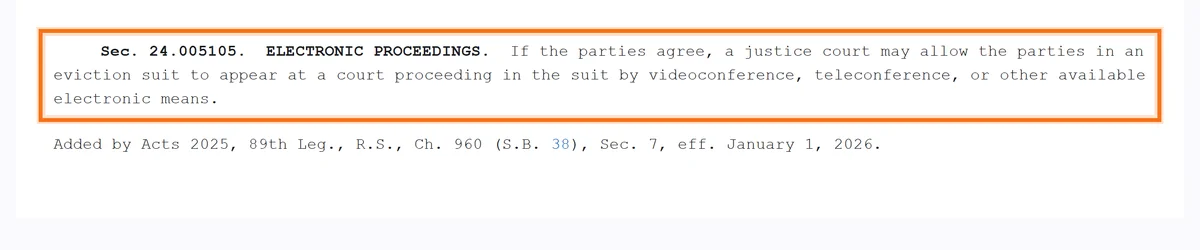
- Since January 1, 2026, Property Code 24.005105 lets a justice court allow appearance by videoconference or phone if the parties agree.
- A tenant cannot be evicted without a court case. Removing a tenant takes a judgment and a writ of possession carried out by a constable.
- Your part is authority, documents and being reachable.
Do you have to go to court for an eviction? Someone does, but it does not have to be you. Texas Property Code 24.011(a) lets an owner be represented in justice court by an authorized agent who need not be an attorney, so you can be in Keller, Houston or overseas on the hearing date while the case on your Fort Worth or North Richland Hills rental goes ahead. What you provide is authority and, occasionally, facts or a signature.
This guide explains who may appear for you at each stage, what you may still be asked for, the cases where your presence matters, what changes on appeal, and how an out-of-area owner stays informed.
Who has to appear at each stage of a Texas eviction
Here is each stage of an eviction on a single-family rental, who can act for the owner, and the Property Code section that says so:
| Stage | Does the owner have to be there? | Who can act for the owner | Source |
|---|---|---|---|
| Notice to vacate, or notice to pay rent or vacate | No. It is a written notice, not a hearing | The landlord or the landlord's manager | Property Code 24.005 |
| Filing the sworn petition | No | An authorized agent or an attorney; whoever signs swears to the facts | 24.00505, 24.011(a) |
| Trial in justice court | No, if an authorized agent or attorney appears | An authorized agent, who need not be an attorney | 24.011(a) |
| Appearing by video or phone | Possible, if both sides agree and the court allows it | The parties | 24.005105 |
| Writ of possession | No. A constable or sheriff carries it out | The landlord or the landlord's representatives may remove property under the officer's supervision | 24.0061 |
| Appeal to county court | Plan to be involved | An attorney. The agent rule covers only multifamily owners in nonpayment appeals | 24.011(b) |
How to read this table: the first five rows are a routine eviction, and none of them requires you in the room. The last row is where that changes, so ask at the start who would handle an appeal. Someone with authority must appear at trial, though: a landlord nobody shows up for should not expect to win.
Who appears in justice court: what Property Code 24.011 says
Texas eviction suits are heard in the justice court for the precinct where the home is located. Property Code 24.011(a) reads: in an eviction suit in justice court, the parties may represent themselves or be represented by their authorized agents, who need not be attorneys. The statute does not limit that to nonpayment cases or to individual owners, so a manager acting under a management agreement that grants the authority can appear for you.
There is a practical reason the agent is usually the better witness. In a nonpayment case the facts are the rent due, the rent paid, the notice given and the dates. The person who kept the ledger and delivered the notice can testify to them. You, in most cases, cannot. Property Code 24.00505 also requires the petition to be sworn, so the person who signs it must actually know the facts.
For how the whole process runs from notice to writ, see the Texas eviction process timeline. This is general information, not legal advice.
What you may still be asked to provide
Not attending is not the same as not being involved. A manager will usually ask you for a few things before filing, most of which take minutes.
- Authority in writing: the management agreement normally covers it, and you may be asked to sign a separate authorization naming the manager as your agent for the case.
- Confirmation of ownership, especially if the house is held in an LLC or trust, so the petition names the correct plaintiff.
- The original lease and any addenda, if the manager took over mid-lease and does not already hold them.
- Any communication you had directly with the tenant, because a text you sent promising to waive a late fee is evidence the manager needs to know about.
- A decision on cash for keys or a payment plan, if the manager recommends one.
- Availability by phone on the hearing date in case the judge or the manager needs a quick answer.
If the manager has been handling the house from the start, most of this is already in the file, and the request to you is a short confirmation. If you were self-managing until the manager took over, the manager will want everything above before filing so the case does not stall at the hearing.
When your presence matters, and what changes on appeal
There are a few situations where you should expect to be more involved, and a good manager tells you in advance, not the night before.
- You are the witness. If the case rests on something only you saw or agreed to, such as a conversation with the tenant or a repair you handled before hiring a manager, the court may need to hear it from you.
- The tenant contests the facts. A defense that turns on something you did may require you to explain it.
- The case is appealed. Either side can appeal within five days after the judgment is signed (Property Code 24.005107), and the county court holds a new trial.
The appeal is the real dividing line. Property Code 24.011(b) lets an authorized agent represent the owner in a county court appeal only when the owner has a multifamily residential property and the case is for nonpayment of rent. A single-family rental is outside that rule, so plan on an attorney, and ask that attorney whether you need to attend. That matters even more if the home is held in an LLC.
Being present does not always mean traveling. Since January 1, 2026, Property Code 24.005105 says that if the parties agree, a justice court may allow them to appear by videoconference, teleconference or other electronic means. It takes the tenant's agreement and the court's permission, so treat it as a possibility, not a right.
For when an attorney should be in the room, see whether a property manager can handle an eviction or you need a lawyer.
If you live out of state or overseas
Distance changes nothing about the hearing and a great deal about communication. An owner in another time zone needs to know the timeline before it starts, not as it unfolds: when the notice goes out, when the petition is filed, when the hearing is set, when the writ is requested. The manager should send each of those as it happens, and your statements should show the court costs.
Signatures are the practical issue. An authorization, a cash-for-keys agreement or a decision on a payment plan may need your signature on a deadline, and electronic signing solves that from anywhere. What an out-of-area owner should avoid is contacting the tenant directly to try to help, because a sympathetic text from the owner can undercut the manager's notice. Let the manager be the only voice. The broader approach to managing from a distance, including how to set up communication before anything goes wrong, is in the out-of-state owner guide.
What it looks like in practice
Say you own a house in Fort Worth and live in Denver. The tenant stops paying in a given month. The manager serves the notice in the second week and emails you the same day with the timeline and the expected court costs. You sign an authorization electronically that evening. The petition is filed, and the filing fee appears on your statement. The hearing is set; the manager tells you the date and asks you to keep your phone nearby that morning. The tenant does not appear, judgment is granted, and the manager emails you within the hour.
The five-day appeal window runs, the writ is requested, the constable posts the 24-hour warning required by Property Code 24.0061, and the manager sends you photos of the house the day possession returns, along with the make-ready estimate. You never left Denver and you knew where the case stood every day. That is what a managed eviction should look like from the owner's chair, and it is an illustration, not a description of any real case.
This is general information, not legal advice. Court practice varies by precinct and rules change, so confirm your situation with an attorney if you are unsure.
What to ask a manager about court appearances
Before you sign, ask whether the manager appears in justice court personally for routine evictions, how they will notify you at each stage, what they need from you before filing and under what circumstances they would ask you to attend. Ask whether they have a landlord-tenant attorney they refer contested cases to and how quickly that handoff happens.
A manager who has done this many times will answer in specifics and will not be surprised by anything the court asks for. Ask last who pays the court and constable fees; the amounts are in what an eviction costs in Tarrant County.
How Perpetual handles this
Perpetual Property Management is broker-owned, with our office at 5755 Rufe Snow Dr in North Richland Hills, and we manage homes in Keller, North Richland Hills, Fort Worth and nearby. When a tenancy fails, we attempt resolution first, deliver and document the notice Texas procedure requires, and keep the paper trail courts expect: ledger, lease, notices and communication history, organized and complete because our systems were building it all along.

We coordinate the legal process: filing logistics and, where appropriate, an attorney experienced in landlord-tenant law. We are not a law firm and do not pretend to be; we make sure the process runs and you are informed at every step. Who appears at the hearing for your home, and what we need from you first, is confirmed in writing before you sign.
Eviction service is included on our Full Service plan and is an optional $7.95 a month on the Standard and Investor Special plans. We also take over homes where an eviction is already needed: the first step is assessing the lease, the ledger and the notices already sent. See the evictions and problem tenants page and pricing.
If you want to know how an eviction on your rental would run without you in the room, call 682-593-7033.
The takeaway: In a Texas justice court eviction an authorized agent can appear for you under Property Code 24.011(a); your part is authority, documents and staying reachable, and an appeal is where an attorney comes in.
Questions owners ask
Can I attend the eviction hearing if I want to?
Yes. As the owner you are a party to the case and can attend any hearing. Many owners find it useful to watch once, and some prefer to be present if the tenant is likely to raise accusations. Tell the manager in advance so the two of you agree on who speaks, because the manager will have the records and the court will expect one clear presentation.
What if the house is owned by my LLC? Does someone from the LLC have to appear?
In justice court, no. Property Code 24.011(a) lets the parties to an eviction suit be represented by authorized agents who need not be attorneys, and it does not exclude an owner that is an LLC. On appeal to county court, the agent rule in 24.011(b) covers only multifamily owners in nonpayment cases, so an LLC that owns a single-family rental should have an attorney. Confirm with one; this is general information, not legal advice.
Will I have to testify against my tenant?
In a routine nonpayment case the testimony comes from the manager who served the notice and kept the ledger, not from you. You would only be needed as a witness for facts the manager did not observe, such as something you personally saw or agreed to with the tenant. A manager should tell you well before the hearing if that is the case.
Can the hearing be attended remotely?
Possibly. Since January 1, 2026, Property Code 24.005105 says a justice court may allow the parties in an eviction suit to appear by videoconference, teleconference or other electronic means if the parties agree. It depends on the tenant's agreement and on the court, so ask the court handling your case. When an authorized agent appears for you in person, you do not need to attend at all.
Can you get evicted without going to court in Texas?
No. A landlord cannot remove a tenant without a court case. A notice to vacate is only the first step; removal takes a judgment and a writ of possession carried out by a constable or sheriff under Property Code 24.0061. Property Code 92.0081 bars a landlord from keeping a tenant out except by judicial process, with narrow exceptions, and even after a lawful lock change the tenant must be given a new key. A tenant who skips the hearing risks a default judgment.
What happens if nobody goes to the eviction hearing?
If the tenant does not appear, the landlord can ask for a default judgment; Property Code 24.0051 requires the citation to warn the tenant of exactly that. If nobody appears for the landlord, there is no one to prove the case, so do not expect a judgment. Make sure you know, in writing, who is appearing for you on the trial date.
Do I have to go to court for an eviction if I manage the rental myself?
Yes, unless you send someone. Without a manager or attorney, you are the one who files the sworn petition and proves the case at trial, which the court must hold between the 10th and 21st day after filing under Property Code 24.0051. You may name an authorized agent under 24.011(a), or ask whether the court will allow a remote appearance.
Property management in Keller, North Richland Hills and Fort Worth. How full-service management works in Tarrant County →