Key takeaways
- Filing an eviction suit in a Tarrant County justice court costs $54, plus a $90 constable fee for each person served: $144 for one tenant (as of November 2026, confirm with the court).
- An eviction notice has no filing fee. The notice to vacate is a written notice from the landlord to the tenant, and nothing is filed with the court until the suit.
- A writ of possession, needed only if the tenant stays after judgment, is $5 at the court plus $180 for the constable, and $80 per deputy per hour after two hours.
- Under Property Code 24.006(d) the winning party recovers court costs, but a judgment is only a right to collect.
- Unpaid rent, the make-ready and the vacancy cost far more than the court fees.
How much are eviction fees in Tarrant County? Filing the eviction suit costs $54, and the constable charges $90 for each person served, so a case against one tenant on a rental in Fort Worth, Keller or North Richland Hills costs $144 to start. If the tenant stays after judgment, a writ of possession adds $185. The eviction notice that comes first has no filing fee at all. These are the county's published amounts as of November 2026; confirm them with the court before you file.
This guide lists every fee from the county's own schedules, explains what Texas law lets you recover, and shows with an illustrative example why the rent that never arrives costs more than every court fee combined.
Tarrant County eviction fees at a glance
Here is each fee an eviction can involve in a Tarrant County justice court, as published by the county and read in November 2026:
| Step | Fee | Paid to | When it applies |
|---|---|---|---|
| Notice to vacate, or notice to pay rent or vacate | No filing fee | Nobody: the landlord gives it to the tenant | Always, before any suit (Property Code 24.005) |
| Filing the eviction suit | $54 | Justice court for the precinct where the home is | When the tenant has not paid or left after the notice |
| Citation for eviction (service on the tenant) | $90 for each person served | Constable | With the filing; two tenants named means two fees |
| Writ of possession | $5 court fee plus $180 constable fee | Justice court and constable | Only if the tenant stays after judgment |
| Extra constable time on the writ | $80 per deputy per hour, after two hours | Constable | Only if carrying out the writ takes longer than two hours |
| Jury, if either side asks for one | $22 | Justice court | Rare in a nonpayment case |
How to read this table: a routine case against one tenant costs $144 to file and serve, and $329 in total if a writ is needed. Fees can change and other charges can apply, so confirm the current amounts with the court before filing. The first row answers the most common question: the notice itself is free to give.
The eviction fee: what the court and the constable charge
An eviction suit must be filed in the justice precinct where the home is located (Property Code 24.0041). Tarrant County has eight justice courts, and the county warns that a case filed in the wrong precinct will be dismissed, so check the address with the county's precinct lookup first. The Precinct 1 court in downtown Fort Worth and the Precinct 3 court in Hurst and Southlake both publish the same two amounts on their eviction pages: a $54 filing fee and a $90 constable fee for each person being served.
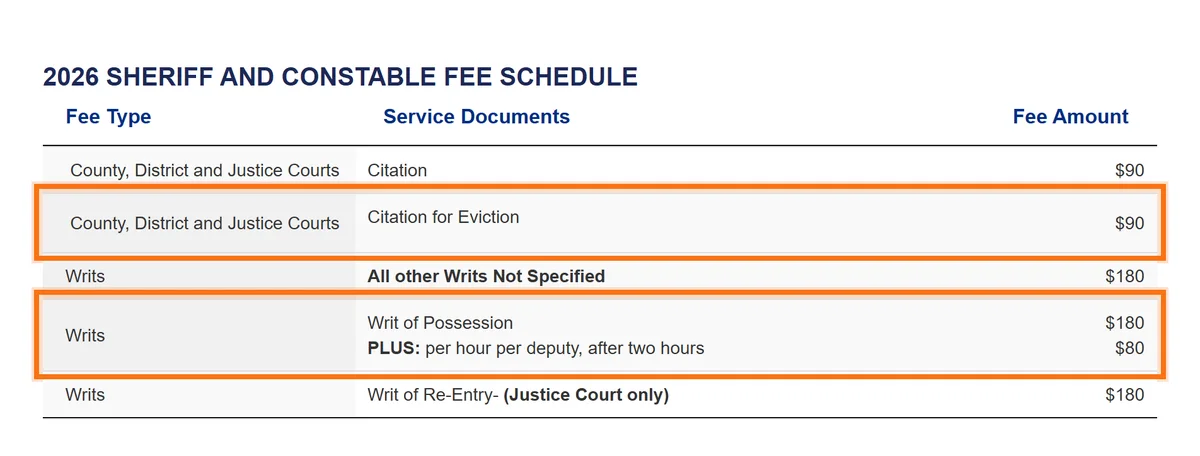
The $90 comes from the county's 2026 sheriff and constable fee schedule, which lists "Citation for Eviction" at $90. The same schedule lists a writ of possession at $180, plus $80 per deputy per hour after two hours. The justice court filing fee schedule adds $5 for the court to issue the writ, and lists $2 for electronic filing and $22 for a jury.
How much is an eviction notice? Nothing, as far as the court is concerned. The notice to vacate is a written notice you or your manager give the tenant before any suit. Property Code 24.005 allows delivery by mail, by hand to a tenant who is 16 or older, by leaving it inside the home in a conspicuous place, or by e-mail if you and the tenant agreed to that in writing. No county office is paid. Your only cost is postage, or whatever your manager or attorney charges to prepare it.
If you win, Property Code 24.006(d) says the prevailing party is entitled to recover all costs of court. How these costs are split between owner and manager is covered in eviction costs: what an owner pays and what a manager covers.
Attorney's fees: when they apply and when you can recover them
Many evictions involve no attorney at all. Property Code 24.011(a) lets the parties to an eviction suit in justice court represent themselves or be represented by authorized agents who need not be attorneys. An attorney usually enters when the tenant raises a real defense or appeals to county court. On appeal, 24.011(b) extends the agent rule only to owners of multifamily property in nonpayment cases, so the owner of a single-family rental should expect to need counsel there.
We do not quote attorney rates, because they vary by attorney and by how far the case goes. Ask for the fee in writing before you engage one. What the statute does set out is when you can get the fee back. Under Property Code 24.006, a landlord who wins is entitled to reasonable attorney's fees from the tenant if either:
- the written lease entitles the landlord to recover attorney's fees, or
- the landlord sent a written demand to vacate by registered or certified mail, return receipt requested, at least 10 days before filing, stating that fees may be recovered if the tenant does not leave before the 11th day after receiving it.
The same section cuts the other way: where the lease or that demand puts fees in play, a tenant who wins is entitled to recover fees from you. And a fee award is only a judgment. Plan on the fee as a cost and treat any recovery as a bonus. More on the decision is in whether a property manager can handle an eviction or you need a lawyer.
Lost rent: the cost that outweighs every fee
From the first missed payment until the constable carries out the writ, you carry the mortgage, taxes and insurance on a house that produces nothing. Texas law changed on January 1, 2026, and Chapter 24 of the Property Code now sets the clock:
- Notice: at least three days' written notice before filing, unless the lease sets a shorter or longer period (24.005). A tenant who was not late before that month must get a notice to pay rent or vacate.
- Service: the constable must make a diligent effort to serve the citation within five business days of filing (24.0051).
- Trial: not earlier than the 10th day or later than the 21st day after filing, and a postponement of more than seven days needs both sides' written agreement (24.0051).
- Appeal: either side has five days after the judgment is signed (24.005107).
- Writ: not issued before the sixth day after judgment, served within five business days, and carried out no sooner than 24 hours after the warning is posted (24.0061).
Add those up and an uncontested case can run roughly three to seven weeks from the notice to possession. That is our arithmetic from the statute's deadlines, not a promise from any court, and it comes after whatever time passed before the notice went out. An appeal adds a new trial in county court, though Property Code 24.0053 requires the tenant to pay rent into the court registry while it is pending.
This is why the date of the first notice matters more than any fee. The step-by-step version is in the Texas eviction process timeline.
Turnover, damage and the deposit that does not cover it
A tenant who leaves under an eviction rarely leaves the house clean. Expect, at minimum, the usual make-ready: cleaning, paint touch-up, carpet cleaning or replacement, rekeying the locks, lawn recovery. Sometimes there is more: belongings left behind, holes in walls, missing appliances, a garage full of trash. The security deposit goes toward what the tenant owes under the lease, and in a nonpayment case the unpaid rent often uses it up.
- Make-ready and repairs beyond normal wear, billed at vendor cost.
- Rekeying and any changed garage codes or smart locks.
- Removal of belongings left behind, following the lease and Texas law.
- The vacancy between possession and the next tenant's move-in.
- Leasing costs for the new tenant, which arrive sooner than planned.
Whatever the deposit does not cover becomes a judgment against the former tenant, which can be pursued but is slow and uncertain. How that recovery works is covered in recovering damage or unpaid rent beyond the deposit in Texas.
An illustrative total for a $2,000 rental
Here is an illustrative example, not a quote and not a prediction for your house. Rent is $2,000 a month, one tenant is on the lease, the case is uncontested, and the home is back in your hands a month and a half after the first missed payment:
- Filing and constable service: $144.
- Writ of possession: $185.
- Unpaid rent, a month and a half: $3,000.
- Half a month vacant while the home is made ready and re-leased: $1,000.
- Tenant placement at 50% of one month's rent, our Full Service rate: $1,000 (75%, or $1,500, on our Standard plan).
That is $5,329 before the make-ready, which is whatever the vendor invoices come to, and before any deposit is applied. The two court lines are $329, about 6% of the total. The security deposit reduces the loss, and in a nonpayment case the unpaid rent often uses it up.
Now change one input. If the notice goes out two weeks earlier, the unpaid rent line falls by about $1,000, three times the court fees. If the ledger and notices are clean, there is less for the tenant to contest. If the home was inspected during the lease, the make-ready is not a surprise. Those are management habits, which is why the cost of an eviction depends more on who is managing the house than on which precinct hears the case.
This is general information, not legal advice. Court fees and procedures change, so confirm current figures with the justice court or an attorney.
How a manager keeps the total down
The cheapest eviction is the one that never gets filed, and the second cheapest is the one filed early. Screening that verifies income and calls the prior landlord removes most of the tenants who would have ended up here. A late-rent process that starts right after the due date and gives notice on schedule shortens the lost-rent line. A clean file leaves the tenant less to contest.
Ask a prospective manager what their late-rent timeline is, what the management agreement says about eviction costs, and whether they handle routine cases in justice court themselves. Our tenant screening and rent collection pages describe the two habits that keep most owners out of court.
How Perpetual handles this
Perpetual Property Management is broker-owned, with our office at 5755 Rufe Snow Dr in North Richland Hills, and we manage homes in Keller, North Richland Hills, Fort Worth and nearby. The goal of our screening, consistent collection and early communication is to make an eviction something you never need. Rent follows a documented late process, and when a tenancy is in trouble we attempt resolution first, because a documented payment conversation resolves many situations faster and cheaper than court.
When it cannot be avoided, we deliver and document the notice Texas procedure requires, keep the ledger, lease, notices and communication history organized, and coordinate the filing logistics and, where appropriate, an attorney experienced in landlord-tenant law. We are not a law firm. After possession the home goes straight into turnover and re-leasing.
Eviction service is included on our Full Service plan and is an optional $7.95 a month on the Standard and Investor Special plans. Exactly what the service covers on your home, including how court and constable fees are handled, is confirmed in writing before you sign. If a tenant we placed defaults and is removed within the first 6 months, we find a new tenant with no additional leasing fee, subject to the Guarantee Addendum. The details are on the evictions and problem tenants and pricing pages.
If you have a tenant who has stopped paying and want to know what the next step costs, call 682-593-7033.
The takeaway: In Tarrant County the court side of an eviction is $144 to file and serve one tenant and $185 for a writ; the notice has no filing fee, and the unpaid rent, make-ready and vacancy are the real cost.
Questions owners ask
Can I recover eviction costs from the tenant in Texas?
Partly. Under Property Code 24.006(d) the prevailing party is entitled to recover all costs of court, and under 24.0051 the eviction suit can include a claim for unpaid rent. Attorney's fees are recoverable if the lease provides for them or the written demand in 24.006(a) was sent. All of that is a judgment you can pursue, and a tenant who could not pay rent may not pay a judgment quickly. This is general information, not legal advice.
Does landlord insurance cover lost rent during an eviction?
Do not assume so. Whether any policy pays for rent a tenant simply does not pay depends on the policy wording, and we cannot tell you what yours covers. Ask your insurance agent in writing whether rent default or eviction costs are covered and what is excluded. This is general information, not insurance advice.
Is cash for keys cheaper than an eviction?
Often, yes. Paying a tenant a modest sum to leave by an agreed date with the house broom-clean can cost less than the lost rent and turnover of a full eviction, and it avoids the uncertainty of a hearing. It only works with a tenant who will actually honor the agreement, and it should be in writing with a signed move-out date. Your manager can advise whether it fits the situation.
Who pays the eviction court fees, the owner or the property manager?
The owner, in most management agreements, because the filing fee, the constable fee and any writ fee are costs of the owner's case. What differs between managers is the charge for their own work: some include it, some bill per case, some sell an eviction service. Ours is included on Full Service and $7.95 a month on the other plans. Read the agreement and get every eviction-related charge in writing.
How much is an eviction notice in Texas?
The notice itself has no filing fee. A notice to vacate, or a notice to pay rent or vacate, is a written notice the landlord gives the tenant under Property Code 24.005, and nothing is filed with the court at that stage. The cost is postage if you mail it, or what your manager or attorney charges to prepare it. Court fees start only when the eviction suit is filed.
How much is it to file an eviction in Tarrant County?
As of November 2026 the Tarrant County justice courts list a $54 filing fee plus a $90 constable fee for each person being served, so $144 for one tenant and $234 for two. A writ of possession, if needed later, is $5 at the court plus $180 for the constable. Confirm the current amounts with the court for your precinct before filing.
What does it cost if the tenant appeals the eviction?
The party who appeals pays the appeal costs. Tarrant County's Precinct 1 court lists a $64 justice court appeal fee and a $350 county court at law filing fee, or the tenant may file a statement of inability to afford court costs. Property Code 24.0053 requires the tenant to pay rent into the court registry during the appeal. Your added costs are time and, usually, an attorney.
Related services
Property management in Keller, North Richland Hills and Fort Worth. How full-service management works in Tarrant County →