Key takeaways
- A property manager can file an eviction and represent you in a Texas justice court: Property Code 24.011(a) allows authorized agents who are not attorneys.
- On appeal to county court, the agent exception covers only owners of multifamily property in nonpayment cases.
- A single-family owner on appeal appears in person or hires an attorney; an LLC owner should plan on an attorney.
- A written answer, a lawyer's letter or a bankruptcy notice from the tenant is the signal to bring in counsel.
- Our Full Service plan includes eviction service; the Investor Special and Standard plans offer it for $7.95 a month.
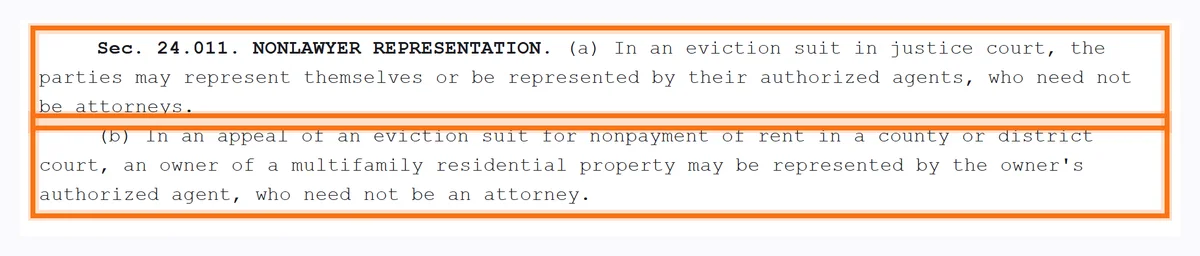
Can a property manager file an eviction in Texas, or do you need a lawyer? For most routine cases, the manager can do it. Texas Property Code Section 24.011(a) says that in an eviction suit in justice court, the parties may represent themselves or be represented by their authorized agents, who need not be attorneys. That is why property managers across Tarrant County, in Fort Worth, Keller and North Richland Hills, file and argue nonpayment cases every week without a lawyer present. A lawyer is needed when the case stops being routine: an appeal, a tenant with an attorney or a real defense, a bankruptcy.
This guide explains what a manager can do, where the line sits, and how a good manager knows when to stop and call counsel rather than learn the hard way at your expense.
What Texas allows a property manager to do
Eviction suits in Texas are filed in the justice court for the precinct where the property sits, and Texas Property Code Section 24.011(a) permits a party to an eviction suit in justice court to be represented by an authorized agent who need not be an attorney. Since a 2025 amendment that took effect January 1, 2026, that rule covers any eviction suit in justice court, not only nonpayment and holdover cases. That is why property managers across Tarrant County appear at eviction hearings every week without an attorney present. The manager acts for you under the authority of the management agreement, which should say in plain terms that the manager may serve notices and file and prosecute eviction suits on your behalf.
In practice the manager handles the whole routine sequence: the written notice to vacate delivered the way Texas law and the lease require, the petition filed with the court, the filing and service fees paid, the hearing attended with the lease, the ledger and the notice as evidence, and the writ of possession requested if the tenant stays past the judgment. For a case where the tenant simply has not paid and does not contest it, there is nothing in that sequence that requires a law license. The full step-by-step is in the Texas eviction process timeline.
When a lawyer becomes necessary
The line is crossed when the case becomes contested or leaves justice court. A good manager recognizes the signs early and tells you before the hearing, not after.
- The tenant appeals. An appeal moves the case to county court. There, Section 24.011(b) lets an authorized agent appear only for an owner of multifamily residential property in an appeal of a nonpayment case. A single-family owner appears in person or through an attorney, and an owner that is an LLC or other entity should plan on an attorney.
- The tenant has a lawyer, or files a written answer raising defenses such as retaliation, improper notice, repair issues or discrimination.
- The tenant files for bankruptcy, which can pause the eviction under federal law until the court lifts the stay.
- The eviction is for something other than nonpayment, such as a lease violation the tenant disputes or a holdover with a complicated lease history.
- There is a question about whether the lease, the notice or the ledger will hold up, for example a notice served to the wrong address or rent accepted after the notice.
- Any situation involving a federally backed mortgage or subsidized tenancy, where additional notice rules may apply.
In each of those cases, an attorney costs less than losing the case and starting over. A manager who presses on alone through a contested hearing is saving you a fee by risking a dismissal, which costs weeks of rent.
Who can appear for you at each stage of a Texas eviction
The Property Code draws the line by court and by type of property. For a house in Tarrant County, it works out like this:
| Stage or situation | Can the property manager appear for you? | What it means for you |
|---|---|---|
| Notice to vacate (Property Code 24.005) | Yes, the manager prepares and delivers it as your agent | At least three days' written notice unless the lease sets a different period; a nonpayment case uses a notice to pay rent or vacate in some cases |
| Eviction suit in justice court | Yes, under 24.011(a), for any eviction suit | The manager files the petition, appears with the lease, ledger and notice, and requests the writ |
| Tenant files an answer or raises a defense | Legally yes, in justice court | We bring in a landlord-tenant attorney before the hearing, because a lost case costs more than the fee |
| Appeal of a nonpayment case, multifamily property | Yes, under 24.011(b) | An apartment or multifamily owner can keep the manager as agent in county court |
| Appeal of a single-family or duplex case | No | You appear in person or hire an attorney; an LLC owner should plan on an attorney |
| Tenant files bankruptcy | No, stop and call counsel | The bankruptcy stay can pause the eviction until the court lifts it |
How to read this table: the first two rows are a routine eviction, and a manager can handle all of it. Every row below that is a reason the case may leave the manager's hands, and most single-family owners in Fort Worth, Keller and North Richland Hills only meet the bottom rows if a tenant appeals or files bankruptcy. The question to ask any manager is not whether they can file, but how fast they hand off when one of those rows applies.
How a good manager decides which one you have
The decision is made at two points. The first is before filing, when the manager reviews the file: was the notice served correctly and on time, is the ledger clean and consistent with the lease, has any rent been accepted since the notice, is there any pending repair request or complaint the tenant could raise. If anything is uncertain, the manager fixes it or asks counsel before filing rather than filing and hoping.
The second is after service, when the tenant's response arrives. No response and no appearance is routine. A written answer, a lawyer's letter, a bankruptcy notice or a counterclaim is the signal to hand the case to an attorney. The manager stays involved, because the manager holds the records and knows the history, but the attorney runs the hearing. A manager who has a relationship with a landlord-tenant attorney can make that handoff in a day, which matters when hearing dates are already set. For when an attorney is the right call beyond evictions, see when you need a landlord attorney rather than just a property manager.
What you pay for in each case
In a routine case, the costs are the court's filing fee, the fee for the constable to serve the tenant, the fee for a writ of possession if one is needed and whatever the management agreement says about the manager's time for the process. Those amounts are published by the court and listed in the agreement, and a good manager tells you the expected total before filing. The larger cost is always the rent you do not collect while it runs, which is why speed matters more than the fees.
In a contested or appealed case, add the attorney's fees, and possibly a longer timeline. Some leases allow the owner to recover attorney's fees from the tenant if the owner wins, which helps on paper but depends on actually collecting from someone who could not pay rent. What a manager should never do is charge you for an attorney you did not need, or avoid one you did. What each party pays, and which costs a manager typically covers, is set out in eviction costs: what an owner pays and what a manager covers.
Two cases, two answers
Take, as an illustration, a house in North Richland Hills renting for $2,000. In the first case, the tenant stops paying, does not respond to the reminder or the call, and the notice to vacate is served properly in the second week. The petition is filed, the tenant is served, and the hearing comes around with no answer filed. The manager appears with the lease, the ledger and the notice, judgment is granted, and the tenant moves out within the appeal period. No lawyer was needed, and the manager's familiarity with the court kept the case moving.
In the second case, the same tenant files an answer claiming the heat was broken and rent was withheld. Now there is a repair defense, a question of whether the manager's maintenance records show the request and the response, and the real chance of an appeal. The manager hands the hearing to an attorney, supplies the maintenance log and the communications, and you pay a legal fee to protect a case that would otherwise have been lost on a technicality. Both decisions were right. The skill is knowing which case you are in.
This is general information, not legal advice. Court rules and procedures change, and your situation should be confirmed with an attorney.
What to ask a manager before you sign
Ask whether the manager handles routine evictions in justice court themselves, how many they have taken through to a writ, and which attorney they refer contested cases to. Ask what the management agreement authorizes them to do without calling you, and what triggers a call. Ask how they track the file so that if a case is handed to an attorney, nothing has to be reconstructed.
A manager who answers those with specifics has done this before. A manager who says evictions are rare and they would figure it out is describing your money as the tuition. The eviction service page sets out how Perpetual runs the process, and the rent collection service page covers the schedule that keeps most cases from ever reaching a courtroom.
How Perpetual handles this
At Perpetual Property Management, broker-owned and local to Keller, North Richland Hills and Fort Worth, routine nonpayment evictions are handled by the company as your authorized agent in the Tarrant County justice courts, from the notice to vacate through the hearing and the writ, under a Texas-compliant lease and a file that is kept ready for court from the first late day. The management agreement states in writing what we are authorized to do and when you are consulted.
When a case becomes contested, is appealed or raises a defense, we tell you before the hearing and bring in a landlord-tenant attorney, supplying the lease, ledger, notices and maintenance records so nothing is rebuilt from memory. You see every court cost on your monthly statement and in the owner portal, and every fee related to the process is listed in your written quote before you sign. If you have an eviction question right now, reach out and we will tell you which kind of case you have.
What it costs is on our price sheet: eviction service is included in the Full Service plan, and the Investor Special and Standard plans offer it as an optional service for $7.95 a month. Court filing and service fees are set by the court and appear on your statement as their own lines.

The takeaway: A property manager can run a routine Texas eviction in justice court; the value is in a manager who knows the moment a case stops being routine and hands it to counsel before it costs you the hearing.
Questions owners ask
Can a property manager represent an LLC in a Texas eviction case?
In justice court, yes: Texas Property Code Section 24.011(a) lets any party to an eviction suit be represented by an authorized agent who need not be an attorney, and that includes an owner that is an LLC. On appeal to county court, the agent exception covers only owners of multifamily residential property in nonpayment cases, so an LLC that owns a single-family rental should plan on an attorney if the tenant appeals. This is general information, not legal advice.
How does the court know the manager is authorized to act for me?
The management agreement is the authority, and the manager typically brings it or a signed authorization to the hearing along with the lease. Some justice courts have their own form for an authorized agent. A good manager knows the practice of the specific court and has the paperwork ready before the filing date rather than at the hearing.
What happens if the manager makes a procedural mistake in the eviction?
Usually the case is dismissed and must be refiled after the error is corrected, which means a new notice, a new filing fee and several more weeks of unpaid rent. That is why a careful manager reviews the notice, the ledger and the lease before filing and uses an attorney when anything is doubtful. Ask a prospective manager how they check a file before filing.
Can a property manager represent a landlord in court in Texas?
In justice court, yes. Property Code Section 24.011(a) allows the parties to an eviction suit to be represented by authorized agents who need not be attorneys, and the management agreement is the manager's authority. In county or district court on appeal, a non-attorney agent may appear only for an owner of multifamily residential property in a nonpayment case. Other lawsuits, such as a suit for damages beyond what justice court handles, need the owner or an attorney.
Does Perpetual charge extra to handle an eviction?
Eviction service is included in our Full Service plan. On the Investor Special and Standard plans it is an optional service at $7.95 a month, listed on the price sheet. Court filing fees, constable service fees and any writ fee are charged by the court and shown on your statement, and if a case needs an attorney, we tell you before the hearing.
Related services
Property management in Keller, North Richland Hills and Fort Worth. How full-service management works in Tarrant County →