
Key takeaways
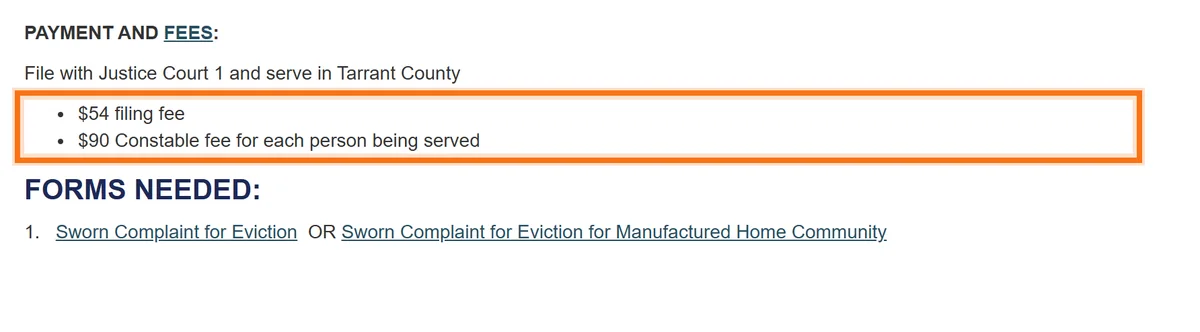
- In Tarrant County Justice Court Precinct 1, filing an eviction costs $54 plus $90 for each person served: $144 for one tenant.
- A writ of possession, if the tenant does not leave after judgment, adds $185 ($5 court plus $180 constable).
- The owner pays legal fees first; a winning landlord recovers reasonable attorney's fees only if the lease allows it or a 10-day written demand was sent (Property Code 24.006).
- Lost rent, make-ready and re-leasing usually cost many times the court fees.
- Our eviction service is $7.95 a month on the Standard and Investor Special plans and included on Full Service.
Who pays for an eviction in Texas? The owner does, at least at first. In Tarrant County Justice Court Precinct 1 the filing fee is $54 plus a $90 constable fee for each person served, and a writ of possession adds $185 if the tenant stays after judgment. Legal fees are the owner's too, though Property Code Section 24.006 lets a winning landlord recover them in some cases. For owners in Fort Worth, Keller and North Richland Hills, the court costs are the smallest part of the bill.
The real cost is the rent that never arrives, the weeks the home sits empty and the make-ready an evicted tenant tends to leave behind. This guide lists every cost, who normally pays it, what can be recovered, and how management fee structures handle evictions.
The full list of eviction costs
Owners tend to count the filing fee and stop. The complete list is longer, and the order below runs roughly from smallest to largest:
- Court filing fee in Justice Court, set by the county.
- Constable or sheriff fee to serve the citation and, later, to execute the writ of possession.
- Attorney fees, if an attorney is used, which is more likely in a contested case or an appeal.
- The manager's eviction handling fee, where one is charged.
- Rent unpaid before the filing and during the process.
- Rent lost after possession while the home is turned and re-leased.
- Make-ready beyond normal wear, which an evicted tenant rarely pays for.
- Trash-out and, occasionally, dealing with abandoned belongings.
- A leasing fee for the replacement tenant.
- Utilities while vacant and any rekeying.
The process itself, from notice to vacate through the writ, is explained in the Texas eviction process timeline. This guide stays on the money.
Tarrant County eviction fees and who pays them
Here are the court and constable fees for an eviction filed in Tarrant County Justice Court Precinct 1, from the court's 2026 fee schedule, with who pays each one and whether it can be recovered:
| Cost | Amount | Who pays first | Can it be recovered? |
|---|---|---|---|
| Eviction filing fee | $54 | Owner (manager pays from your reserve with the receipt) | Court costs go to the winning party (24.006(d)) |
| Constable service of the citation | $90 per person served | Owner | Court costs go to the winning party |
| Writ of possession, if needed | $185 ($5 court, $180 constable) | Owner | Court costs go to the winning party |
| Attorney, if used | Set by the attorney | Owner | Only if the lease allows it or a 10-day demand was sent (24.006(a), (b)) |
| Manager's eviction handling | By agreement | Owner | Usually not |
| Lost rent, make-ready, re-leasing | Often several months of rent | Owner | Unpaid rent can be in the judgment; collecting it is separate |
How to read this table: the first three rows are fixed by the county and are small; the last row is the one that decides what an eviction really costs. Fees differ by precinct and change by date, so check the court where your home is before filing. "Recoverable" means you have a right to collect, not that the tenant will pay.
Court costs and the constable: the owner pays, then may recover
Filing and service fees are set by the county and are paid when the case is filed. They are a pass-through: the manager pays them from your reserve or bills you, and they appear on your statement as a line item with the court receipt behind it. A manager should never mark these up.
If the court rules in your favor, the judgment usually includes court costs along with unpaid rent. That is a right to collect, not a payment. Many tenants who are evicted for nonpayment do not have the money, and collecting on a judgment is a separate effort with its own cost. Plan as if the court costs are yours, and treat anything recovered as a bonus.
The writ of possession, which is the step where a constable removes a tenant who has not left after the judgment, carries its own fee. Most tenants leave before it is needed, but budget for it, because the cases that reach the writ are the ones that have already cost the most in lost rent.
The writ has its own timeline under Property Code 24.0061: it may not issue before the sixth day after the judgment unless a possession bond is approved, and the sheriff or constable must serve it no later than the fifth business day after it is issued.
When an attorney is needed and who pays
Texas Property Code Section 24.011 lets the parties to an eviction suit in justice court be represented by authorized agents who need not be attorneys, which is why many managers handle straightforward nonpayment evictions without a lawyer. An attorney becomes worthwhile when the tenant has a lawyer, raises a defense, files an appeal, is in bankruptcy, or when the eviction is for a lease violation other than nonpayment and the facts are messy.
Who pays legal fees for an eviction? The owner pays them first. Under Section 24.006, a landlord who wins can recover reasonable attorney's fees from the tenant if a written lease entitles the landlord to them, or if the landlord sent a written demand to vacate by registered or certified mail at least 10 days before filing. The same section lets a winning tenant recover attorney's fees in those cases, and the winning party recovers all court costs. Collecting any of it is a separate effort.
Lost rent and turnover: the cost that dwarfs the rest
Here is an illustrative example, with rounded numbers chosen to show the shape of the cost rather than to predict yours. Rent is $2,000 a month, the tenant stops paying in month one, and the home is back in your hands about six weeks after the first missed payment:
| Cost line | Illustrative amount | Note |
|---|---|---|
| Rent not paid before and during the case | $3,000 | About six weeks at $2,000 a month |
| Filing and constable service, one tenant | $144 | Tarrant County Precinct 1 fees |
| Writ of possession, if needed | $185 | Only if the tenant stays after judgment |
| Make-ready heavier than a normal move-out | $2,500 | Example figure |
| Rent lost while re-leasing | $1,500 | About three weeks |
| Tenant placement on our Standard plan | $1,500 | 75% of one month's rent |
| Total before any attorney or deposit offset | About $8,800 | The deposit usually goes to unpaid rent first |
How to read this table: the two court rows add up to $329, under 4% of the total. Everything else depends on speed and on the next tenant. The turnover side of this is broken down in rental turnover cost and timeline.
What the security deposit covers and what it does not
The deposit is applied after move-out to unpaid rent, damage beyond normal wear and other amounts the lease allows, and under Texas law the owner has to account for it in writing within the statutory window. In an eviction the deposit is almost always exhausted by unpaid rent alone, which leaves the damage and the vacancy uncovered.
Owners sometimes ask whether a larger deposit solves this. It helps at the margin, but a deposit large enough to cover a full eviction would price out the good applicants you want. The better protection is at the front: screening that verifies income and rental history, and a manager who acts on the first missed payment instead of the third. How that works is in how tenant screening works.
The manager's eviction fee and what it should cover
Managers handle evictions in one of three ways, and the agreement should say which. Whether the monthly fee covers any of it is answered in are eviction costs included in property management fees. The first is a flat eviction fee per case that covers preparing and delivering the notice to vacate, filing, attending the hearing and coordinating the writ. The second is hourly or per-appearance billing. The third is including eviction handling in the monthly fee, sometimes with an eviction protection program attached.
A flat fee is fair when the work is real: someone on the manager's staff drafts and serves the notice correctly, files with the right exhibits, shows up in court with the ledger and the lease, and follows through on the writ. That is several hours of skilled time and a mistake at any step restarts the clock. What a flat fee should not do is stack: a notice fee plus a filing fee plus a court appearance fee plus a coordination fee is one eviction billed four times.
Ask whether the manager's fee is charged if the tenant pays up after the notice and the case is dropped. Many managers charge a reduced amount or nothing in that case, and it is worth knowing. Our approach, including what we handle in-house, is on the evictions page.
How the monthly fee itself behaves during an eviction
The eviction fee is the visible charge. The quieter question is what happens to the regular management fee while no rent is coming in, and the answer depends on the structure. A manager paid a percentage of rent collected earns nothing during the months the tenant does not pay. That is uncomfortable for the manager and useful for you, because it puts the manager's income on the same side as yours: get the nonpaying tenant out and a paying one in.
A manager paid a flat monthly fee, or a percentage of rent due rather than collected, keeps billing through the eviction. That is not wrong, and the agreement will say so, but it means the manager's income does not change with the speed of the process. If you are on a flat structure, the eviction fee and the manager's track record on timelines carry more weight, because the monthly fee is not doing any aligning for you.
Read the agreement for the phrase that defines the base: collected, due or scheduled. Then read the eviction clause next to it. Together they tell you who feels a slow eviction.
Eviction protection and guarantees: read the trigger
Some managers offer a program, for a monthly charge or as part of the fee, that covers some eviction costs for a tenant the manager placed. These are worth having when the terms are clear, and the terms are where to look. Three questions tell you what the program is worth:
- Which costs are covered: the manager's fee only, court costs, attorney fees, lost rent, or some combination?
- Is there a cap per case or per year?
- Does it apply only to tenants the manager screened and placed, and does it lapse if you override a screening decision?
That last condition is reasonable. A manager who guarantees its own screening is putting money behind its process; a manager who guarantees a tenant you insisted on is not going to. Where a program is offered, it should be in writing with the trigger, the cap and the exclusions spelled out, the same way everything else in the agreement is. What we put in writing is on the guarantees page.
Ours, in writing: if a tenant we place defaults and is removed, or breaks the lease, within the first 6 months, we find you a new tenant with no additional leasing fee. That guarantee covers the leasing fee row in the example above, not the court costs or lost rent.

Where the cost of an eviction is actually controlled
Nothing about the court fee schedule is in your control. Three things are. The first is speed: a manager who sends the notice to vacate the day the lease allows, and files the day the notice period ends, shortens the lost-rent window by weeks compared to one who waits to see whether the tenant pays. Every week of delay at $2,000 rent is roughly $500.
The second is accuracy. A notice with the wrong date, the wrong delivery method or the wrong amount gets a case dismissed and restarted. The manager's experience in Justice Court is worth more than its fee here.
The third is the next tenant. The fastest way to recover from an eviction is to lease the home quickly to someone who will pay, which depends on an efficient turnover and a screening standard that does not bend. A manager who treats the eviction, the make-ready and the re-lease as one project rather than three departments gets you back to income sooner.
This is general information, not legal advice. Eviction law has specific notice and procedure requirements; confirm your situation with the lease and an attorney.
The takeaway: Budget for an eviction as months of lost rent plus a turnover, not as a court fee, and choose a manager whose speed and accuracy shorten that window.
Questions owners ask
Who pays for an eviction, the landlord or the property manager?
The owner pays the court filing fee, constable fees, attorney fees if any, lost rent and the turnover; in Tarrant County Justice Court Precinct 1 filing and service for one tenant cost $144. The manager provides the labor of notices, filing and the hearing, either for a fee, as part of the monthly fee or through an eviction service. On our plans eviction service is $7.95 a month or included on Full Service.
Can I recover eviction costs from the tenant in Texas?
A judgment in your favor typically includes unpaid rent and court costs, and a lease can make attorney fees recoverable. That is a right to collect, not a payment. The security deposit is applied first; beyond that, collecting on a judgment is a separate effort with uncertain results.
Do I need a lawyer to evict a tenant in Texas?
Not always. Owners and their authorized agents can generally handle a straightforward nonpayment case in Justice Court. An attorney is worth it when the tenant is represented, raises a defense, appeals, or when the eviction is for something other than nonpayment. Confirm with an attorney for your situation.
What is the biggest cost of an eviction?
Lost rent and the turnover, not the court. Unpaid rent before and during the case, a heavier-than-normal make-ready and the vacancy while re-leasing usually add up to several months of rent, while filing and constable fees are a few hundred dollars.
Is a property manager's eviction fee worth it?
A flat fee that covers correct notices, filing, the hearing and the writ is usually worth it, because a procedural mistake restarts the clock and costs more in rent than the fee. What to avoid is one eviction billed as several separate fees.
Are eviction costs included in property management fees?
Usually only the manager's labor, and the agreement should say how. Managers handle evictions for a flat fee per case, by hourly or per-appearance billing, or as part of the monthly fee, sometimes with an eviction protection program attached. Court filing fees, constable fees and any attorney cost are passed through to the owner, and lost rent and the turnover are the owner's as well. Read the eviction clause next to the fee schedule, and ask whether the fee is charged if the tenant pays after the notice and the case is dropped. Perpetual lists every fee in writing before you sign, including what we handle in-house.
How much could an eviction cost a landlord in Tarrant County?
In Tarrant County Justice Court Precinct 1, the filing fee is $54 plus $90 for each person served, so $144 for one tenant, and a writ of possession adds $185 if needed. Those are the smallest part of the bill. Rent unpaid before and during the case, a heavier make-ready, the vacancy while re-leasing and a leasing fee for the next tenant routinely add up to several months of rent; in our $2,000 example, about $8,800.
Who pays legal fees for an eviction in Texas?
The landlord pays them first. Under Texas Property Code 24.006, a landlord who wins can recover reasonable attorney's fees from the tenant if a written lease entitles the landlord to them or if a written demand to vacate was sent by registered or certified mail at least 10 days before filing. A winning tenant can recover attorney's fees in the same situations, and the winning party recovers all court costs.
Related services
Property management in Keller, North Richland Hills and Fort Worth. How full-service management works in Tarrant County →