Key takeaways
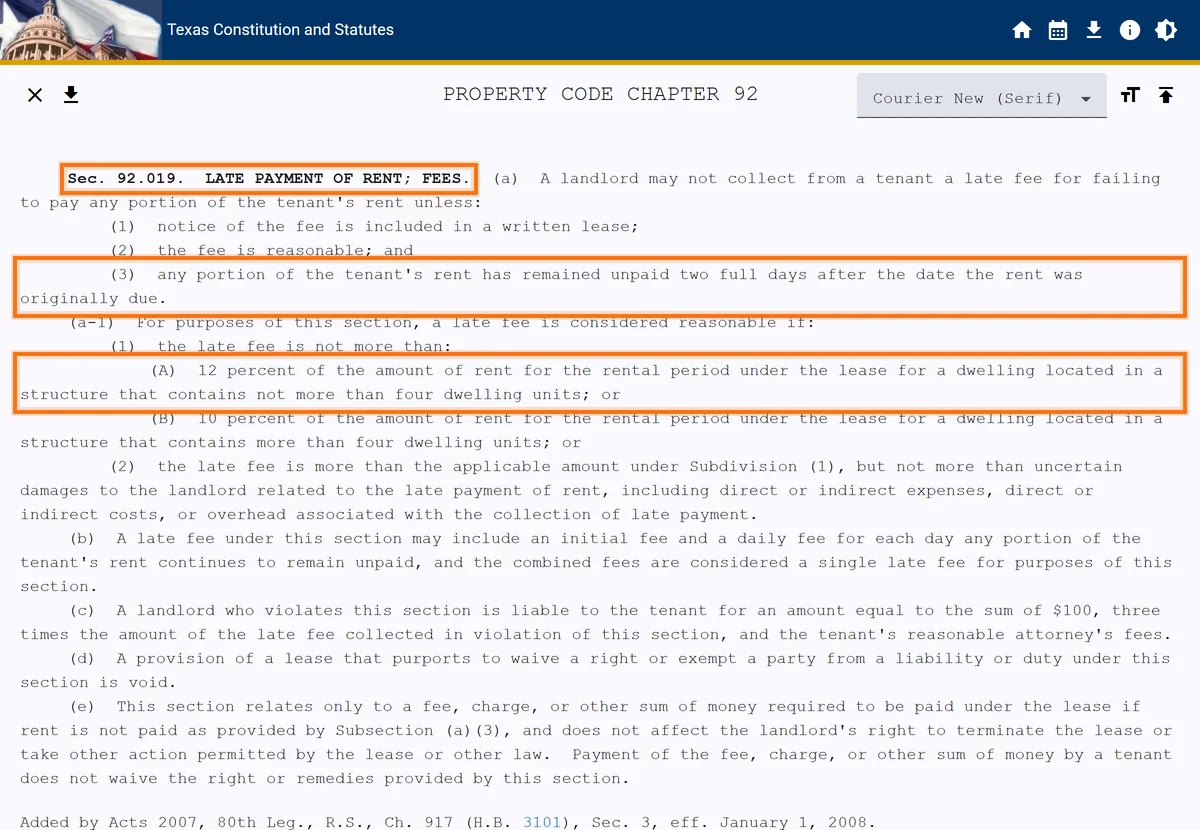
- No late fee until rent has stayed unpaid two full days after the due date, and only if the written lease states the fee (Property Code §92.019).
- A fee up to 12% of the month's rent is presumed reasonable for a home in a building with four or fewer units; 10% in larger buildings.
- There is no 10-day grace period in Texas law; any grace period longer than the two full days comes from the lease.
- Yes, a tenant can be evicted for late rent: after a written notice to vacate, generally at least three days, the landlord can file in justice court.
- The same calendar for every tenant protects the owner from waiver arguments and fair housing complaints.
In Texas, rent is late the day after the due date in the lease, but a late fee can post only after rent has stayed unpaid two full days, and only if the written lease states the fee. If the balance stays open, the landlord can give a written notice to vacate, generally at least three days, and then file for eviction in justice court. That is the schedule we run for every home we manage in Fort Worth, Keller and North Richland Hills.
The outcome depends far more on the process than on the tenant. A clear lease, a late fee that follows the statute, a reminder on the first late day, a written notice to vacate on schedule and a willingness to file if it comes to that will collect rent from almost every tenant who can pay. Improvising, waiting and hoping is what turns one late month into three.
This is the path we follow for every home we manage in Keller, North Richland Hills and Fort Worth, and the reasoning behind each step.
The due date, the grace period and the late fee
Rent is due on the date the lease says, usually the first. What most owners call a grace period comes from Texas law: a late fee cannot be charged until rent has remained unpaid two full days after the date it was originally due. The lease must state the late fee for it to be collectible at all, and the fee has to be reasonable.
Texas Property Code §92.019 presumes a fee reasonable if it is no more than 12% of the month's rent for a home in a building with four or fewer units, or 10% in a building with more than four; a fee above that has to be justified by the owner's actual costs of the late payment. A landlord who collects a fee that breaks these rules owes the tenant $100, three times the fee and attorney's fees.
Two practical points follow. First, the late fee is an incentive, not an income stream. Its job is to make paying on time the easy choice. Second, a fee that is waived for one tenant and charged to another is a problem waiting to happen, so the lease sets the rule and the rule applies to everyone. Texas landlord-tenant law basics covers the surrounding rules on notices and lease terms.
Late rent in Texas, day by day
Here is how a late payment unfolds for rent due on the 1st under a lease that adds no extra grace days, and which rule controls each step:
| When | What happens | Rule that controls |
|---|---|---|
| The 1st | Rent is due; a reminder has already gone out through the portal | The lease |
| The 2nd | First late day: we contact the tenant by text and email, with a call if there is no reply, and log it | Our written process |
| The 4th | Rent has stayed unpaid two full days, so the late fee stated in the lease can post | Property Code §92.019 |
| When the lease window closes | Written notice to vacate; for a tenant who was not late before that month, a notice to pay rent or vacate | Property Code §24.005 and the lease |
| After the notice period | Eviction suit filed in the justice court precinct where the home sits | Property Code chapter 24 |
| After a judgment | A writ of possession can issue no earlier than the sixth day after the judgment | Property Code §24.0061 |
How to read this table: the two full days are the only grace period Texas law sets. A 10-day grace period exists only if your lease grants one, and every extra grace day in the lease pushes each later step back by the same amount. Being 10 days late on rent can lead to eviction once the notice period has run, whether or not a fee was ever charged.
What happens on the first late day
Most late rent is not a crisis. It is a payday that moved, a bank transfer that failed, a tenant who forgot to update a card in the portal. The fastest fix is contact on the first day the rent is late, by text and email through the portal, with a phone call if there is no reply by the end of the day. The message is neutral: rent was due, it has not posted, the late fee applies on this date, here is how to pay.
What we are listening for is whether the tenant has a date and a plan. A tenant who says the money arrives Friday and then pays Friday is a good tenant with a bad week. A tenant who stops answering has told you something different, and the rest of the process exists for that case.
Every contact is logged with the date, the method and the response. That log becomes the record if the matter reaches a courtroom, and it is what the owner sees in the portal.
When the notice to vacate goes out
If rent is not paid within the window the lease allows, the next step is a written notice to vacate. Under Texas law a landlord generally must give at least three days' written notice to vacate before filing an eviction for nonpayment, unless the lease sets a different period. The notice has to be delivered in a way the statute recognizes, and the method and date are recorded.
The notice does two things. Legally, it starts the clock that allows a filing. Practically, it tells the tenant that the situation has become formal, which is often what produces the payment. We send it on the same day of the month for every late tenant, every time. There is no judgment call about whether this particular tenant deserves it; the lease and the calendar decide.
A notice to vacate does not end the lease by itself and it does not remove anyone. It is a required step before the court process, and it can be withdrawn if the tenant pays in full.
Partial payments and payment plans
Accepting a partial payment is a judgment call, and it has consequences. In general, taking money after a notice to vacate has been served can complicate the eviction, because the tenant can argue the landlord waived the notice. A well-drafted lease addresses this, and the safe practice is to accept partial payment only under a written agreement that states the balance, the due date for the rest, and that the notice stays in force.
We use payment plans for tenants with a real reason and a real date: a delayed paycheck, an insurance payout, a one-time expense. We do not use them for tenants who have fallen behind for the second or third time, because a plan at that point usually just delays the inevitable while the balance grows. The question is always whether the plan gets the owner to zero, not whether it feels kind.
Filing in Justice Court, and what it costs you
If the notice period runs out and the rent has not been paid, the next step is an eviction suit in the Justice Court for the precinct where the home sits. In general terms there is a filing fee, a hearing is set within a few weeks, and if the court rules for the landlord and the tenant does not leave, a writ of possession can be requested and a constable carries it out. The full sequence, with the owner's costs, is laid out in the Texas eviction process timeline.
Owners sometimes ask whether filing is worth it when the tenant might pay. Filing is not a declaration of war; it is the only lever that works on a tenant who has stopped responding, and a surprising number of them pay in full once the hearing date is set. Our eviction service handles the notices, the filing and the court appearance so the owner is not learning the process under pressure.
Why consistency matters more than toughness
Three things go wrong when late rent is handled case by case. Fair housing exposure: if one tenant gets a pass and another does not, you have to be able to explain why, and "I liked him" is not an answer. Waiver: accept late rent without the fee a few times and a court may find you changed the terms. And tenant training: a tenant who learns that the lease is not enforced on the fourth will pay on the tenth, then the fifteenth.
The alternative is a written process that runs on a calendar:
- Reminder before the due date, through the portal.
- Contact on the first late day, logged.
- Late fee posted on the date the lease and the statute allow.
- Notice to vacate on a fixed day if the balance is still open.
- Filing when the notice period expires.
Our rent collection service runs exactly this way, and it is why late rent on the homes we manage rarely gets past the first week. The question of how long to wait before each step is answered in how long a property manager should wait before acting on unpaid rent.
What the owner sees, and when the money arrives
Owners should never learn about late rent from a missing disbursement. The portal should show the day rent is late, each contact made, when the fee posted and when the notice went out. The monthly statement then reconciles what was collected, including any late fee, against what was paid out.
A late payment can delay the owner disbursement for that month, since the manager pays out rent that has actually cleared. That is one reason to keep a modest reserve and to understand how the money moves; owner reserves and disbursements explains the timing. The owner portal is where all of it is visible without a phone call.
This is general information, not legal advice. Late fee limits, notice periods and court procedure have specifics that depend on your lease and your situation, so confirm them with an attorney who practices Texas landlord-tenant law.
The takeaway: Late rent is solved by a lease that follows the statute and a calendar that runs the same way for every tenant, every month.
Questions owners ask
How many days late can rent be before a late fee in Texas?
Two full days. Texas Property Code §92.019 bars a late fee until any part of the rent has remained unpaid two full days after the date it was originally due, and the fee must also be stated in a written lease and be reasonable. For rent due on the 1st, that means the fee can post on the 4th. Any longer grace period comes from the lease.
How much can a landlord charge for late rent in Texas?
A fee is presumed reasonable if it is no more than 12% of the month's rent for a home in a building with four or fewer units, or 10% in a building with more than four. A larger fee has to be justified by the owner's actual costs of the late payment. A landlord who charges an unlawful fee owes the tenant $100, three times the fee and attorney's fees under Texas Property Code §92.019.
How long does a tenant have after a notice to vacate in Texas?
Generally at least three days, unless the lease sets a different period. The notice has to be delivered in a recognized way, and the eviction cannot be filed until that period has passed. The tenant can usually stop the process by paying the full balance before filing.
Do property managers accept partial rent payments?
Only under a written agreement, and only when it makes sense for the owner. Accepting money informally after a notice to vacate has been served can complicate an eviction, because the tenant can argue the notice was waived. The safe practice is a short written agreement that states the remaining balance, the date it is due and that any notice already served stays in force. Partial payments make sense for a tenant with a real reason and a real date, not for one who has fallen behind repeatedly. Perpetual applies the same rule to every tenant and logs each payment and agreement in the owner portal.
Who sets late fees and makes sure they're collected?
The lease sets the late fee and the manager enforces it. In general terms the fee must be stated in the lease, must be reasonable, and cannot be charged until rent has remained unpaid two full days after the due date. The manager's job is to post the fee on the date the lease allows, for every tenant, because inconsistent enforcement creates fair housing exposure and can be read as changing the lease terms. Whether late fees go to the owner or the manager is set in the management agreement. Perpetual's rent collection runs on that calendar and the owner sees each fee on the statement.
How long should a property manager wait before taking action on unpaid rent?
Not long, because waiting is what turns one late month into three. Contact goes out on the first late day, by text and email with a phone call if there is no reply, and every contact is logged. The late fee posts on the date the lease and the statute allow. If the balance is still open when the lease's window closes, a written notice to vacate goes out on a fixed day, and under Texas law that notice generally gives at least three days before an eviction can be filed. Perpetual runs the same schedule for every tenant, which is why late rent rarely gets past the first week.
Can a property manager negotiate a payment plan with a tenant?
Yes, with the owner's approval and in writing. A payment plan makes sense for a tenant with a real reason and a real date, such as a delayed paycheck or a one-time expense, and the agreement should state the balance, the dates and that any notice already served stays in force. It is a poor tool for a tenant who has fallen behind for the second or third time, because the plan usually delays the inevitable while the balance grows. The test is whether the plan gets the owner to zero. Perpetual negotiates plans on that basis and keeps the notice and filing schedule running underneath them.
Can you be evicted for being 10 days late on rent in Texas?
Yes. Texas law has no 10-day grace period. Once rent is unpaid and the lease's window has closed, the landlord can give a written notice to vacate, generally at least three days, and file for eviction in justice court when it runs out. Paying the full balance before the filing usually ends the process. This is general information, not legal advice.
Can I be evicted for late fees in Texas?
It depends on the lease. Texas Property Code §92.019 says the late-fee rules do not affect the landlord's right to terminate the lease or take other action the lease permits, so the lease's default clause decides whether unpaid fees alone are a default. Read your lease or ask a Texas attorney about your situation.
Property management in Keller, North Richland Hills and Fort Worth. How full-service management works in Tarrant County →