Key takeaways
- Notice to vacate: at least three days before filing, unless the lease sets a different period (Property Code §24.005).
- Filing to hearing: roughly two to three weeks in the justice court where the home sits, depending on the calendar and service.
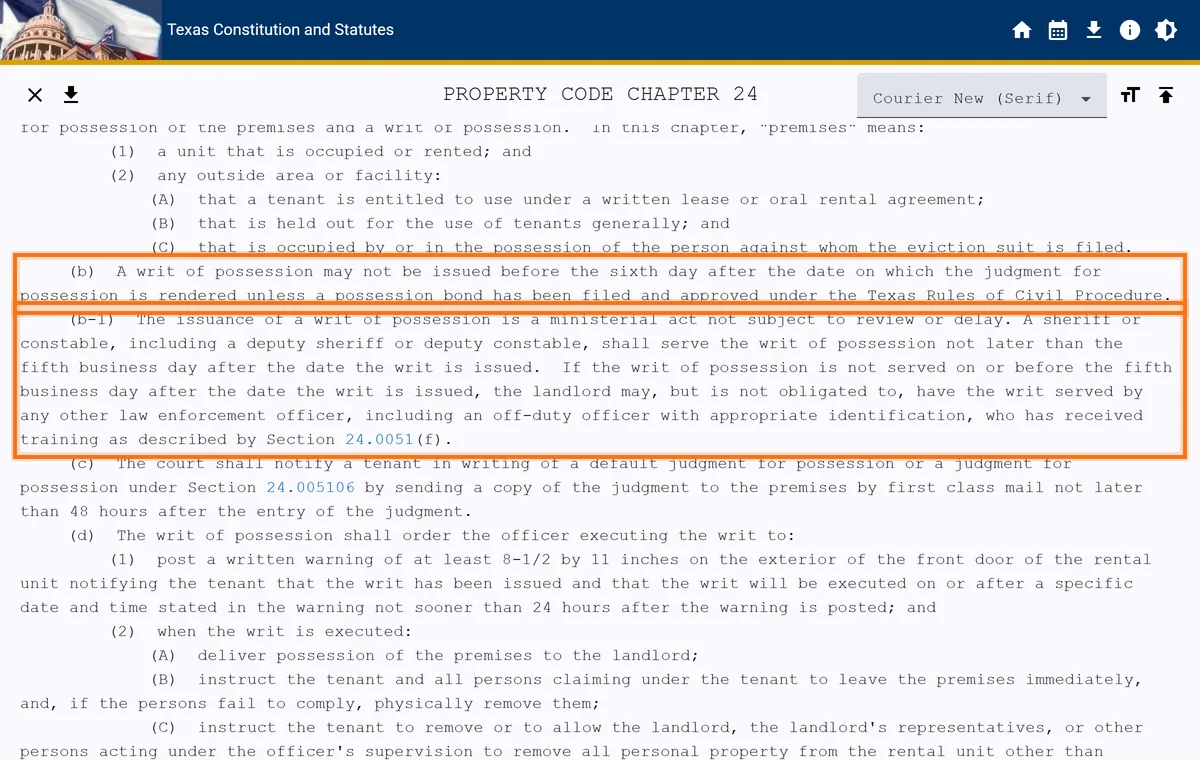
- After the judgment: no writ of possession before the sixth day, unless a possession bond is filed (§24.0061).
- The constable must serve the writ within five business days of issue and post a warning at least 24 hours before carrying it out.
- From the first missed payment to possession is on the order of two months when every stage runs promptly; an appeal adds weeks or months.
An uncontested Texas eviction for nonpayment usually takes several weeks from the day the notice to vacate is delivered to the day the constable returns the house to you, and that is with everything done correctly and the tenant not fighting it. A contested case, a tenant who appeals or a notice that has to be redone can push the total to months. The process is not slow because anyone is dragging their feet; it is slow because Texas law puts a waiting period at every stage.
Here is each stage in order, how long it takes, and which delays are built in versus which ones an owner or manager can avoid.
How long each stage of a Texas eviction takes
- Notice to vacate: a matter of days. Texas law requires at least three days before filing unless the lease sets a different period, and nothing can be filed until it runs.
- Filing and service: the petition is filed in the justice court for the precinct, and the constable serves the citation on the tenant, usually within a few days.
- Filing to hearing: roughly two to three weeks, depending on the court calendar and how quickly service is completed.
- Judgment to writ: a short appeal window, a matter of days, then the writ is requested and the constable posts a final warning at the property. In an uncontested case that is a week or more after the hearing.
- Total: several weeks from the notice to possession, and on the order of two months from the first missed payment.
An appeal, a contested hearing, a bankruptcy filing or a notice that has to be redone can add weeks or months. Each stage is explained below.
The Texas eviction timeline in one table
Each stage, the time the law builds in, and the delay an owner or manager can avoid:
| Stage | Legal minimum or typical time | Rule | Avoidable delay |
|---|---|---|---|
| Notice to vacate | At least 3 days, unless the lease sets a different period | Property Code §24.005 | Serving it late, or the wrong way |
| Filing and service | Citation usually served within a few days of filing | Justice court rules | A tenant the constable cannot find at the house |
| Filing to hearing | Roughly two to three weeks | Justice court rules and the court calendar | Slow service; missing lease, ledger or notice at the hearing |
| Judgment to writ | No writ before the 6th day after the judgment | Property Code §24.0061(b) | Requesting the writ days after it becomes available |
| Writ to possession | Served within 5 business days of issue; posted warning at least 24 hours before | Property Code §24.0061(b-1) and (d) | Little, once the writ is requested |
| Appeal, if filed | Weeks to months in county court | Texas Rules of Civil Procedure | A defective notice or file that invites a defense |
How to read this table: the middle columns are what Texas law requires, and nobody can shorten them. The right column is where most evictions actually lose time. A notice served on the right day and the right way, and a writ requested the day the sixth day arrives, keep an uncontested case close to the legal minimum.
Stage one: the notice to vacate
Nothing can be filed until the tenant has received a written notice to vacate and the notice period has run. Under Texas law the default notice period is short, a matter of days, unless the lease sets a different period, and the notice has to be delivered in one of the ways Property Code §24.005(f-3) allows since January 1, 2026: mail (including certified mail or a delivery service), delivery inside the home in a conspicuous place, hand delivery to a tenant 16 or older, or email if the parties agreed to it in writing.
A tenant who was not late before that month must get a notice to pay rent or vacate rather than a plain notice to vacate. Some leases, and some tenancies tied to federal programs, require longer notice.
The notice is where most avoidable delay happens. A notice delivered the wrong way, addressed to the wrong name or served before the tenant was actually in default under the lease can be challenged at the hearing, and if the judge agrees, the case is dismissed and the whole timeline starts over. A manager who serves notices every month knows the lease and the delivery rules and gets this right the first time. The details of a proper notice are in the notice to vacate in Texas.
Stage two: filing and the hearing
Once the notice period has expired without the tenant leaving or paying, the eviction petition is filed in the justice court for the precinct where the house sits. The court issues a citation, and the constable serves it on the tenant. Texas court rules then require the hearing to be set within a window after the petition is filed, not sooner than a minimum number of days and not later than a maximum, which gives the tenant time to respond and the court time to schedule.
In practice that means a hearing roughly two to three weeks after filing, depending on the court's calendar and how quickly service is completed. At the hearing, an uncontested case is usually short: the manager or owner presents the lease, the ledger and the notice, the tenant either does not appear or does not dispute the facts, and the judge grants a judgment for possession. The full sequence, including what the manager brings to court, is in the Texas eviction process timeline.
Stage three: the appeal window and the writ
A judgment for possession does not put you back in the house that afternoon. Texas gives the losing party a short period, a matter of days, to appeal. Under Texas Property Code §24.0061 a writ of possession may not be issued before the sixth day after the judgment, unless a possession bond has been filed, so the owner cannot get the writ until then. If the tenant does not appeal and does not leave, the manager asks the court for the writ, pays the fee, and the constable posts a warning on the door giving the tenant a final short period before the writ is executed.
- Judgment granted at the hearing.
- Appeal window runs: no writ can issue during it.
- Writ of possession requested and issued.
- Constable posts the required warning at the property.
- Writ executed: the tenant and their belongings are removed and possession returns to the owner.
Add those together and a cooperative, uncontested case still takes a week or more after the hearing before you can change the locks. Changing them earlier, shutting off utilities or removing the tenant's belongings yourself is unlawful in Texas and exposes you to penalties, which is one reason owners use a manager who knows where the line is.
What an appeal or a contested case adds
If the tenant appeals, the case moves to county court for a new trial, and the timeline extends by weeks or months depending on the court's docket. The tenant generally has to post a bond or, in a nonpayment case, pay rent into the court registry to stay in the house during the appeal, which limits the number of tenants who pursue it, but some do. An owner holding the property in an LLC will usually need an attorney at this stage.
A contested case in justice court, where the tenant raises a defense such as a repair issue, improper notice or retaliation, may not add a great deal of calendar time but adds the risk of losing and refiling, which effectively doubles the timeline. Bankruptcy is the other large variable: a filing pauses the eviction under federal law until the bankruptcy court lifts the stay, and that can take weeks on its own.
None of these can be prevented by the owner, but all of them are easier to survive with a clean file: a correct notice, a ledger that matches the lease, documented maintenance responses and no rent accepted after the notice. That file is what makes an appeal unattractive and a defense unlikely to succeed.
An example timeline for a Tarrant County house
Take a tenant in Keller who stops paying on the first of the month. The manager sends a reminder on the second, speaks to the tenant that week and gets a promised date that passes. The notice to vacate is served in the second week. The notice period runs, and the petition is filed in the justice court the following week. The constable serves the tenant within a few days, and the hearing is set roughly two to three weeks after filing. Judgment is granted. The appeal window runs with no appeal. The writ is requested, the constable posts the warning, and possession returns to the owner in the week after that.
From the first missed payment to possession, that is on the order of two months, with every stage done promptly and nothing contested. Delay the notice by a month and the total becomes three. Serve it badly and have it thrown out, and it becomes four. If a tenant stays past the end of the lease rather than stopping payment, the same process applies, as holdover tenants in Texas explains.
This is general information, not legal advice. Notice periods, court rules and fees change, so confirm your situation with the lease or an attorney.
What a good manager does with the waiting periods
The built-in waits are not dead time. While the notice period runs, the manager keeps communicating with the tenant, because a tenant who pays in full or moves out voluntarily ends the process in days instead of weeks. While the hearing is pending, the manager prepares the evidence and, if a cash-for-keys agreement makes sense, offers it in writing. While the appeal window runs, the manager lines up the make-ready vendors and the listing so the vacancy after possession is as short as possible.
A manager who treats the timeline as a schedule to work rather than a wait to endure gets the house back sooner and rented sooner. The eviction service page explains how Perpetual runs each stage, and the rent collection service page covers the late-rent schedule that gets the notice out early.
How Perpetual handles this
At Perpetual Property Management, broker-owned and local to Keller, North Richland Hills and Fort Worth, the eviction timeline starts the first business day rent is late, so the notice to vacate goes out on schedule rather than after weeks of hoping. Notices are served the way the Texas-compliant lease and the law require, routine nonpayment cases are filed and handled in the Tarrant County justice courts as your authorized agent, and the file is kept court-ready from the first late day so there is nothing for a tenant to challenge.
During each waiting period we keep talking to the tenant, prepare the hearing, and line up the make-ready and the listing so the house is back on the market as soon as possession returns. You are told the expected timeline before filing and updated at every stage through the owner portal, every court cost shows on your statement, and every fee tied to the process is listed in your written quote before you sign. If you are in the middle of this now, reach out and we will tell you where your case stands and what should happen next.

The takeaway: A Texas eviction runs on fixed legal waiting periods you cannot shorten, so the total time depends on how fast and how correctly the notice goes out and how clean the file is when the hearing arrives.
Questions owners ask
Can an eviction in Texas be done faster than the standard timeline?
The legal waiting periods cannot be shortened, but the overall time can be cut by serving the notice promptly, filing the day the notice period ends, serving the tenant quickly and requesting the writ the day the appeal window closes. A tenant who agrees to move out, sometimes with a written cash-for-keys agreement, ends the process faster than any court can. There is no legal shortcut around the notice, the hearing or the writ.
What happens if the tenant pays everything after the notice to vacate?
Accepting full payment after a notice may, depending on the lease wording, be treated as waiving the notice and reinstating the tenancy. Many Texas leases address this directly, and a manager should know the rule before accepting money. If the payment is accepted and the tenant is current, the eviction usually does not proceed. This is general information, not legal advice.
How long does the constable give the tenant after the writ is issued?
At least 24 hours. Texas Property Code §24.0061 requires the officer to post a written warning on the front door saying the writ will be carried out on or after a stated date and time, no sooner than 24 hours after posting. The sheriff or constable must serve the writ no later than the fifth business day after it is issued. After that the officer supervises the removal of the tenant and their belongings.
How long after an eviction is filed is the tenant served?
The court issues a citation when the petition is filed, and the constable serves it on the tenant, usually within a few days, depending on the precinct's workload and whether the tenant can be found at the house. The hearing is set roughly two to three weeks after filing, so slow service can push the hearing back.
How long does a tenant have to leave after the eviction court date in Texas?
Not the same day. After the judgment the tenant has a short appeal window, a matter of days, and no writ of possession can issue until it runs. If the tenant has not left by then, the writ is requested and the constable posts a warning at the property giving the tenant a final short period, measured in hours, before removal. In an uncontested case that adds up to a week or more after the hearing.
How long does an eviction appeal take in Texas?
An appeal moves the case to county court for a new trial, which adds weeks or months depending on that court's docket. To stay in the home during the appeal the tenant generally has to post a bond or, in a nonpayment case, pay rent into the court registry. An owner holding the property in an LLC will usually need an attorney at this stage. This is general information, not legal advice.
How long does it take for a writ of possession to be issued in Texas?
A writ of possession may not be issued before the sixth day after the judgment for possession, unless a possession bond has been filed (Texas Property Code §24.0061). The landlord requests it once that day arrives, and issuing it is a ministerial act that is not subject to review or delay.
Related services
Property management in Keller, North Richland Hills and Fort Worth. How full-service management works in Tarrant County →