Key takeaways
- A holdover tenant stays after the lease term ends without a renewal; the lease's holdover clause sets the rent for those days.
- You have three options: a short written extension, a written month-to-month amendment, or a notice to vacate and an eviction.
- Texas requires at least 3 days written notice to vacate a holdover tenant unless the lease sets another period (Property Code 24.005(a)).
- A holdover eviction must also respect the month-to-month notice rules of Section 91.001, which is why accepting rent matters.
- Never change locks, cut utilities or remove belongings, however clearly the lease has ended.
A holdover tenant in Texas is one who stays after the lease term ends without a renewal, and the owner's options are a short written extension, a written month-to-month amendment, or a notice to vacate followed by an eviction filing. For a home in Fort Worth, Keller or North Richland Hills, that filing goes to the Tarrant County justice court for the precinct where the house sits. The lease's holdover clause sets the rent for the days the tenant stays, and what the owner says and accepts in the first week decides which option is still open.
Most holdovers are not malicious: the tenant's new home fell through, the movers rescheduled, or the renewal conversation never happened. This guide explains what a holdover is, how the holdover clause works, what accepting rent does, what notice Texas requires, and when it becomes an eviction.
What a holdover tenant is, in general terms
A holdover tenant is one whose lease term has ended and who remains in possession without a renewal or extension. Under Texas law and standard lease forms, the lease does not simply vanish at the end of the term. What happens next depends on the lease language and on the owner's response.
Three outcomes are possible. If the lease provides for automatic month-to-month continuation, the tenancy continues on those terms. If the lease says holdover is a breach and sets a holdover rent, the tenant is in breach and owes that rent while in possession. If the owner accepts regular rent with no reservation and no lease provision covering it, a court may treat that as consent to a new periodic tenancy.
The lease decides the starting point, and the owner's conduct decides the rest. Reading the holdover and renewal paragraphs of your lease before the term ends is the whole first step.
What the holdover clause in a Texas lease does
Standard Texas association leases, and most manager leases, say that if the tenant stays past the term without the owner's written consent, the tenant is in holdover and owes rent at a higher rate, often stated as a multiple of the regular rent or a daily figure, for each day of holdover. Many also make the tenant liable for the owner's losses if a new tenant cannot move in on time.
The purpose is not to punish. It is to make staying more expensive than leaving, and to put the cost of a delayed turnover on the person who caused it. A tenant who understands that the holdover rent is real and documented usually finds a way to be out quickly.
The clause also protects the owner from the accidental new tenancy described above, because it states that accepting holdover rent does not create a renewal. If your lease lacks a clear holdover clause, add one at the next signing.
The first few days: get the facts and put them in writing
Before anything else, send a written message through the official channel the day after the lease ends: the lease ended on this date, the home has not been surrendered, the holdover clause applies, and you need the tenant's move-out date in writing by a stated deadline. Ask plainly what happened. Most holdovers come with a short, honest answer and a date a few days out.
Do not accept any payment until you have decided how to treat it, and do not say anything that sounds like permission to stay indefinitely. "Take your time" is a sentence that can turn a holdover into a month-to-month tenancy in a judge's eyes.
Photograph the exterior and note any signs of moving activity. A tenant who is clearly packing is a different case from one who has gone quiet.
The three options, and when each one fits
Pick one path in the first week and act on it. Each one has a different paper trail and a different notice rule:
The three options for a holdover tenant in Texas
| Option | When it fits | What to put in writing | Notice rule that applies |
|---|---|---|---|
| Short written extension | The tenant has a firm date within a week or two and has been a good tenant | A one-page extension to that date, at the holdover rate or the regular rate | None beyond the signed date; if they stay past it, start the notice |
| Month-to-month continuation | No new tenant is waiting and you are happy to keep this one | A written amendment with the reviewed rent and the notice period to end it | Section 91.001: a month-to-month tenancy ends on the later of the date in the notice or one month after notice, unless a signed agreement sets a different period |
| Notice to vacate and eviction | No firm date, a missed date, or a new tenant waiting | A notice stating the lease ended and the date to vacate | Section 24.005(a): at least 3 days unless the lease sets a shorter or longer period |
How to read this table: the first two rows keep the tenant in place under terms you chose, the third ends the tenancy. The right-hand column is why drifting is expensive: once the tenancy is treated as month-to-month, a 3-day notice no longer does the job. The trade-offs of keeping a tenant month-to-month are covered in month-to-month vs fixed-term lease.
Accepting rent during holdover: the trap and the fix
Texas courts have historically treated a landlord's acceptance of rent after the lease ends, with nothing else said, as evidence of a new periodic tenancy. That means an owner who takes a regular month's rent on the first and then tries to remove the tenant on the tenth may find that the tenant now has a month-to-month tenancy requiring its own notice.
The fix is the holdover clause plus a written reservation. If the lease says holdover payments do not create a renewal, and you accept the payment with a written statement that it is applied to holdover rent only, the lease controls. If the lease is silent, the safer practice is to accept nothing until the tenant has signed an extension or until counsel has advised, and to apply any payment received against the holdover obligation in writing.
What the tenant owes after they leave, including any shortfall, can be taken from the deposit with an itemization sent within the Texas deadline, and pursued beyond it.
The notice to vacate: what makes it valid
Texas requires a written notice to vacate before an eviction suit can be filed. Section 24.005(a) of the Property Code sets the minimum for a tenant who holds over: at least three days, unless the lease sets a shorter or longer period. The same subsection adds that a landlord filing because the tenant is holding over must also comply with Section 91.001, the month-to-month termination rule.
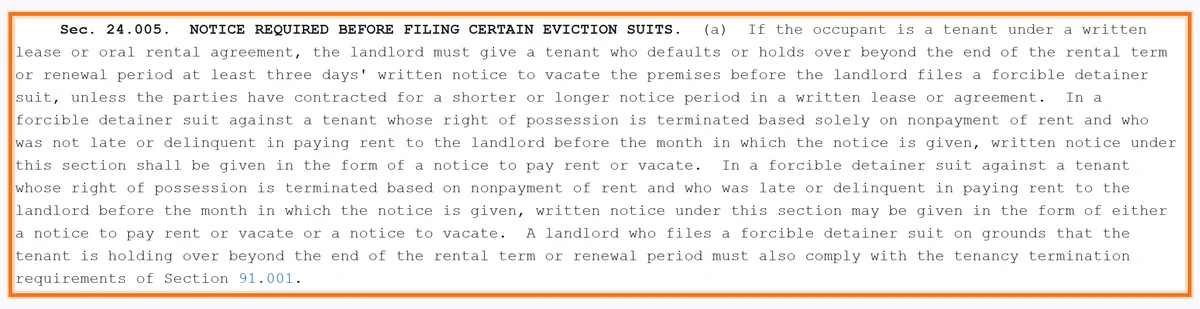
Since January 1, 2026, the notice must be delivered by mail or a delivery service, inside the home in a conspicuous place, by hand to a tenant 16 or older, or by email if both sides agreed in writing (Section 24.005(f-3)). A notice with the wrong number of days or the wrong delivery method is the most common reason an eviction is dismissed and restarted. The detail is in the Texas notice to vacate explained.
This is general information, not legal advice; confirm the notice period and method with your lease and an attorney.
When a holdover becomes an eviction
If the notice period ends and the tenant is still in the home, the owner files an eviction suit in the justice court for the precinct where the property sits (Property Code 24.004). The suit asks for possession and may ask for unpaid rent, including holdover rent. If the owner prevails, the writ of possession cannot issue before the sixth day after judgment unless a possession bond is approved (Section 24.0061(b)).
A holdover case is usually straightforward because the lease has ended and the only question is possession. What slows it down is paperwork: a defective notice, a missing lease copy, or rent accepted in a way that muddied the tenancy. The sequence is in the Texas eviction process and timeline.
Perpetual handles the notice and the paper trail as part of our eviction service, coordinating with a landlord-tenant attorney where the case calls for one. At no point should the owner change locks, remove doors, shut off utilities or remove belongings: under Section 92.0081 a lockout can cost one month's rent plus $1,000, actual damages and attorney's fees.
When a new tenant is already signed
The worst version of a holdover is one with a signed lease and a scheduled move-in behind it. The incoming tenant has given notice at their old home, booked movers and transferred utilities. If the house is not available, the owner has a second problem that can include the incoming tenant's costs and the loss of that tenant entirely.
The incoming lease should carry a clause for delayed possession: the owner is not liable beyond a stated remedy if the home cannot be delivered on time, rent begins when possession is delivered, and the incoming tenant may cancel and receive their deposit back if the delay exceeds a set number of days. Pre-leasing is valuable, and it should be done with that protection in place; the approach is covered in pre-leasing a rental before move-out.
Communicate with the incoming tenant right away, in writing, with a realistic date. Losing a few days of goodwill is better than losing the tenant to a competing listing because they heard nothing.
Preventing holdover: the renewal conversation that never got skipped
Most holdovers are a symptom of a renewal process that did not happen on time. The owner meant to send the renewal, the tenant meant to answer, the date passed, and both assumed the other would say something. A fixed calendar removes that.
- Decide on renewal terms two to three months before the lease ends.
- Send the renewal offer with a response deadline a month or more before the end date.
- If the tenant declines or does not respond by the deadline, send written confirmation of the move-out date and the move-out instructions, and start marketing.
- Confirm the move-out date again two weeks out and arrange the inspection.
A tenant who has received four dated reminders of their move-out date rarely stays past it. That calendar is built into lease renewals.
The takeaway: Read your holdover clause before the lease ends, put the tenant's move-out date in writing in the first days, never accept rent without a reservation, and move to a proper notice to vacate the moment the tenant will not commit.
Questions owners ask
What is a holdover tenant in Texas?
A holdover tenant is one who stays in the home after the lease term ends without a renewal or extension. What happens next depends on the lease: many leases set a higher holdover rent and treat the stay as a breach, while others continue the tenancy month-to-month.
Can I evict a tenant whose lease has expired in Texas?
Yes, if they remain after the term and after a valid written notice to vacate delivered as the lease and Texas law require. The owner files an eviction suit in justice court once the notice period ends. Self-help removal, such as changing locks or shutting off utilities, is not allowed.
If I accept rent from a holdover tenant, does that create a new lease?
It can. Accepting regular rent with nothing else said has historically been treated as consent to a month-to-month tenancy. A lease with a holdover clause stating that payments do not create a renewal, plus a written reservation when the payment is accepted, protects the owner.
How much notice does a holdover tenant get in Texas?
At least 3 days of written notice to vacate under Texas Property Code 24.005(a), unless the lease sets a shorter or longer period. If the tenancy has become month-to-month, Section 91.001 generally requires a month's notice. Since January 1, 2026, the notice goes by mail, inside the home in a conspicuous place, by hand to a tenant 16 or older, or by email if agreed in writing.
What if a new tenant is supposed to move in and the old tenant has not left?
Notify the incoming tenant in writing with a realistic date, rely on the delayed-possession clause in their lease, and pursue the holdover tenant through notice and, if needed, eviction. A delayed-possession clause limits the owner's liability and gives the incoming tenant a defined right to cancel.
What happens if a tenant refuses to leave when the lease ends?
The tenant becomes a holdover, and the lease's holdover clause usually sets a higher rent and treats the stay as a breach. Send a written message the day after the lease ends stating that the holdover clause applies and that you need a move-out date in writing by a deadline, and do not accept rent or say anything that sounds like permission to stay. Then pick one path in the first week: a short written extension to a firm date, a written month-to-month amendment, or a proper notice to vacate followed by an eviction filing if the tenant does not leave. Never change locks, shut off utilities or remove belongings.
Related services
Property management in Keller, North Richland Hills and Fort Worth. How full-service management works in Tarrant County →