Key takeaways
- A fixed-term lease commits both sides until the end date. A month-to-month tenancy commits each side only one rent period at a time.
- Texas Property Code 91.001: a month-to-month tenancy ends on the later of the date in the notice or one month after the notice is given, unless a signed agreement sets a different period.
- On a fixed term, a tenant who leaves early still owes what the lease says, and the landlord has a duty to mitigate damages (Property Code 91.006).
- Month-to-month or a 24-month contract? Pick the end date you want first, then choose the term that lands on it.
- Ending a tenancy or raising the rent within six months after a tenant's repair request can be challenged as retaliation (Property Code 92.331).
Which protects an owner more, a month-to-month or a fixed-term lease? For most rental houses in Fort Worth, Keller and North Richland Hills, the fixed term does: the rent is set, the tenant is committed, and the next vacancy falls in a month you chose. Month-to-month gives you the right to end the tenancy quickly, and gives the tenant the same right, which owners tend to forget until a tenant leaves in December on one month's notice.
This guide puts the two side by side: how lease length and notice periods work in Texas, what each term protects, what month-to-month should cost the tenant, and which term fits which plan.
Month-to-month vs. fixed-term lease, side by side
Here is what each lease term commits a Texas rental owner and tenant to, for month-to-month, a 12-month fixed term and a 24-month fixed term:
| Question | Month-to-month | 12-month fixed term | 24-month fixed term |
|---|---|---|---|
| How long is each side committed? | One rent period at a time | Twelve months | Two years |
| What happens to the rent? | Can change with the written notice the agreement requires | Stays the same from month to month for the whole term, unless the lease itself allows a change | Fixed for two years unless the lease steps it, for example once at month 13 |
| How does it end? | By notice from either side: one month by default (Property Code 91.001) | On the end date, with whatever written notice the lease requires | The same, a year later |
| What if the tenant leaves early? | There is nothing to break. The tenant gives notice and owes rent to the termination date | The tenant still owes what the lease says, and the landlord has a duty to mitigate damages, in practice by trying to re-rent (Property Code 91.006) | The same, with more months at stake for both sides |
| What if you need the house back? | About one month, by notice | You wait for the end date unless the lease has an early-termination clause or the tenant agrees | You may wait up to two years |
How to read this table: every row is about one trade, certainty against flexibility. Moving right, you gain a known rent and end date and give up the ability to change either. Choose the column that matches how sure you are about your own plans for the house.
What a fixed-term lease and a month-to-month lease commit you to
A fixed-term lease, also called a fixed lease, runs from a start date to an end date. Twelve months is the usual choice for a single-family rental, but six, eighteen and twenty-four months are all fixed terms. Neither side can end it early without a reason the lease or the law allows, and the rent stays the same from month to month unless the lease itself says it can change.
A month-to-month lease has no end date. It continues one rent period at a time until one side gives the other notice. People sometimes call a lease with no end date a perpetual lease; on a Texas rental house, a tenancy with no end date is simply a month-to-month tenancy, and either side can end it by notice.
Many owners end up on month-to-month without choosing it, because a fixed lease expired and nobody signed a renewal. If you already have a good tenant in that position, should I let a good tenant stay on a month-to-month lease covers that one decision. This guide compares the terms before you choose.
How lease length and notice periods work in Texas
Lease length is how long both sides are committed. The notice period is how far ahead one side must tell the other that the tenancy will end.
- Month-to-month. Texas Property Code 91.001 sets the default: either side may end the tenancy by notice, and where rent is paid monthly it ends on the later of the day named in the notice or one month after the notice is given. A notice given on the 10th cannot end the tenancy before the 10th of the next month.
- A different period by agreement. Under 91.001(e), that default does not apply if landlord and tenant agreed, in an instrument signed by both, on a different notice period. That is how a lease can require 60 days.
- Fixed term. The lease ends on its end date. Whether either side must give written notice before that date, and how many days, is set by the lease, not by a statute we could find in Property Code chapters 91 or 92.
- A tenant who stays anyway. Before filing an eviction suit for holding over, a landlord must give at least three days' written notice to vacate unless the lease sets another period, and must also have complied with 91.001 (Property Code 24.005).
The types of notice and the mistakes that invalidate them are in lease termination notices in Texas. This is general information, not legal advice.
What a fixed term protects, and what it does not
The owner's largest cost is vacancy, and a fixed term controls when vacancy can happen. With a twelve-month lease ending in June, you know the next marketing window a year ahead. On month-to-month, the tenant can give notice in any month, including one you would never have chosen. Does the time of year affect how quickly a house rents in Fort Worth explains why that timing matters here.
A fixed term also holds the tenant to the rent. If the tenant leaves before the end date, they still owe what the lease says. Two limits apply:
- You have to try to re-rent. Under Property Code 91.006, a landlord has a duty to mitigate damages if a tenant abandons the home in violation of the lease, and a lease clause that waives that duty is void.
- Some early exits are written into the law. Texas gives tenants a right to end a lease early in specific situations, including certain military orders (Property Code 92.017) and family violence (Property Code 92.016), when the tenant follows the steps in those sections.
So a fixed term is strong protection, not a guarantee of twelve payments. When a tenant breaks a lease in Texas covers what happens next.
When month-to-month is the right tool
Month-to-month earns its place when your own plans are uncertain:
- You expect to sell within the year and want to be able to deliver the home vacant on short notice.
- A renovation or a family member's move-in is planned, but the date is not fixed.
- You are relocating, may return, and do not want a lease running past the possible return date.
- The tenant is leaving on a known date a few months out, and a short bridge is simpler than a new lease.
In each case you accept vacancy risk in exchange for control of the end date. That is a reasonable trade when you need the control and a poor one when you simply never got around to a renewal.
What month-to-month should cost the tenant
Month-to-month gives the tenant an option to leave in any month, and an option has a price. A lease can set a higher rent for any month-to-month period, in the clause that says what happens after the end date. Texas law does not set that premium; it exists only if the lease you both signed says so.
Here is the size of the trade, with made-up round numbers: rent of $2,000 a month and a month-to-month premium of $100 a month. Illustrative only, not a quote.
- Six months on month-to-month brings in $600 of extra rent (6 x $100).
- One vacant week at that rent is about $460 of rent not received ($2,000 x 12 / 52).
- So half a year of premium covers roughly nine days of an unplanned vacancy ($600 divided by about $66 a day).
The premium does not make month-to-month profitable. Its job is to make the tenant choose: sign a renewal at the standard rent, or pay for the flexibility.
The risks owners underestimate on month-to-month
Beyond a sudden vacancy, month-to-month carries quieter risks. Rent tends to lag, because nobody reviews an arrangement that has no renewal date, and changes to the pet terms or an addendum have no renewal moment to attach to.
There is also a legal limit that matters more on month-to-month, because ending the tenancy and raising the rent are fresh decisions every month. Property Code 92.331 bars a landlord from retaliating within six months after a tenant, in good faith, asks for a repair, complains to a code office or uses a legal right. Raising the rent and terminating the lease are both on the list.
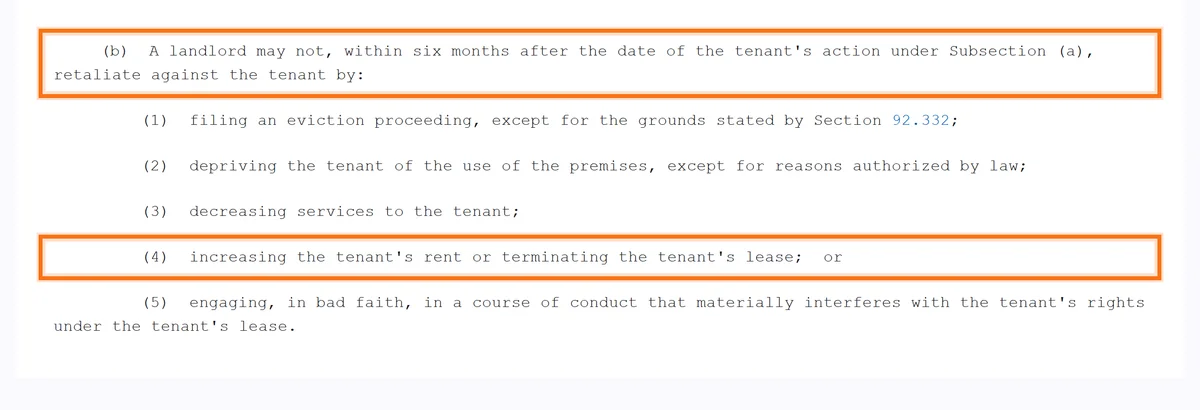
Section 92.332 says a landlord is not liable if the landlord proves the action was not retaliation, and lists grounds that are valid in any event, such as a tenant who is delinquent in rent when the notice is given. In practice that means a written reason: leased comparables for an increase, a sale or move-in plan for a termination. This is general information, not legal advice.
Should you go month-to-month or lock in a 24-month contract?
Start with the month you want the house back or back on the market, then pick the term that ends there. These are the terms that usually fit each plan:
| Your plan for the house | Term that usually fits | Why |
|---|---|---|
| Hold it for years, no changes planned | 12 months, renewed each year | One rent review a year and an end date in the month you chose |
| Hold it for years, tenant you would be glad to keep | 18 or 24 months | Fewer turnovers. Write a rent step into the lease, because the rent cannot change mid-term otherwise |
| The current end date falls in a slow month | 6 or 18 months, once | Moves the end date to a better month, then back to 12-month renewals |
| May sell, renovate or move back within a year | Month-to-month, or a short fixed term | You can end it by notice, or on a date that matches the plan |
| Tenant is leaving on a known date soon | Month-to-month bridge | No new lease to sign for a few weeks of occupancy |
How to read this table: the longer you are sure about your own plans, the longer the term can be. A 24-month contract is not safer than 12 months if you might need the house in month 14.
One caution on 24 months. Texas cities cannot impose rent control outside a declared disaster (Local Government Code 214.902), but your own lease can cap you: on a two-year term the rent is whatever the lease says for all 24 months. Raising the rent in the middle of a lease in Texas explains why the step has to be in the lease from day one.
What the lease must say either way
Whichever term you choose, the lease should answer these questions in writing:
- What happens when the fixed term ends without a signed renewal: does it continue month-to-month, or does it end?
- What notice does each side give to end a month-to-month period, and how is it delivered?
- What rent applies in a month-to-month period?
- How much notice does the owner give to change the rent on month-to-month?
- Do the other terms (deposit, pets, maintenance, late fees) continue unchanged?
A lease that is silent on any of these leaves the answer to the default in Property Code 91.001 and to argument. How to know your lease protects you as the owner covers the other clauses worth reading.
How Perpetual handles this
Perpetual Property Management is broker-owned, with our office at 5755 Rufe Snow Dr in North Richland Hills, and we manage homes in Keller, North Richland Hills, Fort Worth and nearby. What our site states about lease terms and renewals:
- Renewal work starts 120 days before the lease ends, with a rent check against leased comparables. The conversation with the tenant typically happens 60 to 90 days before the end date.
- You get a recommendation with reasoning: keep at market, adjust moderately, or let the tenant go, with the turnover math shown. The decision is always yours, including the term.
- The lease is a current Texas-compliant form with the addenda your property needs (HOA rules, pool, pets, smart devices), and you receive a copy of everything through the owner portal.
- The renewal fee is on the price sheet: $150 on Full Service, $200 on Standard and $149 on Investor Special.
Our site does not state the notice period in our lease, what happens after the end date, any month-to-month premium, or whether a move to month-to-month is billed as a renewal, so those are confirmed in writing before you sign. Our renewals service page has the rest. If a lease ends in the next four months, request a free rental analysis or call 682-593-7033.
The takeaway: Default to a fixed term with an end date you chose, treat month-to-month as a deliberate choice with a reason behind it, and make sure the lease says exactly how each one ends.
Questions owners ask
How much notice is required to end a month-to-month lease in Texas?
Under Property Code 91.001, where rent is paid monthly the tenancy ends on the later of the day named in the notice or one month after the notice is given. A lease or other agreement signed by both sides can set a different period, such as 60 days, so read the lease first. This is general information, not legal advice.
Can a landlord raise rent on a month-to-month tenant in Texas?
Yes. We found no section in Property Code chapters 91 or 92 that sets a notice period for a rent increase on a house, so the written agreement controls. Where it is silent, give written notice at least one month ahead. The increase must not be retaliation under Property Code 92.331. This is general information, not legal advice.
Should month-to-month rent be higher than a fixed-term lease?
It usually should be, but only your lease can make it so. Texas law sets no month-to-month premium. A higher rent in the clause that covers the period after the end date pays you something for the vacancy risk and gives a tenant who plans to stay a reason to renew.
What happens when a fixed-term lease ends and nobody signs anything?
It depends on the lease. Some leases continue month-to-month on the same terms, some at a higher rent, and some treat the end date as final. Read the clause before the end date.
Is a month-to-month lease a good idea if I plan to sell?
It can be, because you can end the tenancy by notice and deliver the home vacant. The trade is that the tenant can leave before you are ready. A short fixed term timed to your sale plan is often the better middle path.
Should I let a good tenant stay on a month-to-month lease?
Only as a deliberate choice, when you need the flexibility yourself, for example because you may sell, renovate or move back in within the year. Otherwise offer a fixed renewal with an end date you chose. The full answer is in our guide on letting a good tenant stay month-to-month.
Should I go month-to-month or lock in a 24-month contract?
Choose by how sure you are about your own plans. If you may sell, renovate or move back within a year, month-to-month or a short fixed term keeps the house available. If you plan to hold it for years and like the tenant, 24 months means fewer turnovers, but write a rent step into the lease, because the rent cannot change mid-term otherwise.
How do lease length and notice periods typically work for a rental?
Lease length is how long both sides are committed: one rent period at a time on month-to-month, or until the end date on a fixed term. The notice period is how far ahead one side must say the tenancy will end. In Texas the default for month-to-month is one month (Property Code 91.001), and a signed lease can set a different period.
Related services
Property management in Keller, North Richland Hills and Fort Worth. How full-service management works in Tarrant County →