Key takeaways
- Texas law sets no flat penalty for breaking a lease; the lease does, usually rent until the home is re-let plus a reletting charge.
- Four statutory reasons let a tenant leave without that liability: military orders, family violence, certain sexual offenses or stalking, and the death of a sole tenant.
- If the lease lacks the required notice of those rights, a tenant who uses them is also released from rent already owed.
- Property Code 91.006 requires the landlord to try to re-let, and a lease clause waiving that duty is void.
- A fast re-let protects the owner more than any penalty; our tenant placement guarantee covers a placed tenant who breaks the lease in the first 6 months.
When a tenant wants to break the lease, a Texas owner has three options: hold the tenant to the lease's early exit terms, which usually means rent until the home is re-let plus a reletting charge; agree a written exit with a fixed move-out date and amount; or, where military orders, family violence or another statutory right applies, accept the termination without penalty. In every case the owner must make reasonable efforts to re-let, so the money is protected by a fast re-let, not by the penalty.
The goal is not to punish the tenant. It is to get the home re-rented with as little lost rent as possible and to have the tenant cover the gap they created, and a cooperative tenant is worth far more than an angry one who stops paying and leaves the home a mess. Here is how we handle it on the homes we manage in Keller, North Richland Hills and Fort Worth, from the first conversation to the re-let.
First, find out why
The reason shapes everything that follows. A job transfer, a divorce, a home purchase or a change in finances are ordinary business situations and the lease handles them. Military orders, family violence and certain other circumstances give the tenant rights under Texas law that override the lease. A tenant who is unhappy with the home is a different conversation, and one you want to have before they decide.
Ask early, in writing, and get the proposed move-out date. A tenant who gives sixty days of notice and keeps the home show-ready is a tenant you can work with. The sooner you know, the smaller the vacancy gap.
One more reason to ask: a tenant who is leaving because of a repair that never got done or a neighbor problem nobody addressed is telling you something about how the home is being run. Fix that before the next tenant arrives, or you will have the same conversation again next year.
What Texas law gives the tenant
Texas law lets a tenant end a lease early and avoid liability for future rent in four situations. Each has its own paperwork and its own effective date, set out in the Property Code:
| Situation | Property Code section | What the tenant must give the landlord | When the termination takes effect |
|---|---|---|---|
| Entering military service, or orders for a permanent change of station or a deployment of 90 days or more | 92.017 | Written notice plus a copy of the military orders or proof of entering service | On a monthly-rent lease, the 30th day after the next rent due date following the notice |
| Family violence against the tenant or an occupant | 92.016 | A qualifying protective order, or documentation from a licensed health care or mental health provider or an advocate, plus written notice | After 30 days from written notice, once the tenant vacates (no notice needed if a cotenant or occupant committed the violence) |
| Certain sexual offenses, or stalking, in the preceding six months | 92.0161 | The documentation the statute lists, plus written notice | After 30 days from written notice, once the tenant vacates |
| Death of a tenant who was the sole occupant | 92.0162 | Written notice from the estate representative, removal of the property, and a signed inventory if the landlord requires one | The later of 30 days after notice or the date all conditions are met |
| Any other reason: a job move, a home purchase, a divorce | None | Whatever the lease requires | The lease terms apply, subject to the duty to mitigate |
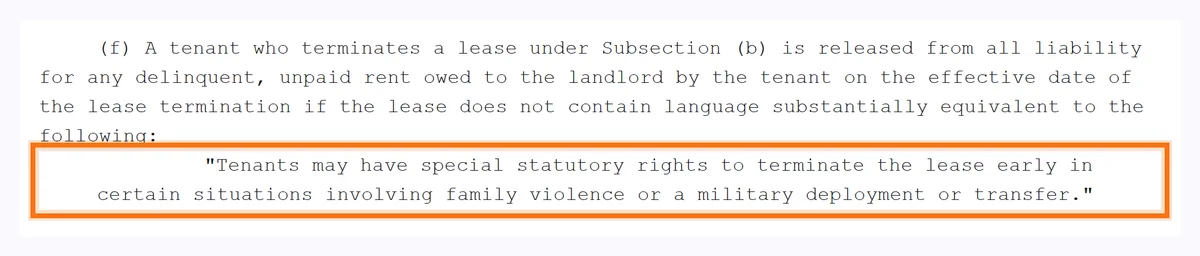
How to read this table: the first four rows are rights the tenant cannot waive, and none of them erases rent that was already past due, with one exception. If the lease does not contain language substantially like "Tenants may have special statutory rights to terminate the lease early in certain situations involving family violence or a military deployment or transfer," a tenant who terminates under 92.016 or 92.017 is also released from delinquent rent; 92.0161 has its own required sentence. A landlord who violates these sections owes actual damages, a civil penalty of one month's rent plus $500, and attorney's fees.
Separately, Section 91.006 puts a duty on the landlord to mitigate damages when a tenant abandons the home in violation of the lease. In plain terms, you have to make reasonable efforts to re-rent rather than leaving it empty and billing the tenant for the rest of the term, and a lease clause that tries to waive that duty is void. Texas landlord-tenant law basics covers the surrounding rules.
What your lease gives you
A good Texas lease anticipates an early exit. The common structure has three parts: the tenant stays responsible for rent until the home is re-let or the lease ends, whichever comes first; the tenant owes a reletting charge that covers the owner's cost of finding a new tenant; and the tenant must give written notice and keep the home accessible for showings.
Some owners prefer an early termination option, where the tenant can end the lease for a fixed amount with set notice and is then released. It trades a smaller certain payment for certainty and a cooperative tenant. Either structure works if it is in writing and applied consistently. What does not work is a lease that says nothing, which leaves the owner negotiating from scratch under the duty to mitigate.
Our leasing service uses a lease written for Texas with these terms in place before the tenant ever moves in.
Negotiating a clean exit
The best outcome is an agreement, signed by both sides, that sets a move-out date, confirms what the tenant owes and when, keeps the home in showing condition, and spells out how the deposit will be handled. In exchange for cooperation, there is often room to be flexible on timing or to credit part of the reletting charge if the tenant helps the home re-let quickly.
A few terms we insist on:
- Rent paid in full through the agreed move-out date.
- Access for showings with reasonable notice, and the home kept clean for them.
- Utilities kept on until the move-out date so the home shows well.
- A proper move-out with keys returned, so the deposit is handled under the normal rules in Texas security deposit rules.
- Agreement that the tenant remains responsible for rent until the home is re-let, or for the termination amount, whichever the lease provides.
A written agreement avoids the worst outcome: a tenant who stops paying, stops responding and leaves the home with the lights off.
Re-letting fast protects the owner more than any penalty
The money an owner actually loses on a broken lease is the vacancy. The reletting charge helps, but a tenant who has just moved across the country is a difficult collection, so the practical protection is a fast re-let. That means pricing the home at market, not above it to recover the loss, and marketing it the moment the exit is agreed, with showings while the tenant is still in place where the lease allows.
Do not shortcut screening because the home is empty sooner than planned. The next tenant is the one who will be in the home for a year or more, and the screening standard does not change. How long it takes to rent a house here explains what drives the days on market, and our marketing service is what gets the listing in front of renters immediately.
When a tenant just leaves
Sometimes there is no conversation; the tenant moves out, the rent stops, and the home sits. The lease usually defines abandonment and what the owner may do, and Texas law has rules about handling property left behind. The steps are to document the condition with photos, secure the home, rekey it, apply the deposit as the lease allows, send the itemization to the last known address within the legal window, and begin marketing.
Whether to pursue the remaining balance is a business decision. A judgment is possible, and sometimes worth it, but collecting from someone who has left the state is slow. The deposit, a quick re-let and a clear itemization recover most of what can be recovered.
For the deposit, Property Code 92.103 gives the landlord 30 days after the tenant surrenders the home to refund it or send a written list of deductions, and under 92.107 the landlord does not have to return the deposit or the list until the tenant gives a written forwarding address. Keep the itemization specific: unpaid rent, the reletting charge the lease provides, and damage beyond normal wear and tear.
Protecting yourself before it happens
The owners who come through a broken lease in good shape share three things: a lease with clear early termination terms, a screening process that favors stable tenants, and a manager who can re-let quickly. The lease is the cheapest of the three. The screening is covered in our tenant screening, and the re-let is what a manager does every week.
If you have a tenant asking to leave right now and want a second opinion on how to handle it, reach out and we will walk through the lease with you.
This is general information, not legal advice. The statutory termination rights and the duty to mitigate have specific requirements, so confirm your situation with an attorney who practices Texas landlord-tenant law.
Our own promise covers the case owners worry about most: if a tenant we place defaults and is removed, or breaks the lease, within the first 6 months, we find you a new tenant with no additional leasing fee. That guarantee is in writing on our guarantees page.
The takeaway: Know the tenant's reason, apply the lease's early exit terms consistently, get the agreement in writing and re-let fast, because vacancy is where the money is lost.
Questions owners ask
Can a tenant break a lease in Texas without penalty?
Only in the situations Texas law sets out: entering military service or receiving qualifying military orders (Property Code 92.017), family violence (92.016), certain sexual offenses or stalking (92.0161) with the required documentation, or the death of a sole tenant (92.0162). Otherwise the tenant is bound by the lease, which usually provides a reletting charge and continued rent until the home is re-let.
Does a landlord have to try to re-rent after a tenant breaks the lease?
Yes. Texas Property Code 91.006 requires the landlord to mitigate damages when a tenant abandons the home in violation of the lease, and any lease clause waiving that duty is void. The tenant is responsible for the rent lost during a reasonable re-letting period, not for the rest of the term regardless of what happens.
What is a reletting charge in a Texas lease?
A reletting charge is an amount set in the lease to cover the owner's cost of finding a replacement tenant when the current tenant leaves early. It compensates for marketing, showings and leasing work; it is not a substitute for rent owed through the re-let date.
Can I keep the security deposit if a tenant breaks the lease?
The deposit can be applied to amounts the tenant owes under the lease, including unpaid rent and a reletting charge, and to damage beyond normal wear. It still has to be itemized in writing within the legal window after the tenant moves out and provides a forwarding address.
What happens if a tenant moves out without giving notice?
A tenant who leaves without notice is still bound by the lease, which usually makes them responsible for rent until the home is re-let or the term ends, plus any reletting charge the lease provides. Texas law requires you to make reasonable efforts to re-rent rather than billing the full term, so document the condition with photos, secure and rekey the home, apply the deposit as the lease allows, send the written itemization to the last known address within the legal window, and start marketing immediately. Property left behind has its own rules under Texas law. Perpetual runs that sequence the same week the home is found empty.
What is the penalty for breaking a lease in Texas?
Texas law does not set one fixed penalty. The lease does, and a typical Texas lease makes the tenant responsible for rent until the home is re-let or the term ends, plus a reletting charge. Because Property Code 91.006 requires the landlord to try to re-let, the tenant usually owes the rent for a reasonable re-letting period and the charge, not the whole remaining term.
What reasons can you break a lease in Texas without paying?
Four: entering military service or receiving orders for a permanent change of station or a deployment of 90 days or more, family violence, certain sexual offenses or stalking within the past six months, and the death of a tenant who lived alone, handled by the estate's representative. Each requires written notice and specific documents, and each takes effect on its own timeline.
Related services
Property management in Keller, North Richland Hills and Fort Worth. How full-service management works in Tarrant County →