Key takeaways
- Read the lease first: its non-renewal window and its notices clause control.
- Month-to-month: at least one month's written notice, unless both parties signed a different period.
- Military orders, family violence, sexual assault or stalking, and a sole tenant's death give tenants statutory early-termination rights.
- For six months after a tenant's good-faith repair request or code complaint, a termination needs an independent, documented reason (Property Code §92.331).
- Deliver two ways, keep the proof, and never accept rent past the end date without a written reservation of rights.
Most Texas lease disputes at the end of a tenancy are not about whether the owner had the right to end it. They are about whether the notice was written, timed and delivered correctly. A non-renewal sent a few days late, a termination letter addressed to one of two tenants, a text message instead of a letter: each one can leave a tenant lawfully in the home for another month while the owner waits.
This guide covers the notices that end a lease in Texas, in general terms, and the mechanics of getting each one right. It is a companion to our guide on the notice to vacate, which is a different document with a different purpose, and the two are confused constantly.
The four ways a Texas lease ends
Set the notice to vacate aside; that is the eviction document. A tenancy itself ends in one of four ways:
- Expiration. A fixed-term lease reaches its end date. Many Texas leases then convert to month-to-month unless one party gives notice, so expiration alone often does not end possession.
- Non-renewal. Either party gives written notice, within the window the lease sets, that the lease will not continue past its end date.
- Termination of a month-to-month tenancy. Either party gives written notice ending the periodic tenancy, with at least the notice period the lease or statute requires.
- Early termination. The lease ends before its term by agreement, by a right the lease grants, by a right Texas or federal law grants to the tenant, or by a landlord's termination for breach.
Each has its own timing and its own document. The first job is to identify which one applies, because sending a month-to-month termination to a tenant with four months left on a fixed term accomplishes nothing.
Which notice you need, and how much time it must give
Find your situation in the left column before you draft anything:
| Situation | Notice to send | Minimum time | Rule that controls |
|---|---|---|---|
| Fixed-term lease ending and you do not want to renew | Non-renewal notice | The window stated in the lease | The lease |
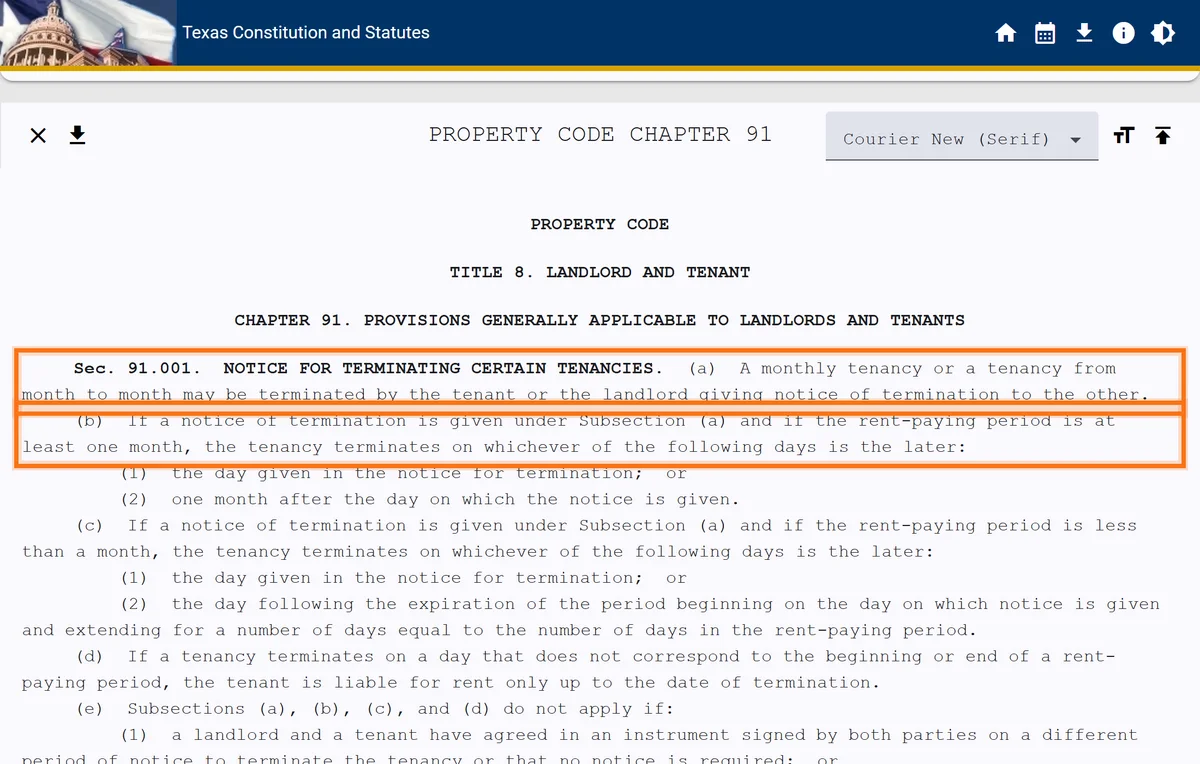
| Lease has rolled to month-to-month | Termination of the month-to-month tenancy | At least one month, unless both parties signed a different period | Property Code §91.001 |
| Tenant on active duty receives deployment or relocation orders | Tenant's written notice with a copy of the orders | Set by the statute after notice is given | Property Code §92.017 and federal law |
| Tenant is a victim of family violence, sexual assault or stalking | Tenant's written notice with the documents the statute lists | Set by the statute | Property Code §92.016 and §92.0161 |
| The sole tenant dies | Notice from the tenant's representative | Set by the statute | Property Code §92.0162 |
| Tenant materially breaches the lease | Termination for breach, then a notice to vacate | The lease's default clause; the notice to vacate gives at least three days unless the lease says otherwise | The lease and Property Code §24.005 |
How to read this table: the first two rows are the owner's choice and run on the lease or §91.001. The middle rows are the tenant's statutory rights, which a lease cannot take away, so the response is to ask for the documents the statute names and process the termination once they arrive. The last row is the only one that leads toward an eviction.
Non-renewal of a fixed-term lease
Read the lease before anything else. The lease sets how far before the end date notice of non-renewal must be given, and what happens if nobody gives it. The standard Texas residential lease converts to month-to-month after the term unless written notice is given within its stated window, which is why an owner who simply assumed the tenant would leave on the end date often finds them still there, lawfully, paying the same rent.
A non-renewal notice is simple: it identifies the lease and the property, states that the lease will not be renewed and that possession must be returned by the end date, and reminds the tenant of the move-out procedure and the deposit rules. It does not need to state a reason, and in most cases it should not, because a stated reason invites argument. The exception is a reason you want on record, such as a sale.
What a non-renewal cannot be is retaliatory or discriminatory. If the tenant requested repairs, complained to a code office or asserted a legal right shortly before the notice, Texas law may presume retaliation. Keep the decision and its timing clean, and if there is a legitimate business reason, note it in the file even if it does not go in the letter. If what you actually want is the tenant to stay on new terms, that is a renewal offer, not a non-renewal, and it uses different paperwork.
Ending a month-to-month tenancy
When a lease has rolled to month-to-month, Texas law requires, in general terms, that either party give at least a month's written notice to end it, unless the lease sets a different period. Many leases do set their own period, and the lease controls. The notice should end the tenancy on a date that lines up with the rental period so there is no argument about a partial month.
Two details catch owners. First, if the notice is delivered mid-month, count forward conservatively; a notice that gives a few days less than the required period is not shortened, it is void. Second, if you accept rent for a period after the termination date, you may have waived the notice and started a new month. Decide what you will do with a payment that arrives after the end date before it arrives.
Month-to-month is useful for a home you plan to sell or move back into. The guide on month-to-month versus fixed-term leases covers when it makes sense and what it costs in stability.
Early termination: the rights the tenant may have
A tenant who wants to leave mid-term is normally liable for rent until the home is re-let, subject to the owner's duty to try to re-let. But Texas and federal law give certain tenants a right to end a lease early without that liability, and a landlord who refuses one of these can be liable. In general terms, the main ones are:
- Active-duty military members who receive orders to deploy or to relocate, under federal law and the Texas lease statute, with written notice and a copy of the orders.
- Tenants who are victims of family violence, sexual assault or stalking, with the documentation Texas law specifies.
- A tenant's death, which allows the estate to end the lease under conditions the statute sets.
- Tenants whose landlord has failed to repair a condition affecting health or safety after proper notice.
Each of these has specific documentation and timing rules. When a tenant raises one, the response is to ask for the documents the statute names, confirm with an attorney if anything is unclear, and process the termination without argument once it is supported. Our guide on a tenant breaking a lease in Texas covers the ordinary case where none of these apply.
Termination by the landlord for breach
A landlord can end a lease early when the tenant has materially breached it: unpaid rent, an unauthorized occupant, a prohibited animal, criminal activity, damage. The lease defines what counts and what notice is required. Some breaches get a notice to cure, giving the tenant a stated period to fix the problem; others, such as nonpayment, go straight to termination.
Here the termination of the lease and the notice to vacate run together. The lease termination letter states the breach, cites the lease clause and declares the lease ended. The notice to vacate, which can be the same document if drafted carefully, demands possession by a date and warns that an eviction will be filed. Many owners send only the second and later discover the lease was never formally terminated, which complicates the claim for future rent.
Do not add anything the lease does not support. A termination letter that demands fees the lease does not authorize, or sets a deadline shorter than the lease allows, gives the tenant's attorney an easy argument. The guide on the Texas eviction process covers what follows if the tenant does not leave.
What every termination notice must contain
Whatever the type, a notice that holds up has the same bones:
- The date of the notice and the full property address.
- The names of every adult tenant on the lease. A notice addressed to one of two signers is a common and avoidable failure.
- A reference to the lease, by date, and the clause the notice relies on.
- A clear statement of what is happening: the lease will not be renewed, the tenancy is terminated, or the lease is ended for breach.
- The exact date possession must be returned, stated as a calendar date, not "thirty days from today."
- What the tenant should do next: move-out procedure, forwarding address for the deposit, key return.
- Signature of the owner or the authorized manager, with contact information.
Keep it to one page. Keep the tone neutral. Do not threaten, do not explain the owner's personal reasons, and do not mix in unrelated complaints. A notice is a legal instrument, not a letter to a friend.
Delivery and proof
The lease usually states how notices must be delivered, and that clause controls. Common methods are hand delivery, mail to the property, and, where the lease permits, email or portal messaging. Whatever the method, you need to be able to prove the date the tenant received it, because every notice period counts from that date.
In practice we deliver termination notices two ways at once: a copy by a method that produces a receipt, and a copy by the fastest method the lease allows, with a photo or a screenshot of each. For a hand delivery, note the date, time, who delivered it and to whom. For posting on the door, which some leases permit and some do not, photograph the posted notice with the date visible.
Then log it. The notice, the proof of delivery and any response from the tenant go in the file together, where the owner can see them on the owner portal. If the matter ever reaches a courtroom, that file is the case.
Mistakes that reset the clock
These are the errors I see most, and every one has cost an owner at least a month:
- Giving notice by text message or in a conversation and assuming it counts.
- Sending the notice a few days inside the lease's non-renewal window, so the lease rolls to month-to-month anyway.
- Naming only one tenant, or using a nickname rather than the name on the lease.
- Stating a possession date that does not match the notice period, or that falls mid-period on a month-to-month tenancy.
- Accepting rent for a period after the termination date without a written reservation of rights.
- Giving a termination notice within weeks of a repair request without a documented, independent reason.
- Confusing non-renewal with a notice to vacate, and filing an eviction on a tenant whose lease has not actually ended.
None of these are legal subtleties. They are process failures, which is why a manager with a checklist rarely makes them. If you are ending a lease on your own and want the notice reviewed before it goes out, that is a good reason for a conversation with Perpetual; the review is cheaper than the month.
This article is general information, not legal advice. Confirm the details of your situation with a Texas attorney.
The takeaway: Identify which notice applies, read the lease's window and delivery clause, name every tenant, state a calendar date, deliver it two ways with proof, and never accept rent past the end date without a written reservation.
Questions owners ask
How much notice does a landlord have to give to not renew a lease in Texas?
For a fixed-term lease, the lease itself sets the non-renewal window, and that controls. If no notice is given, many Texas leases convert to month-to-month. For a month-to-month tenancy, Texas law generally requires at least a month's written notice from either party unless the lease sets a different period.
Does a landlord have to give a reason for not renewing a lease in Texas?
No. A landlord can decline to renew without stating a reason, as long as the decision is not retaliatory or discriminatory. Most non-renewal notices should not state a reason, because it invites argument, though a legitimate business reason should be noted in the file.
Is a text message a valid lease termination notice in Texas?
Usually not. The lease states how notices must be delivered, and most require written notice by a method such as hand delivery or mail. A text is hard to prove and easy to dispute. Deliver by a method that produces a receipt and keep a copy with the proof.
What is the difference between a non-renewal notice and a notice to vacate in Texas?
A non-renewal notice ends the lease at its natural end date and is governed by the lease's notice window. A notice to vacate is the demand for possession that must precede an eviction filing, usually after a breach such as nonpayment. Confusing them is a common reason evictions get dismissed.
Can a landlord terminate a lease early in Texas?
Only for a material breach the lease defines, such as unpaid rent, unauthorized occupants or damage, and only by following the notice the lease requires. Absent a breach, a landlord cannot end a fixed-term lease early without the tenant's agreement.
Can a landlord refuse to renew a lease after a repair request in Texas?
Not as retaliation. Texas Property Code §92.331 bars a landlord, for six months after a tenant's good-faith repair request, code complaint or exercise of a legal right, from terminating the lease or raising the rent because of it. A non-renewal in that window needs an independent, documented reason, such as a sale or a lease violation, and §92.332 lists the reasons that are not retaliation.
Related services
Property management in Keller, North Richland Hills and Fort Worth. How full-service management works in Tarrant County →