Key takeaways
- Pre-leasing is lining up the next tenant before the current one leaves, so the only vacancy is the make-ready window.
- It starts with written notice and a confirmed move-out date. Until then, the date is a guess.
- Showing an occupied home is governed by the access clause in the lease. Texas has no statute that sets an entry notice period.
- If the outgoing tenant stays past the date, the landlord must give at least three days' written notice to vacate before filing an eviction suit, unless the lease sets another period (Property Code 24.005).
- If the new tenant never moves in, Property Code 92.1031 limits what can be kept from their deposit once a replacement tenant is in place.
Can you rent out your property before the current tenant moves out? Yes. Pre-leasing means marketing the home and signing the next tenant during the outgoing tenant's notice period, so the only vacancy you pay for is the handful of days it takes to turn the home. On a rental in Fort Worth, Keller or North Richland Hills it is one of the biggest levers on vacancy cost.
Done badly, it means promising a stranger a home you have not inspected yet, on a date you do not fully control. This guide walks through the timeline from the tenant's notice to the new tenant's keys, where the make-ready fits, what can go wrong and how each risk is controlled.
The pre-leasing timeline, from notice to new keys
Here is the order a pre-lease runs in, what happens at each stage and what each stage depends on:
| Stage | What happens | What it depends on |
|---|---|---|
| 1. Notice | The tenant gives written notice, or the owner gives the notice the lease requires. The move-out date is confirmed in writing | The notice period in the lease |
| 2. Price and listing | A fresh rent check against leased comparables, listing copy, photos, an agreed showing schedule | Usable photos and a cooperative tenant |
| 3. Showings | Showings of the occupied home in agreed time blocks, with the notice the lease requires | The access clause in the lease |
| 4. Walk-through before move-out | A visit that scopes the make-ready while the home is still occupied, so vendors can be booked | Access under the lease |
| 5. Approval and lease | The applicant is screened and approved, the lease is signed and the deposit is paid. The start date sits after the make-ready window | A realistic window plus a buffer |
| 6. Move-out | Keys returned, move-out inspection against the move-in report, deposit accounting begins | The tenant leaving on the date |
| 7. Make-ready | Vendors do the scoped work. Surprises are handled inside the buffer | Vendor commitments made in stage 4 |
| 8. Move-in | Final check, move-in condition report, keys to the new tenant | Everything above finishing on time |
How to read this table: stages 1 to 5 happen while the old tenant still lives in the home, which is where the saved days come from. The right-hand column is the list of things that can stop a pre-lease, and stages 1, 3 and 6 are in the outgoing tenant's hands, not yours.
Pre-leasing starts with written notice, not a conversation
The process begins the day the current tenant gives written notice that they are leaving, or the day the owner decides not to renew and gives the notice the lease requires. Until that is in writing, the move-out date is a guess, and marketing a home on a guessed date is how an owner ends up with two households expecting the same keys.
The notice period in the lease is the pre-leasing window. A lease that asks for thirty days gives about a month of marketing while the tenant is still in place; one that asks for sixty gives two. On a month-to-month tenancy the default is one month under Property Code 91.001, unless a signed agreement sets another period. Lease termination notices in Texas covers the notice types and what makes them valid.
Once notice is in hand, confirm the exact move-out date in writing and ask early whether the tenant could leave a few days sooner if the next tenant's dates are tight. That conversation is easier at the start than at the end.
Deciding whether this home should be pre-leased at all
Not every home is a good candidate. The question is whether a renter touring the home as it is today, with the current tenant's furniture in it, will see something close to what they will receive on move-in day. Three conditions make the answer yes:
- The home is in good condition and the planned make-ready is cosmetic: cleaning, touch-up paint, carpet cleaning, minor repairs.
- The current tenant keeps the home presentable and is cooperative about showings.
- The gap between move-out and the earliest realistic move-in is long enough to do the make-ready, with a margin for surprises.
If the home needs flooring, a kitchen refresh or repairs you cannot scope until it is empty, pre-leasing is usually the wrong call. In that case the better plan is a fast, well-organized turnover after move-out. Rental turnover cost and timeline covers how to compress that path instead.
Showing a lived-in home without losing the tenant's goodwill
The outgoing tenant is packing, busy, and gains nothing from the next tenant's convenience. A manager who treats their cooperation as a favor gets more of it. In practice:
- Agree on a showing schedule up front: specific days and time blocks, not calls at random.
- Give the notice the lease requires before every visit, in writing, and honor it.
- Have a person present at every showing; nobody tours an occupied home alone.
- Group showings so the tenant deals with one busy afternoon instead of six interruptions.
- Thank the tenant.
Texas has no statute that sets a notice period for a landlord to enter a rental house; the lease controls, which is why the access clause matters. If the lease has no showing clause, you are asking for a favor and have to negotiate it. Can a property manager show my house while the current tenant still lives there covers the showings themselves, and landlord entry rights in Texas covers the clause. This is general information, not legal advice.
What the listing has to say when the home is occupied
A pre-leased listing describes the home as it will be delivered, not as it looks with someone else's sofa in it, without overpromising. It states the earliest available date, notes that the home is occupied and shown by appointment, and lists the make-ready work that will be done before move-in in plain terms: professional cleaning, paint touch-up, carpet cleaning.
Photos are the hard part. The first choice is photos from the last vacancy if the home has not changed, with current photos of anything that has. The next best is to photograph the occupied home with the tenant's permission, at angles that show the home and not the belongings. What the listing must never do is show finishes the home will not have on move-in day. The same rule applies to a vacant home that is still being repaired: see can a property manager start advertising before the repairs are finished.
Sizing the make-ready window and the buffer
The make-ready window is the number of days between the outgoing tenant's keys coming back and the incoming tenant's keys going out. Too short, and a single late vendor pushes the new tenant's move-in. Too long, and you are paying for the vacancy that pre-leasing was supposed to remove.
To size it, scope the work at the walk-through before move-out, get vendor commitments for specific days, add up the longest chain of dependent jobs (paint dries before carpet cleaning, cleaning comes last), then add a buffer of a few days for what the walk-through could not see. A home that looked fine furnished can reveal a stained subfloor under a rug once it is empty.
The value of each day is simple arithmetic. Illustrative only, not a quote: at $2,000 a month, rent is about $66 a day ($2,000 x 12 / 365), so a ten-day window is about $660 of rent not received and a five-day window about $330. Our marketing page uses the weekly version of the same figure: about $460 for every week of avoidable vacancy at that rent. Tell the incoming tenant the date with the buffer already in it.
The risks, and how each one is controlled
Pre-leasing creates obligations to a new tenant before the home is in hand. These are the ways it goes wrong, the control for each and what the paperwork should say:
| Risk | Control | What the paperwork should say |
|---|---|---|
| The outgoing tenant does not leave on the date | Written notice, a confirmed move-out date, a start date for the new lease that leaves a margin | The new lease: what happens if possession is delayed. The old lease: its holdover clause |
| The home is in worse condition than expected | The walk-through before move-out, the buffer, vendors already booked | The listing and the new lease: the make-ready work promised, in plain terms |
| The applicant saw it furnished and dislikes it empty | An honest listing and a final walk-through before keys | The move-in condition report, acknowledged by the tenant |
| Showings strain the relationship with the outgoing tenant | Agreed time blocks, proper notice, a pause if the tenant needs a few days | The access clause in the current lease |
How to read this table: every control is something done before the problem, and every row ends in a document. If a tenant does hold over, Property Code 24.005 requires at least three days' written notice to vacate before an eviction suit, unless the lease sets another period; you cannot remove the tenant yourself. What happens if a tenant refuses to leave when the lease ends covers that path.
Read the delayed-possession clause before you approve a pre-lease. It decides whether rent is reduced for the days of delay and whether, and after how long, the new tenant may cancel. This is general information, not legal advice.
Holding the home: the lease, the deposit and a tenant who backs out
Once an application is approved on a pre-leased home, the applicant should sign the lease and pay the security deposit promptly. An approved applicant who has paid and signed nothing can walk away the day before move-in, leaving you with a vacancy and a listing that has to restart.
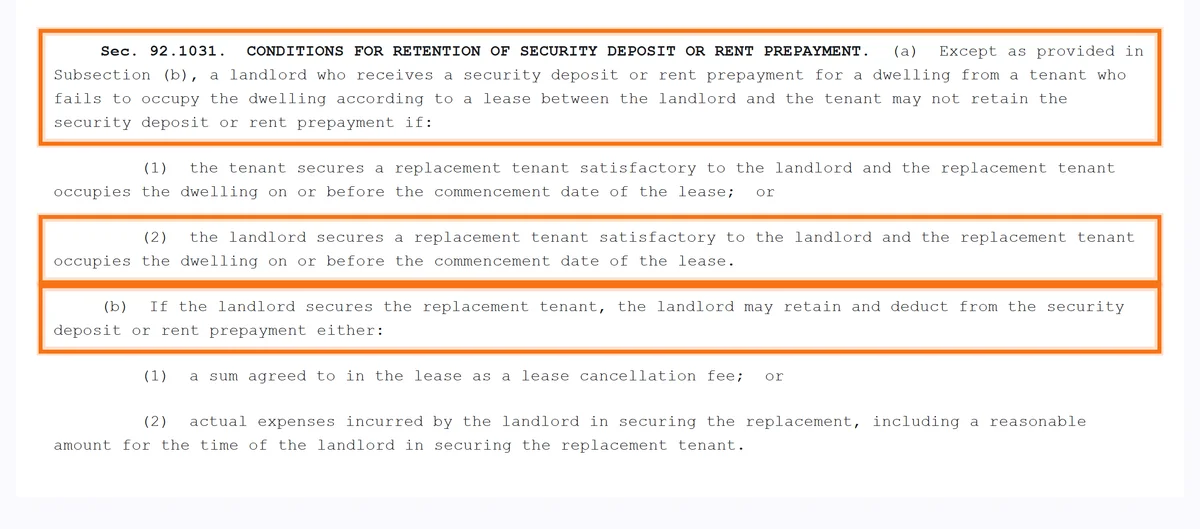
If a tenant signs, pays and then never moves in, Property Code 92.1031 applies. The landlord may not keep the deposit or prepaid rent if a satisfactory replacement tenant, found by either side, occupies the home on or before the lease start date. If the landlord found the replacement, the landlord may deduct either a cancellation fee agreed in the lease or the actual expenses of securing the replacement.
The outgoing tenant's deposit runs on its own clock: refunded or accounted for within 30 days after the tenant surrenders the home (Property Code 92.103), once the tenant has given a written forwarding address (92.107). The two deposits are separate money. More on both situations is in when an approved tenant backs out before move-in and Texas security deposit rules.
When to skip pre-leasing and turn the home instead
Pre-leasing suits well-kept homes with cooperative tenants. It is the wrong tool in a few recognizable situations: a tenant leaving on bad terms who will not cooperate with showings, a home with a major project planned, or a move-out date that is uncertain because the tenant's home purchase has not closed.
In those cases the better plan is a tight turnover: scope the work before move-out, book the vendors, and have the listing ready to go live the day photos are taken. The vacancy is longer than a pre-lease would have produced, but the risk is lower and the listing is stronger. What each extra day costs is in what a vacant month really costs.
How Perpetual handles this
Perpetual Property Management is broker-owned, with our office at 5755 Rufe Snow Dr in North Richland Hills, and we manage homes in Keller, North Richland Hills, Fort Worth and nearby. What our site states about the time around a move-out:
- Renewal work starts 120 days before the lease ends, and conversations with the tenant typically happen 60 to 90 days out, so if the tenant is leaving, marketing starts early and the vacancy gap shrinks. See renewals and turnovers.
- Occupied homes are shown in coordination with the current tenant, scheduled respectfully, to protect your relationship with the outgoing tenant while filling the vacancy.
- Marketing starts before the make-ready work finishes, so the listing and showings queue up.
- Every move-out and move-in gets a 360-degree condition inspection, and the move-out is measured against the move-in baseline.
- A vacant home is listed within 5 business days of being market-ready, or the first month's management fee is waived.
The guarantees are subject to the Guarantee Addendum and are listed on the guarantees page. What our site does not state: whether we sign the next lease before the current tenant is out, how long a make-ready buffer we allow, and what our lease says about delayed possession. Those are confirmed in writing before you sign. The tenant placement fee is on the price sheet. To talk through a lease that is ending, request a free rental analysis or call 682-593-7033.
The takeaway: Pre-lease when the home is in good shape and the tenant is cooperative, size the make-ready window from an inspection with a buffer, and never promise a move-in date the lease cannot back up.
Questions owners ask
Can I show my rental while the tenant is still living there?
Yes, if the lease has an access clause that allows showings and you give the notice it requires. Texas has no statute that sets an entry notice period for a rental house, so the lease governs. Showings of an occupied home should be scheduled with the tenant and have a person present.
How far in advance can a new tenant sign a lease on an occupied home?
As soon as the outgoing tenant's move-out date is confirmed in writing and the make-ready scope is known. The new lease's start date should sit after the make-ready window plus a buffer, and the lease should say what happens if possession is delayed.
What if the current tenant refuses showings?
If the lease has an access clause, the tenant has agreed to showings on the notice it states, but forcing the issue rarely helps. Most refusals come from poor scheduling; grouped showings and proper notice usually resolve it. If not, the home is turned after move-out instead.
Is pre-leasing worth it if the home needs a lot of work?
Usually not. A renter who applied after seeing old carpet and a promise of new floors often expects something different from what arrives. A fast, pre-scoped turnover with finished photos tends to produce fewer disputes.
What happens if the outgoing tenant does not leave on time?
The new tenant's lease decides what you owe them for the delay, so read its delayed-possession clause first. For the tenant who stayed, Property Code 24.005 requires at least three days' written notice to vacate before an eviction suit, unless the lease sets another period. A confirmed written move-out date and a buffer in the start date make this rare. This is general information, not legal advice.
Can I rent out my property before the current tenant moves out?
Yes. You can market the home and sign a lease with the next tenant during the current tenant's notice period, as long as the new lease starts after the current tenant's move-out date and the make-ready. The current tenant keeps full rights to the home until their tenancy ends, so showings follow the access clause in their lease.
What happens to the deposit if a pre-leased tenant backs out before move-in?
Property Code 92.1031 covers a tenant who signed a lease, paid a deposit and failed to occupy. If a satisfactory replacement tenant moves in on or before the lease start date, the landlord may not keep the deposit, except that a landlord who found the replacement may deduct a cancellation fee agreed in the lease or the actual expenses of finding the replacement. This is general information, not legal advice.
Related services
Property management in Keller, North Richland Hills and Fort Worth. How full-service management works in Tarrant County →