
Key takeaways
- No Texas statute sets a notice period for landlord entry; the entry clause in the lease is the rule.
- A good clause names who may enter, the purposes, reasonable times, emergencies and the showing period before the lease ends.
- Our standard: at least a day's written notice through the portal and by text, a two-hour arrival window and the name of the person coming.
- Water, gas, smoke or a burst pipe justify entry without notice; a convenient repair does not.
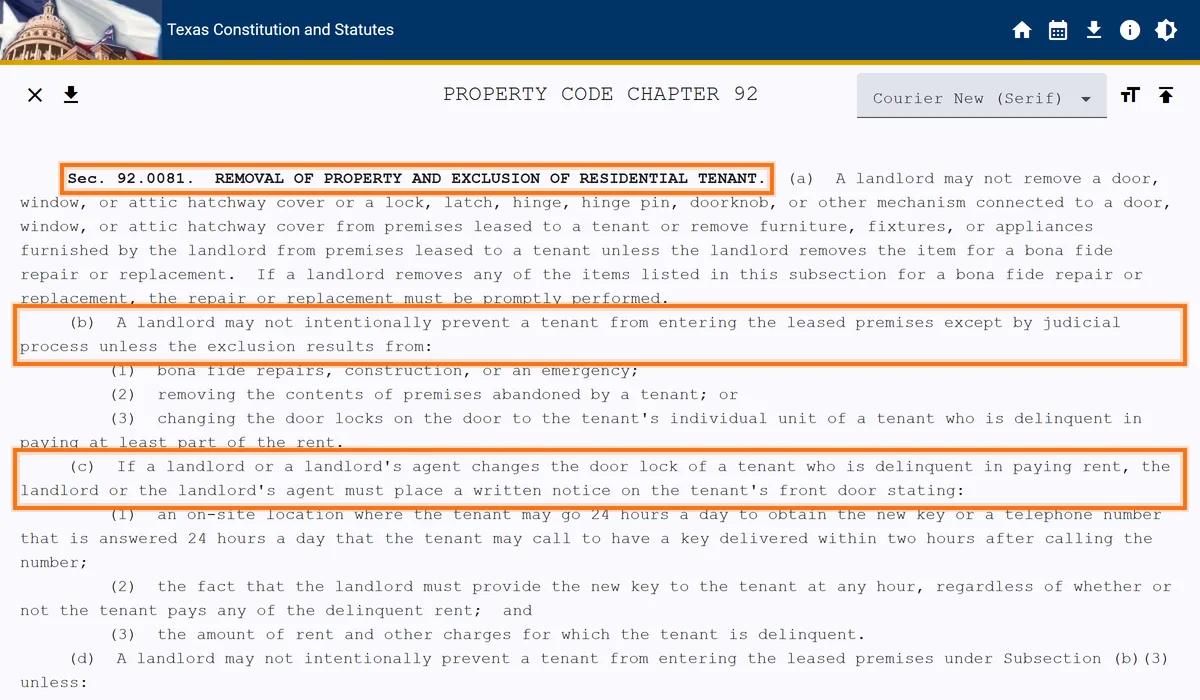
- Keeping a tenant out is a separate question: Property Code §92.0081 limits lockouts and removing doors, locks or appliances.
A Texas landlord's right to enter comes from the lease, not a statute: Texas law sets no notice period for entering a rental home. A well-written lease lets the landlord and its agents enter at reasonable times for repairs, inspections and showings, with notice, and without notice in a true emergency. For the homes we manage in Fort Worth, Keller and North Richland Hills, our standard is at least a day's written notice with a two-hour arrival window.
Many states do have an entry statute, and owners who move here from one of them often assume a day's notice is the law. It is not. In Texas the lease is the rule, and if the lease is silent, the question becomes a dispute about reasonableness that nobody wants to argue in court.
That makes the entry clause one of the most practical paragraphs in the whole lease. Written well, it lets you handle repairs, inspections and showings without friction. Written badly, or not at all, it leaves you either locked out of your own property or accused of harassing the tenant. This guide covers what the clause should say and how to use it.
Why the lease is the only rule that applies
Because Texas law does not set an entry notice period, the lease defines the landlord's right of access. If the lease says the landlord may enter at reasonable times with advance notice, that is the standard. If the lease says nothing, the tenant has a right to quiet enjoyment and the landlord has a property interest, and the gap between them is filled by argument.
Two things are clear even without a statute. A landlord cannot remove doors, windows, locks or landlord-furnished appliances except for a real repair, and cannot keep a tenant out of the home except by court order or in the narrow cases Property Code §92.0081 lists; even a lock change for unpaid rent requires a written notice on the front door and a new key available around the clock. Section 92.008 likewise bars interrupting utilities except for repairs, construction or an emergency. And a landlord who enters repeatedly without a legitimate reason, or at unreasonable hours, risks a claim that the tenant's right to quiet enjoyment was breached, which can support the tenant ending the lease.
So the question is never "how much can I get away with." It is "what does the lease allow, and am I following it." The lease clause does the work, and the habit of following it does the rest.
What a good entry clause includes
The entry language in the lease forms most Texas brokers use is a sensible model. In general terms a strong clause covers these points:
- Who may enter: the landlord, the property manager, their contractors and, with a stated purpose, prospective tenants or buyers.
- The purposes: repairs, inspections, showing to prospective tenants, buyers, lenders or insurers, and verifying lease compliance.
- Timing: at reasonable times, with a plain statement of what notice the landlord will give as a courtesy.
- Emergencies: entry without notice when there is a reasonable belief of danger to people or property.
- Showings: that the landlord may show the home during a stated period before the lease ends, and may place a key box or sign.
- The tenant's obligation not to change locks or refuse reasonable access.
Notice how the clause gives the landlord a right and then commits the landlord to courtesy. That combination holds up. A clause that reads as "landlord may enter at any time for any reason" is legally weak, bad for tenant relations and unnecessary.
When a landlord can enter a Texas rental, and with what notice
Common reasons for entry and how each one is handled under a well-drafted lease:
| Reason for entry | Notice | Who is there | What is recorded |
|---|---|---|---|
| Repair the tenant requested | Appointment confirmed with the tenant | The tenant, or written permission to enter while away | Vendor photos of the work area on arrival and departure |
| Routine inspection | More than a day, so the tenant can be home | Usually the tenant | Dated photo report in the owner portal |
| Showing near the end of the lease | Reasonable notice within the showing period the lease sets | An agent with every visitor | Showing log; no self-guided access while occupied |
| Emergency: water, gas, smoke, burst pipe | None required; call and text first and log the attempts | A second person when possible | Photos on entry and same-day written notice to the tenant |
| Welfare concern | None; call the police rather than entering alone | Police | Written record of the concern and the call |
| A vendor who is nearby and wants in today | Not an emergency: schedule it with normal notice | As for any repair | As for any repair |
How to read this table: the notice column is the lease standard and our practice, not a statute, because Texas has none. The further a visit is from a real emergency, the more notice it gets, and every entry leaves a written record the owner can see.
The notice we actually give
Whatever the lease allows, the practice that keeps good tenants is to give notice and to keep it. Our standard is at least a day's notice for anything scheduled, delivered in writing through the portal and by text, with a two-hour arrival window and the name of the person coming. The tenant can propose another time within a reasonable range, and we take it unless the repair cannot wait.
For routine inspections we give more notice, not less, because we want the tenant home. An inspection with the tenant present is faster, less tense and far more informative; they will show you the drip under the sink they forgot to report. The guide on how often rental inspections should happen covers the cadence.
For a vendor repair the tenant requested, confirm the appointment and whether the tenant needs to be present. Most tenants prefer to be home. If they authorize entry while away, get that in writing, and have the vendor photograph the work area on arrival and departure.
Emergencies: when you enter without notice
An emergency is a situation where waiting to reach the tenant creates a risk to people or the structure. Water pouring through a ceiling, a gas odor reported by a neighbor, smoke, a burst pipe during a freeze, or a tenant who has not been seen in days and is not answering with a welfare concern raised. In those cases the lease should allow entry without notice, and common sense says the same.
What makes an emergency entry defensible is what happens around it:
- Attempt to reach the tenant first, by phone and text, and log the attempts.
- Enter with a second person when possible, and never alone into a home where a welfare concern exists; call the police for that.
- Photograph the condition on entry, do only what the emergency requires, and secure the home on leaving.
- Notify the tenant in writing the same day with what was found and what was done.
A convenient repair is not an emergency. A vendor who happens to be in the area and would like to swap a water heater today does not justify walking in. The guide on rental maintenance emergencies draws that line in more detail.
Showings near the end of a lease
The most sensitive entries are showings while the tenant still lives there. The lease should state the period before the end date during which the landlord may show the home, that reasonable notice will be given, and whether a key box is permitted. With that in place, the practical approach is to agree on a showing schedule with the tenant rather than to invoke the clause.
What works: a set of showing windows the tenant chooses, a limit on showings per day, a promise that an agent accompanies every visitor, and a small courtesy such as a professional cleaning or a rent credit for cooperating. What fails: self-showing lockboxes while a tenant is in residence, surprise visits, and letting applicants wander the home unattended. The guide on pre-leasing a rental before move-out explains how to use that window without losing the current tenant's goodwill.
If the tenant has already given notice and is hostile, it is often better to wait for possession than to force showings. A few days of vacancy cost less than a damaged relationship in the last month, when the home is still in the tenant's care.
When a tenant refuses access
A tenant who refuses reasonable, properly noticed entry is usually in breach of the lease. The response is not to force the door. It is to document the refusal in writing, restate the lease clause and the purpose, offer alternative times, and give a clear deadline. Most refusals end there, because most of them come from a tenant who was embarrassed by the state of the home or anxious about a stranger.
If refusals continue and the entry matters, such as a safety inspection required by the city, an insurer's inspection or a repair the tenant themselves requested, the lease breach becomes grounds for a notice to cure and, if ignored, for non-renewal or termination under the lease. That path is slow and should be reserved for repeated, unreasonable refusals, and a calm phone call usually ends the standoff long before it gets there.
Keep the tone professional in every message. If the dispute ever reaches a judge, the written record of a landlord who was reasonable at every step is the strongest evidence you can have.
Respecting the home you are entering
The legal right to enter and the tenant's sense that their home is theirs sit side by side. Owners who forget that lose tenants at renewal. A few habits make the difference:
- Knock, wait, and announce yourself before using a key, even when notice was given.
- Stay in the areas the visit requires. A vendor fixing a disposal does not need to see the bedrooms.
- Do not comment on housekeeping unless it is a lease issue, and then do it in writing afterward, not in the kitchen.
- Leave the home as found, lock up, and send a short note that you have left.
- Never bring a prospective buyer or tenant through without the agent present.
These are not legal requirements. They are the reason a tenant renews for a third year. The guide on keeping good tenants longer lists the others.
How a manager handles entry for you
One quiet benefit of hiring a manager is that the owner stops being the person at the door. Tenants are more comfortable with a professional who follows a written process than with an owner who feels entitled to walk through. Every entry at Perpetual is scheduled through the portal, noticed in writing, logged with a time stamp and, for inspections, documented with photos the owner sees on the owner portal.
That same process is how we handle showings at turnover, vendor access for repairs, and the occasional welfare check. The owner sees the record and never has to make the call about whether a situation justifies a key.
If you are managing a home yourself and the entry clause in your lease is vague, that is worth fixing before the next renewal. A conversation with Perpetual about leasing and lease documents is a sensible place to start.
This article is general information, not legal advice. Confirm the details of your situation with a Texas attorney.
The takeaway: In Texas your lease is the entry law, so write a clear clause, give more notice than it requires, enter without notice only for a true emergency, and log every visit.
Questions owners ask
How much notice does a landlord have to give to enter in Texas?
Texas law does not set a notice period, so the lease controls. Most Texas leases allow entry at reasonable times for stated purposes and commit the landlord to advance notice as a courtesy. A practical standard is at least a day's written notice with an arrival window, and more for routine inspections.
Can a landlord enter without permission in Texas?
Only as the lease allows. A well-written lease permits entry without notice in an emergency that threatens people or property and otherwise requires reasonable notice for repairs, inspections and showings. Entering outside what the lease allows, or repeatedly without reason, can breach the tenant's right to quiet enjoyment.
What happens if a tenant refuses to let a contractor in?
The contractor does not force the door. Document the refusal in writing, restate the lease's entry clause and the purpose of the visit, offer alternative times and give a clear deadline. Most refusals end there, because they usually come from a tenant embarrassed by the state of the home or nervous about a stranger. If refusals continue and the entry matters, such as a repair the tenant requested or a safety inspection, the breach becomes grounds for a notice to cure and, if ignored, non-renewal or termination under the lease. Perpetual schedules every vendor visit through the portal with written notice, which prevents most refusals before they happen.
Can a landlord show a house while a tenant is still living in it in Texas?
Yes, if the lease allows it, and most Texas leases permit showings during a stated period before the lease ends with reasonable notice. The practical approach is to agree on showing windows with the tenant and have an agent accompany every visitor.
How do property managers arrange inspections without violating tenant privacy?
Texas law sets no notice period for entry, so the lease governs, and a good manager gives more notice than the lease requires. The practical standard is at least a day's written notice with a two-hour arrival window and the name of the person coming, and the tenant may propose another reasonable time. For routine inspections the notice is longer, because an inspection with the tenant present is faster and more informative. The inspector stays in the areas the visit requires and leaves the home as found. Perpetual logs every entry with a time stamp and documents inspections with photos the owner sees in the portal.
Does Texas have a landlord right of entry statute?
No. The Texas Property Code sets no notice period for a landlord to enter a residential rental, so the entry clause in the lease governs. What the Code does regulate is the opposite: §92.0081 limits a landlord's power to lock a tenant out or remove doors, locks or appliances.
Related services
Property management in Keller, North Richland Hills and Fort Worth. How full-service management works in Tarrant County →