Key takeaways
- A showing has six steps: listing live, booking, a qualification check, the tour, the application and a report to the owner.
- Tours run two ways: a scheduled showing with a person present, or a self-guided (self-service) showing of a vacant home with a one-time access code.
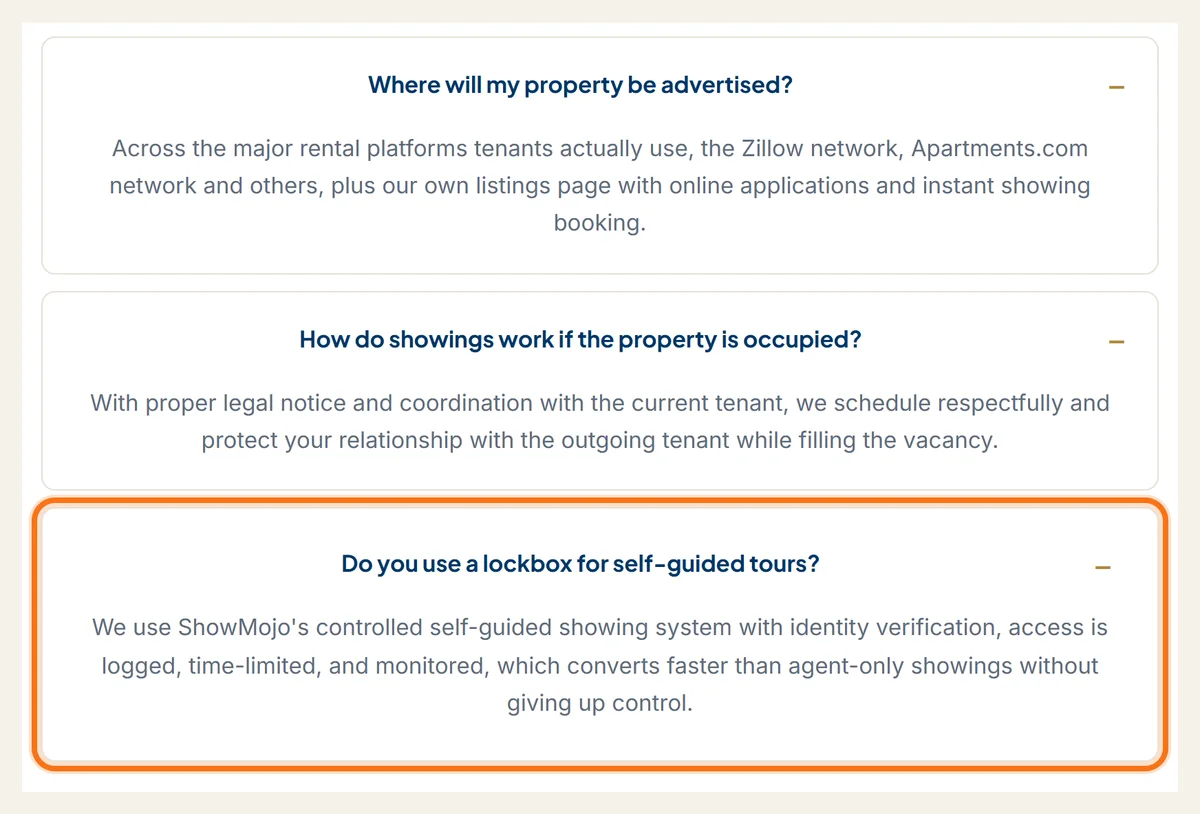
- Our marketing page states self-guided and scheduled showings via ShowMojo, with identity verification and access that is logged, time-limited and monitored.
- Texas has no statute that sets a notice period for showing an occupied rental. The access clause in the lease controls.
- While your home is vacant you get a written activity report every week, with showing feedback and market notes.
How do rental showings work? Once the home is market-ready and listed, a prospect books a time, passes a basic qualification check and tours the home, either on a scheduled showing or on a self-guided one with a one-time access code. On a rental in Fort Worth, Keller or North Richland Hills, a good showing process does two jobs at once: it lets qualified renters see the home quickly, and it keeps unverified people out.
This guide covers the steps in order, both kinds of showing, how to show a rental property that is still occupied, security during the vacancy, and what you should see as the owner.
How a rental showing works, step by step
Here is the path from a live listing to an application on a managed rental, with what happens at each step and what the owner sees:
| Step | What happens | What the owner sees |
|---|---|---|
| 1. The listing goes live | Photos, description and syndication to the major rental sites, once the home is market-ready | The live listing. Ours is up within 5 business days of market-ready, or the first month's management fee is waived |
| 2. A prospect asks to see it | The prospect picks an open time slot on the scheduling link in the listing | Inquiry and showing activity |
| 3. Qualification check | Basic criteria are checked before anyone gets access to the home | Fewer, more serious showings |
| 4. The tour | A scheduled showing, or a self-guided showing with a one-time access code sent to the prospect's phone | Showing feedback in the weekly report |
| 5. The application | The prospect applies online; every adult is screened against the published rental criteria | Applications as they come in |
| 6. The report | While the home is vacant, a written activity report every week with showing feedback and market notes | Whether the price or the condition needs to change |
How to read this table: steps 2 to 4 are the showing itself, and the speed between them is what you are paying a manager for. Steps 5 and 6 are where showings turn into a decision: an application to approve, or a price to adjust.
Showings start with a home that is ready to be seen
A showing can only convert if the home is ready to be seen. That means the make-ready is finished, not mostly finished: clean, lawn cut, bulbs working, blinds hung, air conditioning or heat running, no vendor tools in the garage. A renter who walks into a half-finished house remembers the half that was not finished.
Photos and price do the first filter. Good photos bring showing requests from people who already like the home, and a correctly priced listing brings people who can afford it. The first days of a listing should not be spent showing a home that is not ready. The make-ready guide covers what gets the home to showing condition, and our marketing and showings page covers how the listing is built and syndicated.
Scheduled showings with a person present
On a scheduled showing, someone from the manager's team meets the prospect at the home at a booked time. That is the right approach for a home with a pool or another feature that needs explaining, a home with special access, an occupied home, or whenever the owner prefers it. The person showing the home answers questions, notes the prospect's reaction and explains how to apply.
The cost is scheduling friction. A prospect who wants to see the home at seven tonight and is told Thursday at two may have applied elsewhere by Thursday. That is why many managers pair scheduled showings with self-guided ones. Self-guided showings vs. agent showings compares the two formats side by side.
Self-guided (self-service) showings and how verification works
A self-guided showing, also called a self-service showing or self-showing, lets a verified prospect tour a vacant home alone, at a time they booked, using a one-time access code. Done properly it is safer than the old practice of handing a key to anyone who called, because every entry is tied to an identified person and a time. Done sloppily it is how homes get used for scams.
The controls to ask any manager about:
- Identity verification before a code is issued, so the person at the door is the person who registered.
- Time-limited access: a code that works once, for a booked slot.
- A log of who entered and when.
- Monitoring, so someone follows up when a tour runs long or a door is left unlocked.
Whether self-showing suits your particular house is a separate question, covered in are self-guided rental showings safe for my property.
How to show a rental property while a tenant still lives there
If the current tenant is leaving at the end of the lease, marketing can begin while they are still in the home, which shortens the gap between tenants. It has to be done with care, and it starts with the lease. Texas has no statute that sets a notice period for a landlord to enter or show a rental house; the lease does. A good lease has an access clause that allows showings near the end of the term, with the notice it states.
In practice, how to show a rental property that someone still lives in comes down to four habits: agree a showing schedule with the tenant, give the notice the lease requires before every visit, have a person present for every showing, and never give a stranger an access code while someone's belongings are inside. A tenant who cooperates is doing the owner a favor and should be treated that way.
Can a property manager show my house while the current tenant still lives there covers this case in full, and landlord entry rights in Texas covers the access clause. This is general information, not legal advice.
What showing feedback tells you about the price
Showings are the best market data an owner gets after the listing goes live, and the pattern tells a clear story:
- Many online views, few showing requests: the photos or the price are turning people away before they visit.
- Showings but no applications: the price or the condition does not match what the prospect saw online, and the feedback usually says which.
- Applications from the first few showings: the home is priced right, possibly a little under.
- Nothing at all: the listing is not reaching people, or the price is well off.
There is no number of showings that should produce a lease; the pattern matters more than the count. If the market pushes back on price or condition, you should hear it in week two, with the numbers, not after a vacant quarter. Our marketing page puts the stakes this way: at $2,000 a month in rent, every week of avoidable vacancy costs about $460. Why your rental is not renting walks through each pattern.
Security during the vacancy
A vacant home being shown needs a few protections whichever way it is shown:
- Locks. Texas Property Code 92.156 requires the landlord to rekey the locks operated by a key, card or combination, at the landlord's expense, no later than the seventh day after each tenant turnover date, which the statute defines as the date the new tenant moves in. Rekeying earlier, before the first showing, also takes the old tenant's keys out of play during the vacancy. See Texas security device rules.
- Access. Codes are issued per showing, not shared, and any lockbox comes off when the home leases.
- Utilities. Power and water stay on so the home shows well and the air conditioning protects it in summer.
- Appearance. A mowed lawn and collected mail keep the home from looking empty.
Listing scams are the other risk: someone copies the photos, posts the home elsewhere at a lower rent and collects deposits from strangers. The defenses are one official listing page, one application path and a clear rule that no prospect pays anyone except the manager of record. How property managers protect listings from rental scams has the details.
What the owner should see
You should not have to wonder how the listing is doing. A useful update covers inquiries, showings booked and completed, the feedback from them, applications received and where each one stands, with a recommendation when the pattern calls for a change. Will I get updates on inquiries, showings and applications shows what a good weekly update contains.
Every prospect should also get the same process. The same showing rules and the same written rental criteria apply to everyone who asks to see the home, which is both fair housing practice and the simplest way to run it.
How Perpetual handles this
Perpetual Property Management is broker-owned, with our office at 5755 Rufe Snow Dr in North Richland Hills, and we manage homes in Keller, North Richland Hills, Fort Worth and nearby. What our site states about showings:
- Self-guided and scheduled showings via ShowMojo, so a qualified prospect can tour the same day they find the listing. Our showing page for renters says most showings are self-guided.
- Pre-showing qualification: basic criteria checks before anyone gets access.
- Controlled access: identity verification, and access that is logged, time-limited and monitored.
- Occupied homes: showings are coordinated with the current tenant and scheduled respectfully.
- One listing page: every home we manage is on our own listings page, never on Facebook Marketplace or Nextdoor.
- A weekly written activity report while vacant, with showing feedback and market notes, or that month's management fee is credited.
The guarantees are subject to the Guarantee Addendum and are listed on the guarantees page. What our site does not state: which homes get scheduled showings instead of self-guided ones, who attends a showing of an occupied home, and the hours showings run. Those are confirmed in writing before you sign. To see how we would price and show your home, request a free rental analysis or call 682-593-7033.
The takeaway: Fast, verified showings get the right renters into the home, and the feedback from those showings tells you whether the price is right before the vacancy gets expensive.
Questions owners ask
Are self-guided showings safe for a rental property?
They are when identity is verified before a code is issued, each code is time-limited, entries are logged and someone monitors the activity. Done that way they are safer than handing a key to a caller, and they get qualified renters into a vacant home faster. An occupied home is a different case and should have a person present.
How much notice does a landlord have to give to show a rental in Texas?
Texas has no statute that sets a notice period for a landlord to enter or show a rental house; the lease controls. Read the access clause, give the notice it states before every showing, and agree a schedule with the tenant. This is general information, not legal advice.
Can a property manager show my house while the current tenant still lives there?
Yes, if the lease has an access clause that allows showings, and with the notice that clause requires. Texas has no statute that sets an entry notice period for a rental house, so the lease controls. In practice the manager agrees a schedule with the tenant and has a person present at every showing. Marketing while the tenant is still in place shortens the gap between tenants.
How many showings should it take to rent a house?
There is no fixed number, and the pattern matters more than the count. Several showings with no application usually point to price or condition. Applications from the first few showings mean the home is priced well. Reviewing the showing feedback every week is how a manager decides whether to adjust.
Will I get updates on inquiries, showings, and applications?
You should, without having to ask. A useful update covers inquiries, showings, feedback and applications, with a recommendation when the pattern calls for a change. Under our communication guarantee, you receive a written activity report every week while your home is vacant, with showing feedback and market notes, or that month's management fee is credited.
What are self-service showings?
Self-service showings, also called self-guided showings or self-showings, let a verified prospect tour a vacant rental alone at a booked time, using a one-time access code instead of meeting someone at the door. The prospect is identified before the code is issued, and the entry is logged. They suit vacant homes; an occupied home should be shown with a person present.
How do I show a rental property myself?
Finish the make-ready first, then take inquiries in writing, confirm who is coming before you share the address or a time, and meet prospects in person instead of leaving a key. Give every prospect the same information and the same written criteria. If a tenant still lives there, follow the access clause in the lease and schedule with the tenant.
Related services
Property management in Keller, North Richland Hills and Fort Worth. How full-service management works in Tarrant County →