Key takeaways
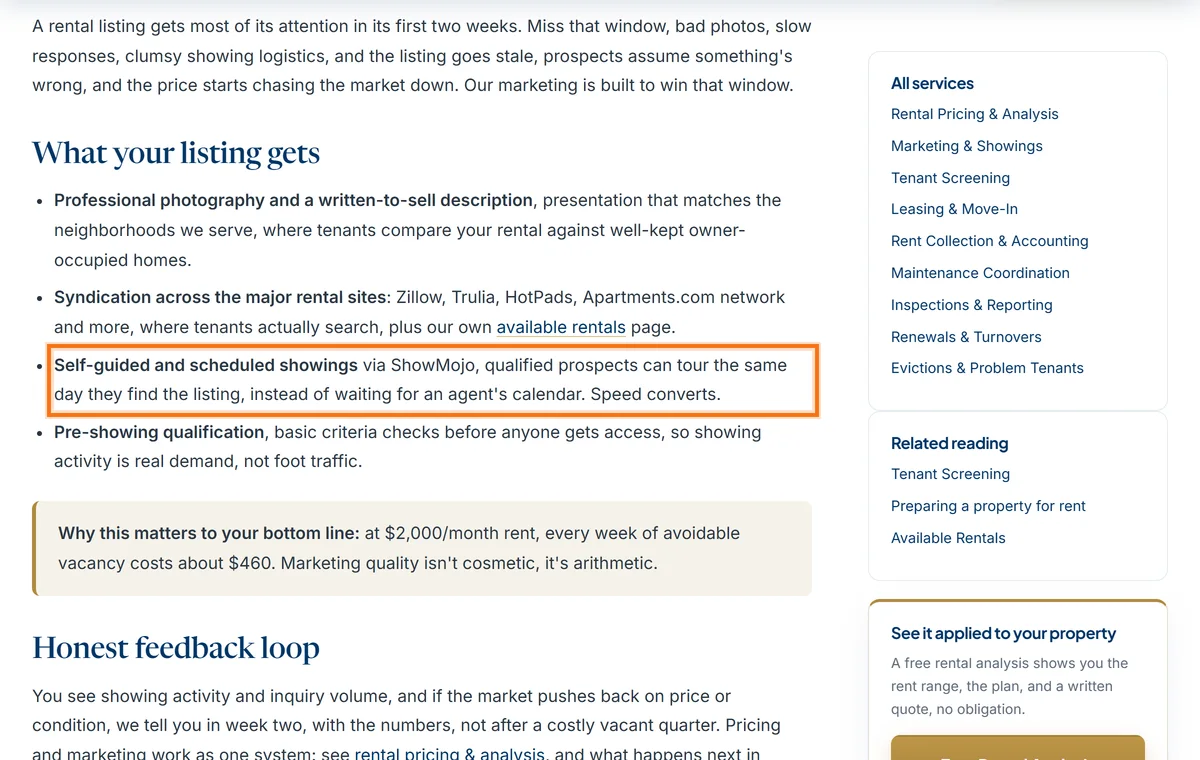
- Self-service showings win on speed: a qualified renter can tour the same day they find the listing.
- Agent showings win on feedback: a person hears why a renter hesitated and reports it.
- Safety depends on verification, not format: ID checked before a single-use, time-limited code, with every entry logged.
- Occupied homes are shown only with an agent, on a schedule agreed with the current tenant.
- Our default for vacant homes is a hybrid: self-guided access for speed, agent showings for serious applicants and feedback.
Self-service showings, also called self-guided showings, let a verified renter tour a vacant rental alone with a one-time access code, so homes get toured and rented faster; agent showings put a person in the home to answer questions and report why a renter passed. For vacant homes in Fort Worth, Keller and North Richland Hills we use both, through ShowMojo, with identity verification before anyone gets access.
The choice between self-guided and agent-led showings is a trade between speed and insight. Self-guided access gets a qualified renter into your vacant home tonight instead of Thursday, and in a market where renters tour two or three homes and apply to the first one that fits, that speed often decides who gets the application. An agent showing gives up some of that speed in exchange for a person who can answer questions, notice hesitation and tell you afterward why the renter did not apply.
Neither format is right for every home or every stage of a listing. This guide compares them on the four things that actually matter to an owner, safety, speed, feedback and verification, and ends with the rule we use to decide. The mechanics of how a showing is run are covered in how showings work when your property is listed for rent; this is about choosing.
Speed: where self-guided showings win outright
A renter who requests a showing at 8 p.m. on a Tuesday is usually looking at several homes at once. If yours can be toured at 7 a.m. the next morning, before work, and the competing home needs an agent on Thursday afternoon, you have a two-day head start on the application. Over a listing's life those head starts add up to fewer vacant days, and vacancy is the largest cost most owners carry.
Self-guided showings also remove the scheduling bottleneck on the manager's side. Rather than one agent covering six showings across three cities, the home shows itself to every verified prospect within the allowed hours, and the agent's time goes to the ones who need a conversation. The practical result is more showings in the first week, which is the week that matters most for pricing feedback and applications. How long it takes to rent a house in DFW explains why the first week carries so much weight.
Feedback: where agent showings earn their keep
After a self-guided showing the renter gets a short survey. Some answer it; many do not, and the ones who do tend to give a rating rather than a reason. After an agent showing, you know. The agent heard the renter say the backyard was smaller than the photos suggested, saw them pause at the primary bathroom, or heard them ask twice whether the owner would consider a lower rent. That is the information that tells an owner whether to adjust price, fix something or hold steady.
Feedback quality is the real cost of going fully self-guided, and it is easy to underestimate. A home that gets twenty self-guided tours and no applications has told you something is wrong, but not what. Ten agent showings would usually have told you which thing.
The way around this is not to abandon self-guided access but to make sure an agent is in the home for a share of the showings, especially in the first week and especially when the pattern is tours without applications. Those visits are where the diagnosis comes from.
Safety: the honest comparison
Owners often assume an agent showing is automatically safer, and in one way it is: a person is present, doors are locked when they leave, and nobody wanders into the attic. But agent showings have historically been run with loose verification, because the agent was the safeguard. Self-guided systems replaced the person with a process, and a well-built process is stricter than most people realize.
The risks that actually hurt owners during a vacancy are a small set:
- Someone gaining access who was never verified, through a shared code or a key under a mat.
- A door or window left unlocked after a tour.
- A scammer touring the home to photograph it and list it elsewhere as their own.
- Damage or theft during a tour with nobody accountable for it.
Self-guided systems answer the first and last with identity-matched, time-stamped, single-use access: every entry ties to a verified name. They answer the second with lock sensors and a daily property check. The third, listing scams, is a risk under either format and is handled by watching for copied listings, which where rental listings get syndicated covers. On balance, a managed self-guided program on a vacant home is at least as safe as agent showings, and considerably safer than an owner handing out a key.
Verification depth: what each format actually checks
The quality of the verification, not the format, is what keeps strangers out of your home. Before a self-guided code is issued, a good system checks a government ID against a live photo, confirms a phone and email, often requires a payment card, and records agreement to showing rules. That is more than most agents collect before meeting a prospect at the door.
Agent showings can match that standard, but only if the manager requires it. Ask what the agent knows about a prospect before unlocking the door. If the answer is "a name and a phone number," the agent format is not providing the safety the owner is paying for with slower showings.
Verification before the showing is also distinct from screening after the application. A verified identity gets someone into a tour; it says nothing about income, rental history or credit. Our tenant screening service handles that stage, and it is the same regardless of how the renter first saw the home.
Self-service vs. agent showings: pros and cons side by side
The factors that matter to an owner, compared:
| Factor | Self-service showing | Agent showing |
|---|---|---|
| Speed | Same day, on the renter's schedule | Waits for an agent's calendar |
| Feedback | A short survey that many renters skip | A person who hears objections and reports them |
| Identity check | ID verified before a one-time code is issued; every entry logged | Only as strict as the manager requires |
| Security after the tour | Lock sensor and a regular property check | The agent locks up in person |
| Occupied homes | Not used | The only format we use |
| Best for | Vacant single-family homes in showing condition | Higher-value homes, homes with features to explain, serious applicants |
How to read this table: neither column wins outright. Self-service showings fill the first week with tours; agent showings explain what those tours are telling you. That is why the hybrid program below uses both on the same vacant home.
Occupied homes: agent showings only
The one bright line is a home with a tenant still living in it. Self-guided access to a home full of someone's belongings is not acceptable, both because the current tenant deserves not to have strangers alone in their home and because the owner would bear the blame for anything that went missing. Every showing of an occupied home is scheduled with the tenant, agent-accompanied, and logged.
This is where the trade-off runs the other way: showings are slower, so the manager compensates by booking them in clusters, giving the tenant a predictable schedule, and using video to let out-of-area prospects pre-qualify themselves before asking for a visit. Pre-leasing before the current tenant moves out covers that process in full.
Which homes suit which format
Beyond occupancy, a few property traits tip the decision:
- Standard single-family home, vacant, in showing condition: self-guided as the default, with agent showings layered on for serious applicants and for feedback.
- Higher-value home, or one in a neighborhood where renters expect a more personal process: agent showings as the default, self-guided as a backup for prospects who cannot make a scheduled time.
- Home with a pool, workshop, well, septic or other feature that needs explaining: agent showings, because an unanswered question at a self-guided tour becomes a reason not to apply.
- Home inside a gated community or building with controlled access: usually agent showings, unless the access system supports verified single-use entry.
- Home with unusual condition or a pending repair: agent showings until the issue is resolved, so the agent can explain it rather than let the renter guess.
For most owners in Keller, North Richland Hills and Fort Worth the first category applies, which is why the hybrid approach is our starting point. Our leasing service adjusts the mix for the specific home rather than running one format for everything.

How a hybrid program runs in practice
Here is what a blended approach looks like on a vacant home from listing day:
- The listing goes live with self-guided access available within set daytime and early evening hours. Every prospect is verified before receiving a code.
- An agent visits the home after the first showing day and again at intervals, checking locks, lights and condition, and resetting anything out of place.
- Prospects who ask questions, request a second visit or say they are ready to apply are offered an agent showing, which is where real feedback is collected.
- At the end of the first week, showing counts, survey responses and agent notes are compared against the price and condition, and the owner gets a recommendation.
- Once an application is approved, self-guided access is switched off and the home is held for the incoming tenant.
The owner can see the showing log and feedback in the owner portal rather than waiting for a weekly summary.
What owners worry about, and what actually happens
The two most common objections to self-guided showings are that someone will damage the home and that renters will not take a listing seriously without a person present. On damage, the record on vacant, verified, logged tours is better than most owners expect; the home is empty, every visitor is identified, and the daily check catches problems the same day. The lock sensor and entry log are what make this format defensible, and an owner should ask to see both.
On seriousness, the opposite tends to be true. Renters who tour on their own schedule, without an agent watching, often spend longer in the home and come back a second time with a partner or parent. Those second visits are strong application signals.
The genuine downside is the one covered earlier: thinner feedback. An owner who wants to know why a renter passed should ask the manager how many showings an agent attends, not whether self-guided access is used at all.
Questions to ask a manager about their showing program
Before signing with any manager, these answers will tell you whether their showing process is built or improvised:
- What is verified before a self-guided code is issued, and can I see a sample entry log?
- Who checks the home after showing days, and how often?
- When does an agent attend showings, and how is their feedback reported to me?
- How are occupied homes shown, and how is the current tenant's schedule respected?
- What happens if a door is left unlocked or a code is shared?
A manager with a real program answers all five without hesitating. If you want to compare notes on how we run showings on homes like yours, reach out and we will walk through it.
The takeaway: Use self-guided access for speed on vacant homes, put an agent in the home when you need answers, and never let anyone tour an occupied home alone.
Questions owners ask
Are self-guided rental showings safe for my property?
On a vacant home with the right process, yes. A good self-guided system checks a government ID against a live photo, confirms phone and email, issues a single-use, time-limited code, records every entry and uses a lock sensor so an unlocked door is caught the same day. The risks that actually hurt owners are unverified access through a shared code or a key under a mat and a door left unlocked, and the process addresses both. An occupied home is shown only with an agent. Perpetual runs a hybrid: verified self-guided access on vacant homes, an agent check after showing days, and agent showings for serious applicants and occupied homes.
Do self-guided showings rent a house faster?
Usually, yes. Renters can tour the same day instead of waiting for an agent's availability, which produces more showings in the critical first week and earlier applications. The trade-off is less detailed feedback on why a renter did not apply.
Can a tenant-occupied home use self-guided showings?
No. A home with a tenant's belongings inside should only be shown with an agent present, scheduled with the tenant and logged. Self-guided access is for vacant homes.
What does an agent showing give me that a self-guided one does not?
A trained person who answers questions on the spot, notices hesitation, and reports back why the renter did or did not apply. That feedback is what tells an owner whether to adjust price, fix a condition issue or hold steady.
Should I ask my property manager which showing method they use?
Ask instead how they decide, what they verify before access, and how feedback reaches you. A good manager uses both formats and chooses by home, occupancy and listing stage rather than running one method for everything.
What is a self-service showing?
A self-service (self-guided) showing lets a verified prospect tour a vacant rental on their own, at a time they book online, using a one-time code for a smart lockbox. The prospect's identity is checked before the code is issued, the entry is logged, and the manager follows up for feedback afterward.
How do self-guided tours verify ID?
Before an access code is issued, a good system checks the renter's government ID against a live photo and confirms their phone and email; the code is single-use and time-limited, and every entry is logged. We use ShowMojo's controlled self-guided showing system with identity verification, with access logged, time-limited and monitored.
Related services
Property management in Keller, North Richland Hills and Fort Worth. How full-service management works in Tarrant County →