Key takeaways
- A tenant who stays after the lease ends is holding over; refusing a written demand for possession is a forcible detainer under Property Code 24.002.
- The notice to vacate is at least 3 days unless the lease sets a different period (Section 24.005(a)), delivered by a method Section 24.005(f-3) allows.
- Only a justice court judgment and a writ of possession, served by a constable, can remove the tenant.
- Changing locks or shutting off utilities can cost one month's rent plus $1,000, damages and attorney's fees (Sections 92.0081 and 92.008).
- Taking rent after the end date without written terms is the mistake that slows everything down.
If a tenant refuses to leave when the lease ends, they are holding over, and in Texas the only lawful way to get the house back is a written notice to vacate followed, if needed, by an eviction suit. For a Fort Worth or Keller home, that suit is filed in the Tarrant County justice court for the precinct where the house sits. You cannot change the locks, remove belongings or cut the utilities, and the police will not remove a tenant without a court order.
What happens next depends on three things: what the lease says about holding over, whether any rent has been accepted since the term ended, and how quickly the notice is served. This guide covers each one, with the Property Code sections that apply.
What a holdover tenant is under Texas law
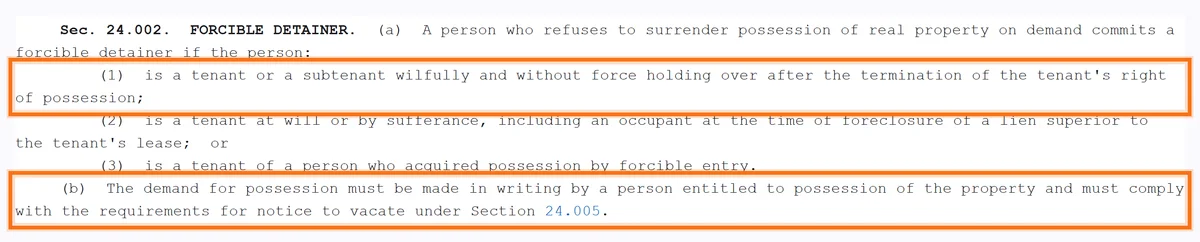
When a fixed-term lease expires and the tenant stays, Texas law does not treat them as a trespasser. They are a tenant holding over. Property Code Section 24.002 says a tenant who refuses to surrender possession on demand, while wilfully holding over after the right of possession ended, commits a forcible detainer, and that the demand must be in writing and meet the notice rules of Section 24.005.
The end date on the lease is not a deadline that enforces itself. It is the point at which the owner's remedies change. Depending on the lease and whether rent is accepted, the tenancy can also turn into a month-to-month tenancy, which needs its own notice under Section 91.001. How a holdover is classified and what rent applies are in holdover tenants in Texas; this guide is about what to do.
What your lease should already say about holding over
A Texas-compliant lease drafted with this situation in mind does three things. It states that the tenant must vacate on the end date unless a renewal is signed. It sets a holdover rent, often a stated increase over the regular rent, that applies for any period the tenant stays without a new agreement. And it says that accepting holdover rent does not create a new term or waive the owner's right to possession.
- Vacate requirement: the tenant agrees to leave on the end date absent a signed renewal.
- Holdover rent: a daily or monthly amount above the regular rent for any period held over, which makes staying expensive rather than free.
- No waiver: acceptance of any payment during a holdover does not extend the lease or create a month-to-month tenancy unless the owner agrees in writing.
- Notice requirements for both sides before the end date, so neither party is surprised, including the notice-to-vacate period that Section 24.005(a) lets the lease set.
If your lease is silent on holdover, the manager should tell you before the end date, because the owner's position is weaker and every step has to be taken more carefully. The checklist for a lease that covers this and the rest of what Texas requires is in what a Texas residential lease must cover.
Why accepting rent after the end date is the main risk
The mistake that costs owners the most is taking a rent payment after the lease has ended without a clear written basis for it. Depending on the lease wording and the circumstances, accepting rent can be argued to create a month-to-month tenancy, which then has to be ended with its own notice before an eviction can be filed. The owner wanted the house back in March and now cannot file until May.
A manager handles this deliberately. If the owner wants the tenant out, no rent is accepted after the end date without written terms stating it is holdover rent accepted without waiver, and the notice to vacate goes out on or before the end date rather than after. If the owner is content for the tenant to stay a little longer, that is put in writing as a short extension with a firm end date, so both sides know where they stand. What the manager never does is let an automatic payment land in the account and sort it out later.
The notice and eviction process for a holdover
Getting the house back follows the same court path as a nonpayment eviction. Here are the steps with the section of the Texas Property Code behind each one.
Holdover eviction steps in Texas
| Step | What the law says | Section | What it means for you |
|---|---|---|---|
| 1. Notice to vacate | At least 3 days written notice to a tenant who holds over, unless the lease sets a shorter or longer period | 24.005(a) | Read the lease notice paragraph first; the lease period controls |
| 2. Delivery | Mail or a delivery service, inside the home in a conspicuous place, hand delivery to a tenant 16 or older, or email if agreed in writing | 24.005(f-3) | Taping the notice outside the door is no longer a listed method since January 1, 2026 |
| 3. Filing | A justice court in the precinct where the property is located hears the eviction suit, started by a sworn petition | 24.004, 24.00505 | For Tarrant County homes, the JP precinct of the house, not of the owner |
| 4. Judgment | A landlord who prevails gets a judgment for possession and a writ of possession | 24.0061(a) | Holdover rent the lease provides can be claimed in the same suit |
| 5. Writ | The writ cannot issue before the sixth day after judgment unless a possession bond is approved; the constable serves it within 5 business days of issue | 24.0061(b), (b-1) | The constable, not the owner, removes the tenant |
How to read this table: each row is a step that has to be done right before the next one starts, and a defect at any step, most often the notice, sends the case back to the beginning. A tenant can appeal the judgment, which adds weeks; the stages are in how long an eviction can take in Texas.
This is general information, not legal advice. Notice periods and court procedures depend on your lease and Texas law, so confirm your situation with an attorney.
What a manager should have done before the end date
Most holdovers are preventable, because most tenants do not refuse to leave out of spite. They stay because nobody told them clearly what was happening, or because their next place fell through and they assumed a few extra weeks would be fine. A manager who runs the renewal process properly removes most of that.
Well before the end date, the manager has either offered a renewal or sent a non-renewal notice, in writing, on the timeline the lease requires. If the tenant is leaving, the manager has confirmed the move-out date in writing, scheduled the move-out inspection and reminded the tenant of the holdover rent in the lease.
If the tenant asks for extra time, the manager has either agreed to a short written extension or said no in writing. By the end date, nobody is surprised, and a tenant who stays anyway has done so against a clear record, which is what the judge will see. For the renewal side of that process, the lease renewal service page explains how Perpetual handles the months before a lease ends.
An example from an owner's chair
Say your Keller house is leased through the end of June, you have decided to move back in, and the manager sent the non-renewal notice in writing in the spring. The tenant acknowledged it, then in the last week of June says their new home is not ready and they will need until August. Rent for July arrives by auto-pay on July first.
A manager handling this well had already turned off the auto-pay authorization at the end of the term, or has the funds returned with a written statement that no rent is accepted beyond the lease end.
The manager offers a written two-week extension at the lease's holdover rate with a firm date, if that suits your plans, or serves the notice to vacate on July first if it does not. Either way, you are told the same day, and the record shows a clear end date and a clear refusal. If the tenant is still there when the notice expires, the eviction is filed with no waiver argument available to them. The eviction service page covers what happens from that point.
How Perpetual handles this
Perpetual Property Management is broker-owned and works from North Richland Hills for owners in Keller, Fort Worth and the rest of northeast Tarrant County. We start renewal conversations well before the lease ends, typically 60 to 90 days out, so a tenant who is leaving has a confirmed date in writing and a tenant who wants more time asks early.
If a tenant will not leave, we follow the process on our eviction service page: a documented conversation first, then the notice Texas procedure requires, served and recorded correctly, the ledger and lease organized for the court, and an attorney experienced in landlord-tenant law where the case calls for one. We are not a law firm. Eviction service is an optional $7.95 a month on the Standard and Investor Special plans and included on Full Service, as our price sheet shows.
If you have a lease ending soon and a tenant who is not making plans to leave, get in touch and we will tell you what should be in writing this week.
The takeaway: A tenant who stays past the lease is a holdover, not a trespasser: no self-help, no rent accepted without written terms, and the notice to vacate served on the end date rather than after.
Questions owners ask
Can I charge a tenant double rent for holding over in Texas?
The holdover rent is whatever the lease provides. Many Texas leases set a holdover rate above the regular rent, sometimes substantially, and it is enforceable as a lease term when clearly stated. Without a holdover clause, the rent during the holdover period is generally the rent under the expired lease. Confirm the enforceability of your clause with an attorney; this is general information, not legal advice.
Does the security deposit cover rent during a holdover?
The deposit is applied at the end of the tenancy to unpaid rent and damage under Texas rules, so unpaid holdover rent can be deducted from it when the tenant finally leaves. It is not a substitute for collecting rent during the holdover, and a long holdover will exceed it. The judgment in a holdover eviction can include the unpaid holdover rent beyond the deposit.
Can a tenant who refuses to leave be removed by the police?
No. A holdover tenant is not a trespasser, and police generally will not remove a tenant without a court order. Under Texas Property Code 24.0061, the lawful removal is a sheriff or constable serving a writ of possession after an eviction judgment. Changing the locks or cutting utilities yourself can make you liable for one month's rent plus $1,000, actual damages and attorney's fees.
What if the tenant says they will leave but keeps pushing the date back?
Put the date in writing as a short extension with holdover rent and a firm end, and serve the notice to vacate if the date passes. Verbal promises that keep moving are the most common way a holdover drags into months. A manager should treat the first missed promised date as the signal to proceed under the lease rather than negotiate a third date.
How much notice does a tenant who will not leave get in Texas?
At least 3 days of written notice to vacate under Texas Property Code 24.005(a), unless the lease sets a shorter or longer period. If the tenancy has become month-to-month, Section 91.001 generally requires a month's notice to end it first. The notice must be delivered by mail, inside the home in a conspicuous place, by hand to a tenant 16 or older, or by email if agreed in writing.
Related services
Property management in Keller, North Richland Hills and Fort Worth. How full-service management works in Tarrant County →