
Key takeaways
- A leasing fee is the one-time charge for placing a new tenant, separate from the monthly management fee.
- Lease-up fee and tenant placement fee usually mean the same thing; a renewal fee is a smaller charge when the same tenant stays.
- Ours is 50% of one month's rent on Full Service and Investor Special and 75% on Standard, charged when a tenant is placed.
- Nothing should be stacked on top of it for marketing, photos, lease preparation or the move-in inspection.
- The application fee is paid by the applicant, not the owner: $60 per adult applicant on our listings.
A leasing fee is the one-time charge a property manager earns for putting a qualified tenant in your house: pricing, marketing, showings, screening, the lease and the move-in. It is separate from the monthly management fee, and in a year with a turnover it is usually the largest single fee you pay. For owners in Fort Worth, Keller and North Richland Hills, ours is 50% of one month's rent on the Full Service and Investor Special plans and 75% on Standard.
Whether a leasing fee is fair depends on what it covers and what gets charged around it. Here is what the term means, what each related fee is, and the questions to ask before you compare quotes.
Leasing fee meaning, and the fees with similar names
In real estate, a lease fee or leasing fee is what an owner pays an agent or manager for finding a tenant and signing a lease. The names overlap, so read the agreement for what each one covers.
Fees that sound alike, and who pays them
| Fee name | What it usually means | Who pays |
|---|---|---|
| Leasing fee / tenant placement fee | One-time charge for pricing, marketing, showings, screening, the lease and the move-in | Owner, when a new tenant is placed |
| Lease-up fee | Usually another name for the leasing fee, sometimes used for filling a vacant or new property | Owner |
| Lease preparation fee | A separate charge for drafting the lease; on a full placement it duplicates the leasing fee | Owner, if the agreement lists it |
| Lease renewal fee | A smaller charge when the same tenant signs a new term | Owner; ours is $149, $200 or $150 by plan |
| Application fee | Covers screening an applicant; required to come with written selection criteria in Texas | Applicant; $60 per applicant on our listings |
How to read this table: the first two rows are the same service under different names, the third is the one to question, and the last two are separate events. Texas Property Code 92.3515 requires a landlord to make the tenant selection criteria available when an applicant gets the application, or return the fee if the applicant is rejected.
What the leasing fee actually pays for
A lease-up is the most labor-intensive stretch in the life of a rental, and the fee is meant to cover all of it. On a properly run lease-up, that includes:
- A rent analysis from leased comps, not asking prices, so the house is priced to move.
- A make-ready walk and a punch list, so the house photographs and shows well.
- Professional photos, a written listing and syndication to the rental sites renters actually use.
- Showings, including evenings and weekends, with identity checks before anyone gets access to a self-guided tour.
- Screening every adult applicant against written criteria: income, credit, rental history, background, and verification calls.
- Drafting the lease and addenda, collecting the deposit and first month's rent, and holding the funds correctly.
- A documented move-in inspection with photos, so the deposit itemization at move-out holds up.
If a manager's fee does not include all of these, ask what you are paying for instead. The details of our process are on the leasing service page.
How leasing fees are usually structured
Most managers charge the leasing fee as a percentage of one month's rent, sometimes the whole month, or as a flat amount. Either can be reasonable. What matters is that you know the number before you sign and that it is charged once per new tenant, not once per lease document.
Our placement fee on a $2,000 rental
| Plan | Placement fee | On $2,000 rent | Monthly fee | Renewal fee |
|---|---|---|---|---|
| Investor Special (5 or more units) | 50% of one month | $1,000 | 7% ($140) | $149 |
| Standard | 75% of one month | $1,500 | 9% ($180) | $200 |
| Full Service | 50% of one month | $1,000 | 10% ($200) | $150 |
How to read this table: $2,000 is an example rent; the percentages and renewal fees are our published price sheet, and the final numbers are confirmed in your written agreement. The placement fee is charged when a tenant is placed, so the first statement on a new tenant is smaller than the rest. Plan your cash flow if the mortgage draft lands before the disbursement.
If you bring your own applicant, see what a manager charges when you find the tenant yourself. Placement-only services charge a leasing fee and nothing else; full-service managers charge it alongside the monthly fee, compared in full-service management vs. tenant placement only.
Why the fee is front-loaded, and what that does to incentives
The work is front-loaded, so the fee is too. A manager might spend more hours in the three weeks of a lease-up than in the following six months combined. Charging for that work at the point it happens is honest accounting, and it is why a lease-up with no leasing fee usually means the cost is buried somewhere else, often in a higher monthly fee or a markup on repairs.
The incentive problem comes when the leasing fee is large and the monthly fee is small. A manager paid mostly at placement is paid for turnover. Every time a tenant leaves, the manager earns again. A manager paid mostly from monthly rent collected is paid for occupancy, and has every reason to keep the good tenant in place.
You do not need to guess which model you are looking at. Compare the leasing fee to twelve months of the management fee. If the lease-up pays the manager more than a year of management does, ask how they handle renewals and what they do to retain tenants.
What should never be stacked on top of the leasing fee
The leasing fee is supposed to be the whole price of placing a tenant. Watch for anything that charges you twice for the same work:
- A separate marketing or photo fee, when marketing is the first thing the leasing fee covers.
- A lease preparation or document fee on top of the fee for leasing.
- A move-in inspection fee, when the move-in inspection is part of placing the tenant.
- A markup on the application fee, which the tenant pays to cover screening costs.
- A setup or onboarding fee that duplicates the leasing fee on your first tenant.
Some of these appear only in the fee schedule attached to the agreement, not in the quote. The full list to check is in hidden property management fees to ask about.
Who keeps the application fee
Applicants pay an application fee that covers the cost of credit, background and rental history checks. It is not an owner expense and not owner income. On our listings it is $60 per applicant, and every adult 18 or older completes a separate application.
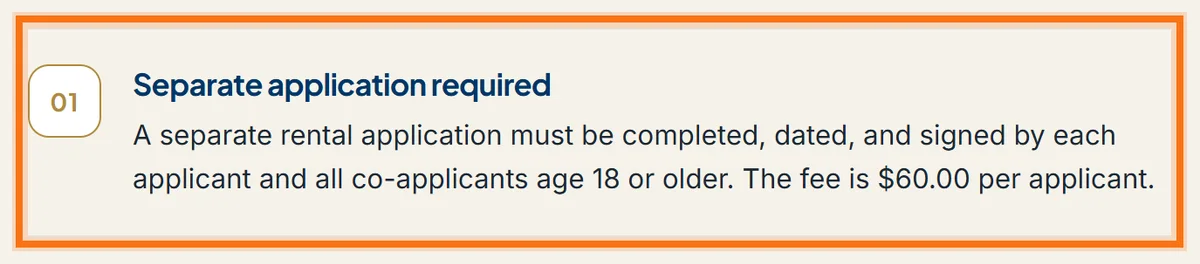
Texas Property Code 92.3515 requires the landlord to make printed tenant selection criteria available with the application; if they were not provided and the applicant is rejected, the fee must be returned. A manager whose criteria are written and applied the same way to everyone is doing the job the fee is meant to fund. The process is in tenant screening and how tenant screening works.
What the fee looks like on one lease-up
Say rent is $2,000 a month on our Standard plan. We price the home from leased comparables, market it, run showings, screen the applicants against written criteria, sign the lease and do the photo-documented move-in report. The placement fee is 75% of one month's rent, $1,500, charged when the tenant is placed. From then on you pay the 9% monthly fee, $180.
If that tenant renews, the next year costs a $200 renewal fee instead of another placement fee. If a tenant we place defaults and is removed, or breaks the lease, within the first 6 months, we find you a new tenant with no additional leasing fee. That is why screening and renewals matter more to your total cost than the fee percentage itself.
Questions to ask about the leasing fee
- Is it a flat amount or a share of rent, and exactly how much?
- When and from what funds is it deducted?
- What is included: photos, listing, showings, screening, lease, move-in inspection?
- Is there any separate fee for marketing, documents, inspection or setup on a new tenant?
- What happens to the fee if the tenant leaves or is evicted in the first few months?
- What do you charge at renewal, and how does that compare?
A manager who answers these without hesitation has nothing to hide in the fee schedule. At Perpetual, every fee is listed in writing before you sign, and the structure is on the pricing and fees page. If you want to see what your house would rent for before you compare fees, start with a free rental analysis.
The takeaway: A fair leasing fee is one number, in writing, that covers the entire lease-up, with nothing charged twice around it.
Questions owners ask
How much do property managers charge to find a new tenant?
Most managers charge either a flat amount or a share of one month's rent, and some charge the whole first month. Perpetual's placement fee is 50% of one month's rent on the Full Service and Investor Special plans and 75% on Standard, charged when a tenant is placed. It covers pricing, marketing, showings, screening, the lease and the move-in inspection, and nothing should be stacked on top of it for marketing, documents or the move-in.
Is the leasing fee charged every year?
No. A leasing fee is charged when a new tenant is placed. If the same tenant renews, you should see either no fee or a smaller renewal fee, not a second leasing fee. If a manager charges the full leasing fee at every renewal, that is a reason to look elsewhere.
Do I pay the leasing fee if the tenant leaves early?
That depends on the agreement, so ask before signing. Under Perpetual's tenant placement guarantee, if a tenant we place defaults and is removed, or breaks the lease, within the first 6 months, we find you a new tenant with no additional leasing fee.
Does the tenant's application fee go to the owner?
No. The application fee covers the cost of running credit, background and rental history checks, and it is paid by the applicant. On Perpetual listings it is $60 per applicant 18 or older. It is not an owner expense and not owner income.
Do I pay extra for rental advertising and professional photos?
You should not, if the leasing fee is doing its job. Marketing is the first thing a leasing fee is supposed to cover, so a separate marketing or photo fee charges you twice for the same work. The same goes for a lease preparation fee, a move-in inspection fee or a setup fee on your first tenant. Perpetual's placement fee covers pricing, marketing with professional photography and syndication, showings, screening, the lease and the move-in inspection.
What is a lease-up fee?
A lease-up fee is usually another name for the leasing or tenant placement fee: the one-time charge for finding and signing a tenant. Some managers use it for filling a newly built or fully vacant property. Read the agreement for what it covers, and make sure it is not charged on top of a separate leasing fee.
Related services
Property management in Keller, North Richland Hills and Fort Worth. How full-service management works in Tarrant County →