Key takeaways
- Managing a rented house for someone else for pay is real estate brokerage in Texas: leasing it, or controlling the rent from a single-family home, takes a license (Occupations Code 1101.002 and 1101.351).
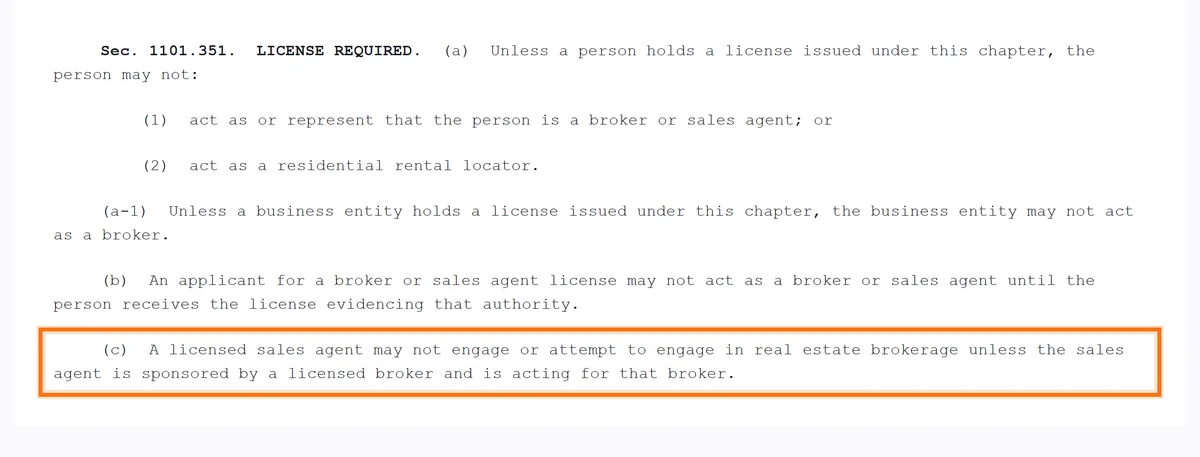
- A sales agent, the license most realtors hold, may do it only while sponsored by a licensed broker and acting for that broker (section 1101.351(c)).
- You may manage your own rental without a license, and so may your employee who leases your property (section 1101.005(8)).
- The existing lease stays in force. A takeover changes where rent goes and who takes repair calls, nothing else.
- A takeover is priced differently than a new placement: the placement fee is charged when a tenant is placed, not when a manager takes over.
A Texas real estate broker, or a sales agent working through one, can manage a house that already has tenants, and you can always manage your own. If you own a rental in Fort Worth, Keller or North Richland Hills, you do not need to wait for the lease to end, ask the tenant to leave or start over with a new lease. The lease you have stays in force and the manager steps in as your agent under it.
This guide covers who needs a license and who does not, whether the realtor who leased the house can keep managing it, what a good takeover looks like, what to have ready and what it costs.
Who can manage a house that already has tenants in Texas
This table shows who may manage a tenant-occupied house in Texas, whether a real estate license is needed and what to check first:
| Who | License needed? | What to check |
|---|---|---|
| You, the owner | No. The license law does not apply to an owner who leases the owner's own real estate (Occupations Code 1101.005(8)) | Whether you can take the calls and keep the deposit records yourself |
| Your own employee | No, for leasing the owner's real estate (1101.005(8)) | That the person really is your employee, not a contractor paid per house |
| A property management company | Yes. It works under a broker's license | The broker's name and an active license in the Texas Real Estate Commission's License Holder Search |
| The sales agent (realtor) who leased the house | Yes, and only while sponsored by a broker and acting for that broker (1101.351(c)) | That the management agreement is in the broker's name and rent goes to the broker's trust account |
| A friend, relative or handyman you pay to collect rent | Yes, if the person controls the acceptance or deposit of rent from a single-family home for pay (1101.002(1)(A)(x)) | Whether the person decides where the rent is deposited or spends from it |
| A co-owner acting for the other owner for pay | Yes, unless exempt (Commission rule 535.5) | Whether that owner is paid to act as the other owner's agent |
How to read this table: the dividing line is acting for someone else for compensation. Managing what you own takes no license. Leasing a house or controlling its rent for another person, for pay, does.
What takes a license: Occupations Code chapter 1101
The Real Estate License Act, Occupations Code chapter 1101, has two kinds of license holder, a broker and a sales agent, and no separate property manager license. It defines a broker as a person who, for compensation, does certain things for another person. Two of them are the core of managing a rented house: leasing real estate, and controlling the acceptance or deposit of rent from a resident of a single-family residential unit (section 1101.002(1)(A)). Section 1101.351 then says nobody may act as a broker or sales agent without a license.
Texas Real Estate Commission rule 535.4 spells out "controls the rent." A person controls it, and must be licensed, if the person has the authority to use the rent to pay for services related to managing the property, to decide where the rent is deposited, or to sign checks or withdraw money from a trust account.
The exemptions are in section 1101.005. The ones owners ask about: an owner, or the owner's employee, who leases the owner's own real estate; an attorney licensed in Texas; and an on-site manager of an apartment complex, which is not a rental house. The full guide to a mid-lease takeover walks through the handover steps in order.
Can a realtor manage a landlord's property after leasing it out?
Yes, but not alone. A realtor who holds a sales agent license can manage the house after leasing it only through the sponsoring broker. Occupations Code 1101.351(c) says a licensed sales agent may not engage in real estate brokerage unless the agent is sponsored by a licensed broker and is acting for that broker. A realtor who is a broker can manage it under that broker's own license.
In practice that means four things you can check before you agree:
- The agreement is with the broker. Commission rule 535.2 says agreements for brokerage services must be solicited and accepted in a broker's name, and it makes the broker responsible for any property management activity by a sponsored sales agent that requires a license.
- The money goes to the broker. Rule 535.146 says a sales agent shall not maintain a trust account, and trust money a sales agent receives must be delivered immediately to the sponsoring broker. Rent and deposits are trust money.
- The agent is paid through the broker. Section 1101.651(b) bars a sales agent from accepting compensation for a real estate transaction from anyone other than the sponsoring broker.
- The broker allows it. A broker sets the scope of each agent's authorized activities in writing, and some brokerages do not take on management at all.
So ask the agent one question: "Is my management agreement with your broker, and does the rent go into the broker's trust account?" If the answer is that rent goes to the agent's own account, stop there. Management company vs. an agent who manages on the side compares the two setups. This is general information, not legal advice.
The five situations that usually bring an occupied house to a manager
Owners rarely hire a manager for a tenanted house on a whim. It usually follows one of these events.
- You bought the house with the tenant in it. You inherited a lease you did not write and a tenant you did not screen, and you need someone to read the lease and establish a relationship with the tenant quickly. The due diligence checklist for buying with a tenant in place covers what to confirm before closing.
- You inherited the house. A parent's long-term tenant may have been paying the same rent for years, sometimes with no written lease at all; how a manager formalizes a tenancy with no written lease covers that case.
- You have been self-managing and want out. The tenant is fine, but you are moving, busy, or tired of being the person who answers the phone.
- The agent who leased it is done. A realtor found the tenant, the lease is signed, and now someone has to collect rent and take the repair calls.
- The tenant has become a problem. Rent is late every month, and you want a professional between you and the tenant.
Each of these calls for a slightly different first month, and a company that asks which one you are in before quoting is paying attention.
What separates a good takeover from a bad one
The difference is almost entirely in the first two weeks. A good manager reads your existing lease before signing anything with you and tells you what it allows: whether the lease permits a management company to act for you, how late fees are set, what the notice periods are, and whether anything in it would be a problem to enforce. If the lease is thin or missing, the manager explains what can be fixed now and what must wait for renewal.
A good manager also handles the tenant with care. The tenant did not choose to switch, and a cold form letter saying "pay us now" invites suspicion. The letter should come from you, name the company, give the new payment method and repair line, and state plainly that nothing in the lease has changed. A company that has done this before will have that letter ready. Who tells the tenant the manager is changing covers what it says.
What changes for the tenant, and what does not
From the tenant's side, three things change: where rent goes, who to call about repairs, and who will show up for inspections. Everything else stays as it was. The rent amount, the lease end date, the pet terms and the deposit amount are all fixed by the lease until it is renewed.
The one thing that can go wrong is a manager who treats a takeover as a chance to enforce every clause at once. Reasonable enforcement starts with written notice and a start date, not with a stack of violation letters in the first week. What a new manager can and cannot change mid lease covers where that line sits.
What you need to have ready before the manager starts
A takeover goes faster when the owner shows up with the paperwork. Gather these before your first meeting.
- The signed lease and every addendum, plus any written changes you agreed to by text or email.
- The security deposit amount and where it is held today.
- A rent ledger, even a simple one, showing what has been paid and when.
- The tenant's contact details, the names of every adult in the house, and any pets.
- Keys, garage remotes, gate codes and any smart-lock logins.
- Open repair requests and the names of vendors who have been in the house.
If some of this does not exist, say so. A manager who has done takeovers will know how to rebuild a ledger from bank records and how to confirm a deposit the tenant says they paid. Property Code 92.103 requires the landlord to refund the deposit within 30 days after the tenant surrenders the home, and section 92.104 requires an itemized list of any deductions, so getting the amount documented now protects you later.
When to make the switch
There is no need to wait for the lease to end. A takeover can start any month, and the cleanest start date is the first of a month so the rent ledger begins on a clean line. If the lease ends within a few months, the renewal becomes part of the takeover, which is the moment to move the tenant onto a current Texas lease.
If the tenant is already behind on rent, do not wait for a better month. A manager can take over rent collection right away and apply the late process in the lease the same way every month, which is what unpaid rent needs first.
What it costs to hand over a house with a tenant in place
Our pricing page lists occupied versus vacant as one of the things that determine a quote, because taking over a tenant in place is a different job than a full placement. The placement fee is charged when a tenant is placed, so it belongs to a later event, not to the takeover itself. This table uses our published plan prices and an assumed rent of $2,000 a month, illustrative only, not a quote:
| Charge | Full Service (10%) | Standard (9%) | Investor Special (7%, 5 or more units) |
|---|---|---|---|
| Monthly management at $2,000 rent | $200 | $180 | $140 |
| Enrollment inspection at takeover | Included with onboarding | $49 | $125 |
| Lease renewal, when the current lease is renewed | $150 | $200 | $149 |
| Tenant placement, only if a new tenant is placed later | 50% of one month's rent: $1,000 | 75% of one month's rent: $1,500 | 50% of one month's rent: $1,000 |
How to read this table: the first two rows apply when we take over an occupied house. The last two are later events that may never happen with this tenant. Plans are negotiable case by case, the final fee is set after the free rental analysis, and your written quote lists every number.
How Perpetual handles this
Perpetual Property Management regularly takes over occupied properties in Keller, North Richland Hills, Fort Worth and nearby cities. We are broker-owned: Justin Brown is a Texas broker and owns both Perpetual Property Management and our affiliated brokerage, so there is one accountable license holder, not a franchise office or a corporate parent.
The takeover follows the order on our switching page. The lease, deposit and records transfer to us, the tenant gets new payment and maintenance instructions, and we complete an enrollment inspection so there is a condition record from the day we start. You stay involved where it counts: you set a pre-approved spending limit for repairs, larger jobs come to you with a description, photos and a recommendation, and renewal decisions are always yours. Statements, documents and disbursement history are in the AppFolio owner portal.
Our property management page covers the ongoing service. How the deposit is held, the reserve amount and the agreement's term and cancellation terms are confirmed in writing before you sign. To talk through a house with a tenant in place, call 682-593-7033.
The takeaway: Any licensed Texas management company can take over a house with tenants in place, so choose one that has done it before, reads your lease first, and handles the tenant with care.
Questions owners ask
Can a property manager take over if my tenant has no written lease?
Yes. A tenancy with no written lease usually runs month to month, and Property Code 92.001 counts an oral agreement as a lease. A manager can act for you under it: confirm the rent, the deposit and what was agreed, then offer a written Texas lease. Either side can end a month-to-month tenancy with at least one month's notice unless a signed writing says otherwise (section 91.001).
Does the tenant have to agree to the new property manager?
No. The lease is between you and the tenant, and you may appoint an agent to act for you under it. The tenant must be told in writing where to pay rent and who to contact, before the next rent date.
Will a new manager raise my tenant's rent right away?
Not during the current lease term, because the rent is fixed by the lease. At renewal the manager compares the rent with leased comparable homes and recommends a figure, which you approve or decline. At Perpetual that work starts 120 days before the lease ends, and the decision is always the owner's.
What happens to the security deposit when a manager takes over?
The money moves from wherever it is held today into the account where the manager holds deposits, and the amount is written down for you and the tenant. If you cannot find a record of it, the manager asks the tenant for proof of payment and compares it with your bank records. The obligation stays yours: the landlord must refund the deposit or itemize deductions within 30 days after move-out (Property Code 92.103 and 92.104).
Can a realtor manage a landlord's property after leasing it out?
Yes, if the realtor is a broker, or a sales agent acting through the sponsoring broker. Occupations Code 1101.351(c) does not let a sales agent do brokerage work alone. The management agreement should be in the broker's name, rent and deposits should go to the broker's trust account, and the agent is paid through the broker. Confirm the license in the Texas Real Estate Commission's License Holder Search.
Do I need a license to manage my own rental house in Texas?
No. Occupations Code 1101.005(8) says the license law does not apply to an owner, or the owner's employee, who leases the owner's own real estate. A license becomes necessary when someone leases the house or controls its rent for another person for compensation.
Which property manager lets single-family landlords stay involved?
Look for one that puts your decisions in writing. At Perpetual you set a pre-approved spending limit for repairs, anything larger comes to you with a description, photos and a recommendation, and the renewal decision is always yours. The original vendor invoice and your statements are in the owner portal, so you can follow every dollar without taking the calls.
Property management in Keller, North Richland Hills and Fort Worth. How full-service management works in Tarrant County →