Key takeaways
- A manager can approve repairs only up to the dollar limit in your management agreement, plus genuine emergencies.
- Texas law sets no approval limit. It does set the landlord's duty: a diligent effort to repair conditions that materially affect health or safety (Property Code 92.052), with seven days presumed a reasonable time (92.056(d)).
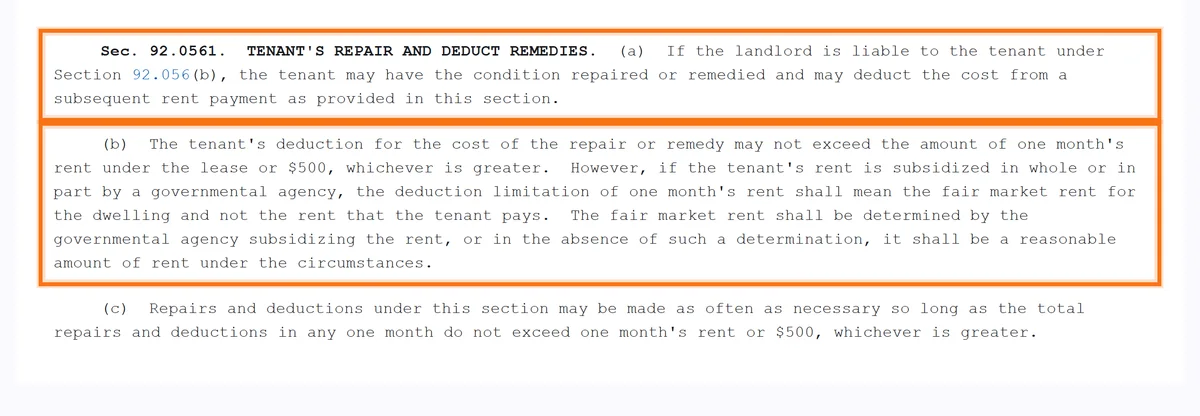
- Refusing a required repair has a price: the tenant may end the lease, or repair and deduct up to one month's rent or $500, whichever is greater (92.0561), and a court can add a civil penalty of one month's rent plus $500 (92.0563).
- Any markup on a repair has to be disclosed: an undisclosed profit on an expenditure made for a client is a ground for license discipline (Occupations Code 1101.652(b)(13)).
- With us, you set a pre-approved limit, larger jobs come to you with a description, photos and a recommendation, and the original vendor invoice is always in your portal.
Only up to the limit you gave them. Every management agreement grants the manager authority to arrange repairs, and nearly every one caps that authority at a dollar amount per repair that the manager may approve on its own. Above the cap, the manager must get your approval first.
The exception is an emergency: a condition that threatens the tenant's health or safety or risks serious damage to the house, where waiting for an answer would make things worse. In that case the manager is expected to act and tell you immediately afterward.
So a manager who approves an expensive repair on your Fort Worth, Keller or North Richland Hills rental without asking has either stayed within the cap, acted in a real emergency, or breached the agreement. Which one it is comes down to the number in your agreement and the definition of emergency next to it. The guide to how property managers handle vendors covers quotes, vendor vetting and invoices; this article is about the authority itself and how to set it.
Who approves which repair on a managed Fort Worth rental
Here is who makes the call for each kind of repair, and what you should be able to see afterward:
| Repair situation | Who approves | What you should see |
|---|---|---|
| Routine repair under your limit | The manager, without asking | The work order and the vendor's invoice on your statement |
| Repair above your limit, not urgent | You, from a quote with photos and a recommendation | Your approval on record before the work is scheduled |
| Emergency above the limit (active leak, no heat in a freeze) | The manager acts to make it safe; you are told right away | The reason it was an emergency, the invoice, and a quote for any further repair |
| Planned replacement (roof, HVAC system, fence) | You, after two or three quotes | The quotes side by side |
| Health or safety repair you would rather skip | Not optional: Property Code 92.052 requires a diligent effort to repair | The manager's written warning about the tenant's remedies |
How to read this table: the first two rows are set by one number, your approval limit. The third row is set by the emergency definition in your agreement. The last row is set by Texas law, and no agreement changes it. If a repair on your statement does not fit one of these rows, ask the manager which one it was.
How the spending limit works in practice
The limit is a per-repair amount. Below it, the manager dispatches a vendor, approves the invoice and pays it from rent or your reserve, and you see it on the monthly statement. Above it, the manager gets a quote, sends it to you with an explanation, and waits for a yes. Most agreements also require the manager to keep a reserve on hand so small repairs do not stall waiting for funds.
Two details decide whether the limit protects you. First, whether it is per repair or per month: a per-repair limit can be exceeded by several repairs in one month, which is normal, but you should know it. Second, whether the agreement has a deemed approval clause, where your silence after a set number of hours counts as a yes. Those clauses keep repairs moving when owners are hard to reach, and they are reasonable if the window is long enough for you to actually respond. Read for both before signing.
What counts as an emergency, and why the definition matters
An emergency clause lets the manager exceed the limit without asking. That is necessary, because a burst supply line at midnight cannot wait for an email reply, but the definition has to be tight or the exception swallows the rule. A sound definition covers conditions that threaten health or safety or will cause serious further damage if not addressed right away: active water leaks, no heat in freezing weather, no air conditioning in dangerous summer heat, gas smell, sewage backup, electrical hazards, a house that cannot be secured.
Texas law adds a reason managers act fast on these. Under Property Code 92.052, a landlord who has been notified of a condition that materially affects the physical health or safety of an ordinary tenant must make a diligent effort to repair it, and 92.056 gives the tenant remedies if the landlord does not. A manager who sits on a no-heat call in January to wait for owner approval is exposing you, not protecting your money.
What you can insist on is that the emergency work is limited to making the situation safe and stopping the damage, with the full repair quoted and approved afterward in the usual way. The guide to rental maintenance emergencies lists the conditions and the response expected for each.
How to set maintenance approval limits so repairs are not delayed but you control bigger expenses
Owners tend to set the limit too low, then get frustrated by a stream of approval requests for small jobs. A limit set so low that every service call needs your sign-off costs you in slower repairs, unhappier tenants and more of your own time, which is what you hired a manager to avoid. A limit set too high leaves you with no visibility until the statement arrives.
A practical way to choose: set it at the level where you would want a phone call before the money is spent. For many single-family owners around Keller, North Richland Hills and Fort Worth that lands somewhere between the cost of a typical service call and a major component replacement. Then pair it with three things:
- A reserve large enough to cover a few repairs under the limit without waiting for rent.
- A rule that any repair above the limit comes with a quote, photos and a plain explanation of why it is needed.
- A second-quote threshold for larger jobs, so expensive work is priced competitively before it reaches you; asking for a second quote before a major repair explains where that threshold belongs.
Say the limit is set at a level that covers a plumbing service call but not a water heater replacement. The manager fixes the leaking valve the same day and sends you the invoice on the statement; the failed water heater comes to you as a quote with a photo and a recommendation, and you approve it in an hour. That is the system working.
If a manager has already spent beyond the limit
Start with the agreement, not the phone. Confirm the limit, the emergency definition and any deemed-approval clause. Then ask the manager in writing for the work order, the invoice, the photos, and the reason the work qualified as an emergency or as approved. If the work was a genuine emergency and the amount is in line with the invoice, the manager did its job, even if the number stings. If it was not, you have a breach, and the usual remedies are a credit on your next statement, a reduction to what the work should have cost, or, if the pattern repeats, termination for cause.
Keep it factual. A manager that overstepped once by acting fast on a borderline call is a different case from one that routinely dispatches expensive work without approval. The first is worth a conversation and a tightened definition; the second is a reason to leave. Check the invoice too: under Occupations Code 1101.652(b)(13), a broker who takes an undisclosed commission, rebate or direct profit on an expenditure made for a client risks the license, so any coordination charge should match what the agreement states. We describe how we handle approvals on the maintenance service page, and the original vendor invoice is always in the owner portal.
What you cannot refuse, even above the limit
The limit controls when the manager can spend without asking. It does not let you decline repairs the law requires. Under Property Code 92.052, once a tenant who is current on rent reports a condition that materially affects the physical health or safety of an ordinary tenant, the landlord must make a diligent effort to repair it, and 92.056(d) presumes seven days is a reasonable time.
If you refuse to approve the fix, the manager cannot simply pass your refusal on to the tenant. After the notice steps in 92.056, the tenant may terminate the lease, have the condition repaired and deduct the cost from rent, or go to court. The deduction is capped at one month's rent or $500, whichever is greater (92.0561), and a court can order the repair, reduce the rent, and award a civil penalty of one month's rent plus $500, actual damages and attorney's fees (92.0563).
A manager may also be entitled to end the agreement instead of carrying that liability, and a good one will tell you so plainly. Our inspection service exists partly so these conditions are found and quoted before they become urgent. This is general information, not legal advice; a Texas attorney can confirm how the repair statutes apply to a specific situation.
How Perpetual handles this
At Perpetual Property Management you set a pre-approved spending limit, and it is agreed with you in advance. Routine repairs under that limit get fixed fast. Anything larger comes to you with a description, photos and a recommendation. Tenants report issues through their portal with photos, which lets us triage before dispatching anyone, and all of our plans include 24/7 emergency response.
You can check every job yourself. What was reported, what was done and what it cost are documented in your owner portal, the original vendor invoice is always there, and every completed repair over $500 gets photo or video proof under The Perpetual Promise, subject to its Guarantee Addendum. Our maintenance coordination charge is a stated percentage of the vendor's invoice (5% on Full Service, 4.9% on Standard), listed on the pricing page and confirmed in writing before you sign.
Perpetual is broker-owned, with our office at 5755 Rufe Snow Dr in North Richland Hills, and we manage homes in Keller, North Richland Hills, Fort Worth and nearby. To talk through the right limit for your rental, call 682-593-7033.
The takeaway: A manager can only approve repairs up to the limit you set, plus genuine emergencies, so choose the number deliberately, define emergency in writing, and check every invoice against both in your portal.
Questions owners ask
What is a typical repair approval limit in a property management agreement?
There is no legal standard in Texas; it is whatever you and the company write down. Agreements commonly set a modest per-repair amount for single-family rentals, with higher limits for owners who prefer fewer approvals. Choose the amount at which you would want a call before the money is spent, and pair it with a reserve that covers a few repairs under that amount.
Can I require my property manager to get multiple quotes for a big repair?
Yes, and most agreements allow it above a stated amount. Put the threshold in writing so there is no argument about when a second quote is required. Be realistic about emergencies, where waiting for a second bid could worsen the damage, and about very specialized work where few vendors are available. For planned replacements such as a roof, HVAC system or fence, two or three quotes is a reasonable expectation.
Does a property manager have to tell me about every repair?
Every repair should appear on your monthly statement with the invoice, and most owners see the work order in the portal when it is opened. What the manager does not need is your approval for each one below the limit; that is the point of the limit. If you want notice of every repair as it happens, ask for it, but expect that to slow things down compared with reviewing the statement.
What if I disagree with a repair the manager made under the limit?
Ask for the work order, photos and invoice and compare them with the tenant's original request. If the work was needed and priced fairly, there is not much to dispute, even if you would have chosen a different vendor. If the work was unnecessary or overpriced, raise it in writing and ask for a credit. A pattern of unnecessary repairs under the limit is a reason to lower the limit or change managers.
How do I set clear maintenance approval limits with my property manager?
Put four things in the agreement: a per-repair dollar limit the manager may approve alone, a short written definition of emergency, a rule that anything above the limit comes with a quote, photos and a recommendation, and a second-quote threshold for large planned work. Repairs under the limit then move without delay, and you still control the bigger expenses.
Can a tenant fix a problem and deduct the cost if I refuse to approve the repair?
In some cases, yes. If the condition materially affects health or safety and the tenant follows the notice steps in Property Code 92.056, section 92.0561 lets the tenant have it repaired and deduct the cost from rent, up to one month's rent or $500, whichever is greater. The tenant may instead end the lease or ask a court for a penalty of one month's rent plus $500.
Related services
Property management in Keller, North Richland Hills and Fort Worth. How full-service management works in Tarrant County →