Key takeaways
- Sort every review by who wrote it. Tenants grade the experience of renting; owners grade results.
- Complaints about deposits, denials and late fees often mean the lease was enforced. Complaints about ignored repairs and unreturned calls are owner problems too.
- A federal rule, 16 CFR Part 465, makes fake reviews, paid-for sentiment and hiding negative reviews unlawful. It does not verify any single review for you.
- A review can be anonymous. A complaint to the Texas Real Estate Commission must be written and signed, and the license status is public on trec.texas.gov.
- Responsiveness is easier to judge from a written commitment with a remedy than from a star average.
A property management company has two customers who want opposite things. The owner wants rent collected on time, the lease enforced and the deposit applied to real damage. The tenant wants flexibility on all three. Both write reviews about the same company on the same page. So if you own a rental in Fort Worth, Keller or North Richland Hills, the first step is to sort each review by who wrote it, and only then judge it.
That is why a star average tells you very little. This guide shows how to read past the rating to the pattern, what federal law says about fake reviews, and which public record to check beside them. For the wider list of warning signs before signing, see property management red flags.
What each kind of review tells an owner
This table sorts the most common review themes by who writes them, what each one usually means for an owner, and what to check outside the reviews:
| What the review says | Usually written by | What it tells an owner | What to check outside the reviews |
|---|---|---|---|
| A deposit deduction was unfair | Tenant | Often the lease was enforced | Ask for a sample itemized move-out statement; Property Code 92.104 requires a written, itemized list of deductions |
| The application was denied | Applicant | Written criteria were applied | Read the company's published rental criteria |
| A late fee was charged | Tenant | The lease was enforced | Read the late-fee clause in the sample lease |
| A repair was ignored for weeks | Tenant | A service failure that reaches you | Ask how repairs are documented and what you see for each one |
| Nobody returns calls | Tenant or owner | A service failure that reaches you | Call the office yourself; ask for the response time in writing |
| A specific result: a vacancy filled, a hard handover | Owner | Useful, because it can be checked | Ask about that situation in the interview |
| "Great company, highly recommend" | Anyone | Nothing you can use | Give it no weight in either direction |
How to read this table: the first three rows are complaints an owner can often read as good news, provided the company's reply is calm and specific. The next two are the ones to count. The last column matters most: a review is one person's account, the documents are the company's own.
Tenants and owners are grading different things
A tenant who leaves a one-star review is grading the experience of renting: how fast repairs happened, how the deposit was handled, whether anyone picked up the phone. An owner is grading results: vacancy days, rent collected, the condition of the house at move-out, how clearly the statements read.
Those expectations overlap on repairs and collide on deposits. The tenant who lost part of a deposit to carpet damage is unhappy, and the owner whose carpet got paid for is not. So first identify who wrote the review. Tenants mention their lease, their landlord, their deposit. Owners mention their property, their rent, their statement. Sort before you judge.
Tenant complaints that mean the company works for the owner
Some complaints are, from your chair, evidence of a company doing its job. Read these without alarm, as long as the company's reply is professional and specific:
- Deposit deductions for damage beyond normal wear, with the tenant disputing what counts as damage. Texas Property Code 92.104 requires a written description and itemized list of deductions, and a company that itemizes carefully will still be argued with.
- Denied applications. Consistent written screening criteria produce denials, and some denied applicants write reviews. The tell is whether the complaint describes an inconsistent or unexplained process, or simply an unwelcome outcome.
- Late fees charged as the lease states. A tenant upset about a late fee after paying on the sixth is upset about the lease, not the manager.
- Notices for lease violations, such as an unauthorized pet or occupant, followed by a review about being treated unfairly.
- Rent increases at renewal, which are the owner's decision executed by the manager.
Tenant complaints that should worry you too
Other tenant complaints describe failures that reach you directly, because a tenant who is not served well leaves, and a turnover costs you vacancy, make-ready and a new placement. Treat these as owner problems in disguise:
- Repair requests that went unanswered for weeks, with no explanation. That tenant is not renewing, and the problem is probably getting worse in your house.
- Nobody answers the phone or returns messages. If tenants cannot reach the company, neither can the plumber, and eventually neither can you.
- Move-in condition was poor and never corrected. The make-ready was skipped, which means the next one will be too.
- Deposit accounting that arrived late or not at all. Property Code 92.103 sets a 30-day refund deadline after the tenant surrenders the home, and a company that misses it for tenants is exposing its owners.
One review in any of these categories is noise. Three across different months with the same theme is data.
How to judge whether a company is responsive and reliable once tenants move in
Owners ask what to look for to judge whether a property management company is actually responsive and reliable once tenants move in. Reviews help with half of that. In tenant reviews, look for time: how long between the repair request and the repair, and whether anyone called back.
The other half is not in the reviews. Ask each company these four questions, and ask where the answer is written:
- How fast do you answer an owner's call or email, and what happens if you miss it?
- What do I receive while the house is vacant, and how often?
- By what date each month is my rent paid out?
- What proof do I get that a repair was done?
A company that is reliable puts numbers on those answers. A promise with a deadline and a remedy can be checked every month. A reputation for being responsive cannot. Our guide to how management guarantees work explains how to read the remedy.
What owner reviews tell you, and what they leave out
Owner reviews are the ones that speak your language, so read them closely but skeptically. The useful ones describe a specific situation and outcome: a vacancy filled in a stated window, an eviction handled start to finish, a hail claim coordinated, a difficult takeover from a previous manager, a statement that finally made sense. Specifics are hard to fake and easy to compare.
The less useful ones are warm and vague. "Great communication, highly recommend" could describe any company on any day. A page full of those, posted within the same few weeks, may simply mean the company asked its clients for reviews. That is not a negative on its own, but it is not evidence either.
What owner reviews rarely mention is anything the owner never saw. An owner who was never told a repair invoice carried a markup will not review the markup. For that, you need the agreement and the fee list, not the reviews. Hidden property management fees covers what to look for in writing.
Patterns that matter: repetition, timing and drift
A single review, good or bad, is one person on one day. The pattern is what you are reading for. Three questions bring it out:
- Does the same complaint repeat across different reviewers and different months? One tenant furious about a deposit is Tuesday. Eight tenants describing deposit accounting that arrived late is a process failure.
- Has the tone changed over time? Sort by newest. Old praise followed by recent complaints about unreturned calls is a warning. Old complaints followed by recent praise often means a fix happened.
- Do owner and tenant reviews agree? When owners praise the maintenance coordination and tenants complain that repairs are slow, one of those groups is seeing something the other is not. Usually the tenants are closer to the house.
Write down the themes as you go. If you cannot state a company's real strengths and weaknesses in a sentence each by the end, the reviews are not telling you much, and the star average will not either.
What federal law says about fake and filtered reviews
A federal rule now covers reviews directly: the Rule on the Use of Consumer Reviews and Testimonials, 16 CFR Part 465, published by the Federal Trade Commission in August 2024. It treats star ratings as reviews even when they carry no text (section 465.1). Among other things, the rule treats each of these as an unfair or deceptive practice:
- a business writing, creating or selling a review that misrepresents that the reviewer exists or had experience with the business (465.2);
- a business giving compensation or other incentives conditioned on a review expressing a particular sentiment, positive or negative (465.4);
- an officer or manager reviewing the business without clearly disclosing the relationship (465.5);
- a business presenting its own review page as most or all of the reviews submitted while suppressing reviews because of their rating or negative sentiment (465.7);
- using a groundless legal threat or intimidation to stop a review or have it removed (465.7).
Two limits matter when you read a review page. First, a general request to all customers for reviews is not what the rule targets: section 465.2(d) carves such reviews out of its bought-review and insider-review paragraphs. A burst of reviews proves little either way. Second, the rule does not verify any review for you. Read reviews on the platform where they were posted, not only the selection a company quotes on its own site. This is general information, not legal advice.
The company's replies are the most honest part of the page
Owners reading reviews often skip the replies. They are the most honest evidence on the page, because the company wrote them under pressure and in public. You learn how a company treats a complaint by watching it handle one.
A good reply is short, specific and non-defensive. It acknowledges what happened, says what the company did, and invites a direct conversation without disclosing private details.
A bad reply tells you more than the review did. Sarcasm, accusations, a wall of text relitigating the lease, or silence under every negative review: each of those is how that company will handle a dispute with your tenant, and eventually with you. You are hiring the person who wrote the replies.
A ten-minute review audit you can do today
Here is the process, in order, for each company on your shortlist:
- Open the reviews and sort by newest. Read the most recent twenty, noting for each whether it was a tenant or an owner.
- For tenant complaints, tag each as enforcement (deposit, denial, late fee, violation) or service failure (repairs, communication, move-in condition, missing accounting).
- Count the service failures. One or two with a reasonable reply is normal. A cluster on one theme is not.
- Read the owner reviews for specifics. Write down any outcome you can ask about in an interview, such as a vacancy filled, an eviction handled or a takeover in the middle of a lease.
- Read every company reply under a negative review. Decide whether you would want that tone used with your tenant.
- Sort by lowest rating and skim for anything you did not see in the newest twenty.
Bring the themes to the interview and ask about them directly. The interview scorecard gives you a place to record the answers.
Check the record a review cannot give you: the Texas license
A review can be anonymous and costs nothing to write. The licensing record is different. Leasing and managing homes for owners is done under a Texas broker license, and the Texas Real Estate Commission publishes a License Holder Search on trec.texas.gov. Search the company and the broker by name or license number and confirm the status is active. Our license verification guide shows the steps.
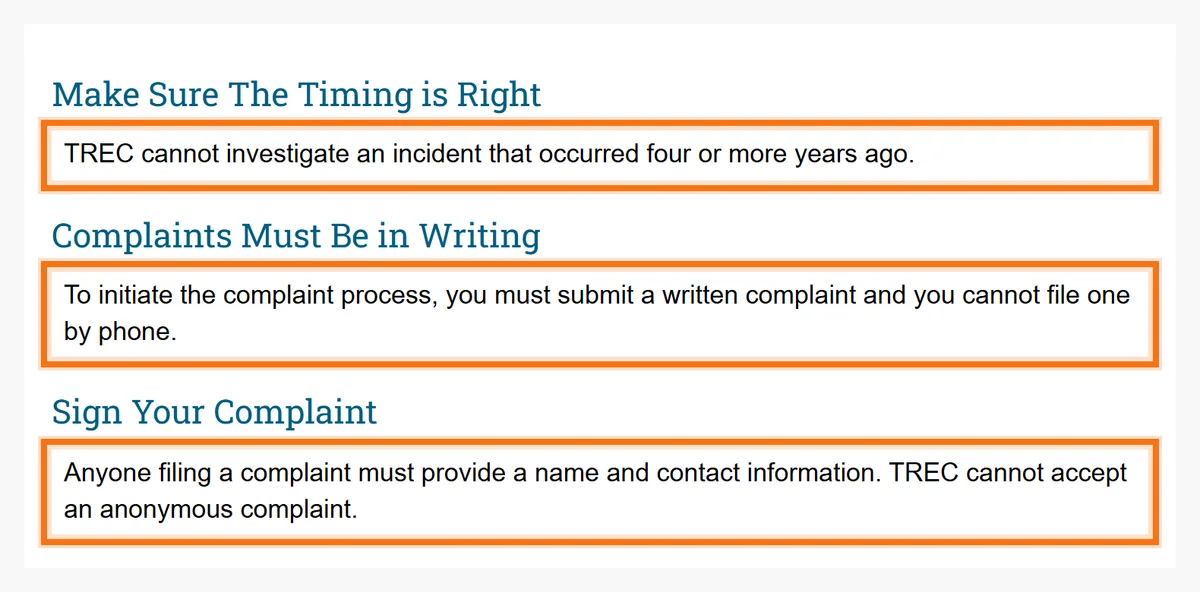
The Commission's complaint page explains what stands behind that record. Anyone can file a complaint against a license holder, but it must be written, filed through the Commission's online portal and signed with a name and contact information. The Commission says you should hear within 30 days whether it is moving forward. Discipline can include a reprimand, an administrative penalty, or suspension or revocation of the license.
The same page lists the limits. The Commission cannot order a license holder to pay you damages, and it generally does not handle personal or contractual disputes. It also says it has no jurisdiction over rude or unprofessional comments on social media unless they involve discrimination in a real estate transaction. So a hostile reply tells you about character. It is not a licensing matter.
How Perpetual handles this
Read ours the way this guide describes. Our reviews page shows excerpts from our public Zillow profile with the original reviewer usernames, and links to the full profile. They are a selection, and several describe home sales and purchases handled by Justin Brown through our affiliated brokerage. Open the full profile and judge the pattern yourself.
For responsiveness, we would rather be held to a document than to a rating. The Perpetual Promise puts it in the management agreement: calls and emails answered within one business day, a written activity report every week while your home is vacant, and rent we collect disbursed by the 10th. If we miss one, that month's management fee is credited or waived, subject to the Guarantee Addendum. Every completed repair over $500 gets photo or video proof in your portal.
The rest is public too: the rental criteria every applicant is measured against, the price sheet, and our broker license numbers in the site footer. Who answers after hours and who your day-to-day contact will be are confirmed in writing before you sign. Bring any review you want explained and call 682-593-7033.
The takeaway: Sort every review by who wrote it, tag tenant complaints as enforcement or service failure, read the company's replies as a sample of its character, and bring the themes to the interview instead of trusting the star average.
Questions owners ask
Are bad tenant reviews a red flag for a property management company?
Not by themselves. Complaints about deposit deductions, denied applications and late fees often mean the company enforces the lease for its owners. Complaints about ignored repairs, unreturned calls and missing deposit accounting are a different matter, because those tenants leave and turnover costs the owner.
How many reviews should a property manager have?
Enough to show a pattern across more than one season, and there is no magic number. Volume mostly reflects how many homes a company manages. Weigh repeated themes, the detail in owner reviews and the tone of the company's replies over the raw count or the star average.
Should I pay more attention to landlord reviews or tenant reviews?
Read both, for different things. Weigh owner reviews that describe a specific result and discount the vague ones. Sort tenant reviews: complaints about deposits, denials and late fees often mean the lease was enforced, while complaints about ignored repairs and unreturned calls are owner problems in disguise.
What does it mean if a property manager never replies to reviews?
Usually that nobody owns the task, which is a small sign of how complaints are handled generally. Silence is better than hostility, but a company that responds briefly, specifically and without defensiveness is showing you how it will treat a dispute with your tenant.
Can I ask a property manager about a negative review?
Yes, and you should. Bring two or three specific reviews to the interview and ask what happened and what changed. A company that knows its own weaknesses will answer directly.
How do I judge whether a property management company is responsive and reliable once tenants move in?
Look for time in the reviews: how long repairs took and whether calls were returned, repeated across different months. Then ask for the response time, the vacancy reporting, the payout date and the repair proof in writing, with what happens if each is missed. A written commitment with a remedy is a better test than a star rating.
Are fake reviews illegal?
A federal rule, 16 CFR Part 465, makes it an unfair or deceptive practice for a business to write or buy fake reviews, to pay for reviews conditioned on a positive or negative sentiment, or to present its own review page as complete while suppressing negative reviews. The rule does not check individual reviews for you, so read them on the original platform. This is general information, not legal advice.
Related services
Property management in Keller, North Richland Hills and Fort Worth. How full-service management works in Tarrant County →