
Key takeaways
- You should see the vendor's own itemized invoice on every repair, without asking.
- Photos matter most on the jobs you may have to prove later: roof, plumbing, HVAC, anything charged to a tenant.
- A markup or coordination fee is legitimate when it is disclosed in the agreement. An undisclosed profit on an owner's expense is grounds for discipline of a Texas broker (Occupations Code 1101.652(b)(13)).
- The portal, the monthly statement and the year-end summary should agree with each other.
- At Perpetual the original vendor invoice is always in your portal, and every completed repair over $500 gets photo or video proof.
You should see the original vendor invoice on every repair, and photos of the finished work on any job of size, without having to ask. That is the standard to hold a property manager to on a rental in Fort Worth, Keller or North Richland Hills. Documentation is how you know what you paid for, how you prove a deposit deduction, how you file a warranty or insurance claim, and how your CPA treats the expense.
This guide describes what a complete repair record looks like, where it should live, how to read a repair line on your statement, what Texas license law says about undisclosed markups, and the signs that the record you are getting is thinner than it should be.
The default should be yes, and you should never have to ask
A repair in a managed home produces a paper trail whether or not anyone shares it. The tenant's request has a timestamp. The vendor wrote up a work order and an invoice. The technician took photos on a phone. The manager paid someone from your account. Every piece exists. The only question is whether the manager's system captures all of it and whether you can see it.
The right standard is that every repair closes with the vendor's original invoice visible in the owner portal, with photos attached on the larger jobs, by the time the charge appears on your statement. If you have to email to request an invoice, the system is not doing its job. If you request it and it arrives as a summary line from the management company rather than the vendor's own document, ask the follow-up question in the red flags section below.
What a complete repair record contains
Here is a full record for one repair on a Tarrant County rental, say a water heater that failed on a Tuesday, with why each piece matters:
| Piece of the record | What it shows | Why you need it |
|---|---|---|
| Tenant's request | Date, time, description, the tenant's photos | Starts the clock; shows how fast the response was |
| Triage notes | What was asked, what the tenant tried, urgent or routine | Explains the dispatch decision |
| Work order | Scope sent to the vendor and any approval limit | Shows what was authorized |
| Owner approval | When you were asked and when you answered, if over your limit | Proves the spending limit was respected |
| Before photos | The failed unit, the leak, the damage | Supports a tenant charge or an insurance claim |
| Vendor's original invoice | Labor and materials, on the vendor's own document | Lets you check any markup; needed for warranty and taxes |
| After photos | The finished work and the data plate on new equipment | Registers the warranty; shows the job as left |
| Close-out | Date, amount charged to you, expense category | Ties the job to your statement and Schedule E |
How to read this table: not every job needs every row. A furnace filter delivery does not need before photos. A roof repair, a slab leak or any job you may later charge to a tenant or claim on insurance needs all of it, because those are the jobs you will have to prove. If a row is routinely missing on large jobs, ask the manager which step of their process produces it.
Why the original invoice matters, not a summary
The vendor's own invoice tells you four things a summary cannot. It shows the labor and materials breakdown, so you can see whether a markup was added and how much. It carries the vendor's name, which you need if the work has to be warrantied or redone. It carries the parts detail that a manufacturer warranty or an insurance adjuster will ask for. And it is the document your CPA will want if an expense is ever questioned.
On markups, Texas license law draws the line at disclosure. Under Occupations Code 1101.652(b)(13), the Texas Real Estate Commission may suspend or revoke the license of a broker who accepts, receives or charges an undisclosed commission, rebate or direct profit on an expenditure made for a principal. A stated coordination percentage in your management agreement is disclosed. A padded invoice is not. The original is how you check the charge against the markup described in your agreement.
There is one more reason. If a tenant disputes a deposit deduction for damage, the Justice Court judge will want to see what the repair actually cost, from whoever actually did it. A management company's internal charge line is weaker evidence than a plumber's invoice with a photo of the broken fixture.
What good repair photos show
Photos are not decoration. They answer specific questions a year later when nobody remembers the job. A useful photo set shows:
- The problem as found: the failed part, the stain, the leak source, the broken fixture.
- Anything hidden during the work: a corroded fitting behind a wall, a rotted subfloor, the inside of a unit before it was replaced. Once it is closed up, the photo is the only proof.
- The finished result, from the same angle as the before shot where possible.
- Data plates on new equipment: model, serial, manufacture date. This is what registers the warranty and what the next technician asks for.
- Any condition the technician noticed that was not part of the job, such as a tenant's unauthorized pet, a dryer vent packed with lint or a water stain on a ceiling elsewhere. Vendors are the manager's eyes between inspections.
If a repair touched something the tenant may be charged for at move-out, the before photo is what makes the charge stick. Documentation on repairs and documentation on inspections are the same discipline applied at different moments.
Where it should live: portal, statement, year-end
The record belongs in three places that should agree with each other. In the owner portal, each work order should open to show the full chain described above, searchable by date and by category, so you can pull every HVAC visit on the house in one view. On the monthly statement, each repair appears as a line with the vendor name, a short description and the amount, with the invoice attached or linked; how to read the rest of the statement is in the owner statement explained. At year-end, repairs roll into an expense summary by category that matches the sum of the monthly lines, which is what goes to your CPA.
Ask to see a real example of all three during your first conversation with a manager, with another owner's details hidden. The portal demo tells you more about a company's maintenance practice than anything they say about it.
Reading a repair line on your statement
Take an illustrative line: "Plumbing, kitchen drain line cleared, ABC Plumbing, $245." The questions you should be able to answer from the attached record, in under a minute:
- Who reported it and when, and how long until the vendor arrived?
- Was it tenant-caused? If a drain was packed with grease or a toy, the lease may allow the cost to be charged back to the tenant, and the photo is what supports that.
- Does the $245 match the vendor invoice, and if not, what is the difference and where is it disclosed?
- Is this the second drain call on this house in a year? If so, the record should show a recommendation, not just another invoice.
If any of those answers takes an email and a two-day wait, the record is incomplete. If the manager cannot answer the second question at all, the house is paying for tenant behavior that should be billed to the tenant.
Red flags when the paperwork is thin
A few patterns tell you the documentation practice is weak before anything goes wrong:
- Invoices on the management company's letterhead only. Sometimes the company has an in-house maintenance arm, which is fine if disclosed and itemized. If every repair comes from the manager's own name with no vendor behind it and no breakdown, ask who did the work and at what rate.
- "Misc repairs" or "service call" lines without a description. Every charge should say what was done.
- No photos on larger jobs. A technician with a phone has no excuse. Ask what dollar amount triggers photos; ours is $500.
- Invoices that arrive only at year-end, or only on request, or as a bundle PDF with no link to the individual charge.
- Repairs you learn about from the statement rather than from a notice when the work order opened, especially above your approval threshold.
None of these proves anything improper. All of them mean you cannot verify what you are paying for, and an owner who cannot verify is relying on trust alone. The fee schedule should make the maintenance charges clear; if it does not, ask for the fee list in writing before signing.
What to ask before you sign
Four questions settle this in the first meeting. Will I see the vendor's original invoice on every repair, attached to the charge, in the portal? Will I see before and after photos, and on which jobs? How soon after a job closes does the record appear, and before or after the charge hits my statement? And if the company does any work in-house, how is it itemized and priced compared with an outside vendor?
A manager with a real system answers all four in a minute and offers to show you. A manager who hedges on any of them is telling you what your statements will look like.
How Perpetual handles this
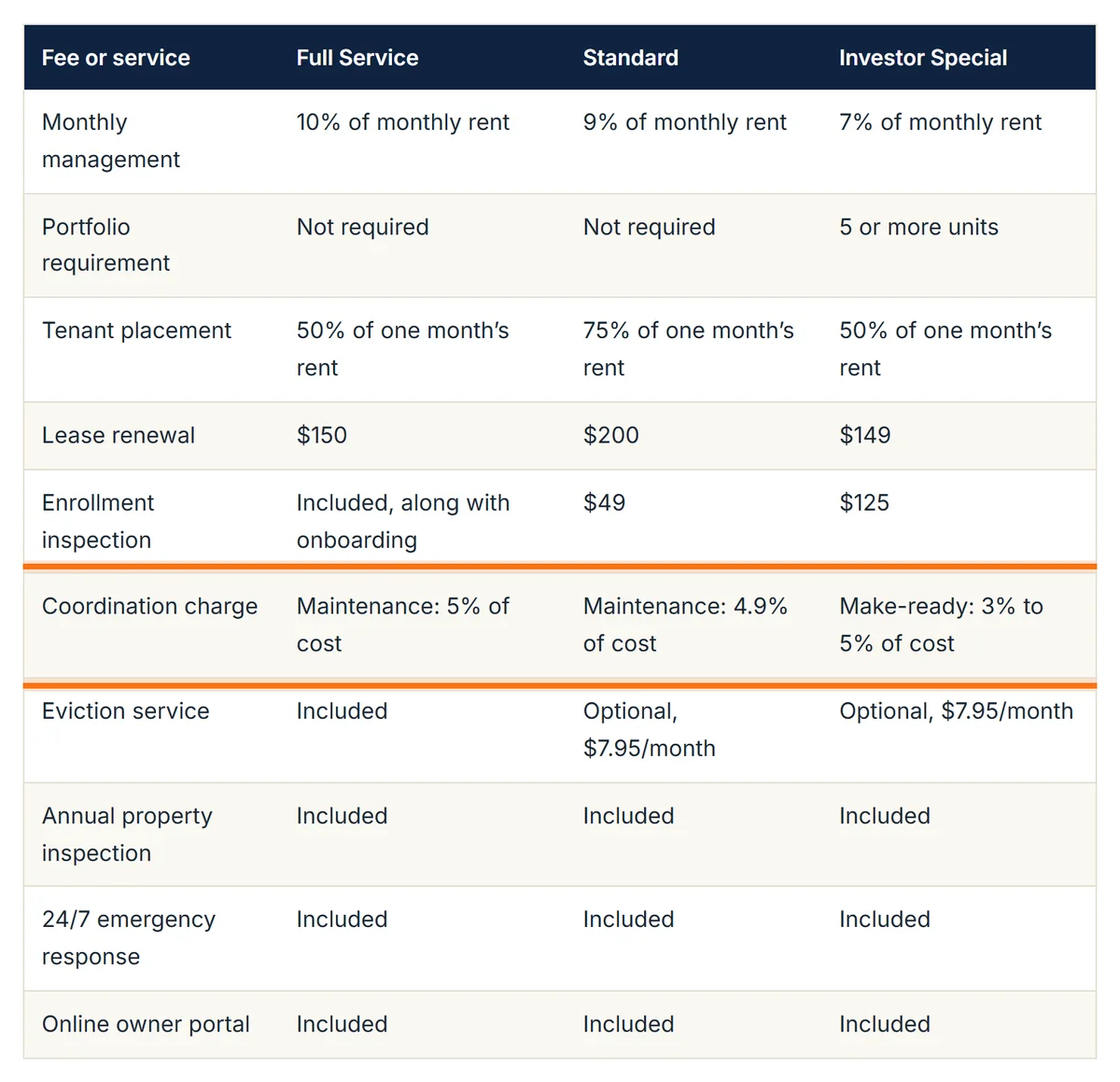
Our numbers on this are published. When we coordinate maintenance on a home in Keller, North Richland Hills or Fort Worth, the original vendor invoice is always in your AppFolio owner portal. The coordination charge is a percentage of that vendor invoice and is on the price sheet: 5% of cost on the Full Service plan and 4.9% on Standard, with make-ready coordination at 3% to 5% on Investor Special.
Photos are a written guarantee, not a habit. Under our Documented Work Guarantee, every completed repair over $500 gets photo or video proof in your portal, and every move-in and move-out gets a 360-degree condition inspection. If a fee is not in your management agreement, you do not pay it. The guarantees are part of The Perpetual Promise and subject to its Guarantee Addendum.
The process behind it is on our maintenance page: tenants report issues through their portal with photos, repairs under your pre-approved spending limit get fixed fast, and anything larger comes to you with a description, photos and a recommendation. What was reported, what was done and what it cost are visible in your portal, and statements and year-end reporting export from it for your CPA. To see how this would work on your house, contact us or call 682-593-7033.
The takeaway: A repair you cannot document is a repair you cannot prove, and the vendor's original invoice with photos is the difference between paying for work and paying for a line on a statement.
Questions owners ask
Will I see the original repair invoices and photos of completed work?
With a well-run manager, yes: the vendor's own itemized invoice on every repair, in the owner portal and reflected on your monthly statement, without you having to ask, and photos on the larger jobs. At Perpetual the original vendor invoice is always in the portal and every completed repair over $500 gets photo or video proof. If a manager offers only its own summary line, ask who did the work and request the vendor document.
Does a property manager keep repair invoices for my taxes?
A good one does, and makes them available to you in the portal year-round and in a year-end export by expense category. You should still download and keep your own copies, since you, not the manager, are the one who has to support the deduction if it is ever questioned. Confirm with your CPA which records they want retained and for how long.
What if the repair invoice is from the manager's own maintenance company?
In-house maintenance is legitimate if it is disclosed in the management agreement, the invoice is itemized by labor and materials, and the rates are stated. Ask how in-house pricing compares with outside vendors and whether you can require an outside bid above a certain amount. The red flag is an unitemized charge from the manager's own name with no explanation.
How long should repair records be kept on a rental?
Long enough to cover deposit disputes, warranty claims, insurance claims and tax questions, which in practice means for the life of the equipment and for as long as your CPA advises keeping expense support. Keep the full record for major systems such as roof, HVAC, water heater and plumbing for as long as you own the house, because the next buyer and the next technician will ask.
Should I be notified before a repair is done on my rental?
For routine repairs under the authority limit in your management agreement, most owners prefer to be notified when the work order opens and see the record at close rather than approve each one. Above the limit, the manager should ask before proceeding except in a genuine emergency. Make sure the limit and the emergency exception are in writing.
Can a Texas property manager mark up repair invoices?
Yes, if the charge is disclosed. A coordination fee or markup written into the management agreement is legitimate. What Texas license law targets is the hidden kind: Occupations Code 1101.652(b)(13) lets the Texas Real Estate Commission discipline a broker who accepts, receives or charges an undisclosed commission, rebate or direct profit on an expenditure made for a principal. Ask for the vendor's original invoice to check.
What does Perpetual charge to coordinate a repair?
Maintenance coordination is a percentage of the vendor's invoice: 5% of cost on the Full Service plan and 4.9% on the Standard plan, with make-ready coordination at 3% to 5% of cost on the Investor Special plan. The original vendor invoice is always in your owner portal, plans are negotiable case by case, and every number is confirmed in writing before you sign.
Related services
Property management in Keller, North Richland Hills and Fort Worth. How full-service management works in Tarrant County →