Key takeaways
- A setup fee is fair when it is written into the agreement, charged once per property and tied to work you can see.
- The first inspection with dated photos is the part of onboarding most worth paying for.
- Texas requires a property manager to hold your rent in a trust account, not mixed with its own money (Occupations Code 1101.652(b)).
- Locks must be rekeyed within 7 days after each tenant turnover (Property Code 92.156), so keys are part of onboarding.
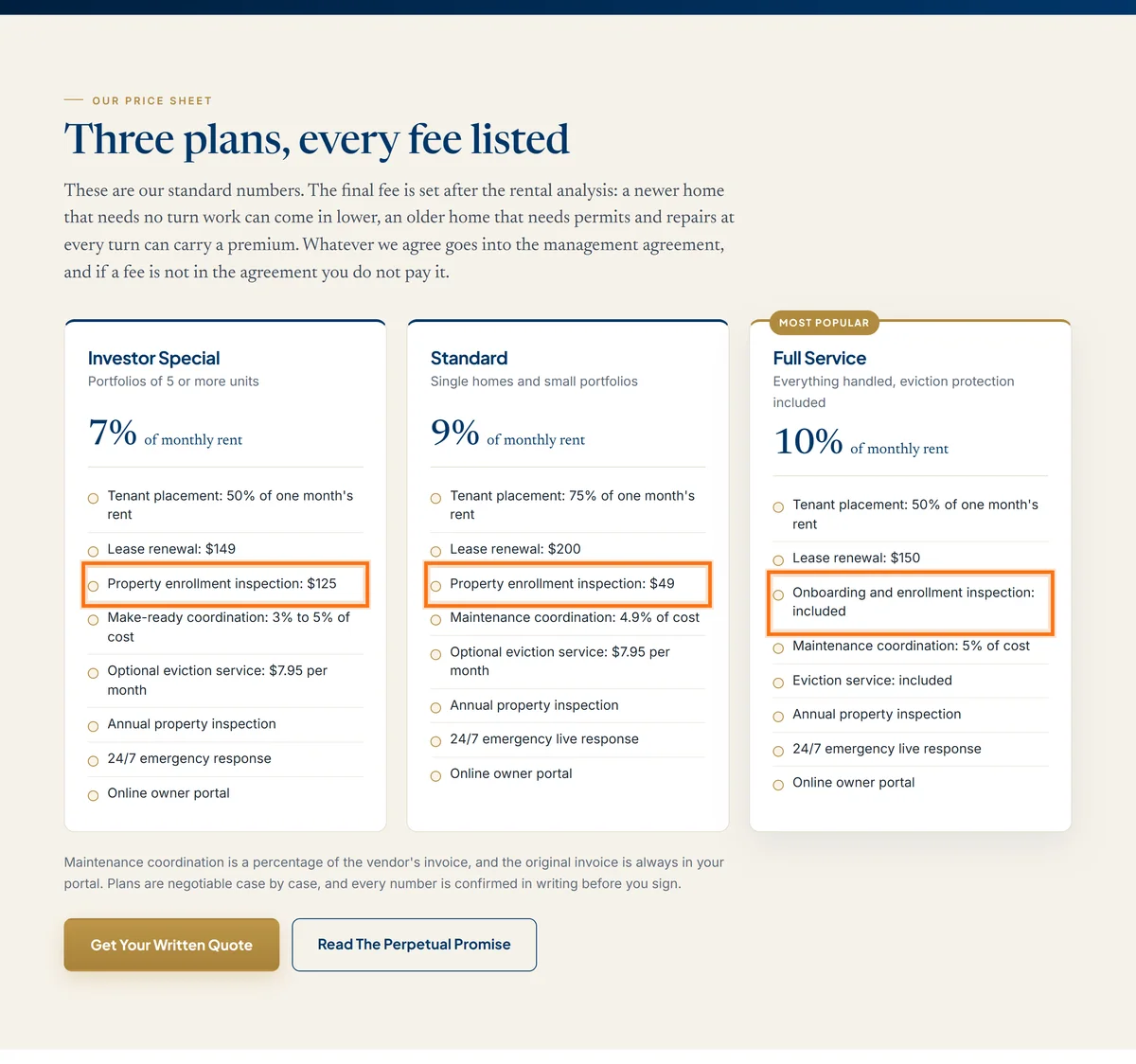
- Our enrollment inspection is $49 on Standard, $125 on Investor Special and included on Full Service.
A property management setup or onboarding fee pays for the work of taking on your rental: your owner account and trust ledger, the lease and deposit records, keys, a first inspection with photos and the introduction of any tenant in place. For an owner in Fort Worth, Keller or North Richland Hills, the test is simple: within the first weeks you should be able to see what the fee bought. If an inspection report with photos, a reviewed lease and a working owner portal show up, it bought something.
This guide walks through what onboarding involves, what we charge for it, and the situations where a setup fee is reasonable, negotiable or padding.
What onboarding a rental actually involves
From the outside, taking on a property looks like signing an agreement and waiting for rent. From the inside, it is a checklist that has to be completed in order before the first month runs cleanly. Skipping a step creates a problem that surfaces months later, usually as a deposit dispute or a maintenance call nobody has keys for.
Here are the main pieces and what you should have in hand when each is done:
| Onboarding step | What you should receive | Why it matters |
|---|---|---|
| Owner account and trust ledger | An owner portal login, your disbursement date and reserve in writing | Your rent is held in trust; errors here show up as statements that do not reconcile |
| Document collection and lease review | Confirmation of the lease, addenda, deposit amount and tenant ledger | A deposit or late fee that does not match the lease becomes your dispute |
| Keys and access | A record of keys, codes and remotes, and a rekey where copies are unknown | Property Code 92.156 requires rekeying within 7 days after each tenant turnover |
| First inspection | A report with dated photos of every room, systems and exterior | The baseline every later deposit and repair decision is measured against |
| Tenant introduction (occupied homes) | Confirmation the tenant has new payment and maintenance instructions | The first rent payment goes to the right place |
How to read this table: the middle column is your checklist. If a setup fee was charged and the items in that column have not reached you, ask what the fee paid for. The order matters too: a manager who markets a vacant home before inspecting it is marketing a home they have not seen.
What onboarding costs on our Fort Worth area plans
Our price sheet does not list a separate setup fee. The one-time charge when a home enrolls is the enrollment inspection, and what it costs depends on the plan:
| Plan | Monthly management | Enrollment inspection at the start | Tenant placement, when a new tenant is placed |
|---|---|---|---|
| Standard (single homes and small portfolios) | 9% of monthly rent | $49 | 75% of one month's rent |
| Investor Special (5 or more units) | 7% of monthly rent | $125 | 50% of one month's rent |
| Full Service (eviction service included) | 10% of monthly rent | Included, along with onboarding | 50% of one month's rent |
How to read this table: the third column is what onboarding costs you on day one. Tenant placement is not an onboarding fee; it applies only when we place a new tenant, so an occupied takeover does not trigger it at the start. Every number is confirmed in writing before you sign, and the final fee is set after the rental analysis.
Account setup and the trust ledger
Your money will move through a trust account that holds client funds separately from the manager's operating money. In Texas this is not optional: Occupations Code 1101.652(b) lets the Texas Real Estate Commission discipline a license holder who commingles another person's money with their own or fails to properly account for or remit it. Setting you up means creating your owner ledger inside that account, linking your bank details for disbursements, recording your tax information for year-end reporting and setting your reserve and disbursement date.
If you own several rentals, the work is per property: each home needs its own ledger so rent, deposits and repairs are reported door by door. That is real administrative work, and errors here produce statements that do not reconcile months later.
What you should receive: a login to the owner portal, confirmation of your disbursement schedule and reserve, and a copy of the signed agreement with every fee in it. Our owners are paid by the 10th of each month under our on-time payout guarantee.
Document collection and lease review
Where a tenant is already in the home, onboarding is mostly a document job. The manager needs the signed lease and every addendum, the move-in condition report, the security deposit amount and where it is held, the rent ledger showing what has been paid and when, any notices sent or received, pet records, HOA rules and the tenant's contact details.
Collecting those is one task. Reviewing them is the valuable one. A real lease review flags the things that will bite later: a deposit recorded at one figure and held at another, a late fee clause that does not match what has been charged, a pet that is not on the lease, a renewal date two months away that nobody has planned for. The mechanics of transferring a tenant are covered in taking over management with a tenant in place.
For a vacant home the document list is shorter: deed or proof of ownership, insurance declarations, HOA documents, mortgage lender details if required, warranty paperwork for any systems and appliances, and any permits or inspection history. The review here is about what the manager needs before marketing: is the insurance a landlord policy, does the HOA require tenant registration, is there a lease restriction on the subdivision.
Keys, codes and physical access
Nobody thinks about keys until a water heater fails at nine on a Saturday and the vendor cannot get in. Onboarding should collect every key, remote, fob, mailbox key and gate code, label them, and record them in the property file. Where the manager cannot confirm who holds copies of the current keys, rekeying is the responsible step, and Texas Property Code 92.156 already requires the owner to rekey within 7 days after each tenant turnover.
Smart locks and lockboxes get their own line: who owns the device, what codes exist, and how tenant codes are rotated. A manager who takes this seriously will tell you on day one how a vendor will get in during an emergency and how a tenant lockout is handled after hours.
Ask where your keys are kept and who can sign them out. If the home has a garage door opener or an alarm system, the codes belong in the file too, with a note on who else knows them.
This is a modest amount of work, and a setup fee that leans heavily on it is leaning on the wrong thing. The inspection is where the value is.
The first inspection is the part worth paying for
Of everything in onboarding, the first inspection is the item that most justifies a fee, because it creates the baseline every later decision depends on. For a vacant home it drives the make-ready list and the rent recommendation. For an occupied home it records the condition on the day the manager took responsibility, so that wear that happened under the previous arrangement is not blamed on the new manager, or on the tenant, later.
A real first inspection is done in person by someone on the manager's staff and produces a report with dated photos of every room, the exterior, the roofline from the ground, the water heater and HVAC, under every sink, and any existing damage. You should be able to open that report in your portal. Our inspection program starts from that photo baseline, and the enrollment inspection on our plans is separate from the 360-degree condition inspection we do at every move-in and move-out.
If the manager's version of a first inspection is asking the tenant to send photos, or a drive-by, then the setup fee is paying for something you did not get. Ask to see a sample first-inspection report from another property before you sign. It is the quickest way to know what you are buying.
Tenant introduction and the first rent cycle
With a tenant in place, onboarding includes a written introduction: who the new manager is, where rent is now paid, how maintenance requests are submitted, and that the lease terms do not change. The tenant also gets a portal login and, ideally, a call. The quality of this step shows up in whether the first month's rent arrives on time to the right place.
Good managers also use this moment to reset expectations that may have slipped under self-management: rent due date, late fee enforcement, the maintenance request process. Done well, the tenant experiences the change as an upgrade. Done badly, the first rent payment goes to the old address and the first maintenance request goes to your cell phone.
What happens across the first month after this point, from marketing to the first statement, is laid out in your first 30 days with a property manager.
When a setup fee is fair and when it is padding
A setup fee is fair when four things are true: it is stated in writing before you sign, it is charged once per property, it is tied to work you can see delivered, and it is not also charged under another name. A manager who meets those four is simply pricing real labor, and many good companies do.
It becomes padding in recognizable patterns:
- A setup fee plus a separate first-inspection fee plus a separate lease-review fee. That is one onboarding billed three times.
- A setup fee charged per property on a portfolio where the documents, the owner account and the banking are shared.
- A setup fee that is not reduced for a takeover from another manager, where the file arrives mostly complete.
- A setup fee charged again if you add a property, or if you leave and come back.
- A setup fee with no first inspection report behind it.
There is also the opposite case to be aware of. A company that charges nothing to onboard and then performs no first inspection has not saved you money. It has skipped the baseline, and you will pay for that at the first deposit dispute.
What to ask before you agree to one
Five questions settle most setup fee conversations. Ask them by email so you have the answers in writing.
- What specifically is included in the setup fee, item by item?
- Is a first inspection with a photo report included, and may I see a sample?
- Is the fee per owner or per property, and what happens when I add a second home?
- Is it reduced or waived when I am transferring from another manager with a complete file?
- Is there any other fee in the first sixty days beyond this and the leasing fee?
Then compare the answer to the full list of fees that tend to hide in an agreement so you know the setup fee is the only one-time charge in play. Whatever the answer, every fee should sit on one page in the agreement before you sign it. On our side, if a fee is not in the management agreement, you do not pay it, and our full-service process is described on the property management page.
The takeaway: A setup fee is worth paying when it buys a documented first inspection and a clean handover, and worth questioning when it buys a welcome email.
Questions owners ask
Is there a setup fee when I hire a property manager?
Some companies charge one and some do not, so ask before you sign. Where a setup fee exists, it should be a one-time charge per property covering the owner account and trust ledger, document collection and lease review, keys, a first inspection with dated photos, and the introduction of any tenant in place. Perpetual's price sheet lists no separate setup fee; the one-time charge at the start is the enrollment inspection, $49 on Standard, $125 on Investor Special and included on Full Service.
Is a property management onboarding fee negotiable?
Often, especially when you are transferring from another manager with a complete file, bringing more than one property, or signing a longer initial term. Rather than asking for a discount, ask what the fee includes and whether a first inspection report is part of it.
Should I pay a setup fee if the home already has a tenant?
Onboarding an occupied home is real work: lease review, deposit reconciliation, tenant introduction and a condition inspection. A fee can be fair for that. What is not fair is a full setup fee plus separate charges for the inspection and the lease review.
What should I receive after paying a setup fee?
An owner portal login, a copy of the signed agreement with the fee schedule, a first inspection report with dated photos, and confirmation of your reserve and disbursement schedule. With a tenant in place, you should also have confirmation that the tenant has been introduced and knows where to pay. If none of that appears within two weeks, ask what the fee paid for.
How much does onboarding cost with a property management company?
It varies by company, so get every one-time charge in writing before you sign. With Perpetual, the one-time charge when a home enrolls is the enrollment inspection: $49 on the Standard plan, $125 on the Investor Special plan for 5 or more units, and included with onboarding on the Full Service plan. Tenant placement is charged only when we place a new tenant.
Property management in Keller, North Richland Hills and Fort Worth. How full-service management works in Tarrant County →