Key takeaways
- A rental analysis (also called a rent analysis or rental analysis report) is a written rent estimate built from homes that actually leased, not from asking prices.
- A real report has six parts: leased comps, adjustments for your house, a rent range with a recommended start, demand notes, make-ready guidance and a written management quote.
- A single confident number with no comps behind it is a sales pitch.
- Ours is free, typically arrives by email within one business day, and is yours to keep whether or not you hire us.
- Our final management fee is set after the rental analysis, and every number is confirmed in writing before you sign.
What is a rental analysis? It is a written estimate of what your house will rent for, based on what comparable houses nearby actually leased for, adjusted for your house's condition and features. For a rental in Fort Worth, Keller or North Richland Hills, a good one also tells you what to fix before listing and exactly what management would cost. A bad one is a phone call with a flattering number and a contract attached.
Most management companies offer a rental analysis for free, so it is the first piece of work you get to judge them on. Here is what should be in the report and how to check each part.
What a rental analysis report should include
These are the six parts of a real rental analysis report, what each one should show, and the question to ask when one is missing:
| Part of the report | What it should show | Ask this if it is missing |
|---|---|---|
| Leased comparables | Similar homes near yours that actually leased, with the rent each one leased for | Are these leased homes or active listings? |
| Adjustments for your house | What moves your number up or down against the comps: condition, updates, parking, yard, school zone | Why is my house above or below these comps? |
| A rent range | A low and a high figure, with a recommended place to start inside it | What happens at the top of the range, and at the middle? |
| Demand notes | How fast comparable homes are leasing in your neighborhood right now | What is this based on, and how recent is it? |
| Make-ready guidance | Which fixes raise the rent or shorten the vacancy, and which just cost money | If I only do two things, which two? |
| A written management quote | Every fee the company can charge, with the amount or the formula next to each | Is any fee missing from this page? |
How to read this table: the first four rows are the rent estimate, the fifth is the plan for the house, and the sixth is the price of the service. If a company sends only a number, you have the result of an analysis without any way to check it.
What a rental analysis is, and what it is not
A rental analysis, sometimes called a rent analysis or a rental market analysis, answers one question: what will this house lease for, to a qualified tenant, in today's market? It is prepared by a property manager or broker, usually at no charge, and it should arrive in writing.
It is not three other things it gets confused with:
- An online rent estimate. That is a formula applied to public data. It has never seen your kitchen. Is a free rental analysis more useful than an online rent estimate compares the two.
- An appraisal. An appraisal is an opinion of what the house would sell for, usually ordered for a loan. A rental analysis is about rent.
- A promise. No analysis guarantees a rent or a lease date. It is an estimate with its evidence attached, which is exactly why the evidence matters.
All six parts in the table above fit on a few pages. A number produced without looking at the house, or at current photos of it, is a guess with a logo on it.
Leased comps, not listed comps
The most common way a rent analysis goes wrong is by using active listings as comparables. Active listings are what other owners are hoping for. Leased comps are what renters actually paid. In a neighborhood where three houses are listed high and sitting, an analysis built on those three will tell you to list high and sit with them.
Ask where the comps came from and whether they are leased or listed. A page of current listings shows you the competition, which is useful, but it is not the comp set. Do property managers use actual leased homes or advertised rents goes deeper on where leased data comes from.
Condition adjustments: why two houses on the same street rent differently
Two houses with the same floor plan on the same street in North Richland Hills can lease for different rents, and the difference is usually condition and features: an updated kitchen, covered parking, the yard, the school zone. A real analysis names each adjustment and its direction. It should say, in plain words, that your house sits toward the top of the range because of the renovated kitchen, or toward the bottom because the carpet needs replacing.
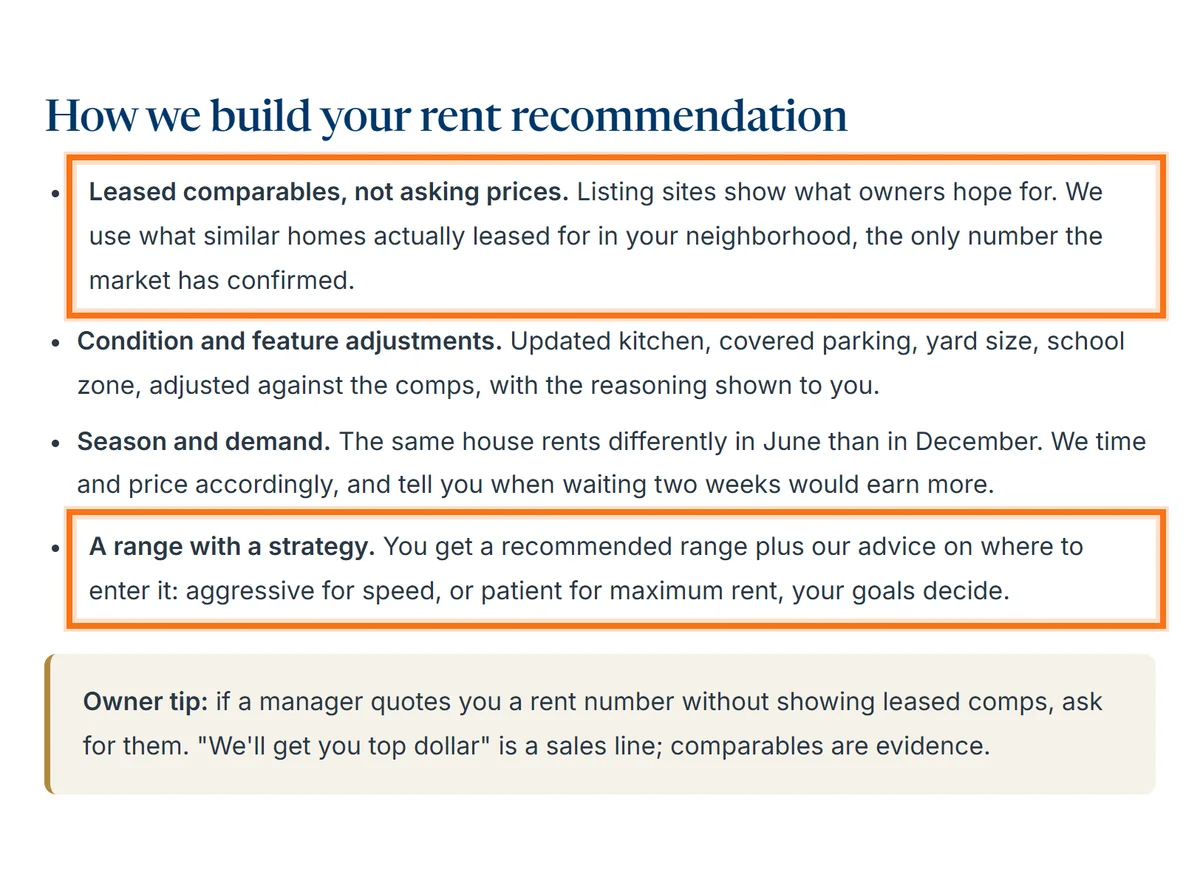
That is the part of the analysis a formula cannot do. The method is on our rental pricing page: leased comparables, condition and feature adjustments with the reasoning shown to you, season and demand, and a range with a strategy.
The rent range, and why a single number is a warning sign
A house does not have one rent. It has a range, and where you list inside it is a decision about speed against rent. Enter at the top and accept a longer wait. Enter toward the middle and lease sooner. A good analysis lays out that trade and makes a recommendation; your goals decide.
The cost of getting it wrong runs one way more than the other. Our rental pricing page puts it like this: price a rental $100 too high and it can sit vacant for an extra month, which costs far more than the $1,200 a year ($100 x 12) you were holding out for. Price it $100 too low and you hand the tenant that $1,200.
A single confident number, especially a high one, is usually a tactic. It wins the listing, and a few weeks later the price comes down. If one company's number is well above everyone else's, ask for the comps behind it. The checks are in how to tell if a property manager's rent estimate is realistic, and the full method is in how to price a rental in DFW.
The make-ready list and what it does to the number
The analysis should tell you what to do to the house before it is photographed, and which items are worth the money. Some usually pay for themselves: paint, a deep clean, a yard cleanup, replacing a stained carpet in one room. Some rarely do: a full kitchen remodel seldom returns its cost in rent on an ordinary rental.
The guidance should be specific to your house, not a generic checklist, and in order of priority, so an owner with a limited budget knows where to stop. Our general list is in the make-ready guide; the analysis applies it to your house.
The written quote: the part a sales pitch leaves out
The analysis is also the natural moment to receive the price of management, and the format tells you a lot. A written quote lists every fee the company can charge, with the amount or the formula next to each. A verbal "we charge a small percentage" is not a quote.
Because the fees are mostly percentages of rent, the rent range turns the quote into dollars. Take our Standard plan as an example, with a recommended rent of $2,000 a month. Illustrative only, not a quote:
- Management fee of 9% of monthly rent: $180 a month ($2,000 x 0.09).
- Tenant placement fee of 75% of one month's rent: $1,500, charged when a tenant is placed.
- Lease renewal: $200. Enrollment inspection: $49.
Every plan and fee is on the pricing and fees page, so you can compare any other company's quote against it line by line. What to look for when you do is in hidden property management fees to ask about.
How to use a rental analysis report
Get more than one, and compare them on the same points: which comps were used, what adjustments were made, how wide the range is, what the make-ready guidance says and what management costs in full. The analysis that shows its comps and explains its reasoning is the one you can trust on the day the market moves.
Ask questions. A manager who can explain why a comp on the next street leased lower, or why your pool adds less than you think, will be able to explain your statement in a year. A manager who gets defensive about the number has told you how the relationship would go.
You are not obligated to anyone by requesting one. Use it to decide whether to rent at all, to set your own asking rent if you self-manage, or to choose a manager.
What happens after the analysis
If you move forward, the analysis becomes the plan: the make-ready guidance becomes the punch list, the recommended rent becomes the listing price, and the written quote becomes the fee schedule in the management agreement. Nothing should change between the analysis and the agreement without a reason you can see.
It is also not a one-time document. The same comparison against leased homes should be repeated before every renewal, so the renewal offer reflects today's market and not last year's. The first weeks after signing follow a predictable sequence, described in your first 30 days with a property manager.
How Perpetual handles this
Perpetual Property Management is broker-owned, with our office at 5755 Rufe Snow Dr in North Richland Hills. Our free rental analysis covers Keller, North Richland Hills, Fort Worth and the surrounding area, and this is the process our site describes:
- You submit a short form with the property address and your situation. It takes about 60 seconds.
- We research your property and the neighborhood comps.
- You receive the analysis by email, typically within one business day.
- Optional: a 15-minute call to walk through it.
What you receive: a rent range built from leased comparables, demand notes for your neighborhood, make-ready guidance and a written management quote with every fee in plain English. It is free whether or not you hire us, and it is yours to keep. It also applies if the house is occupied or you are switching managers.
The analysis is also where your fee is set. Our price sheet lists the standard plans, and the final fee comes after the rental analysis: a newer home that needs no turn work can come in lower, an older home that needs repairs at every turn can carry a premium. Whether we visit the house before the numbers are final and how many comps the report lists are not stated on our site, so ask when you request it; every fee is confirmed in writing before you sign. To start, request the analysis online or call 682-593-7033.
The takeaway: A rental analysis is only as good as its comps. Trust the one that shows leased comparables, names its adjustments, gives a range and attaches a written quote.
Questions owners ask
What is included in a free rental analysis?
A real one includes leased comparables, adjustments for your house's condition and features, a rent range with a recommended start, demand notes for your neighborhood, make-ready guidance and a written management quote. If it is just a number, it is a sales pitch.
Is a rental analysis the same as an appraisal?
No. An appraisal is an opinion of what a house would sell for, usually ordered for a loan. A rental analysis estimates what a house will lease for, based on leased comparables and condition, and is usually prepared by a broker or property manager at no charge.
How can I tell if a property manager's rent estimate is realistic?
Ask for the comp set and check three things: whether the comparables leased or are merely listed, whether they are similar in size, condition and location, and whether the estimate is a range with reasoning. A single confident number with no comps behind it is a warning sign, since it often wins the listing and comes down weeks later.
Do I have to sign anything to get a rental analysis?
No. A rental analysis comes before any agreement. Ours is free with no obligation, and it is yours to keep whether you hire us, self-manage or go elsewhere. A company that requires a commitment before showing you the numbers is not the one to pick.
Is a free rental analysis more useful than an online rent estimate?
Usually, yes. An online estimate is a formula applied to public data and has never seen your house. A rental analysis starts from leased comparables, adjusts for the condition and features that make two houses on the same street rent differently, and gives a range with a recommended start. Treat the online number as a sanity check, not as evidence.
Do property managers use actual leased homes or advertised rents to set the price?
The good ones use leased comparables: what similar homes actually leased for. Active listings are what other owners are hoping for. Ask every manager whether the comps leased or are still listed; if one number is well above the others and rests on listings, that is the explanation. Our own pricing starts from leased comparables in your neighborhood.
What is a rent analysis report?
It is the written version of a rental analysis: a few pages showing the leased comparables, the adjustments made for your house, the recommended rent range, demand notes and make-ready guidance, usually with a management quote attached. Rent analysis report and rental analysis report mean the same thing. The value is that you can check the reasoning, not just read the number.
How long does a rental analysis take?
Ours starts with a short online form that takes about 60 seconds, and we typically respond with the analysis by email within one business day. A 15-minute call to walk through it is optional.
Related services
Property management in Keller, North Richland Hills and Fort Worth. How full-service management works in Tarrant County →