Key takeaways
- A tenant who is pre-approved and pays the market price is a good buyer: no vacancy, no make-ready, no showings.
- The lease stays in force until closing day. Rent and purchase money are kept separate.
- Texas Property Code 5.062(a)(2) treats an option to buy that is combined with a residential lease as an executory contract. Subchapter D then puts duties on the seller.
- A contract that delivers the deed within 180 days is outside that subchapter (5.062(c)). An ordinary sale that closes in weeks is the clean route.
- A rental is not your main home for tax purposes. Ask your CPA about the gain and the depreciation before you agree on a price.
If your renter wants to buy your house in Fort Worth, Keller or North Richland Hills, say yes to the conversation and treat it as a sale, not a favor. Price the home against recent sales, ask for a written lender pre-approval, keep the lease running until closing, and use a standard sale contract with a title company. Say no to "keep renting and buy it in two years." Texas law treats a lease with an option to buy as an executory contract, and the penalties land on the seller.
This guide covers how to judge the offer, what happens to the lease, who represents whom, what the rent-to-own statute says, the tax point most owners miss, and what to do if the deal falls through.
Four ways a tenant offers to buy, and how Texas treats each
A tenant buyer usually proposes one of these four structures, and Texas Property Code chapter 5, subchapter D treats them very differently:
| What the tenant proposes | How Texas law treats it | What it means for you |
|---|---|---|
| Buy now with a loan or cash, closing in weeks | An ordinary sale. A contract that delivers the deed within 180 days is outside subchapter D (5.062(c)) | The clean route: sale contract, title company, lease ends at closing |
| Keep leasing, with a written option to buy within 3 years | An executory contract (5.062(a)(2)). Sections 5.063 to 5.065, most of 5.073, 5.083 and 5.085 apply (5.062(f)) | A 30-day right to cure before you can enforce a default, limits on contract terms, and the title rule in 5.085 |
| Keep leasing, with an option that runs longer than 3 years | An executory contract with more of the subchapter: property, tax and insurance disclosures (5.069, 5.070), a 14-day right to cancel (5.074), recording within 30 days (5.076), an annual statement each January (5.077) | Attorney-drafted or not at all |
| A handshake: "I pay extra each month toward the price" | Nothing in writing fixes the price, the credits or the deadline, and a later dispute can argue that an option was combined with the lease | Refuse. Offer a normal lease now and a normal sale when the tenant is pre-approved |
How to read this table: only the first row is a sale you can run with a standard contract. Every other row adds seller duties that come from the statute, and they exist whether or not the paperwork mentions them. The details are in the rent-to-own section below.
Why a tenant sale can be the best exit you get
The ordinary cost of selling a rental includes the vacancy between the tenant leaving and closing, the make-ready to bring the home to retail condition, the staging and photography, and the showings that disrupt a tenant who is still there. A tenant purchase removes most of that. The home sells in its current condition, the rent continues until closing, and nobody tours a stranger through the kitchen.
There is also a timing advantage. A tenant buyer often wants to close at or near the end of the lease, which lines up the sale with a point where you would otherwise face turnover anyway. The savings are real, but they are savings on cost, not a reason to discount the price.
Whether to sell at all is covered in when to sell a rental property.
Price it against the market, not against the tenant's number
Tenants tend to open with a number based on what they can afford or what they think the home is worth after living in it, which is usually lower than the market. Owners tend to accept a soft number because the buyer is familiar and the deal feels easy. Both are mistakes.
Start with a broker's valuation using recent closed sales of comparable homes in the same neighborhood, adjusted for condition. Then decide what the convenience of a tenant sale is worth to you, in dollars, by adding up the vacancy, make-ready and marketing you avoid. That total is the most you should concede from the market price. If the tenant's offer is below that, counter at the market figure and let them decide.
A rental valuation and a sale valuation are different exercises. The hold-versus-sell comparison is laid out in sell or rent my house in DFW.
Require a lender pre-approval before anything else moves
The most common way a tenant purchase fails is that the tenant cannot actually get the loan. They assumed their rent payment history would carry them, or they planned to qualify "in a few months," and the owner spent that time treating the home as sold.
Before you negotiate price, before you touch the lease, ask for a written pre-approval from a lender, not a pre-qualification, with the loan amount and the conditions. If the tenant needs time to repair credit or save a down payment, the honest answer is that the house is not for sale to them yet, and the lease continues as written. You can revisit it when they are ready.
What happens to the lease during the sale
The lease stays in force until the day of closing. Rent is due on time, late fees apply, the deposit is held, and the tenant's obligations do not change because a contract is pending. Owners who stop enforcing the lease during a sale discover, when the sale falls apart, that they have a tenant two months behind with an argument that rent was "going toward the purchase."
The purchase contract should address the lease directly: the lease ends at closing, the contract states whether the deposit is credited to the buyer or refunded, and if the sale does not close, the lease continues on its own terms. If the lease ends before the expected closing, sign a short extension rather than letting it lapse into holdover.
Keep rent and purchase money strictly separate. Earnest money goes to the title company. Rent goes to the owner or manager as usual. No rent credit toward the price unless it is written into the contract and reviewed by your attorney.
You still need a broker, and the tenant should have one too
Owners ask why they should pay for representation when the buyer is already found. Finding the buyer is the smallest part of a sale. The contract, the inspection negotiations, the appraisal, the title work, the end of the lease and the closing all still happen.
Texas sets the rules for who represents whom in Occupations Code chapter 1101:
- One broker for both sides is an intermediary. A broker who agrees to represent both the buyer and the seller must act as an intermediary (1101.561(b)), and that takes written consent from each party stating the source of the broker's expected pay (1101.559).
- The tenant's agent needs a written agreement. Since January 1, 2026, a license holder working for a prospective buyer of a house must have a written agreement with that buyer stating the services and the compensation (1101.563).
- Commission is owed only on a written agreement. Nobody can sue to recover a commission on a sale unless the promise is in writing and signed by the party charged (1101.806(c)).
It is usually cleaner for the tenant to have their own agent. One more duty does not go away because the buyer already lives there: Property Code 5.008 requires the seller of a single-family home to give the seller's disclosure notice on or before the contract's effective date. Without it, the buyer may terminate for any reason within seven days after finally receiving it (5.008(f)).
Why the informal rent-to-own is the one structure to refuse
The tenant's proposal often sounds like this: keep paying rent, add a little extra each month toward a down payment, and buy the house in two years at a price we agree now. Texas law does not treat that as a simple lease.
Under Texas Property Code 5.062(a)(2), an option to purchase that "includes or is combined or executed concurrently with a residential lease agreement, together with the lease, is considered an executory contract for conveyance of real property." The only clean exit is in 5.062(c): the subchapter does not apply to a contract that delivers the deed within 180 days.
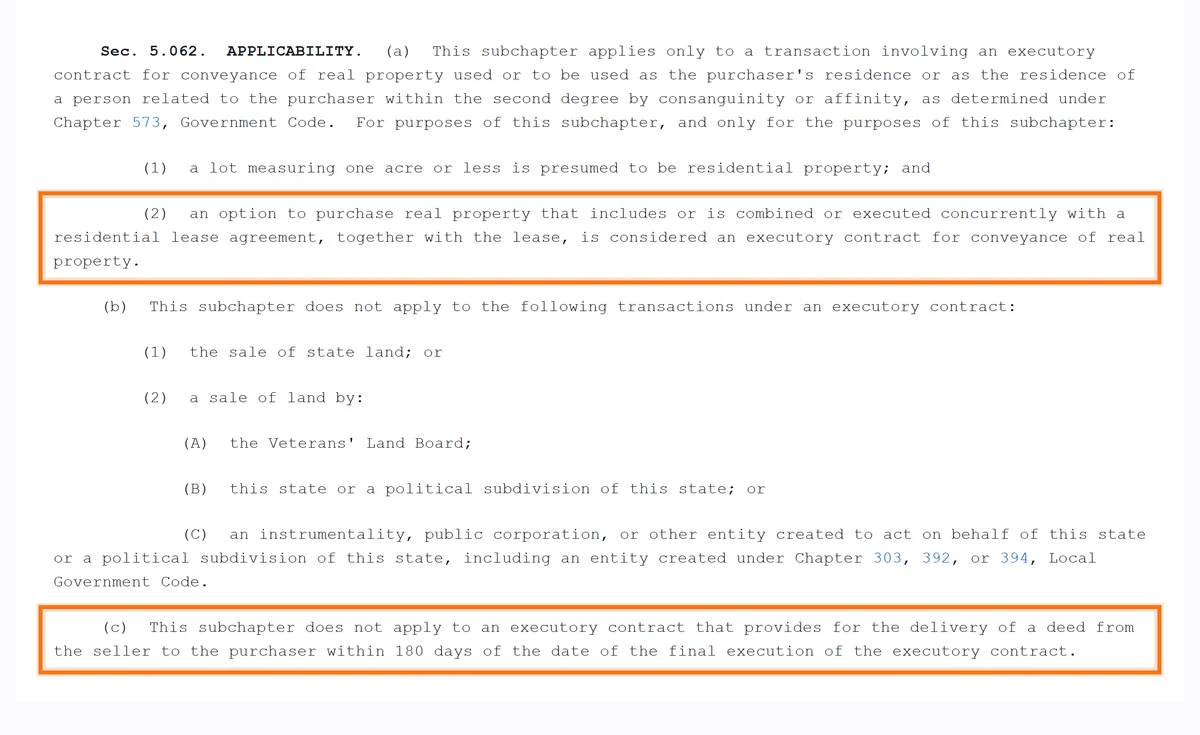
Once the arrangement is an executory contract, these rules apply even to an option of three years or less (5.062(f)):
- Title must be clear. A seller may not sign one unless the seller owns the property free of liens, with a narrow exception for a purchase-money loan that requires written disclosure and the lender's cooperation (5.085). A violation lets the buyer cancel and get back every payment, plus taxes paid and the value of improvements.
- Default is slower. You must give a written notice in the statutory form, and the buyer has 30 days to cure (5.063 to 5.065).
- Some terms are banned. You may not forfeit the option fee for a late payment, or raise the price or charge a fee because the tenant asked for a repair (5.073(a)(4) and (5)).
- You are still the landlord. Chapter 92 keeps applying to the lease part until the option is exercised (5.0621).
Most rentals carry a mortgage, so the title rule alone is a reason to stop. If a tenant needs time, the clean version is a standard lease now and a standard sale later, with no credits and no option. This is general information, not legal advice; any lease-option or seller financing needs a Texas real estate attorney before anyone signs.
The step-by-step process that keeps it clean
- Get a broker valuation and decide your price and your walk-away number.
- Ask the tenant for a lender pre-approval letter and a proposed closing date.
- Negotiate price and terms in a written sale contract, with earnest money held by a title company and a closing date weeks away, not years.
- Deliver the seller's disclosure notice on or before the contract's effective date.
- Address the lease in the contract: termination at closing, deposit handling, what happens if closing slips.
- Continue enforcing the lease and collecting rent through the manager until closing day.
- Allow the buyer's inspection and appraisal access as any seller would, with notice under the lease.
- At closing, the title company reconciles rent, deposit and prorations, and the lease ends.
If the home does not sell to the tenant and goes to market with them still living there, see selling a rental with a tenant in place.
If the deal falls through, you still have a tenant
Plan for the failure case before you sign. If the tenant's financing collapses, the contract ends, the earnest money is handled as the contract says, and the tenant is still your tenant under the same lease. That is a good outcome as long as the lease was kept current.
A tenant who tried and failed to buy may be more likely to leave at the end of the lease, so start the renewal conversation early.
The tax point: a rental sale is not a home sale
Owners sometimes assume the home-sale exclusion covers this sale. IRS Topic 701 says the exclusion of up to $250,000 ($500,000 on a joint return) requires that you owned the home and used it as your residence for at least 2 of the 5 years before the sale. IRS Publication 523 adds that you cannot exclude the part of the gain equal to depreciation allowed or allowable after May 6, 1997. A long-held rental usually fails the use test, and the depreciation is taxed either way. Deferral through an exchange is introduced in the 1031 exchange overview for Texas landlords. This is general information, not tax advice; get your CPA's number before you agree on a price.
How Perpetual handles a tenant who wants to buy
Perpetual is two companies with one team. Perpetual Property Management runs the rental: rent, maintenance, inspections and the lease. Perpetual Realty Group is the affiliated brokerage, led by Broker/Owner Justin Brown, and it sells rentals occupied or vacant. When a tenant in a home we manage asks to buy, the management side keeps the lease enforced and the rent collected until closing day, and the sale itself goes through the brokerage as a separate, written engagement.
On the sale side, the selling investment property page states what you get: an honest read on timing, tenant considerations and pricing before you decide anything, and the math for selling occupied against selling vacant. We do not publish a sale commission or a fee for a tenant purchase on the website, so the terms of any sale are confirmed in writing before you sign.
If the tenant is not ready to buy, nothing changes: the lease continues and the home stays under full-service management. To talk through an offer from your tenant, call 682-593-7033.
The takeaway: Treat a tenant's offer as a market sale to a pre-approved buyer, with a standard contract and a lease that runs until closing. Refuse any informal rent-to-own: in Texas a lease with an option to buy is an executory contract.
Questions owners ask
Should I sell my rental to my tenant?
Often yes, if the tenant is pre-approved by a lender and the price is at or near market. You avoid vacancy, make-ready and showings, and the timing often lines up with the lease end. Decline if the tenant cannot get financing, expects a price well below market in exchange for convenience, or wants to rent now and buy years later.
Do I need a realtor to sell my house to my tenant?
No Texas law requires a seller to hire an agent, but the contract, seller's disclosure, inspection negotiation, appraisal, title work and closing still have to be done correctly. If one broker works with both you and the tenant, Occupations Code 1101.559 requires written consent from each of you for the broker to act as an intermediary. Any commission must be agreed in writing (1101.806(c)).
Can rent count toward the purchase price?
Only if it is written into a contract your attorney has reviewed. A rent credit tied to a right to buy later is the kind of arrangement Texas Property Code 5.062(a)(2) treats as an executory contract when the option is combined with the lease, which brings the seller duties of chapter 5, subchapter D. In an ordinary sale that closes within weeks, keep rent and purchase money separate.
Is rent-to-own legal in Texas?
Yes, but it is regulated. Property Code 5.062(a)(2) treats an option to buy combined with a residential lease as an executory contract. Even for an option of three years or less, the seller must own the home free of liens with a narrow exception (5.085), must give a 30-day chance to cure before enforcing a default (5.065), and cannot forfeit the option fee for a late payment (5.073). Longer options add disclosure, recording and annual statement duties. Use an attorney or avoid it.
What happens to the security deposit when a tenant buys the house?
The lease ends at closing, and the sale contract should state whether the deposit is credited to the buyer on the settlement statement or refunded under the lease's deposit terms. Write it into the contract so there is no separate deposit dispute after closing. If the sale does not close, the deposit stays where it is and the lease continues.
My renter wants to buy my house. What is the first step?
Two things before you discuss price: a broker's valuation based on recent closed sales near the home, and a written pre-approval from the tenant's lender showing the loan amount and conditions. With both in hand you know what the home is worth and whether this tenant buyer can close. Until then, the lease continues exactly as written and rent is due as usual.
Do I have to give my tenant a seller's disclosure if they already live in the house?
Yes. Texas Property Code 5.008 requires the seller of a home with not more than one dwelling unit to give the written disclosure notice, and its list of exempt transfers does not include a sale to a tenant. It is due on or before the effective date of the contract. If you skip it, the buyer may terminate for any reason within seven days after receiving the notice.
Related services
Property management in Keller, North Richland Hills and Fort Worth. How full-service management works in Tarrant County →