Key takeaways
- You can change property managers mid-lease; the tenant's lease stays exactly as written.
- Check your current management agreement's notice and termination terms first, then give notice in the way it requires.
- The best window is a couple of months before the lease ends, so the new manager runs the renewal.
- Waiting for move-out leaves the old company doing the move-out inspection and the deposit accounting, which Texas requires within 30 days (Property Code 92.103).
- The old manager must account for and hand over money it holds for you; Texas license law treats failing to do so as a violation (Occupations Code 1101.652(b)).
Yes, you can change property managers mid-lease in Texas, and for a rental in Keller, North Richland Hills or Fort Worth it is usually the better choice. The lease is between you and your tenant, so it stays exactly as written; the switch changes who collects rent, holds the deposit and answers repair calls. The best moment is a couple of months before the lease ends, so the new manager handles the renewal. Waiting for move-out hands the old company the move-out inspection and the deposit accounting.
There are situations where waiting is right, and this article names them. The full guide to switching property managers covers the mechanics. Here the question is only when.
Why switching mid-lease usually wins
A tenant in place is an asset, not an obstacle. Rent is coming in, the house is occupied, and the handover is paperwork rather than a turnover. The new manager takes over collection, maintenance and the deposit, sends the tenant one letter, and does a documented inspection to set a baseline. The guide to a tenant-in-place takeover shows what that looks like week by week.
Three things improve the day the switch happens. Repairs get answered by a company you chose, which the tenant notices. The ledger and the deposit move into an account you can see on a monthly statement. And the renewal decision, which is the most valuable decision in a tenancy, is made by the new manager with current comparables instead of being rushed by a company on its way out.
The hidden cost of waiting is that every month under a manager you have lost confidence in is a month of repairs you cannot verify, inspections that may not happen and a tenant relationship that may be quietly souring. Those costs do not show on a statement, but they show at move-out.
The trap in waiting for the tenant to leave
Owners wait for move-out because it seems like a natural break. In practice, move-out is the moment when the most money changes hands and the most judgment is required, and you would be leaving it with the company you are about to fire.
- The move-out inspection and deposit itemization are done by the old company, against a move-in report the old company may or may not have kept. Under Property Code 92.103 and 92.104 the deposit refund and its itemized list of deductions are due within 30 days after the tenant surrenders the home, and the owner answers for them, so a sloppy itemization becomes your dispute.
- The old company may start marketing and sign a new tenant before you leave, which can trigger its leasing fee and leave you with a tenant screened under criteria you did not choose.
- Make-ready work gets ordered by a company with no reason to be careful with your money on its last job.
- The gap between the old company's exit and the new company's start lands in the middle of a vacancy, when every day costs rent.
If you are set on waiting, at least sign with the new manager before the tenant gives notice, with a start date that puts the new company in charge of the move-out inspection. The guide to turnover cost and timing shows why the handling of that one week matters so much.
The best window: before renewal
The ideal time to switch is a couple of months before the lease ends, before anyone has started renewal conversations. The new manager inherits a paying tenant, has time to inspect and review the lease, and then runs the renewal with a recommendation on rent and terms.
Say the lease ends in June and you switch in March. March is the takeover: tenant letter, payment portal, deposit transfer, inspection. April is the review: the manager has seen the house, checked the ledger and pulled comparable rents. By early May the tenant has a renewal offer, with enough notice for either side to plan.
If the tenant renews, the new manager starts the next term with its own inspection baseline. If the tenant leaves, the new manager runs the move-out and the leasing, and you never pay two companies for one placement.
Switching this way also lets the new manager apply its renewal process rather than simply rolling the old lease over; our lease renewal page explains ours.
When to switch, by how much time is left on the lease
Your lease end date decides most of the answer. Here is how we would time a switch at each point:
| Time left on the lease | When to switch | Why |
|---|---|---|
| More than 3 months | Now | Every month under a manager you do not trust is a month of repairs and records you cannot verify |
| About 2 to 3 months | Now; this is the best window | The new manager inspects, reviews the lease and makes the renewal offer |
| Under 6 weeks, tenant has given notice | Sign now, start on the move-out date | The new manager does the move-out inspection and the deposit accounting due within 30 days |
| Any time, with a termination fee that ends with the lease | Compare the fee with the cost of waiting | Sometimes waiting a few weeks is cheaper; it should be a calculated choice |
How to read this table: find your row by the lease end date, then check your management agreement's notice period, because the switch takes effect only when that notice runs out. The first two rows are the common case, and both say the same thing: do not wait for a vacancy to make the change.
When waiting for move-out is the right call
There are honest cases for waiting, and they have one thing in common: the switch itself would create more disruption than it removes.
- The lease ends within a few weeks and the tenant has already given notice. The new manager's first real job is the turnover, so sign now with a start date at move-out and let the new company run the move-out inspection.
- Your agreement with the old company has a long notice period or a termination fee that expires at the end of the current lease. Compare the fee against the cost of a few more months of poor service before deciding.
- The tenant is in a dispute with the old company that is close to resolution. A change of manager mid-dispute can reset it.
- You are selling the house when the tenant leaves. In that case you may not need a new manager at all, and the question is who handles the last month.
In every one of those cases, the advice is the same: pick the new company now, sign now, and set the start date to match the event you are waiting for. Deciding is the part that should not wait.
How to decide for your house
Ask three questions. How many months are left on the lease? Is the problem with the old company about money and records, or about service? And would you trust the old company to itemize the deposit fairly?
If more than a couple of months remain, switch now. If the problem is money or records, switch now regardless, because waiting gives the company more of both to hold. If you would not trust the old company with the deposit accounting, do not let it reach move-out in charge. Only when the lease is nearly over and the old company is merely unremarkable does waiting cost you nothing.
If you want a second opinion on your timing, with your lease dates and your agreement in front of us, send them over and we will tell you plainly whether to move now or set a date.
How Perpetual handles this
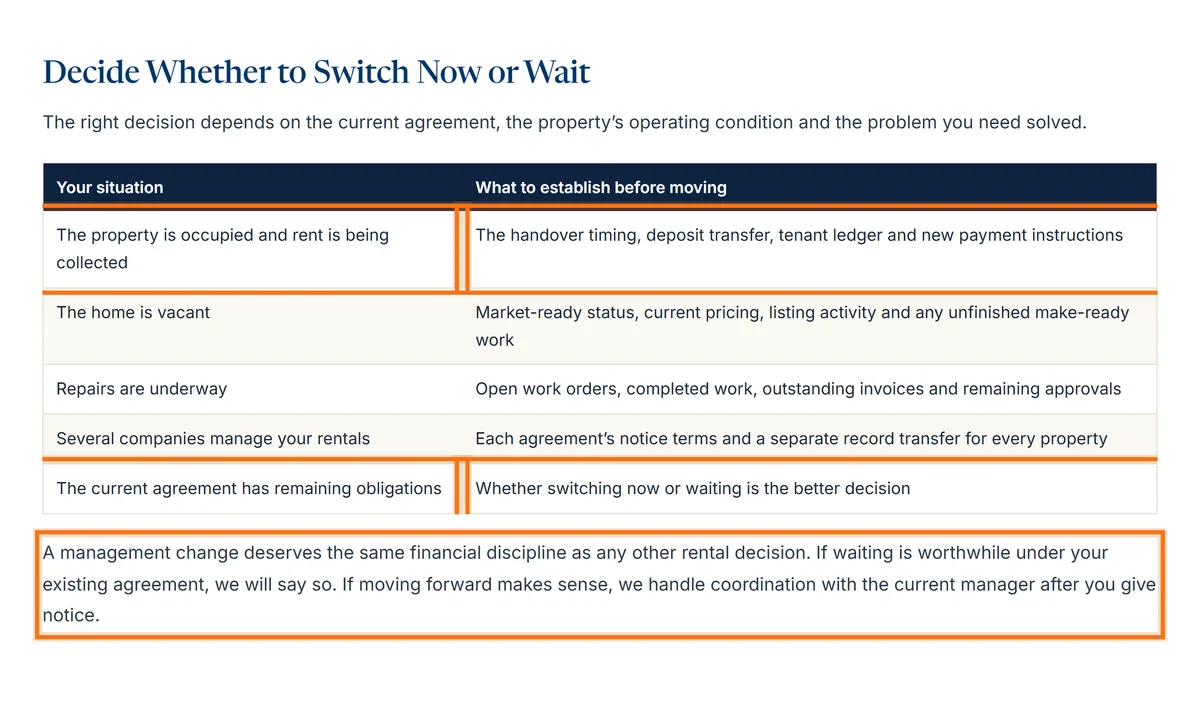
Perpetual Property Management takes over rentals with the tenant in place, and we start with your current agreement: its notice requirements and any remaining obligations decide whether switching now or waiting is the better result, and if waiting is worthwhile we will say so. Once you give notice, we handle the coordination with the current manager. We request the lease and addenda, security deposit, keys, tenant ledger, property records and open work orders, then give the tenant new payment and maintenance instructions, with the handover designed so rent never misses a beat.
An enrollment inspection records the condition as we begin, separate from the 360-degree condition inspection we do at every move-in and move-out. Your first statement and the disbursement history are in the owner portal. Fees are confirmed in writing before you sign, and our switching page walks through the handover in order.

The takeaway: Switch while the tenant is in place, ideally a couple of months before renewal, and only wait for move-out when the lease is nearly over, which still means signing the new company now with a start date at the turnover.
Questions owners ask
Will I pay a leasing fee twice if I switch managers around move-out?
Only if the old company places a new tenant before your termination takes effect and then the new company has to re-lease the house. Avoid it by ending the old agreement before the old company starts marketing, or by writing into your termination notice that the company is not to list the house. Check the old agreement for any clause claiming a fee on tenants placed after termination.
Does switching managers mid-lease upset the tenant?
Rarely, if it is handled with one clear letter. Tenants care about three things: the lease is unchanged, where to pay, and who to call for repairs. A new manager that answers the phone is an improvement from the tenant's side. Problems come from mixed messages, such as two companies both asking for rent, which the letter and a fixed cutover date prevent.
How much notice do I need to give my current property manager before switching?
Whatever your management agreement says, typically a stated number of days in writing. Some agreements also allow termination for breach on shorter notice. Read the clause, send the notice in the manner it requires and keep proof of delivery. Sign with the new company so its start date matches the end of the notice period, and the handover has no gap.
Can the new manager handle the renewal if I switch a few months before the lease ends?
Yes, and that is the best reason to switch in that window. The new manager has time to inspect the house, review the lease, check current rents and bring you a renewal recommendation with proper notice to the tenant, instead of a company on its way out rolling the old lease over.
Can I change property managers mid-lease?
Yes. The lease is between you and the tenant, so it stays in force; the switch changes who collects rent, holds the deposit and handles repairs. Check your management agreement's notice and termination terms, give notice the way it requires, and have the new manager collect the lease, deposit, keys, tenant ledger and open work orders before the next rent is due.
What happens to the security deposit when I switch property managers?
The old manager should hand it over with the tenant ledger, because Texas license law treats failing to properly account for or remit money that belongs to another person as a violation (Occupations Code 1101.652(b)). The deposit stays the tenant's money under the same lease, and the refund rules of Property Code 92.103 apply at move-out.
Related services
Property management in Keller, North Richland Hills and Fort Worth. How full-service management works in Tarrant County →