Key takeaways
- Broker-owned: the licensed Texas broker who is responsible for the company also owns it.
- Franchise: a local business that uses a national brand's trademark and system and pays the brand for it (the federal definition is in 16 CFR 436.1(h)).
- Every Texas property management company must name a designated broker; if that broker owns less than 10 percent, the company must carry $1 million in errors and omissions coverage (Occupations Code 1101.355).
- Neither model is better by default. The answers to who decides, who answers the phone and what every fee is matter more than the label.
Broker-owned means the person whose Texas broker license is responsible for the company also owns it. A property management franchise is a locally owned office that pays a national brand for its name, software and operating system, and may be run by someone other than the broker. For a rental in Keller, North Richland Hills or Fort Worth, the difference shows up in who decides about your house, who answers your call and how the fee schedule was written.
I own a broker-owned company, so you know where I sit. A franchise is not automatically a worse choice, and this guide is meant to help you see which one you are talking to and what that means for you.
What each one actually is
A franchise office is a locally owned business that pays a national brand for the right to use its name, software, marketing and operating system. The Federal Trade Commission's Franchise Rule (16 CFR 436.1(h)) defines a franchise by three things: the brand's trademark, the brand's significant control or assistance in how the business runs, and a required payment to the brand. The local owner may or may not be the licensed broker; often a separate broker of record holds the license while the owner runs the business. Payments go to the franchisor, and many decisions about process, vendors and pricing structure come from the system rather than from the person you meet.
A broker-owned company is one where the licensed Texas broker owns the business, holds the trust account, and is responsible to the Texas Real Estate Commission for the company's brokerage activity. There is no outside system to follow and nobody above the broker to approve a decision. The person whose license is on the line is the person who runs the company.
What broker owned means under Texas law
In Texas, collecting rent on a single-family rental for someone else is brokerage: Occupations Code 1101.002(1)(A)(x) puts "controls the acceptance or deposit of rent" in the definition of a broker, and 1101.351 says a person or company may not act as a broker without a license. So every property management company you interview, franchise or not, must hold a TREC license. What differs is who owns it.
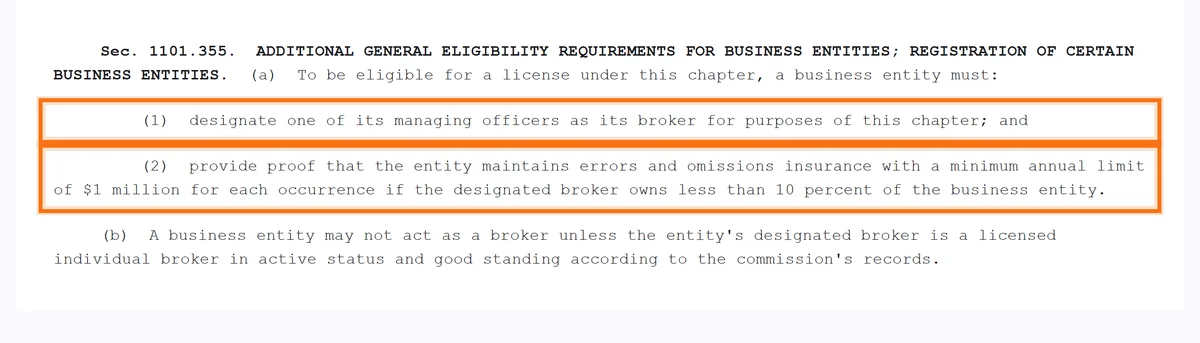
Those two lines are the legal version of the question in this guide. A broker-owned company is one where the designated broker is also the owner. When the broker owns little or none of the business, the law asks for insurance because the license holder and the owner are different people.
Who makes the decisions about your property
When a tenant asks for a rent concession, or a repair comes in above your limit, or you want a lease written with an unusual clause, someone has to decide. In a broker-owned company, that someone is the broker or a manager the broker directly supervises, and they can decide on the phone with you.
In a franchise, decisions tend to follow the system's playbook. That brings consistency, which is useful for a new operator who has not managed before. It also means the local owner may not be able to vary the fee schedule, the lease, the vendor list or the maintenance process even when your property calls for it. Ask a simple question: "If I want something done differently, who says yes?" The answer tells you which structure you are dealing with.
Franchise vs broker-owned property management, side by side
Here is how the two models usually differ on the points owners notice. The franchise column describes what the federal definition of a franchise implies, not any particular brand:
| Question | Franchise office | Broker-owned company |
|---|---|---|
| Who owns the business | A local franchisee, under a franchise agreement with a national brand | The licensed Texas broker |
| Who answers to TREC | The designated broker, who may or may not be the owner | The owner, who is the designated broker |
| Who sets the system | The franchisor, which controls or assists the method of operation (16 CFR 436.1(h)(2)) | The broker |
| Where the money goes | Payments to the franchisor are a condition of the franchise (16 CFR 436.1(h)(3)) | Stays with the local company |
| Can a fee or process change for your house | Only within what the system allows | The broker can decide |
| What happens if the owner leaves | The brand can continue with another operator | Depends on the broker staying in business |
How to read this table: the first four rows are structure, and they are facts you can check. The last two are trade-offs. A franchise buys consistency and continuity with a payment to the brand; a broker-owned company buys flexibility and a shorter path to the decision maker, with the risk that the company depends on one broker.
Who answers the phone
Some larger and franchise systems route owner and tenant calls to centralized intake or shared maintenance desks, while the local office handles showings and inspections. For a tenant reporting a leak, that can mean a scripted intake and a work order that reaches the local office later. Ask any company, franchise or not, where the phone is answered after hours.
In a broker-owned company, the phone usually rings at the company, and the person who picks up can dispatch a vendor without a hand-off. That difference is small on a quiet month and large on the night a water heater fails. Our guide on local versus national property management goes deeper on what call centers mean for an individual owner.
How fees and vendor choices differ
A franchisee pays the brand as a condition of the franchise, and that cost has to come from somewhere. Compare the complete fee schedule, not the monthly percentage: setup, technology, inspection, renewal and maintenance coordination fees all add up over a year.
Vendors are the other place the structure can show. Some systems have national vendor programs the local office is encouraged to use. A broker-owned company chooses its own plumbers, electricians and HVAC contractors. Ask any manager how vendor billing works. At Perpetual, maintenance coordination is a stated percentage of the vendor's invoice on each plan and the original invoice is always in your owner portal; every fee is on our pricing page, and our maintenance page describes how repairs are approved.
Where a franchise genuinely helps
Fairness requires saying this plainly: a franchise gives a new operator a working system on day one. Software, lease templates, screening criteria, accounting procedures and training all arrive in a box. If the alternative is an independent broker who manages six doors as a side business with no portal and no process, the franchise is the safer choice.
A franchise also offers continuity if the local owner sells the office or leaves the business. The brand stays, and another operator takes over. With an independent company, you are relying on that broker staying in business and staying interested. So the real question is not franchise or independent. It is whether the independent company has systems as good as the franchise, with decisions made closer to your property.
Where a broker-owned company helps
Accountability has a name. When the broker owns the company, there is nobody to escalate past and nobody to blame upstream. If a statement is wrong or a vendor overcharged, the person responsible is the person you can call. Occupations Code 1101.803 makes a licensed broker liable for the conduct of the sales agents acting for that broker, which is one more reason the broker's attention matters.
Flexibility is the second benefit. At Perpetual, plans are negotiable case by case and the final fee is set after the rental analysis, repair spending limits are agreed with you in advance, and the lease carries the addenda your property needs, such as HOA rules or a pool. None of that requires a call to a franchisor. You can read about who owns the company and holds the license.
How to tell which one you are talking to
Franchises do not always announce themselves, and "locally owned and operated" appears on both kinds of websites. A few checks settle it in minutes.
- Search the company name without the city. If the same name appears in many other metro areas, it is likely a franchise or a chain.
- Read the website footer. A Texas brokerage lists its license, and a broker-owned company names the same person as broker and owner. Ours reads: Perpetual Property Management, a DBA of Perpetual Realty Group, LLC, TREC 9008702-BB, Justin Brown, Broker, TREC 549418-B.
- Ask who owns the business entity and who the designated broker is. If they are two different people, ask how often the broker looks at your file.
- Ask whether the fee schedule was set locally or by the system.
- Look the broker up on the Texas Real Estate Commission license search. Our guide to verifying a property manager's license shows what to look for.
Questions that settle it
Whichever structure you are talking to, the same questions apply, and the answers matter more than the label. Who holds the license, and how often does that person look at your file? Who decides when a repair comes in above the limit? Who answers the phone at nine at night? Can any fee on the schedule be changed for your property, and who has the authority to change it? What happens, in writing, if the company misses a promise?
Bring the full list from our guide to questions to ask a property manager, and compare the answers across each company you interview. Our own answer to the last question is on the guarantees page. If you want to hear how a broker-owned company answers the rest for a house in Tarrant County, talk to us or call 682-593-7033 and ask for Justin directly.
The takeaway: The label matters less than the answer to one question: when something goes wrong with your property, can you reach the person whose license and reputation are on the line?
Questions owners ask
Is a franchise property management company better than an independent one?
Neither is better by default. A franchise gives a new operator proven systems; a broker-owned company puts the decision-maker and the license holder in the same chair. Judge the specific company on who decides, who answers the phone, and whether every fee is in writing.
How do I know if a property management company is a franchise?
Search the company name without your city. If the same brand appears in many other metro areas, it is a franchise. You can also ask directly who owns the local entity, who the sponsoring broker is, and whether the fee schedule was set locally or by the national system.
Does a franchise property manager cost more?
Not always in the headline management fee. A franchisee makes required payments to the brand, and that cost has to be covered somewhere, so compare the complete fee schedule, including setup, inspection, renewal and maintenance coordination fees, over a full year rather than the monthly percentage alone.
What does broker owned mean in property management?
It means the licensed Texas real estate broker who is responsible for the company's brokerage activity also owns the company. Every Texas property management company must designate a broker under Occupations Code 1101.355; in a broker-owned company, that broker and the owner are the same person, so the decision maker and the license holder sit in the same chair.
Does a property management company in Texas need a license?
Yes. Occupations Code 1101.002 includes controlling the acceptance or deposit of rent from a resident of a single-family rental in the definition of a broker, and 1101.351 prohibits acting as a broker without a license. A company must also designate a licensed broker, which you can check on the TREC license search.
Related services
Property management in Keller, North Richland Hills and Fort Worth. How full-service management works in Tarrant County →