Key takeaways
- The label "local" or "national" proves nothing by itself. Compare companies on things you can check: license, office, written guarantees, published fees and who answers.
- In Texas, a company that leases homes or controls rent for owners needs a broker license, whatever its size (Occupations Code 1101.002 and 1101.351). Look up the broker on trec.texas.gov.
- Scale helps when you own rentals in several metros. For one house or a few in DFW, ask who sets the rent and who approves repairs.
- Our side of the comparison is public: broker-owned, an office at 5755 Rufe Snow Dr in North Richland Hills, three plans on a price sheet and five written guarantees.
- We manage long-term rentals. A vacation rental is a different business with different rules.
What distinguishes local property management companies from national ones is where the decisions are made. A national company runs one system across many markets, which helps an owner with rentals in several metros. A local company has a broker and an office in the market, which helps an owner with one house or a few in Fort Worth, Keller or North Richland Hills. Neither label guarantees good management. The honest way to choose is to compare both on evidence you can verify yourself.
I manage rentals in Keller, North Richland Hills and Fort Worth, so I have a view. This guide gives you the checks instead of a sales pitch: what to look up, what to ask, and what our own site states for each point.
Property management companies in DFW: seven things you can verify
This table lists seven points on which local and national companies differ, where you can verify each one, and what our own site states:
| What to compare | How to verify it for any company | What Perpetual states |
|---|---|---|
| Texas broker license | License Holder Search on trec.texas.gov: the company and its broker, and that the status is active | Broker-owned. Justin Brown is the broker; the license numbers are printed in the footer of our site |
| Office location | A street address on the agreement that you can visit | 5755 Rufe Snow Dr, Suite 155, North Richland Hills |
| Who answers | Call the main number as an owner would; ask who can approve a repair | A local team, with calls and emails answered within one business day under a written guarantee |
| Fees | Ask for the complete fee schedule before the first meeting | Three plans on a public price sheet: 7%, 9% or 10% of monthly rent, every fee listed |
| Written guarantees | Ask where each promise appears in the agreement and what you get if it is missed | Five written guarantees, each with a stated remedy, subject to a Guarantee Addendum |
| Who sets the rent | Ask what the rent is based on and who signs off | Rent set from comparable leased homes near yours, in a free rental analysis |
| Service area | Ask which cities the company manages in today | Keller, North Richland Hills, Fort Worth and nearby; portfolios across Tarrant, Dallas, Collin and Denton counties |
How to read this table: the middle column works for any company, local or national. Run the same seven checks on every company you are considering and write the answers side by side. A company that cannot give you a written answer to a row has answered it.
Start with the Texas broker license
Size does not change the licensing rule. Under Texas Occupations Code 1101.002, a broker includes a person who, for compensation and for another person, leases real estate or controls the acceptance or deposit of rent from a resident of a single-family residential real property unit. Section 1101.351 says a person may not act as a broker without a license, and a business entity may not act as a broker unless the entity holds one.
A company organized as a business entity must designate one of its managing officers as its broker, and that designated broker must be a licensed individual broker in active status and good standing (section 1101.355). So every company that manages your single-family rental in Texas, national brand or two-person office, has a named broker who answers for it.
Look that person up. The Texas Real Estate Commission's License Holder Search on trec.texas.gov takes a company name, a person's name or a license number, and shows the license status. Our guide to verifying a property manager's license in Texas walks through it. Then ask one question: is the broker in this market, and will I ever speak to them? This is general information, not legal advice.
The call center versus the manager who drives your street
The clearest difference between companies is where the phone rings and what the person who answers is allowed to decide. Some companies route owner and tenant calls to a central service desk. Others route them to the office that manages the house. You cannot tell which from a website, and it is not safe to assume it from the size of the brand.
So test it. Call the main number as an owner would and ask three things: where are you located, who would be my contact, and who can approve a repair on my house today. Then call the number on one of the company's rental listings and ask a tenant's question.
A person who has been inside the house answers differently. They know whether the water heater is in the garage or the attic and whether the ceiling stain is new. That knowledge shortens repairs, inspections and hard conversations. It exists in any company that keeps the same manager on the same houses, and it is missing in any company that does not.
When scale helps an owner
Scale does help in a few specific situations, and it is worth being honest about them.
- You own properties in several metro areas and want one portal, one statement format and one point of contact for all of them.
- You own a large number of doors and the company can show, in writing, pricing that applies to a portfolio your size.
- You care most about one login and one report format across every market you own in.
- The local alternatives in your area are small, informal operations without portals, trust accounting or a written process.
That last point matters. Local is not a virtue by itself; is a local property manager better than a big national company gives the short answer for a single house. A local company needs an owner portal, monthly statements, documented inspections and a written process before its local knowledge counts for anything. If you live in another state, our guide to DFW property management for out-of-state owners lists what to require from either kind of company.
When scale hurts an individual owner
If you own one house, or a handful, the question is how much of the company's structure applies to you. Ask these before you sign with a large company, and ask the same of a small one:
- How many homes does my manager carry, and how long have they been with you? Every handoff loses information about your house.
- Who can change my asking rent, and on what basis? A reduction should follow a look at the photos, the showings and the comparable homes, not only a number of days.
- How is a renewal offer set? It should reflect what similar homes nearby leased for.
- If I disagree with a decision, who is the last person I can talk to, and where are they?
None of these are dramatic. Together they decide whether small problems are handled by someone who knows the house or by a queue. A good answer from a national company beats a vague answer from a local one, and the reverse is just as true.
What local knowledge means in Keller, North Richland Hills and Fort Worth
Local knowledge sounds vague until you list what it actually covers in this part of Tarrant County.
- Which HOAs require tenant registration, restrict leasing, or fine quickly for trash cans and lawn height, and how each one prefers to be contacted.
- School attendance boundaries, which drive demand and rent in Keller and parts of North Richland Hills in a way that a national pricing tool does not capture.
- Which cities in the area have rental registration or inspection requirements. Confirm the current rule with the city itself.
- North Texas clay soil, foundation watering, and the difference between normal seasonal cracking and a problem that needs an engineer.
- Hail season, and what a roof looks like before and after a storm.
- How a street in Fort Worth rents differently from a street two miles away, and why.
A manager who drives these neighborhoods every week carries all of this. Ask any company how its manager for your house learns the same things.
Vendor relationships are local by nature
Every repair on your property is done by a local tradesperson, whoever manages it. What differs is who chose that tradesperson, on what basis, and what the company earns on the job. Ask any company three things: how vendors are selected, whether the company or an affiliate earns anything on a repair, and whether you see the vendor's own invoice.
Our answers are published. We work with plumbers, electricians, HVAC and general trades we use repeatedly. Maintenance coordination is a percentage of the vendor's invoice (5% on Full Service, 4.9% on Standard), and the original invoice is always in your portal. Every completed repair over $500 gets photo or video proof. Our guide to repair invoices and photos for owners shows what that record should contain.
Who sets your rent and who decides on your repair
Two decisions matter most to your return: the asking rent and how maintenance money is spent. Ask any company, local or national, who makes each one and what they look at.
Rent should be set from leased comparables, condition and showing feedback, by someone who has seen the house. If it is set by a pricing tool and adjusted by policy alone, ask who reviews the result. Repairs above your limit should come with an estimate, a photo and a recommendation from a person who can explain the trade-off. If they come as a notification in an app, you are approving blind. Our guide on how many properties one manager should handle explains why the number of doors per manager is a useful predictor of which experience you will get.
Local vs. national vacation rental management company: a different business
Some owners arrive at this question while choosing a local vs national vacation rental management company. We manage long-term rentals, meaning houses leased to a tenant who lives there, so this guide compares companies for that kind of property.
The checks in the table still transfer: the license, the office, the written fee schedule and who answers. What changes is everything around them. Nightly stays bring city rules, cleaning between guests and a different insurance question, so confirm the rules with your city before you choose a manager for that use. Our guide to long-term versus short-term rentals in Texas compares the two.
How to decide
Make the choice on evidence rather than on the brand. Ask each company the same questions and compare the answers side by side.
- Who will be my manager, how many properties do they carry, and how long have they been with you?
- Where does the phone ring after hours, and who can authorize a vendor?
- Who decides the asking rent, and what do they look at?
- Who chooses vendors, and does the company earn anything on a repair?
- What does the complete fee schedule look like, in writing?
Our full list of questions to ask a property manager covers the rest, and our guide to broker-owned versus franchise management explains a related distinction that is easy to miss. If you would like to see how a local, broker-owned company answers all of this for your property, request a free rental analysis. It comes with a rent range from leased comparables and a written quote.
How Perpetual handles this
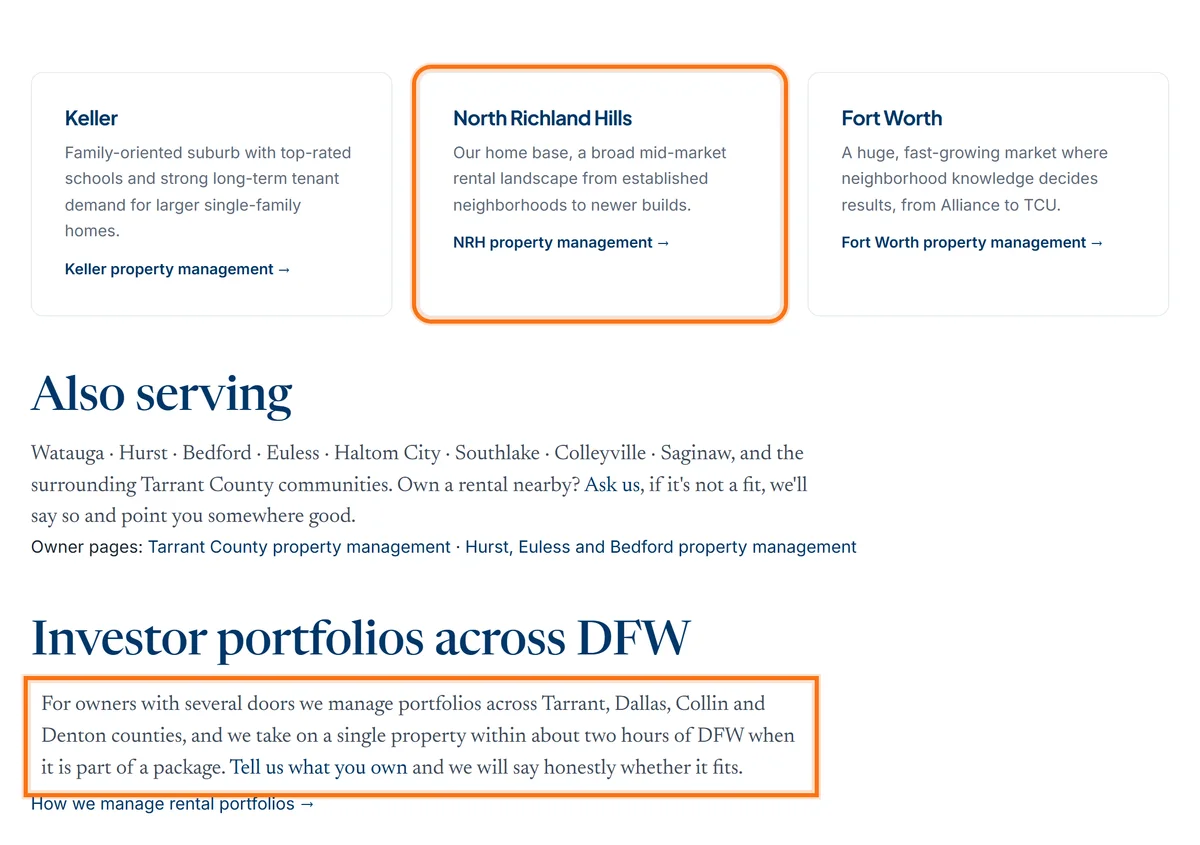
Perpetual Property Management is broker-owned. Justin Brown is a Texas broker and owns both Perpetual Property Management and our affiliated brokerage, Perpetual Realty Group, LLC, so one license holder is accountable for your house. Our office is at 5755 Rufe Snow Dr in North Richland Hills, and Northeast Tarrant County is our home market. For owners with several doors we manage portfolios across Tarrant, Dallas, Collin and Denton counties.
What a national brand is known for, we publish too. The price sheet lists three plans at 7%, 9% and 10% of monthly rent with every fee. The Perpetual Promise is five written guarantees, including calls and emails answered within one business day and rent disbursed by the 10th. Statements, documents and disbursement history are in the AppFolio owner portal, and the original vendor invoice for every repair is there too.
Who your day-to-day contact is, how after-hours calls are handled and the length of the agreement are confirmed in writing before you sign. To compare us against any company on your list, local or national, call 682-593-7033.
The takeaway: Choose the company whose manager has stood in your house and whose systems are as good as the national brand's, because that combination is what actually protects a single rental.
Questions owners ask
Are national property management companies cheaper?
You cannot tell from the size of the brand. Ask each company for its complete fee schedule in writing and compare the whole list: monthly fee, placement, renewal, inspections, maintenance coordination and any setup charge. Our price sheet is public: 7%, 9% or 10% of monthly rent depending on the plan, with every fee listed.
Is a local property manager better than a big national company?
For one house or a few in one area, a local company is often the better fit, provided it has real systems: an owner portal, monthly statements, documented inspections and a written process. A national company helps most when you own in several metros and want one system. Compare both on the license, the office, the written fees and who answers.
Does my property manager need experience in my specific neighborhood?
It helps more than most owners expect. In this part of Tarrant County that means knowing the HOAs, the school attendance boundaries, the city rules and how one street rents compared with another two miles away. Ask any candidate who will set your rent and what they look at. We set rent from comparable leased homes near yours.
What happens if my local property manager goes out of business?
The lease stays valid and the tenant stays in place. The management agreement ends, and the deposit, your records and any money held for you must be accounted for. Ask any company, local or national, who the broker is and what the agreement says about returning your file. Then look up the broker's license status on trec.texas.gov.
What distinguishes local property management companies from national ones?
Mainly where decisions are made. A national company applies one system across many markets. A local company has its broker and office in the market it manages. Both need a Texas broker license to lease homes and handle rent for owners. Judge each on what you can verify: license status, office address, written guarantees, published fees and who answers your call.
Does the same comparison apply to a local vs national vacation rental management company?
Partly. The license, the office, the fee schedule and who answers still matter. A vacation rental adds city rules, guest turnover and different insurance, so confirm the rules with your city first. We manage long-term rentals, which are homes leased to a tenant who lives there.
How do I compare property management companies in DFW?
Use the same seven checks on each one: Texas broker license, office location, who answers, the full fee schedule, written guarantees, who sets the rent and the service area. Get the answers in writing and put them side by side. A company in Fort Worth, Keller or North Richland Hills should be able to answer all seven before the first meeting.
Related services
Property management in Keller, North Richland Hills and Fort Worth. How full-service management works in Tarrant County →