Key takeaways
- No Texas statute or Real Estate Commission rule caps how many properties one manager may handle.
- The broker is responsible for property management done by sponsored agents (Commission Rule 535.2), so ask who the broker is and how involved they are.
- Team structure, property age, geography, software and tenant quality all move the right number.
- Overload shows up as slow replies, thin inspection reports and renewals sent late at a default increase.
- Written service standards, such as a one-business-day reply, let you measure the result instead of guessing at the ratio.
The number that best predicts your experience with a property management company in Fort Worth, Keller or North Richland Hills is how many properties your manager personally carries. It decides how quickly your call is returned, whether anyone noticed the roof stain in the last inspection photo, and whether your renewal was priced from research or from a default percentage.
Few companies publish that number, and most owners never ask. Here is why it matters, what changes it, what Texas rules say about who is responsible, and how to get an honest answer.
Why the doors-per-manager ratio predicts your experience
A property manager's day is a fixed number of hours divided across every property in their portfolio. Each property generates a predictable amount of routine work, rent posting, statements, filter reminders, and an unpredictable amount of event work: a leak, a late payment, a renewal, a move-out. When the portfolio is sized well, the event work gets handled the day it arrives. When it is not, events queue behind each other.
You feel the queue as small things. A tenant's maintenance request is acknowledged two days later. Your approval request arrives without photos because there was no time to take them. The asking rent on your vacant house is lowered by policy after a set number of days instead of by looking at the showing feedback. None of these is a dramatic failure, and all of them cost you money.
What changes the right number
There is no single correct ratio, which is why a company that quotes one without explanation has not thought about it. The right number depends on several things.
- Team structure. A portfolio manager who handles everything for their properties can carry fewer than a manager supported by a dedicated leasing agent, maintenance coordinator and accountant. Ask what the manager does personally and what is handled by specialists.
- Property type and age. Older single-family homes with yards, foundations and aging HVAC generate more work than newer townhomes.
- Geography. Homes close to each other and to the office in Keller, North Richland Hills and Fort Worth take less travel per visit than homes spread across the metro area.
- Software. A real portal with tenant requests, photo inspections and online rent payments removes manual work on every property each month.
- Tenant quality. A tenant who was screened against written criteria and started with clear expectations tends to generate fewer late-rent and lease-violation events, which is why screening affects the manager's capacity, not just yours.
How many units one property manager can handle: the factors
Here is how each factor moves the number of homes or units one manager can carry well, and the question that uncovers it:
| Factor | Manager can carry more when | Manager should carry fewer when | Ask |
|---|---|---|---|
| Team structure | Leasing, maintenance and accounting have their own staff | One person does everything for each home | What does my manager do personally? |
| Property type and age | Newer homes and townhomes | Older single-family homes with yards and aging systems | What kinds of homes are in the portfolio? |
| Geography | Homes sit close to the office | Homes are spread across the metro area | How far is the office from my house? |
| Software | Tenants and owners use a portal for requests, payments and statements | Requests and rent arrive by phone, text and check | What runs through the portal? |
| Tenant quality | Every adult is screened against written criteria | Screening is loose or inconsistent | What are your written criteria? |
How to read this table: no row gives you a number, and that is the point. A company whose answers sit mostly in the second column can carry more homes per manager without your service slipping; one whose answers sit in the third column cannot. Apartment managers quote units and single-family managers quote homes or doors, so make sure you compare like with like.
The signs that a manager is carrying too much
You can usually detect an overloaded manager before you sign, and certainly within the first few months.
- Calls and emails are returned in days, not hours, and often by someone other than your manager.
- Inspection reports are late, thin on photos, or missing entirely.
- Maintenance approvals arrive as a dollar figure with no estimate attached.
- Renewals go out at the last minute with a standard increase and no market check.
- Your manager changes every year or so because the job burns people out.
- During a vacancy, you have to ask for showing updates instead of receiving them.
If you see three of these, the problem is not the individual. It is the number of properties the company has decided one person can carry. Complaining to the manager will not fix it, because the manager already knows. The only remedies are a company that staffs differently or a company that has drawn the line somewhere lower. Our list of red flags when hiring a property management company covers the related warning signs.
What Texas rules say about who is responsible
Texas does not set a doors-per-manager limit. What the Texas Real Estate Commission's rules do set is responsibility. Rule 535.2 says a broker is responsible for any property management activity by the broker's sponsored sales agent that requires a real estate license, and that a broker may delegate supervision in writing but may not relinquish overall responsibility. The same rule requires a broker who sponsors agents to maintain written policies and procedures.
Money is covered too. Rule 535.146 defines rent and security deposits as trust money, requires a designated trust account, and requires an accounting to each beneficiary at least monthly when the account has had activity. So however many homes a manager carries, the monthly statement and the broker's oversight are not optional extras.
For an owner, that turns the ratio question into two more: who is the broker, and how close is the broker to the files? A company that can name the broker and describe what that person reviews has an answer. This is general information, not legal advice.
How to ask about it
Ask the question plainly: "How many properties will the person managing my home personally be responsible for, and what do they do versus what the rest of the team does?" Then ask two follow-ups: "How long has that person been with you?" and "How many properties did you take on in the last year, and did you add staff?"
A good company answers all three without hesitation and explains why its number works. An evasive company talks about the size of the overall team, the technology, or the number of doors under management, which is the opposite of what you asked. A company that is growing fast without adding people is the one to be careful of; your property will be the one absorbed into an already full portfolio. Ask, too, what happens to your file when your manager leaves, because turnover is the moment most owners discover how much lived in one person's head rather than in the system. The full interview list is in our guide to questions to ask a property manager.
What a well-sized portfolio looks like from your side
When the ratio is right, the owner's experience is quiet and specific. Your manager knows your house without opening the file: which HVAC unit was replaced, which tenant is on a month-to-month, which HOA sends letters fast. Approval requests come with an estimate, photos and a recommendation. Inspection reports arrive on the schedule the agreement promised, with enough photos to see what the inspector saw.
During a vacancy, you get a weekly note on inquiries, showings and feedback without asking, and the pricing conversation is about why renters are passing, not about how many days have gone by. At renewal, the offer is based on what nearby homes actually leased for. Every one of those is a function of time per property, and time per property is a function of the ratio.
How we think about it at Perpetual
We are a broker-owned company. Justin Brown is a Texas broker and owns both Perpetual Property Management and the affiliated brokerage, Perpetual Realty Group, and you can read about who holds the license. Our home market is Northeast Tarrant County, with Keller, North Richland Hills and Fort Worth as our main cities, and our office is at 5755 Rufe Snow Dr in North Richland Hills.
Rather than ask you to trust a ratio, we put the results a well-sized portfolio should produce into the management agreement. The table on our switching page lines up the usual complaints about an overloaded manager with the written commitment that answers each one:
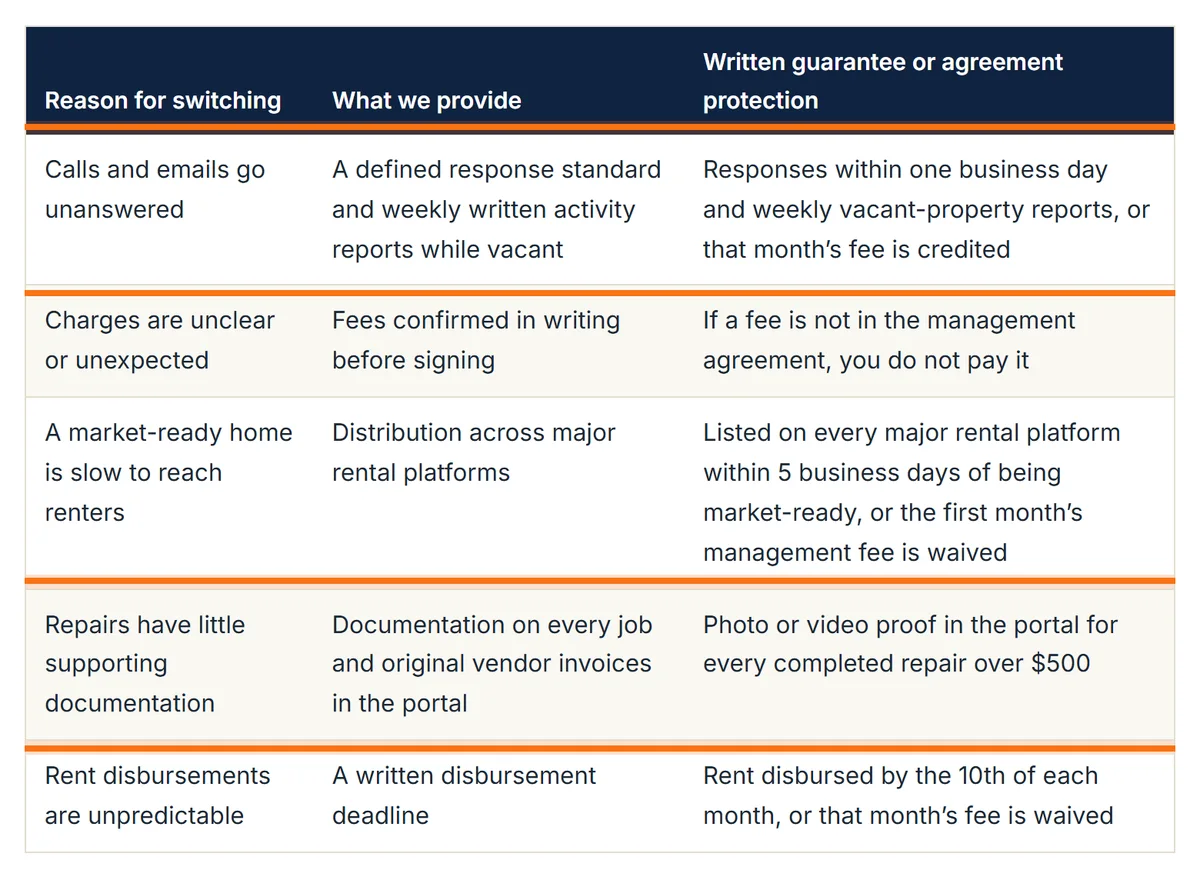
The other rows are a market-ready home listed on every major rental platform within 5 business days, rent disbursed by the 10th of each month, and no fee you did not agree to in writing. These are part of The Perpetual Promise and subject to its Guarantee Addendum. The AppFolio owner portal carries statements, documents and disbursement history. Ask us the ratio question directly when you call 682-593-7033; it is a fair one.
The questions to bring
Take these to every interview and write the answers down.
- How many properties does my manager personally carry?
- What does my manager do, and what is done by leasing, maintenance or accounting staff?
- How long has my manager been with the company?
- How many properties did you add last year, and how many people?
- How far is the office from my property, and how often is it driven past?
Compare the answers across companies, and weigh them alongside what you learn in our guide to local versus national property management, because the ratio and the structure usually go together. If you want to hear our answers for a home in Tarrant County, ask us directly.
The takeaway: Ask how many properties your manager personally carries and why that number works; a company that answers with a number and a reason has thought about your experience, and one that answers with the size of its team has not.
Questions owners ask
How many properties does an average property manager handle?
It varies widely by company structure, property type and software, and a quoted industry average is not useful for judging a specific company. Ask how many properties your manager personally carries, what they handle versus the rest of the team, and why that number works. The quality of the explanation matters more than the figure.
Does it matter if a property management company is large?
Not by itself. What matters is the number of properties per manager and the support each manager has. A large company with a well-staffed team can serve you well; a small company where one person handles everything for too many homes cannot. Ask about the ratio, not the total.
What happens if my property manager has too many properties?
Response times stretch, inspections get thin or late, maintenance approvals lose their detail, and renewals go out at a default increase without a market check. Each is small on its own, but together they lower your rent, raise your repair costs and lengthen your vacancies.
How many rentals is too many for one property manager to handle?
There is no single number, because it depends on team structure, software, property type and how spread out the portfolio is. Overload is easier to spot than the number: calls returned in days, inspection reports late or thin on photos, approvals with no estimate, and renewals sent late with a default increase. Ask how many properties your manager handles, what the rest of the team does, and whether the company added staff as it grew.
How many units can one property manager handle?
No fixed number applies, and Texas law does not set one. A manager backed by leasing, maintenance and accounting staff and a tenant portal can carry more units than one person doing everything, and newer units close together take less time than older houses spread across a metro area. Ask how many your manager personally carries and what the team handles for them.
Is there a legal limit on how many properties a Texas property manager can manage?
No. Neither the Texas Occupations Code nor the Texas Real Estate Commission's rules cap the number. Commission Rule 535.2 instead makes the broker responsible for property management done by sponsored agents under the license, and Rule 535.146 requires a monthly accounting to each owner whose trust money had activity.
Related services
Property management in Keller, North Richland Hills and Fort Worth. How full-service management works in Tarrant County →