Key takeaways
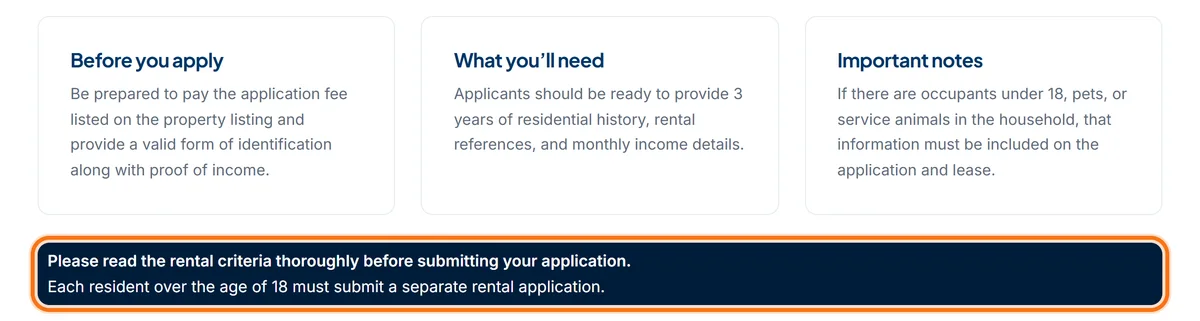
- Every adult who will live in the house applies and is screened, including a partner, adult child or parent who will not pay rent.
- Our published criteria: a separate application from each applicant age 18 or older, $60 per applicant, the same checks on all applicants.
- Income must be at least 3 times the rent, and only the two highest earners are counted. A third adult's income does not help or hurt the ratio.
- Texas Property Code 92.352(b): rejecting one co-applicant is deemed a rejection of all co-applicants.
- Texas Property Code 92.010 caps adults at three times the number of bedrooms, with narrow exceptions.
Yes. Every adult who will live in the house applies and is screened, whether or not they pay rent. On a rental in Fort Worth, Keller or North Richland Hills the reasons are practical: you cannot evaluate a household you only half know, an adult who is just living there has a key but no obligations, and a lease that names only the person who pays leaves you with little to act on when the other adult is the problem. Minors are listed as occupants and are not screened.
Owners ask this most often when an applicant mentions a partner, an adult child moving back, or a parent coming to live with them. The answer is the same each time. This guide covers who applies, what Texas law says about applications and occupancy, and how a mid-lease move-in is handled. The mechanics of tenants, occupants and guarantors are in roommates, co-signers and occupants.
Who has to apply and be screened: the short table
Here is who applies and who is screened under our published rental criteria, and how a lease should treat each person:
| Person in the household | Separate application and $60 fee | Screened | Counts toward 3x income | How the lease should treat them |
|---|---|---|---|---|
| Adult who will pay rent | Yes | Yes | Yes, if one of the two highest earners | Named as a tenant |
| Adult who will live there and not pay (partner, adult child, parent) | Yes | Yes | Only if one of the two highest earners | Named as a tenant |
| Child under 18 | No, but listed on the application | No | No | Listed as an occupant |
| Short-stay guest | No | No | No | Not named; the lease's guest clause applies |
| Adult who wants to move in after the lease starts | Should apply before moving in | Should be, under the same criteria | Same rule | Added by a signed amendment, or not approved to live there |
How to read this table: the first three columns for the first three rows come straight from our criteria page. The last column is how a well-written lease handles each person; the lease itself decides the wording.
Why the rule is every adult, not every payer
Screening exists to predict two things: whether rent will be paid and whether the house will be cared for. An adult who lives there affects both, whether or not their name is on the rent payment. Their credit history shows how they treat obligations, their rental history shows how they treated prior landlords, and the criminal background check bears on the safety of the property and the neighbors.
There is a legal reason too. Texas Property Code 92.001 defines a tenant as a person authorized by a lease to occupy the dwelling. A person who signs the lease can be held to it. A person who is just living there has no contract with you. If the paying tenant leaves and the unscreened partner stays, you have someone in your house with no lease, no obligation and no screening. Naming every adult turns a household into a set of accountable tenants.
Partners, adult children and parents moving in
The same rule covers the three situations owners ask about most.
- A partner who "is not really moving in." If they will sleep there most nights, they live there and should apply. If they truly are a guest, the lease's guest clause, usually a stated number of days, applies.
- An adult child. One who is already 18 at application applies now. Their income may be zero, and that does not sink the household: under our criteria only the two highest earners count toward the 3 times rent requirement. The other checks still run.
- A parent moving in. Same application, same checks, same criteria as any other adult.
In each case the screening is the same package every adult gets, which is what makes it defensible. Deciding case by case who "seems worth checking" is how both bad placements and complaints start. How the checks work is in how tenant screening works.
What Texas law says about applications with more than one adult
Subchapter I of Texas Property Code chapter 92 covers rental applications. These are the sections that matter when several adults apply together:
| Section | What it says | What it means for a household |
|---|---|---|
| 92.3515 | When an application is provided, the landlord makes the written tenant selection criteria available, and the applicant signs an acknowledgment | Every adult applicant should receive the criteria. If a rejected applicant was never given them, the application fee and any application deposit must be returned. |
| 92.351 | A co-applicant is a person who applies with other applicants and plans to live in the dwelling with them. An application fee is a nonrefundable sum to offset the cost of screening. | Adults applying together are co-applicants, each with a fee. |
| 92.352 | An applicant is deemed rejected if no notice of acceptance is given by the seventh day after a completed application. Rejecting one co-applicant is deemed a rejection of all. | The household is approved or declined as a group. |
| 92.354 | Bad-faith failure to refund an application fee or deposit owed: $100, three times the amount wrongfully retained, and attorney's fees | Follow the refund rules exactly. |
How to read this table: the middle column is the statute, and the right column is what it means when two or three adults apply for one house. Section 92.355 adds that an application cannot waive these rights.
One federal rule sits on top. The Consumer Financial Protection Bureau explains that under the Fair Credit Reporting Act, a landlord who denies an application because of information in a tenant screening report must give an adverse action notice. It names the company that supplied the report, with its address and phone number, and explains the applicant's right to a free copy within 60 days and to dispute inaccurate information. The CFPB notes that requiring a co-signer or a larger deposit because of the report also counts. This is general information, not legal advice.
Occupancy limits, guests and unauthorized occupants in Texas
Screening every adult also answers the occupancy question. Texas Property Code 92.010 says the maximum number of adults a landlord may allow to occupy a dwelling is three times the number of bedrooms, and it defines an adult as anyone 18 or older. A three-bedroom house tops out at nine adults under that section. The section has two narrow exceptions, and a neighbor within 3,000 feet can sue to stop a violation and recover $500 for each one. City codes and HOA rules can add their own limits, so confirm those with the city or the association.
The statute sets the ceiling. The lease sets the house rule: it lists every adult and every minor by name, and it says how long a guest may stay before they count as an occupant. We found no section in Property Code chapter 92 that sets a guest period for a house, so the number in your lease is the number that applies. That clause is what gives a manager grounds to act when a cousin has been on the couch for three months. The guide to what a Texas lease must cover shows where occupancy sits among the other terms.
When someone moves in after the lease starts
People's lives change mid-lease, and the right response is a process, not a refusal. The tenant tells the manager that a partner wants to move in. The partner completes an application and is screened under the same criteria before moving in. If approved, the lease is amended in writing to add them. If not approved, they cannot live there, and the tenant decides whether to stay without them.
Say your Fort Worth tenant's boyfriend has been staying over and the tenant asks to add him. He applies, his identity and income check out, but his rental history shows an eviction by a previous landlord, which is a listed cause for rejection in our criteria. He is not added, the tenant is told in writing, and the guest clause still applies to him. Finding him there at the next inspection with no paperwork is harder on everyone. See catching damage and unauthorized occupants mid-lease.
What the owner sees, and what stays private
With a manager, you should not need to read each adult's credit report. What you need is the result: every adult passed the written criteria, the names going on the lease, the minors listed as occupants, and the income of the two highest earners against the rent. If one adult did not pass, you are told the household could not be approved as presented and whether the others chose to apply again without that person.
One applicant's report is not shared with another applicant, and the reason for a denial goes to the person it concerns. The leasing service page describes the lease and move-in file that follow an approval.
This is general information, not legal advice. Confirm occupancy limits and lease terms with an attorney if your situation is unusual.
How Perpetual handles this
Perpetual Property Management is broker-owned, with our office at 5755 Rufe Snow Dr in North Richland Hills, and we manage homes in Keller, North Richland Hills, Fort Worth and nearby. Our rental criteria are published, and they are applied to every applicant without exceptions:
- A separate application, completed, dated and signed by each applicant and all co-applicants age 18 or older, at $60 per applicant. Denied or canceled applications are non-refundable.
- Occupants under 18 are included on the application and the lease.
- Income of at least 3 times the rent, with pay stubs (minimum 6 weeks) and 2 months of bank statements. Only the two highest earners are counted.
- A credit history evaluation, rental history verification, employment and income verification, and a criminal background check on all applicants.
Perpetual Property Management supports and complies with the Fair Housing Act, and all applicants are evaluated against the same written criteria. During the lease, our scheduled inspections are how unauthorized occupants are caught early. If you hire us with a tenant already in place, we take over the property as-is and apply full screening at the next vacancy, as the tenant screening page says.
Our site does not state the guest period in our lease or the steps and cost of adding an adult mid-lease, so those are confirmed in writing before you sign. Questions about who is living in your rental: call 682-593-7033.
The takeaway: Screen and name every adult who will live in the house, paying or not, so you always know who is there and who is responsible. Texas law treats co-applicants as one decision, and so should you.
Questions owners ask
Do minors need to be screened for a rental application?
No. Minors are listed on the application and the lease as occupants so the household count is accurate, but they do not complete an application and are not screened. Our criteria require a separate application only from applicants and co-applicants age 18 or older. What happens when a minor turns 18 during the tenancy depends on the lease.
Can a tenant have a long-term guest without adding them to the lease?
Only within the lease's guest clause, which usually allows a stated number of days. We found no section in Property Code chapter 92 that sets that number for a house, so the lease controls. Beyond it, the guest is living there and should apply and be added. The clause is what lets a manager act when a guest quietly becomes a resident.
What if one adult in the household fails screening?
The household cannot be approved as presented. Texas Property Code 92.352(b) says the rejection of one co-applicant is deemed a rejection of all co-applicants. The others may choose to apply again without that person, who then cannot live there beyond the lease's guest clause. If the denial rests on a screening report, the federal adverse action notice goes to the applicant it concerns.
Does an adult child who does not pay rent have to sign the lease?
They have to apply and be screened, and the lease should name them as a tenant. That matters if the paying parent moves out or stops paying, and it keeps the occupancy count accurate. Under our criteria their income is counted only if they are one of the two highest earners, so a low or zero income does not disqualify the household.
Does someone who is just living in the house, but not paying rent, have to apply?
Yes. Paying rent is not the test; living there is. Our criteria say each resident over the age of 18 must submit a separate rental application, and the same credit, rental history, income and criminal checks run on all applicants. An adult who is only visiting falls under the lease's guest clause.
How much is the application fee when several adults apply?
Our fee is $60.00 per applicant, and every applicant and co-applicant age 18 or older submits a separate application. Three adults means three applications and $180 in fees. Under Texas Property Code 92.351 an application fee is a nonrefundable sum that offsets the cost of screening.
How many adults can live in a rental house in Texas?
Texas Property Code 92.010 caps the number of adults a landlord may allow at three times the number of bedrooms, so six in a two-bedroom and nine in a three-bedroom, with two narrow exceptions in the section. A lease, a city code or an HOA rule can be stricter. This is general information, not legal advice.
Related services
Property management in Keller, North Richland Hills and Fort Worth. How full-service management works in Tarrant County →