Key takeaways
- Tenant = signs, lives there, owes everything. Occupant = lives there, does not sign or owe rent. Co-signer = signs a guaranty, does not live there.
- Every adult who lives in the home should apply, be screened and sign as a tenant, not be listed as an occupant.
- Joint and several liability means each tenant owes the full rent and all damage, not a share.
- Texas Property Code 92.010 limits a dwelling to three adults per bedroom, with narrow exceptions.
- Add or remove anyone only by written amendment, after screening or re-qualifying.
On a Texas lease, every adult who lives in the home should be a tenant: screened, signing, and liable for the full rent and all damage. An occupant is someone who lives there with the landlord's consent but does not sign or owe rent, which should mean minor children. A co-signer, or guarantor, does not live there and promises to pay if the tenants do not. In the Fort Worth, Keller and North Richland Hills homes we manage, that is the rule we apply at every application and every renewal.
The most common lease problem we inherit from self-managing owners is not a bad clause. It is a missing name: an adult who moved in after signing, a partner who became a permanent resident, or roommates splitting the rent while only one of them ever signed. This guide explains who should sign, what joint liability means in practice, when a co-signer actually helps, and the right way to add or remove a person from a lease that is already running.
Tenant, occupant and guarantor are three different things
A tenant signs the lease, has the right to live in the home and owes every obligation in it. An occupant is a person the lease lists as living there who does not sign, typically a minor child. A guarantor, often called a co-signer, does not live in the home and signs a separate guaranty promising to pay if the tenants fail to.
The rule that keeps owners out of trouble is simple: every adult who lives in the home is a tenant, screened and signing. Not an occupant, not a guest who stays, not a name on a text message. Adults listed as occupants have the benefit of living there with none of the obligations, which is the worst combination for the owner.
The lease should state the maximum number of occupants, name each one, and define how long a guest can stay before they must apply. A common threshold is a set number of nights in a given period, written into the lease so it is a rule and not a judgment call.
Tenant vs occupant vs co-signer: the comparison
The four people who can be connected to a lease, and what each one owes:
| Role | Lives in the home? | Signs the lease? | Owes rent and damage? | Screened? |
|---|---|---|---|---|
| Tenant (co-tenant, roommate) | Yes | Yes | Yes, the full amount, jointly with the other tenants | Yes, to the written criteria |
| Authorized occupant | Yes, with the landlord's consent | No (listed in the lease) | No obligation to pay rent | Should be limited to minors; adults apply and sign |
| Co-signer or guarantor | No | Signs a separate guaranty | Yes, if the tenants do not pay, to the extent the guaranty says | Yes, to the same standard as a tenant |
| Guest | Short visits only | No | No | No; a guest who stays past the lease limit must apply |
How to read this table: the only row that both lives in the home and owes the full rent is the tenant row, which is why every adult resident belongs there. The occupant row is the gap: Texas Property Code 92.016 describes an occupant as a person who has the landlord's consent to occupy a dwelling but has no obligation to pay the rent, so an adult listed only as an occupant can stay without owing anything if the signing tenant leaves.
Joint and several liability: what it means when rent is short
Most residential leases, including the standard Texas association forms, make all tenants jointly and severally liable. In plain terms, each tenant is responsible for the whole rent and all damage, not just their share. If three roommates each pay a third and one leaves, the other two owe the full amount. If the home is damaged, the owner can pursue any or all of them for the entire cost.
This is the single most important protection in a roommate situation, and it only works if every roommate signed. It also means the owner should never agree to collect separate partial payments as if they were separate leases. One lease, one rent, one deposit, paid in full by the tenants collectively. How they divide it among themselves is their business.
When a tenant asks you to accept two-thirds of the rent because a roommate left, the answer is that the full rent is due from the remaining tenants, and the departed roommate remains liable until the lease is amended or ends. What happens if the shortfall continues is described in what happens when rent is late in Texas.
When a co-signer actually helps and when it is theater
A guarantor is useful when the applicants are otherwise acceptable but fall short on income or credit history: a student, a recent graduate, someone newly relocated with a job offer but no local pay stubs. The guarantor should be screened to the same standard as a tenant, with income that comfortably covers the rent on top of their own housing cost, because that is the promise they are making.
A guarantor is theater when the lease or the guaranty is weak. Watch for these:
- A guaranty that covers only the first term and silently lapses at renewal while the tenants stay.
- A guaranty that covers rent but not damage, or vice versa.
- A guarantor who was never screened and turns out to have less income than the tenant.
- A guarantor out of state with no assets in Texas, which makes collection slow and expensive even when you win.
Perpetual's tenant screening applies the same criteria to guarantors as to applicants, and the guaranty form is written to run for the full tenancy, including renewals and holdover. The criteria themselves are explained in tenant screening criteria in Texas.
Adult occupants: the gap most leases leave open
The typical scenario is a married couple where only one spouse applied, or a parent moving in with an adult child, or a partner who was "just staying a while" and never left. The owner has a person in the home with no application, no background check and no signature. If the signing tenant leaves, the owner may have an occupant with no lease, which is a slow and uncertain situation to resolve.
The fix is a lease clause that every person over a stated age who lives in the home must apply, be approved and sign, and a practice of actually enforcing it. When a tenant asks whether someone can move in, the answer is yes, after they apply. When an inspection shows an extra adult, the notice goes out the same week: apply within a set number of days or the person must leave.
This is not about suspicion. Screening an adult occupant protects the signing tenant too, because a roommate with a judgment history or a prior eviction is their problem as much as yours.
How many people can live in a rental in Texas?
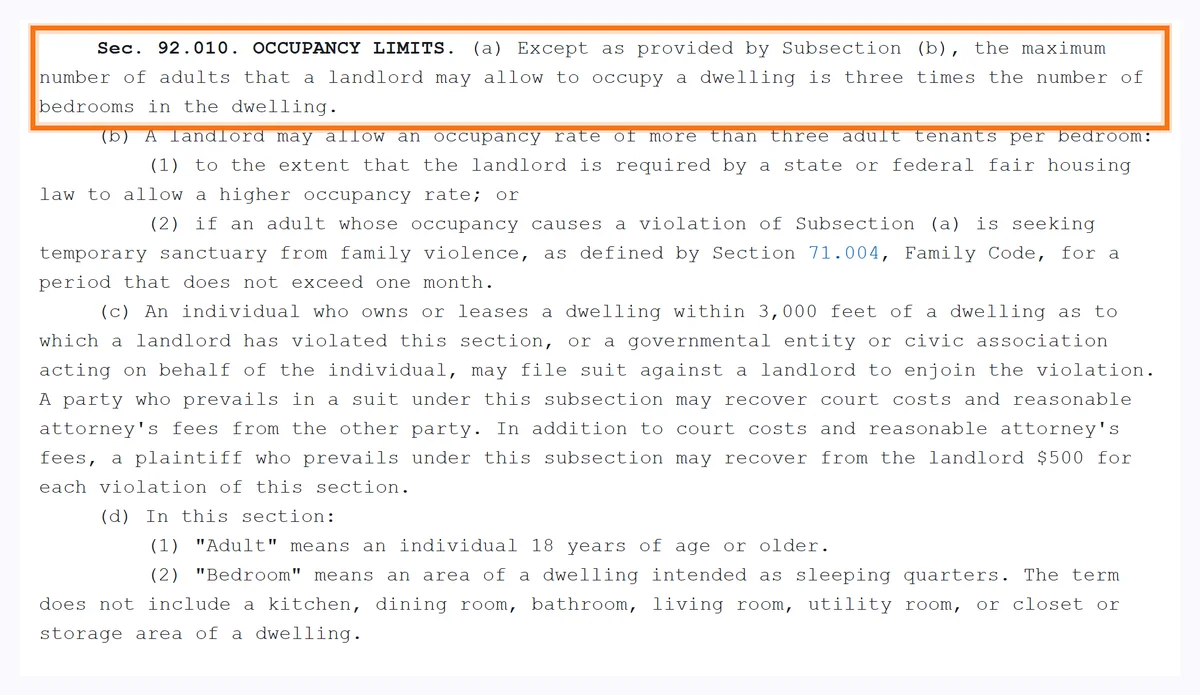
Texas sets an outer limit before any lease clause does. Under Property Code 92.010, the maximum number of adults a landlord may allow to occupy a dwelling is three times the number of bedrooms, and "adult" means anyone 18 or older. A bedroom is an area intended as sleeping quarters, so a living room, dining room or utility room does not count. The narrow exceptions are when a state or federal fair housing law requires a higher number, and an adult seeking temporary sanctuary from family violence for up to one month. A neighbor within 3,000 feet can sue a landlord who breaks the limit and recover $500 per violation plus attorney's fees.
Your lease can and should set its own limit, applied the same way to every applicant, and city rules can be stricter: Fort Worth, for example, limits occupancy to three unrelated persons in single-family zoning inside its TCU overlay district. The practical rule for owners is to state the maximum number of residents in the lease and to treat anyone beyond it as an applicant, not a guest.
Adding a roommate mid-lease, step by step
Adding a person is routine when it is done in order. Out of order, it creates exactly the gaps described above.
- The new person submits a full application and is screened to the same criteria as the original tenants. The existing tenants' approval does not substitute for screening.
- If approved, all parties sign a lease amendment adding the new tenant as of a specific date, with joint and several liability from that date.
- The deposit stays as one deposit on the lease. If a higher deposit is warranted by the new occupancy, the amendment says so and it is collected before move-in.
- The new tenant signs the same addenda as the others: pets, HOA rules, renters insurance, lead disclosure where applicable.
- Keys, access codes and utility accounts are updated and noted in the file.
Do not let the new person move in while the application is pending. Once they are in the home, your leverage to require anything is mostly gone. The signing mechanics are handled under leasing, and the lease forms themselves are covered in Texas residential lease essentials.
Removing a tenant mid-lease without releasing the wrong person
A roommate wants out: a breakup, a job in another city, a falling out. The departing tenant wants to be released from liability, and the remaining tenants often want to help them. The owner's interest is different: the remaining tenants must qualify on their own, or the departing tenant stays on the hook.
The process is a re-qualification. Run the remaining tenants' income against the rent as if they were applying fresh. If they qualify, sign an amendment releasing the departing tenant as of a date, confirming the remaining tenants' full liability and leaving the deposit with the lease. If they do not qualify, the options are a replacement roommate who applies and is added, or no release at all.
Never release a tenant verbally or by simply stopping to list them. A release is a written amendment or it did not happen. And the deposit is not refunded to the departing roommate by the owner; it stays with the lease, and the roommates settle between themselves.
One deposit, one accounting, no matter how many roommates
Roommates frequently ask the owner to split the deposit refund three ways, or to refund one person's share early when they leave. Both requests should be declined. Under Texas deposit rules the owner refunds the deposit within 30 days after the tenants surrender the home (Property Code 92.103), with a written, itemized list of any deductions (92.104), and does not have to send it until the tenants give a written forwarding address (92.107). It goes out as one refund.
How the roommates divide that refund is their agreement, not yours. Your lease should say so, and the move-out instructions should ask for a single forwarding address and, ideally, a single named payee. If the roommates cannot agree, the owner's obligation is still to account properly, and the refund can go to all named tenants jointly.
The timing and itemization rules are in Texas security deposit rules. The practical lesson is that a clear deposit clause at signing prevents a three-way argument at move-out.
When the relationship between tenants ends
Couples separate, and one of them calls the owner asking to have the other removed from the lease or locked out. The owner cannot do either. Both are tenants with the same right to occupy, and the lease does not end because the relationship did. Changing locks on a tenant or removing their belongings exposes the owner to serious liability under Texas law; Property Code 92.0081 bars a landlord from intentionally keeping a tenant out except by judicial process or in narrow situations the section lists.
The owner's position is narrow and should be stated plainly: both tenants remain liable for the full rent until the lease ends or is amended by both; either tenant may be released only if the other re-qualifies; and any protective order or court decision affecting occupancy should be sent to the owner in writing so it can be followed. Where a tenant cites family violence, Property Code 92.016 lets that tenant end the lease and avoid future rent once they provide a qualifying protective order or documentation from a health care provider, mental health provider or advocate and meet the section's other steps; an attorney should be consulted on the owner's obligations.
What happens when a tenant wants to leave early for any reason, and what they owe, is covered in tenant breaking a lease in Texas. This is general information, not legal advice; confirm specifics with your lease and an attorney.
Use every renewal to reconcile who lives there
The renewal is the natural checkpoint. Before sending renewal terms, compare the lease roster with what the last inspection showed and what the tenants report. Any adult who has moved in applies and signs. Any tenant who has moved out is released in writing after re-qualification. Any guarantor's guaranty is confirmed to extend to the new term.
Owners who skip this find, two renewals later, that the person paying rent is nobody on the lease and the people on the lease moved to another state. Perpetual builds the roster check into lease renewals, alongside the rent review and the inspection. It takes a few minutes a year and removes a category of problem entirely.
The takeaway: Screen and sign every adult, keep all tenants jointly liable for the full rent, treat guarantors like applicants, and change the roster only by written amendment.
Questions owners ask
Does every adult living in the house need to be screened?
Yes. Every adult who lives in the home should apply, be screened to the same written criteria and sign the lease as a tenant, not be listed as an occupant. An unsigned adult has the benefit of living there with none of the obligations, and if the signing tenant leaves you have a resident who owes you nothing. The lease should say that anyone over a stated age who moves in must apply and be approved, enforced when a tenant asks to add someone and checked at every renewal. Perpetual screens the new person to the same standard and adds them by written amendment with joint liability.
What happens if one roommate stops paying rent?
Under a lease with joint and several liability, the full rent is still due from the remaining tenants, and the non-paying roommate remains liable too. The owner should not accept partial rent as if it satisfied the lease, and should send the standard late notice to all tenants.
Can I refuse to add a tenant's partner to the lease?
You can require the partner to apply and meet the same screening criteria as every applicant, and decline if they do not. You cannot refuse based on a protected class, and you should apply the occupancy limit and the criteria consistently. Document the decision the same way as any application.
Is a co-signer the same as a guarantor on a lease?
In everyday use the terms are interchangeable: a non-resident who promises to pay if the tenants do not. The practical questions are whether the guaranty covers rent and damage, whether it runs through renewals, and whether the guarantor was screened. A guaranty that fails any of those offers little protection.
Can I lock out one tenant if the other asks me to?
No. Both are tenants with equal rights to occupy, and Texas law restricts lockouts strictly. Occupancy disputes between tenants are resolved by agreement, lease amendment or a court, not by the owner. If a court order affects occupancy, get it in writing and follow it.
Should I accept a co-signer or guarantor for a tenant?
A guarantor can work when the applicants are otherwise acceptable but fall short on income or credit history, such as a student, a recent graduate or someone newly relocated with a job offer. Screen the guarantor to the same standard as a tenant, with income that comfortably covers the rent on top of their own housing cost, because that is the promise they are making. The guaranty must cover both rent and damage, run through renewals and holdover rather than lapsing after the first term, and be signed by someone you can actually reach. A weak guaranty is theater. Perpetual confirms the guaranty extends to each new term at renewal.
Does an occupant have to sign the lease?
An occupant is listed in the lease but does not sign it, and has no obligation to pay rent. That is why only minor children should be occupants. Any adult who will live in the home should apply, be screened and sign as a tenant, so they are jointly liable for the rent and any damage.
What is the difference between a tenant and an occupant on a lease?
A tenant signs the lease, has the right to live in the home and owes rent and every other obligation in it. An occupant lives there with the landlord's consent but does not sign and owes no rent; Texas Property Code 92.016 describes an occupant exactly that way. If the signing tenant leaves, an adult occupant owes you nothing.
Related services
Property management in Keller, North Richland Hills and Fort Worth. How full-service management works in Tarrant County →