Key takeaways
- Price a Fort Worth rental from homes that actually leased near your address, not a citywide average.
- Texas requires security devices (Property Code 92.153), rekeying within 7 days of each turnover (92.156) and a smoke alarm in each bedroom (92.255).
- In Fort Worth, registering a one- or two-family rental is voluntary when it has no violations and mandatory, at $200 a unit a year, when it has fire safety or sanitation code violations.
- The lease needs a signed floodplain notice (92.0135), and the deposit is refunded within 30 days of move-out (92.103).
- Our Fort Worth management runs 7% to 10% of monthly rent, with every fee on the price sheet.
To rent out your home in Fort Worth, Texas, price it from leased comparables in your own submarket, fix anything that fails the Texas security device and smoke alarm rules, check whether the City of Fort Worth requires your house to be registered, screen every adult against written criteria and sign a Texas lease with the required notices. Then decide whether you manage it or hire a local manager. Each step is below, with the rule behind it.
Fort Worth is also several rental markets inside one city limit. The second half of this guide lays out the submarkets the way a local manager reads them, because the right price, tenant and make-ready depend on which part of the city your house is in.
How to rent out your home in Fort Worth, step by step
- Price it from your submarket. Use leased comparables near your address, not a citywide number. Our free rental analysis does this for your home, in writing.
- Check the address rules. Confirm the city on the Tarrant Appraisal District record, the school district and any HOA leasing rules; see checking whether your HOA allows renting.
- Make it rent-ready. Repairs, the required locks and smoke alarms, cleaning and photos before the listing goes live, so the first weeks on the market are not wasted.
- Screen every adult. Credit, income, rental history, criminal and eviction checks against written criteria; see tenant screening.
- Sign a Texas lease. The lease, addenda, deposit and a move-in inspection with photos; see tenant placement and leasing.
- Decide who manages it. Self-manage, or hand rent collection, repairs and renewals to a local manager. Every plan and fee is on our pricing page, and Fort Worth property management explains what we do there.
The rest of this guide covers the part most owners skip: which Fort Worth submarket the home is in, and what that changes about the price and the tenant.
What each step requires in Fort Worth, and the rule behind it
Most of the legal requirements for a Fort Worth rental come from the Texas Property Code, with one city rule on registration. Here they are in the order you meet them:
| Step | What is required | Rule or source |
|---|---|---|
| Prepare the house | A window latch on each exterior window, a keyed deadbolt or doorknob lock, a keyless bolting device and a door viewer on each exterior door, pin locks and latches on sliding doors | Texas Property Code 92.153 |
| Change of tenant | Rekey key, card or combination locks at the owner's expense within 7 days after each tenant turnover | Property Code 92.156 |
| Smoke alarms | At least one smoke alarm in each separate bedroom, plus the other locations the section lists | Property Code 92.255 |
| City registration | Voluntary for one- and two-family rentals with no violations; mandatory, $200 a unit a year, with fire safety or sanitation code violations; owners out of state name a local agent | City of Fort Worth Code Compliance, rental registration page |
| Application | Printed tenant selection criteria made available with the application | Property Code 92.3515 |
| Lease signing | A signed notice saying whether you know the home is in a 100-year floodplain | Property Code 92.0135 |
| Move-out | Refund the deposit, less itemized deductions, within 30 days after the tenant surrenders the home | Property Code 92.103 and 92.104 |
How to read this table: the first three rows are about the house and apply before a tenant gets keys; the last three are paperwork that follows the lease. Only the registration row is a Fort Worth rule. If the Tarrant Appraisal District record shows your house in Keller, Watauga, Haltom City or another city, that city's rules replace the Fort Worth row. The Fort Worth registration and inspection guide covers that row in detail.
Why Fort Worth has to be read as submarkets
Three things fragment the Fort Worth rental market. The first is school districts: the city's boundaries extend over several districts, and a house in the far north can sit in a suburban district while a house ten miles south sits in the city's own. Families sort on this before anything else. The second is housing age, which varies from new construction at the edges to pre-war homes near the core, with every decade in between. The third is employment geography: the downtown and medical district, the military base and defense employers on the west side, the logistics and corporate employers in the far north, and the industrial employers to the east and south each anchor a different tenant pool.
The practical result is that the comp set for your house is a few square miles, not the city. Two houses with the same bedroom count and square footage, one in a far north subdivision and one in an established west side neighborhood, will draw different applicants and rent at different levels. Everything that follows starts from knowing which square miles you are in.
The far north: new subdivisions and relocation tenants
The far north of the city is where most of the new single-family construction has gone. Master-planned subdivisions with HOAs, amenity centers and newer schools, inside suburban districts rather than the city's own. The housing is two-story, builder-grade, and arranged in streets where your house has near-identical competition.
The tenant here is a relocating or transferring household drawn by the employment corridor to the north, often with a corporate relocation package, a defined start date and a lease term that matches a job assignment. Families with children in those school zones are the other large group. Both are stable, both are demanding on condition, and both compare your house to the one next door that looks the same.
Management emphasis: HOA leasing rules, builder-grade fixtures failing at ten years, fences and sod, and move-in timing tied to job start dates. The Saginaw and north Fort Worth guide goes deeper on these areas.
The west and southwest: established neighborhoods and the base
The west side holds Fort Worth's most established residential neighborhoods: brick homes on mature lots, tree-lined streets, some of the city's best-regarded elementary zones, and a tenant pool of professionals, families and military households tied to Naval Air Station Joint Reserve Base Fort Worth and its contractors. Further southwest, the housing gets newer and more suburban, with a mix of subdivisions from the past few decades.
Military tenants are a distinct feature of the west side. They arrive on orders, want a house near the base and in a specific school zone, and often leave on orders, which affects lease length and termination terms. The guide to renting to military tenants in Fort Worth covers the lease language and the practical side of that relationship.
Management emphasis: older-home maintenance on the established streets, from plumbing and roofs to foundation watch, and the higher condition bar that an established neighborhood sets. A house on a well-kept street here rents for the street as much as for the house.
Near downtown and the medical district: older homes, different renters
The neighborhoods around downtown, the hospital district and the university hold the city's oldest housing: bungalows, cottages and early brick homes, many renovated, some not. The renter is different here: medical residents and hospital staff, graduate students, young professionals who want to walk to restaurants, and couples without school-age children who do not care about the district.
These houses rent on character, location and renovation quality rather than bedroom count. A renovated two-bedroom bungalow with original hardwoods near the hospital district competes well against a larger house further out. An unrenovated one with original wiring and plumbing does not, and the maintenance load on a century-old house is real.
Management emphasis: knowing which blocks have turned and which have not, pricing on renovation level, shorter tenant tenure than the family submarkets, and old-house systems. Parking, alley access and historic district rules on exterior changes all come up. This is the part of the city where an owner most needs a manager who has walked the streets.
The east and south side: workforce rentals and value
The east and south sides of the city hold a large stock of smaller, older single-family homes that rent to working households at lower price points. The purchase prices are lower, the rent-to-price ratio is often stronger, and the tenant is a workforce household: service, industrial, healthcare support, trades. Demand is steady because the housing is affordable and the employers are close.
This submarket rewards strict, consistent screening and a fully functioning house. Tenants here have fewer options and sometimes thinner margins, so the screening criteria have to be written, applied uniformly and defensible under fair housing rules, and the house has to work: locks, plumbing, heat and air, with no deferred items left for the tenant to discover. The same workforce rental playbook that fits Watauga and Haltom City applies here almost line for line.
Management emphasis: screening discipline, rent collection systems, responsive repairs on older systems, and documented inspections. The margin in this submarket comes from avoiding a bad placement, not from maximizing rent.
How pricing shifts between submarkets
In every submarket the method is the same: leased comps, same area, same school zone, same housing type, adjusted for condition and features. What changes is which features matter. In the far north, a game room, a three-car garage and a covered patio move the price. On the west side, the elementary zone and the street move it more than the house. Near downtown, renovation quality and walkability move it, and a third bedroom barely registers. On the east and south side, a working house at a fair price moves faster than a renovated house at a premium.
Owners get this wrong when they apply one submarket's logic to another: adding high-end finishes to a workforce rental that will never recover them, or skipping the renovation in a near-downtown bungalow that cannot compete without it. A free rental analysis prices against the right comps for your address, and the guide to pricing a rental in DFW explains the method.
City rules and district checks that apply everywhere
Wherever the house sits, run the same checks. Confirm the school district and campus zone for the exact address with the district itself. Check Fort Worth's rental registration rule, which is voluntary for a one- or two-family rental with no code violations and mandatory once it has fire safety or sanitation violations, and confirm how water and trash service transfer to a tenant. Check whether the house falls in a historic or conservation district that restricts exterior changes, which matters near the core.
Confirm the city's short-term rental rules and write the lease prohibition to match. Confirm any HOA leasing rules in the subdivisions where associations exist, which is most of the far north and southwest and almost none of the core. And in the older areas, check whether the house has had a permitted update to electrical and plumbing, because an insurance carrier will ask before writing a landlord policy.
What a local manager does differently in Fort Worth
A manager working all of Fort Worth has to carry more than one playbook. The vendor bench has to cover old-house trades near the core and warranty-era repairs in the far north. The screening standard has to be uniform across the city but the marketing has to speak to a medical resident in one listing and a relocating family in the next. Showings have to reach a far north subdivision and a near-downtown bungalow on the same day.
The difference shows up in three places. Pricing: a local manager knows which blocks have turned, which school zones carry a premium and which subdivisions have HOA leasing caps, and prices to that. Placement: knowing the tenant profile for each submarket means the listing is written for the person who will actually apply. Maintenance: knowing which housing stock fails in which way means the make-ready prevents the calls instead of reacting to them.
Our Fort Worth management is built around that submarket knowledge, with every fee in writing before you sign, documented inspections and an owner portal with monthly statements. If you want to know which submarket your house competes in and what that means for rent, contact us and we will walk through it.
Which parts of Fort Worth we manage, and what it costs
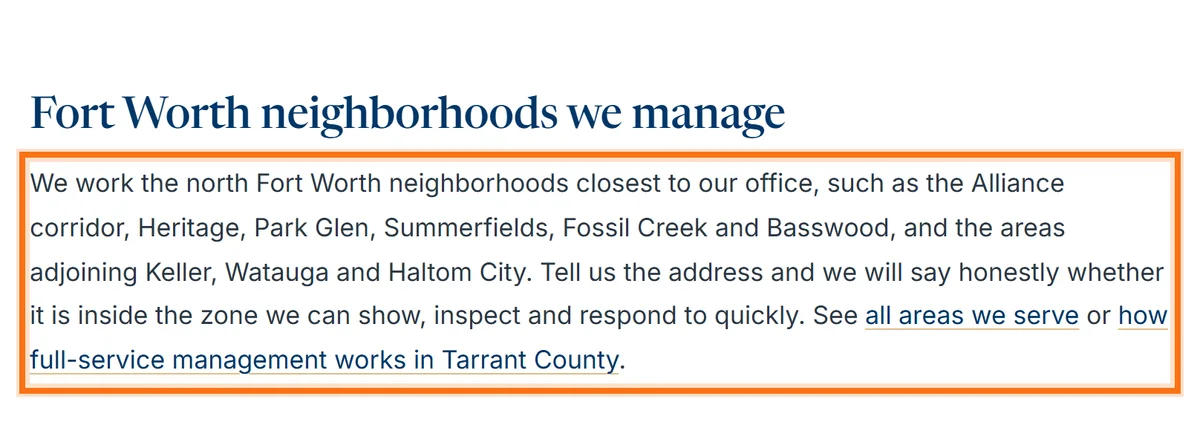
We manage from our office in North Richland Hills, so our Fort Worth zone is the north side of the city and the areas next to our Northeast Tarrant County base. Our Fort Worth page names them:
Management is 9% of monthly rent on the Standard plan, 10% on Full Service with eviction service included, and 7% on the Investor Special for portfolios of 5 or more units. Tenant placement is 75% of one month's rent on Standard and 50% on the other two plans. The final fee is set after the rental analysis and confirmed in writing; every number is on our pricing page.
Deciding whether to rent a Fort Worth house at all
Fort Worth rewards renting in most submarkets, but not every house. A far north subdivision house with a strong school zone and a tenant pool of relocating families is close to the easiest rental in the county. A west side house on a good street holds tenants for years. A near-downtown bungalow that has been renovated rents well to a renter who values it.
The houses that struggle are the ones that need a major update to compete in their submarket and whose owner is not ready to fund it: the unrenovated bungalow, the far north house with fifteen-year-old carpet on a street of fresh ones, the east side house with deferred systems. In those cases the honest question is whether to invest, rent as-is at a lower point, or sell. The sell or rent guide frames that decision with the Fort Worth numbers your house will actually face.
The takeaway: Fort Worth rewards owners who price, position and maintain to the submarket their house sits in, and a manager who knows that part of the city is the difference between a steady rental and a guessing game.
Questions owners ask
Is Fort Worth a good city to own rental property in?
Yes, with the caveat that it is several markets inside one city. The far north subdivisions, the established west side, the near-downtown districts and the east and south side each have a different tenant, price level and maintenance profile. Owners who manage to their submarket do well; owners who manage to a citywide average struggle.
How do I know which school district my Fort Worth rental is in?
Fort Worth's city limits cover several independent school districts, and the district and campus zone are set by exact address. Verify with the district directly, not from a listing site's map, and state the district in the listing because families filter on it first.
What kind of tenants rent houses in Fort Worth?
It depends on the area. Relocating and transferring families in the far north, professionals and military households on the west side, medical staff and young professionals near downtown and the hospital district, and workforce households on the east and south side. The listing and the screening should be written for the tenant your submarket draws.
Does Fort Worth allow short-term rentals?
The city regulates where short-term rentals are permitted, and many residential areas are restricted. Confirm the current rule with the City of Fort Worth before planning nightly stays, and write your lease so a long-term tenant is clearly prohibited from listing the house or any room on a short-term platform.
Do I need a property manager who knows Fort Worth specifically?
It helps more here than in a single suburb. Pricing by block and school zone, knowing which housing stock fails in which way, and having a vendor bench that covers both old houses near the core and new builds in the far north are all local knowledge that a citywide average cannot replace.
Can you rent out my home in Fort Worth for me?
Yes. Perpetual manages rental homes in north Fort Worth from our office in North Richland Hills: pricing, marketing and showings, tenant screening, the lease, rent collection and maintenance. Start with the free rental analysis; the written quote comes with it.
How much can I rent my Fort Worth home for?
It depends on the submarket, the size and condition of the home and the school district, which is why a citywide average misleads. The reliable number comes from homes like yours that actually leased nearby in recent months, and that is what the free rental analysis uses.
Do I have to register my rental house with the City of Fort Worth?
Not if it is a one- or two-family rental with no code violations: the city's rental registration page says registration is voluntary in that case. It becomes mandatory, at $200 a unit a year, when the rental has fire safety or public health and sanitation code violations. Owners who live out of state name a local agent and an emergency contact. Apartment properties with three or more units register every year.
Property management in Keller, North Richland Hills and Fort Worth. How full-service management works in Tarrant County →