
Key takeaways
- Choose by order and criteria, not preference: the first complete application that meets every written criterion is approved.
- Texas Property Code 92.3515 requires printed notice of your selection criteria when the application is handed out.
- An applicant not told of acceptance by the seventh day after submitting a completed application is deemed rejected (Property Code 92.352(a)).
- Rejecting one co-applicant is treated as rejecting all co-applicants (92.352(b)).
- A denial based on a consumer report needs an adverse action notice under the Fair Credit Reporting Act.
When several applicants want your rental, choose by a written first-qualified policy: process applications in the order they are completed and approve the first one that meets every published criterion. A well-priced home in Keller or North Richland Hills can draw several complete applications in its first weekend, and that is where many owners make their most expensive mistake. Faced with three qualified households, the instinct is to pick the "best" one, and the moment an owner starts ranking people by feel, the decision becomes hard to defend.
The policy has to be decided before the first application arrives. This guide explains how it works in practice, what Texas law says about timing, how ties are handled, and the habits that create fair housing exposure without the owner intending it. The application steps themselves are covered in the rental application process from the owner's side.
Why picking the best applicant is the wrong goal
Ranking applicants sounds reasonable: more income, longer job tenure, fewer pets. The problem is that "best" is a judgment, and judgments are where protected characteristics creep in without anyone noticing. An owner who prefers the applicant with no children because the home will see less wear has just made a decision based on familial status. An owner who prefers the household whose names felt familiar has done something worse. Neither owner thinks of themselves as discriminating, and both have created a record that looks exactly like it.
The federal Fair Housing Act and the Texas Fair Housing Act (Property Code Chapter 301) prohibit decisions based on race, color, religion, sex, national origin, familial status and disability. The practical defense is not good intentions; it is a decision process that never asks the owner to compare people at all. Fair housing for Texas landlords covers the protected classes and advertising rules in more depth.
The first-qualified policy, and exactly how it runs
Under a first-qualified policy the home goes to the first applicant whose application is complete and who meets every written criterion. "Complete" is defined: every adult has applied, paid the fee, supplied ID and income documents, and signed the consent for reports. "First" is the time stamp on completion, not on the initial inquiry or the showing.
The sequence looks like this:
- Applications are logged with the date and time each one became complete.
- The earliest complete application is fully verified against the criteria.
- If it qualifies, it is approved and the applicant is offered the lease with a short deadline to sign and pay the deposit.
- If it does not qualify, the applicant is denied with the reason, and the next complete application is verified.
- Later applicants are told their application is in line behind an approved applicant, and are processed only if the approved applicant fails to sign and pay.
The owner's judgment is exercised once, when the criteria are written, and never again on individual applicants. That is the entire point.
The Texas 7-day rule when several people have applied
Texas puts a clock on every application. Property Code 92.352(a) says an applicant is deemed rejected if the landlord does not give notice of acceptance on or before the seventh day after the applicant submits a completed application on the landlord's form.
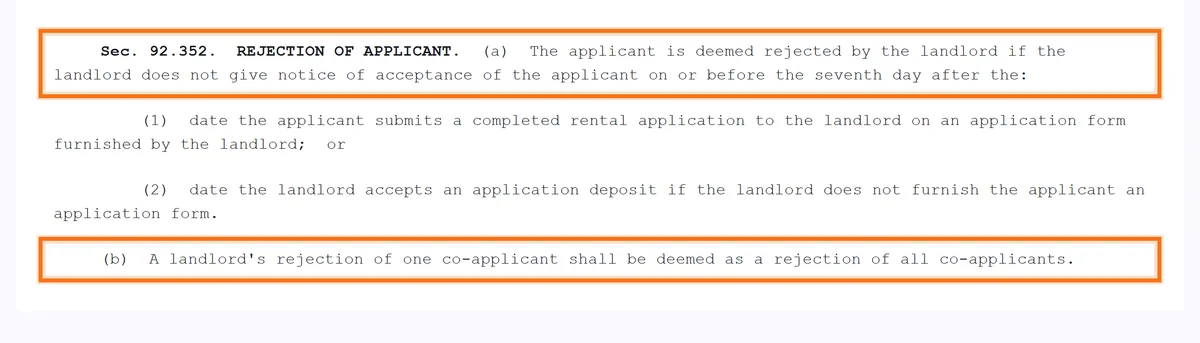
For a listing with a line of applicants this matters in two ways. The second and third applicants cannot be left waiting indefinitely behind the first: after seven days of silence the law treats them as rejected, and any application deposit they paid has to be handled under the same subchapter. And because one co-applicant's rejection rejects the whole group, verify every adult on the first application before telling anyone they are approved.
Here is how the common situations are decided:
| Situation | What decides it | Rule or source |
|---|---|---|
| Three complete applications arrive in one weekend | The order each became complete; the first that meets every criterion is approved | Your written policy |
| An application is missing documents or a fee | It is not in line until complete | Our criteria: paperwork and fees must be in before processing begins |
| One of two co-applicants fails the criteria | The whole application is rejected | Property Code 92.352(b) |
| An applicant hears nothing for a week | Deemed rejected on the seventh day after the completed application | Property Code 92.352(a) |
| You never gave out written criteria and you reject someone | Return the application fee and any application deposit | Property Code 92.3515(e) |
How to read this table: the first two rows are policy, and they only protect you if they were written before the listing went live. The last three rows are statute and apply whether or not you have a policy. Together they mean every applicant in line should get a clear answer within a week.
The criteria have to be written, published and specific
First-qualified only works if "qualified" is defined before anyone applies, and Property Code 92.3515 requires printed notice of the selection criteria when the application is provided. The criteria should state, in plain language: the minimum verifiable income as a multiple of rent, what counts as acceptable credit and what disqualifies, how rental history is evaluated and what a prior eviction judgment means, how criminal history is considered, the occupancy limit, and the pet policy. They should be in the listing, on the application and available to anyone who asks.
Vague criteria such as "good credit" or "stable employment" invite inconsistent application and look like cover for something else. Specific criteria that are applied to everyone the same way are the strongest position an owner can hold. Tenant screening criteria in Texas walks through how each criterion should be set and what the fair housing boundaries are.
Once the criteria are set, resist adjusting them mid-listing because a particular applicant appeared. Raising the income requirement after a qualified applicant has applied, or waiving it for a later one, is exactly the pattern a complaint is built around.
Timing questions: ties, partial applications and the applicant who came first
Real listings produce messy sequences, and the policy has to answer each one in advance:
- Two applications complete within minutes of each other. The time stamp decides. If the system cannot distinguish them, the policy should say what happens, such as processing both and approving the first to be verified as qualified, and that rule is applied every time.
- An earlier applicant is incomplete when a later one is complete. The complete one is first. The incomplete applicant is told what is missing and keeps their place only from the moment they complete it.
- Someone toured first but applied second. Showing order does not matter; completion order does. Say so in the listing so no one feels cheated.
- The approved applicant delays signing. The deadline in the offer controls. When it passes, the next complete, qualified application is approved. The deadline is the same for everyone.
Every one of these rules is easy to apply if it was written down beforehand and nearly impossible to apply fairly if it was invented in the moment.
Applicants who offer more rent, more deposit or a longer lease
In a competitive weekend, an applicant will sometimes offer to pay above the listed rent, put down a larger deposit, or sign for two years. Owners understandably want to say yes. The careful answer is that the home was listed at a price under published criteria, and accepting a sweetened offer from one applicant over an earlier qualified one is a preference-based decision, with all the exposure that carries.
If the market is telling you the price was too low, the right response is to adjust the listed price for everyone going forward, not to run an auction among the people already in line. A manager who sees several above-asking offers in the first days will usually recommend a price correction before the next listing rather than an exception on this one. Our rental pricing service is designed to catch that before the listing goes live, so the owner is not leaving money on the table and is not tempted into a risky choice.
What to document, for every applicant, every time
The record is the defense. For each application, keep:
- The criteria as published at the time the listing was live.
- The time stamp of the completed application and the order it fell in.
- The verification results for each criterion, in summary form.
- The decision, the reason, and the date the applicant was notified.
- For denials based on a consumer report, a copy of the adverse action notice sent.
Records are kept for every applicant, not just the one approved, and for a set retention period. If an applicant later asks why they were not chosen, the answer should take thirty seconds to find and should read as a fact: "A complete, qualified application was received before yours and that applicant signed." With our tenant screening, approval decisions are documented against the published criteria for every applicant.
Telling the applicants who were not chosen
Every applicant deserves a prompt, plain answer. Applicants behind an approved applicant are told that a qualified application was received ahead of theirs and that they will be contacted if the home becomes available again. Applicants who did not meet a criterion are told which one, in writing, with the adverse action notice where a consumer report was involved.
What not to say matters as much. "We chose a better fit," "the owner preferred another family," or any reference to the other applicant's characteristics are the phrases that turn a routine decision into a complaint. The manager handles this communication so that the owner is never in a conversation about why one household was chosen over another. That buffer is one of the quieter benefits of management, covered in professional tenant communication.
Owner habits that quietly create exposure
Most fair housing problems on single-family rentals do not come from a policy; they come from an owner's small habits during a busy listing. The common ones:
- Asking the manager "what are they like?" and expecting an answer about the household rather than the criteria.
- Looking up applicants on social media before deciding.
- Asking for a photo of the applicants, or meeting them "just to get a feel."
- Deciding that a home "is not right for kids" because of a pool or stairs, rather than disclosing the feature and letting applicants decide.
- Approving a friend's referral without running the same screen.
None of these feels like discrimination from the inside. All of them put a decision on a basis other than the written criteria. A manager's job includes declining to participate when an owner drifts toward one of them, and a good one will say so plainly.
How a manager runs this so the owner never has to choose
On the homes we manage, you set the screening standards with us before marketing, and we apply them without exceptions. Every adult applicant is measured against the same published criteria, and approval decisions are documented against those standards, never gut feel. Our criteria also say when an application counts: all paperwork and fees must be in before processing begins. Screening typically takes one to three business days once a complete application is in.
Owners sometimes ask to meet or approve the tenant themselves. We recommend that decisions stay criteria-based, because that is what protects you legally. If you are about to list a home that is likely to draw a crowd, talk through the policy with us before the first application lands, or call 682-593-7033. This is general information, not legal advice; confirm your criteria and process with an attorney if you self-manage.

The takeaway: Write the criteria once, process applications in the order they are completed, approve the first that qualifies, and keep a record that explains every decision in one sentence.
Questions owners ask
How do property managers choose between several qualified applicants?
By a written first-qualified policy rather than by ranking people. Applications are logged with the time each one became complete, meaning every adult has applied, paid the fee, supplied ID and income documents and signed the consent for reports. The earliest complete application is verified against the published criteria; if it qualifies it is approved and offered the lease with a short signing deadline, and if not, the applicant is told why and the next one is verified. Showing order, offers of higher rent or a larger deposit, and how a household feels do not change the order. Each decision is documented as a fact.
Can I accept an applicant who offers more rent than the listing?
Accepting a higher offer from one applicant over an earlier qualified one is a preference-based decision and carries the same risk as any other. If several applicants offer more, the listing price was likely low; correct it for everyone going forward rather than running an auction.
What if two rental applications arrive at the same time?
The completion time stamp decides. If the system cannot separate them, the policy should state in advance what happens, such as approving the first of the two to be verified as qualified, and that rule is applied the same way every time.
Do I have to tell applicants why they were not chosen?
Applicants denied on a consumer report are generally owed an adverse action notice under federal law. Beyond that, telling each applicant plainly that a qualified application came first, or which criterion they did not meet, is the fairest practice and the best record for the owner.
Is it discrimination to prefer applicants without children?
Yes. Familial status is a protected class under fair housing law. Features like a pool or stairs should be disclosed so applicants can decide for themselves; the owner should not decide for them.
Who makes the final decision on a tenant, me or the property manager?
You decide the standard once, and the manager applies it. The owner sets the written screening criteria before marketing: minimum income, credit, rental history, background and pet policy. From then on applications are processed in the order they are completed and the first one that meets every criterion is approved. That protects you, because choosing by preference among qualified applicants is where fair housing exposure lives. At Perpetual you set the standards with us and we apply them without exceptions.
How do I pick between two tenants who both qualify?
Approve the one whose application was complete first. A complete application means every adult has applied, paid the fee and supplied the documents your criteria ask for. Do not compare the two households on income above the minimum, family size or how they came across; that comparison is where fair housing complaints start. Tell the second applicant promptly that a qualified application came first.
How long does a Texas landlord have to answer a rental application?
Under Property Code 92.352, an applicant is deemed rejected if the landlord does not give notice of acceptance on or before the seventh day after the applicant submits a completed application on the landlord's form. Rejecting one co-applicant counts as rejecting all of them.
Related services
Property management in Keller, North Richland Hills and Fort Worth. How full-service management works in Tarrant County →