Key takeaways
- Nobody checks an empty house by default. A manager does it for a house under management; otherwise it is you or someone you name.
- No Texas statute sets how often an empty house must be checked. The schedule belongs in your management agreement, in writing.
- Utilities stay on and in the owner's name while the house is empty, and the owner pays them.
- The Texas Department of Insurance says most companies stop coverage once a house has been vacant 60 days. Call your agent before that.
- In Fort Worth, grass over 12 inches brings a certified notice and 10 days to mow, on vacant lots as well.
Who checks on empty houses? Only the people the owner arranges. When a rental in Fort Worth, Keller or North Richland Hills is under management, the property manager looks after it during the vacancy between tenants and in the weeks before a first listing. When it is not, the owner, a neighbor or a paid house-watcher has to walk it, because the city looks only at the yard and the insurance company does not look at all.
This guide shows who checks what and how often, what a vacant check covers, who holds and pays the utilities, how to protect an empty house in a freeze, what your insurance says about vacancy, and what we do while a home we manage is empty.
Who checks on an empty house, what they check and how often
Here is everyone who may look at a vacant house in the Fort Worth area, what each one actually checks, and how often:
| Who | What they check | How often |
|---|---|---|
| Property manager (house under management) | Inside and out: locks, leaks, thermostat, lawn, make-ready work, showing access | On the schedule your management agreement states. Ask for it in writing |
| You, a neighbor or a paid house-watcher (house not managed) | Whatever you ask them to: ideally the same inside-and-out walk | You decide. No Texas statute sets a schedule |
| Prospects and agents at showings | Only the rooms they came to see. Nobody runs the water or looks at the ceilings | Whenever a showing is booked |
| City code compliance (Fort Worth) | The outside only: grass and weeds over 12 inches | No set schedule. A violation brings one certified notice per year and 10 days to mow |
| Your insurance company | Nothing in person. The policy states how long the house may sit vacant | Most companies stop coverage at 60 days vacant, per the Texas Department of Insurance |
| Water utility (Fort Worth Water MyH2O) | Continuous water flow on the meter, which can mean a leak | Usage is shown a day behind; you set the alerts yourself |
How to read this table: only the first two rows put a person inside the house, and both exist only if you arrange them. The city, the insurer and the utility react to a problem; none of them prevents one.
Can a property manager look after an empty house?
Yes, and the answer depends on which of three situations you are in.
- Between tenants. From the move-out inspection to the next move-in, the house is empty and the manager is responsible for it. The make-ready, the showings and the checks are covered as the agreement states.
- Before the first listing. A house that was just inherited, vacated by the owner or renovated is empty while the manager prepares it. Once the agreement is signed, this is treated like any other vacancy.
- Long-term vacant with no plan to rent. A second home, a house held for a future sale, or an estate house that is not ready to lease. This is caretaking, not management, and companies differ on whether they offer it and at what fee.
For the first two, the question is what the service includes. For the third, ask plainly whether the manager will take a house that is not going to be rented, and get the fee in writing if they do.
What a vacant check includes
A vacant check is a scheduled walk-through, documented with photos, that confirms the house is secure, dry and running. A thorough one covers:
- Exterior: doors and windows locked, no signs of forced entry, lawn in order, no flyers piling up, no standing water near the foundation, mailbox empty.
- Interior: every faucet run briefly so traps do not dry out, toilets flushed, the water heater and under-sink areas checked for leaks, ceilings checked for stains, heating or cooling confirmed running.
- Systems: thermostat setting right for the season, sprinkler controller checked, garage door operating, smoke alarms present.
- Record: dated photos of each room and of any problem, sent to the owner.
Ask how often the house is walked when it is empty for a month, and whether showings count as checks. A showing is a visit, but it is not a check unless someone ran the water and looked at the ceilings. The inspections we do during a tenancy are described on our inspections page.
Who handles utilities while the house is empty
Utilities stay on during a vacancy. A house without electricity cannot run the heat that protects the pipes or the air conditioning, and a house without water cannot be cleaned or shown. The question is whose name the accounts are in and who pays.
The usual arrangement: when a tenant moves out and transfers or closes their accounts, service goes into the owner's name, and the owner pays the bills until the next tenant moves in. Electricity, water and trash, and gas each have their own provider and their own transfer steps, and water is typically a city account.
Ask a manager three things: whether they will open and transfer the accounts for you, whether vacant-period bills are paid from your funds and shown on your statement or billed to you directly, and how they confirm the new tenant has moved the accounts into their own name at move-in. That last step is where owners end up paying a tenant's first month of electricity. The details are in who handles utilities while a rental is empty.
Freeze and heat: protecting an empty house in North Texas
A winter freeze can burst a pipe in an attic or an exterior wall, and in an empty house nobody notices until the water has run for hours. The official guidance for a house nobody is living in is specific.
- Keep the heat on. The Texas Department of Insurance warns that home policies might not pay for frozen-pipe damage if you did not take steps to protect the pipes, such as keeping the heater on.
- Leaving before a freeze? The same page says to turn off the water at the shutoff valve and leave the heat on.
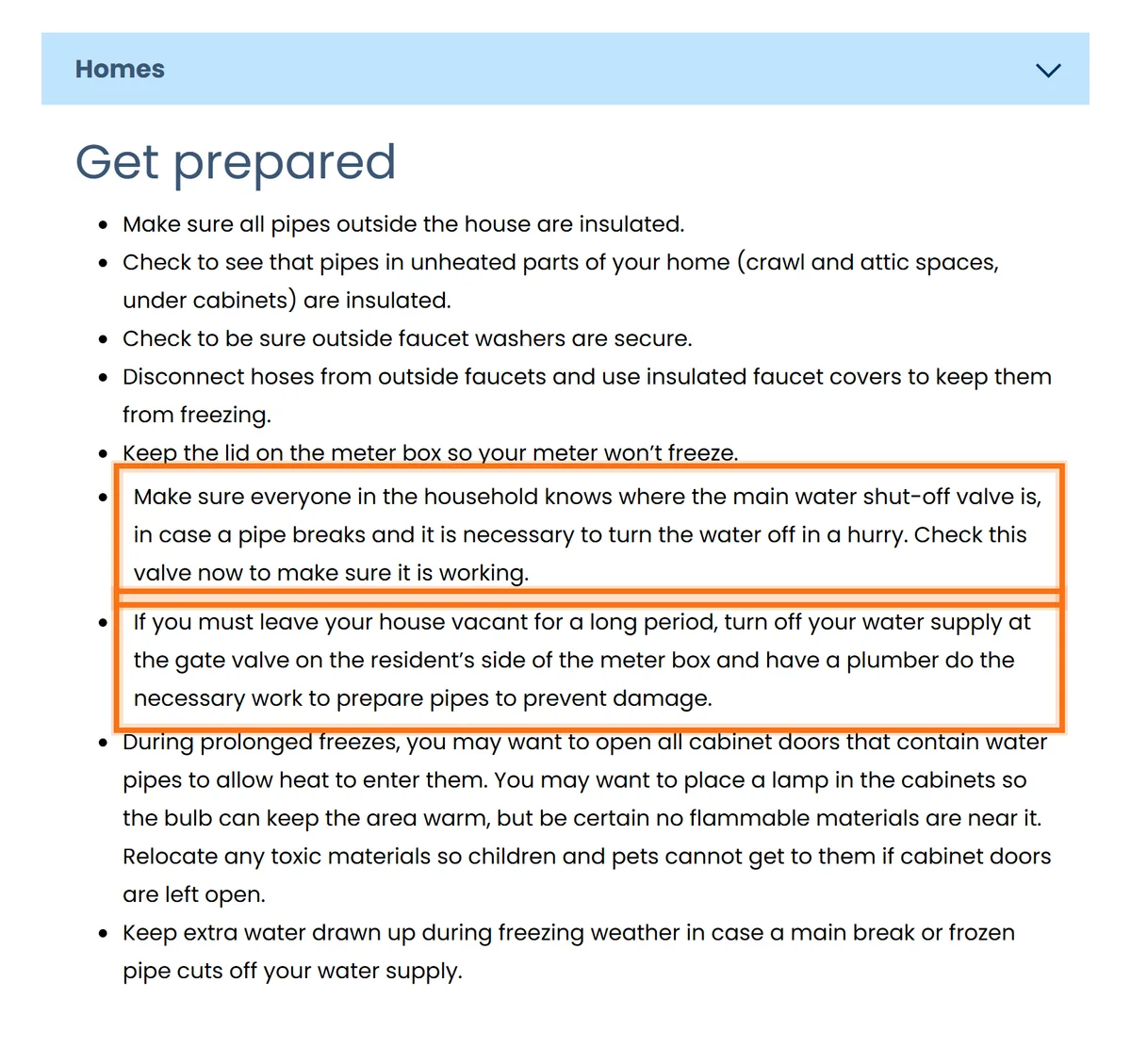
- Vacant for a long period? Fort Worth Water says to turn off the supply at the gate valve on the resident's side of the meter box and have a plumber prepare the pipes.
- Outside: remove hoses, wrap outdoor pipes, drain and turn off the sprinkler system, and keep the lid on the meter box.
- Know the main shut-off valve and test it now, before it is needed in a hurry.
Summer is the other risk. The cooling stays on at a protective setting, because a closed-up house in August heat cannot be shown and is hard on its finishes. In both seasons someone has to physically do these things, and the agreement should say who. The full winter routine is in winter freeze prep for a Texas rental.
Security, locks and the lawn on an empty house
An empty house attracts attention from people who notice a dark house, a full mailbox and tall grass. The job is to make the house look lived in and make entry inconvenient.
- Locks. Texas Property Code 92.156 requires the landlord to rekey the locks operated by a key, card or combination, at the landlord's expense, no later than the seventh day after each tenant turnover date. If vendors use a smart lock or lockbox, each code is removed when the work is done.
- Lights. Interior lights on timers and exterior lights on dusk-to-dawn sensors.
- Lawn. Mowed on the schedule a tenant would keep. Fort Worth requires grass and weeds to be kept at 12 inches or less on developed and vacant lots. A violation brings one certified notice per year and 10 days to mow; after that the city sends a contractor at the owner's expense, with an average mowing fee of $250, and unpaid charges may become a lien. For Keller, North Richland Hills and other cities, confirm the height limit with the city.
- Mail and flyers. Mail forwarded or held, flyers removed at each check, and a neighbor who has a number to call.
- Showing access. A log of who entered and when.
Some cities also register vacant buildings. Confirm with your city whether yours does before a long vacancy.
Insurance while the house is vacant: the 60-day question
The Texas Department of Insurance's home insurance guide lists losses that happen after a house has been vacant for the number of days stated in the policy among the things most policies do not cover. It also says most companies stop your coverage if the house is vacant for 60 days or more, although they usually do not stop the liability coverage.
A normal turnover between tenants is usually shorter than that. A renovation, an estate or a slow season may not be. TDI's advice is to talk to your company before an extended absence so coverage continues. Read the vacancy clause in your own policy, because the number of days and what counts as vacant are set there, and tell your agent the house is a rental.
The manager does not buy or change the policy; that stays with you, as described in what full service leaves out. What dated photo reports give you is a record that the house was being looked after. This is general information, not insurance advice.
What an empty month actually costs, and how to shorten it
During a vacancy you pay the mortgage, insurance, taxes, utilities and lawn service with no rent coming in. At $2,000 a month in rent, every week of avoidable vacancy costs about $460. So the checks are only half the job. The other half is making the vacancy short: a price set from leased comparables, photos taken as soon as the cleaners leave, the listing live when the make-ready finishes, and showings and applications answered quickly. The full accounting is in what vacancy really costs, and our marketing and showings page describes the listing side.
What you should see from your manager during a vacancy
A vacancy is when owners most want to know what is happening and most often hear nothing. Without a phone call, you should be able to see:
- The move-out inspection report with photos, and the deposit itemization once it is prepared.
- The make-ready scope and the vendor invoices as they arrive.
- Each vacant check, dated, with photos.
- Any utility bill paid on your behalf, as its own line.
- Listing activity: the date it went live, inquiries and showings, and any price change with the reasoning.
If none of that reaches you, the answer to "what is happening with my house" depends on who picks up the phone.
How Perpetual handles this
Perpetual Property Management is broker-owned, with our office at 5755 Rufe Snow Dr in North Richland Hills, and we manage homes in Keller, North Richland Hills, Fort Worth and nearby. What our site commits to for an empty home is in The Perpetual Promise, five written guarantees in every management agreement, subject to its Guarantee Addendum:
- While your home is vacant you get a written activity report every week, with showing feedback and market notes, or that month's management fee is credited.
- The home is live on every major rental platform within 5 business days of being market-ready, or the first month's management fee is waived.
- Every move-out gets a 360-degree condition inspection, and every completed repair over $500 gets photo or video proof in your portal.
Showings run through a self-guided and scheduled system with identity verification, and access is logged and time-limited. Make-ready repairs under the spending limit you pre-approve are done without waiting; anything larger comes to you with photos and a recommendation. Emergency response is 24/7 on every plan.
What the site does not state is how often we walk an empty home in person, who opens the utility accounts, and what, if anything, is charged while the home is vacant. Those are confirmed in writing before you sign. If you own a house that is empty right now and are not sure what it needs this week, call 682-593-7033.
The takeaway: An empty house is protected by someone walking it, utilities kept on in the right name and a thermostat that never goes off, and it is made profitable again by a listing that goes live the day the work ends.
Questions owners ask
Can I hire a property manager to look after a house while it's empty?
Yes. During a vacancy between tenants, or the preparation weeks before a first listing, looking after the empty house is part of management: walk-throughs, locks, thermostat, lawn and utilities, as the agreement states. Long-term caretaking of a house you do not plan to rent is a separate request that some companies offer and others do not, so ask directly and get the fee in writing.
Who handles utilities while the rental is empty?
Utilities stay on during a vacancy so the house can be cleaned, shown, heated and cooled. The accounts are usually in the owner's name and the owner pays the bills while the house is empty. A manager can open or transfer the accounts with your authorization, and should confirm the tenant has moved them into their own name at move-in so you are not paying the tenant's first month.
How often should an empty rental house be checked?
No Texas statute sets a schedule, so the management agreement should. Often enough that a leak or a break-in is found in days, not weeks, and more often during a freeze or a heat wave. Showings are not checks unless someone runs the water, looks at the ceilings and confirms the thermostat, so ask the manager to report the two separately.
What temperature should an empty house be kept at?
Never off. The Texas Department of Insurance warns that a policy might not pay for frozen-pipe damage if you did not take steps such as keeping the heater on. No official source sets one number for an empty house, so agree the winter and summer settings with your manager and your insurance agent. The goal is protecting the plumbing and finishes, not comfort.
Does my insurance still cover the house while it sits empty?
Usually for a limited period. The Texas Department of Insurance says most companies stop coverage if a house is vacant for 60 days or more, though usually not the liability coverage. A normal turnover is typically shorter. Call your agent before a long vacancy and ask how the policy defines vacant. This is general information; the policy and the company decide.
Who checks on empty houses?
Whoever the owner arranges. For a house under management it is the property manager, between tenants and before a first listing. For any other empty house it is the owner, a neighbor, a relative or a paid house-watcher. The city checks only the exterior, such as grass over 12 inches in Fort Worth, and an insurance company does not inspect a vacant house for you.
How should a landlord prepare a property for vacancy (utilities, lockbox, water shutoff, insurance checks)?
Move the utilities into your name the day the tenant's service ends and keep power and heat on. Rekey the locks and control every lockbox or smart-lock code. Find and test the main water shut-off valve. Call your insurance agent if the house may sit empty near 60 days. Then set a written check schedule. Whether a manager includes those steps in the fee is a question for the agreement.
Related services
Property management in Keller, North Richland Hills and Fort Worth. How full-service management works in Tarrant County →