Key takeaways
- The reserve is a fixed dollar amount per house, written into the management agreement, not a percentage of rent.
- It is the owner's money; Texas license law bars a broker from commingling it with company funds (Occupations Code 1101.652).
- It covers ordinary service calls; a roof or an HVAC replacement needs your own repair fund.
- Rent refills it each month, so repairs lower that month's payout, not the reserve.
- On our Standard plan a $220 repair costs $230.78 with the 4.9% maintenance coordination fee.
How much money does a property manager keep in a maintenance reserve? A fixed amount for each house, stated in the management agreement rather than as a percentage of rent, held separately from company funds so a repair invoice can be paid the day it arrives instead of waiting for next month's rent. For owners in Fort Worth, Keller and North Richland Hills, the amount is sized to the house: higher for an older home or one with a pool.
The reserve is not your emergency fund, it is not a fee, and it is not the manager's money. It is a float that lets maintenance happen without a phone call for every invoice. Below is how it is sized, how it refills, how to read it on your statement, and when you get it back.
How the reserve is sized
The agreement sets the number, and the manager sets it from experience of what a typical repair costs. The reserve needs to cover one ordinary service call and the small invoices that accumulate in a month, so that only large jobs ever wait for owner funds. As an illustration only: a reserve of $300 covers a plumber's visit or a garbage disposal; $500 covers a water heater element plus a lock change; neither covers an HVAC compressor, and neither is meant to.
Managers commonly set a higher reserve when the house is older, has a pool, has original HVAC or plumbing, or when the owner lives overseas and cannot send funds quickly. Some set it per owner across a portfolio rather than per house. Ask for the number and the reasoning in the written quote. How the reserve sits inside the whole flow of your money is explained in owner reserves and disbursements.
How it refills, and what it does to your monthly payment
Each month the manager collects rent, pays that month's invoices from the trust account, tops the reserve back up to its stated level, and sends you the rest. On a quiet month the reserve stays full and your disbursement is rent minus the management fee. On a month with a $220 repair, the reserve pays it, the reserve is refilled from rent, and your disbursement is $220 lower.
The practical consequence is that your payment varies with repairs, not with the reserve. The reserve only changes your cash flow twice: when it is first funded, usually out of the first month's rent or an initial contribution, and when it is returned at the end. If a manager keeps increasing the reserve without a stated reason, ask why; the agreement should require your agreement to change it.
A month with and without a repair, on our Standard plan
Here is how one month of rent moves for a home renting at $2,000 on our Standard plan, which charges 9% of monthly rent and 4.9% of cost for maintenance coordination. The reserve starts and ends full in both columns:
| Line on the statement | Quiet month | Month with a $220 plumber invoice |
|---|---|---|
| Rent collected | $2,000.00 | $2,000.00 |
| Management fee (9%) | -$180.00 | -$180.00 |
| Vendor invoice, paid from the reserve | $0.00 | -$220.00 |
| Maintenance coordination (4.9% of $220) | $0.00 | -$10.78 |
| Reserve refilled to its stated level | No change | Refilled from rent |
| Paid to the owner | $1,820.00 | $1,589.22 |
How to read this table: the repair lowers that month's payout by the invoice plus the coordination fee, and the reserve itself ends the month at the same balance. The illustrative $220 invoice is an example, not a price. Rent we collect is paid out by the 10th of the month, or that month's management fee is waived, as our guarantees page states.
What the reserve is not
Three things get confused with the reserve:
- Your own repair fund. The reserve covers a service call. A roof, a foundation repair or an HVAC replacement needs owner money that you keep in your own account.
- The security deposit. That is the tenant's money, held under Property Code Chapter 92, Subchapter C, and it is not used for repairs during the lease.
- A fee. The reserve is your money on deposit with the manager. It is returned to you when management ends.
Texas license law treats money a broker holds for others seriously: under Occupations Code Section 1101.652(b), a license holder can be disciplined for failing to properly account for or remit money that belongs to another person, or for commingling it with the license holder's own money. Ask the manager to confirm where your reserve is held. This is general information, not legal advice.
Reserve, security deposit and your own repair fund compared
Three pots of money sit around every managed rental, and they are easy to confuse. Here is what each one is for:
| Owner reserve | Security deposit | Your own repair fund | |
|---|---|---|---|
| Whose money | The owner's | The tenant's, until move-out | The owner's |
| Who holds it | The manager, apart from company funds | The landlord or manager, under the lease | You, in your own account |
| What it pays for | Ordinary repairs and service calls between rent payments | Unpaid rent and damage beyond normal wear at move-out | Roofs, HVAC replacements, foundation work, turnovers |
| Rules that govern it | The management agreement and Occupations Code 1101.652 | Property Code Chapter 92, Subchapter C | Your own plan |
| When it ends | Returned when management ends, after open invoices | Refunded or itemized within 30 days of surrender (92.103) | Never; it is your cushion |
How to read this table: only the first column is the maintenance reserve. If a manager ever proposes paying a mid-lease repair from the security deposit, that is the wrong pot. How much to keep in your own fund is covered in how much reserve to keep per rental.
How to see it on the statement
The reserve should appear on every monthly statement as a balance carried forward, with the top-up shown as a line in any month it was used. A clean statement reads, in effect: rent received, management fee, repair invoice with vendor name, reserve replenished, amount disbursed, reserve balance. If the reserve balance is not on the statement, you cannot tell whether a repair was paid from your rent or from money already held, and you should ask for a statement format that shows it.
The owner portal should show the same figure in real time, with the invoices behind every draw on it. What each line means is in how to read your monthly owner statement, and the owner portal page shows the view Perpetual's owners have.
Large repairs, the approval limit and when you send funds
The reserve works with the approval limit in the agreement. Repairs under the limit are done and paid from the reserve; repairs over it wait for your approval unless they are emergencies that protect the house or the tenant. When a job exceeds what the reserve and the month's rent can cover, the manager asks you to send funds before the vendor is paid, or arranges for the vendor to be paid from the next rent with your agreement.
Ask how that works before you need it: "If a repair costs more than the reserve plus this month's rent, how do you handle payment and how fast do you need funds from me?" The answer tells you how the maintenance process actually runs when a water heater fails in July.
How Perpetual handles this
Your reserve amount is agreed with you and goes into the management agreement with every fee, and if a fee is not in the agreement you do not pay it. It appears on every monthly statement, so you can see it was used only for invoices you can open in the owner portal, where the vendor's original invoice always sits next to the 4.9% to 5% maintenance coordination charge on Standard and Full Service.
Perpetual Property Management is broker-owned and local to Keller, North Richland Hills and Fort Worth. Routine repairs under your pre-approved limit get fixed fast; anything larger comes to you with a description, photos and a recommendation, unless it is an emergency that protects the house or the tenant. Every completed repair over $500 gets photo or video proof in your portal.
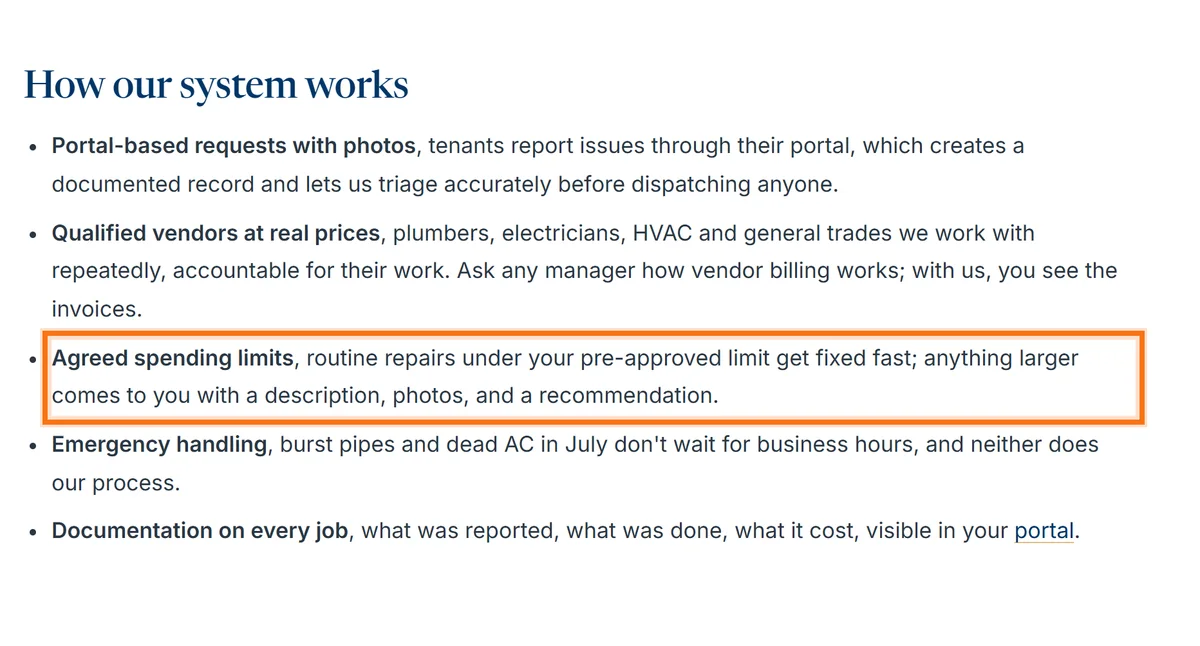
The maintenance service page shows how a work order moves from the tenant's request to your statement.
The takeaway: The reserve is a fixed, stated float held in trust and refilled from rent, so get the amount in writing, make sure it shows on every statement, and keep your own fund for the large repairs it was never meant to cover.
Questions owners ask
Is the owner reserve the same as a security deposit?
No. The reserve is the owner's money, held to pay repairs between rent payments. The security deposit is the tenant's money, held to cover damage or unpaid rent at move-out and returned under Texas deposit rules. They are tracked separately and should appear separately on your statements.
Does the property manager earn interest on my reserve?
The reserve sits in a trust account for your benefit, and the manager should not be using it for anything other than your property's expenses. Whether a trust account pays interest and to whom depends on the account and the agreement; most owner reserves are small enough that interest is negligible. Ask the manager to confirm in writing.
Can I refuse to fund a maintenance reserve?
Most managers will not take a house without one, because they cannot pay vendors promptly otherwise, and slow payment costs you the good vendors. If cash is tight at the start, ask whether the reserve can be funded from the first month's rent rather than up front, and get the answer in the agreement.
When do I get the reserve back?
When the management agreement ends, after any open invoices have cleared, with a final statement showing the accounting. A short holdback for outstanding bills is normal; a reserve that is still unreturned months after termination is not, and you should request it in writing.
How much should a rental property repair reserve be?
There are two numbers. The manager's reserve is a small float per house, set in the agreement and sized to the home, enough for an ordinary service call. Your own repair reserve is larger and sits in your account for roofs, HVAC and turnovers. The guide on how much reserve to keep per rental works through that second number.
How do I track what the property manager spends from the reserve?
Every draw should appear on the monthly owner statement with the vendor's name, and the invoice behind it should be in the owner portal. On our plans the original vendor invoice is always in the portal, with the maintenance coordination charge shown as its own line.
Related services
Property management in Keller, North Richland Hills and Fort Worth. How full-service management works in Tarrant County →