Key takeaways
- A rental needs two reserves of your own: an operating cushion for vacancy and turnover, and a repair reserve for the big systems.
- Size the repair reserve from your own house: each system's replacement quote divided by the years it has left, plus your insurance deductible.
- A percentage deductible is a percentage of the home's insured value, not of the claim: on a home insured for $200,000, 1% means the first $2,000 of a hail claim is yours.
- The working reserve a manager holds is separate and small. Its amount is set in the management agreement and confirmed in writing.
- Keep your own reserves in a separate savings account, and refill them after every draw.
Keep two reserves per rental: an operating cushion that carries your own costs through a vacant month or a turnover, and a repair reserve sized from the age and replacement cost of the HVAC, roof, water heater and foundation, plus your insurance deductible. That holds in Fort Worth, Keller or North Richland Hills, and matters most in Northeast Tarrant County, where much of the housing is 30 to 50 years old. Keep both in your own savings account.
Most advice gives a rule of thumb. I would rather show you how to size the number from your own house, because a rule of thumb is wrong for a house with a twenty-year-old roof and wrong in the other direction for a new build. Then we will cover where the money should live.
Rental property reserves at a glance
Here are the four amounts a rental owner should be able to point to, what each one pays for and how each is sized:
| Reserve | What it pays for | How to size it | Where it sits |
|---|---|---|---|
| Operating reserve | A vacant month, a late rent payment, a turnover make-ready, a property tax bill that is not escrowed | Your own monthly mortgage, tax and insurance payment for the months you want covered, plus one make-ready | Your savings account |
| Repair (capital) reserve | HVAC, roof, water heater, foundation, sewer line, appliances | Each system's replacement quote divided by its remaining years, funded for the oldest system first | Your savings account |
| Insurance deductible | Your share of a covered claim, such as hail damage to the roof | The amount on your policy's declarations page; a percentage deductible is a percentage of the insured value | Your savings account, inside the repair reserve |
| Manager's working reserve | Routine repairs under the spending limit you pre-approve, between disbursements | The amount written in your management agreement | With the manager, in money held for you |
How to read this table: the first three rows are your money in your own account, and together they are what people mean by a rental property repair reserve or maintenance reserve. The last row is the only part a manager holds, and it is sized for small repairs, not for a compressor or a roof.
You need two reserves, not one
Owners usually think of the reserve as a single pile of money for emergencies. It works better as two, because they answer different questions.
The operating reserve covers the gap between money going out and rent coming in: a vacancy month, a tenant who pays late, a turnover's make-ready, the property tax bill if it is not escrowed. It is sized in months of rent and expenses. The capital reserve covers the big-ticket items that fail on their own schedule regardless of tenant or market: the HVAC system, the roof, the water heater, the foundation, the sewer line. It is sized from what those systems cost and how much life they have left.
Keeping them separate, even just as two lines in a spreadsheet, stops the common mistake of spending the capital reserve on a vacancy and then having nothing when the compressor goes. Both should exist before the first tenant moves in. If you are still at that stage, the full first-year picture is in your first year as a landlord.
Sizing the operating reserve
Start with the worst ordinary month, not the average one. For a single-family rental that means a turnover: a month with no rent, a make-ready bill, utilities in your name and the mortgage still due. Add the second month in case leasing takes longer than hoped.
A practical way to size it is to add up three lines from your own records:
- Two months of your mortgage, tax and insurance payment, because those are due while no rent arrives.
- One turnover make-ready: paint, cleaning and small repairs. Use your last make-ready invoice, or a contractor's quote if you have never had one.
- Utilities and lawn care during the vacancy.
As arithmetic only, not a quote: at $2,000 a month in rent, each vacant week is about $460 of rent you do not collect, and two empty months are $4,000 before a single bill is paid. That is why the cushion is sized in months of your own costs, and why it should be larger when the mortgage payment is high relative to rent.
Owners with several properties can hold somewhat less per door, because vacancies rarely line up, but never less than one turnover's worth for the portfolio. If the tax bill is not escrowed, add it to the operating reserve in the months before it is due, because it arrives whether or not the house is rented. The full list of vacant-month costs is in how much to set aside before renting.
Sizing the capital reserve from the systems you actually have
This is where a rule of thumb fails and a walk through the house succeeds. List the major systems, note the age of each, estimate the remaining life, and get a replacement cost from a contractor or a recent quote. Then fund the ones closest to failure first. As our maintenance page notes, much of Northeast Tarrant's housing stock is 30 to 50 years old, so in Keller, North Richland Hills and older parts of Fort Worth this list is rarely short.
The items that drive the number in North Texas:
- HVAC. The most likely large failure, and the one that cannot wait in a Texas summer. If the unit is past the middle of its expected life, the repair reserve should be building toward a replacement quote. The HVAC guide for Texas rentals covers repair versus replace.
- Roof. Hail decides when. Insurance may pay for a covered loss, but the deductible is yours. Know the number and keep it in the reserve.
- Water heater. Fails without warning, often with water damage. A smaller bill, but an immediate one.
- Foundation and sewer line. Not annual risks, but in North Texas clay they are real ones. The warning signs are in foundation and plumbing in North Texas rentals.
- Appliances, fencing, garage door opener. Smaller, but they add up across a decade.
A simple method is to divide each item's replacement quote by its remaining years and add those up as a monthly contribution. A house with new systems needs little. A house with original everything needs a serious number, and pretending otherwise is just borrowing from a future repair. We do not print replacement prices here because they change with the house and the year; a quote for your own equipment is the only figure worth saving toward.
Your insurance deductible belongs in the reserve
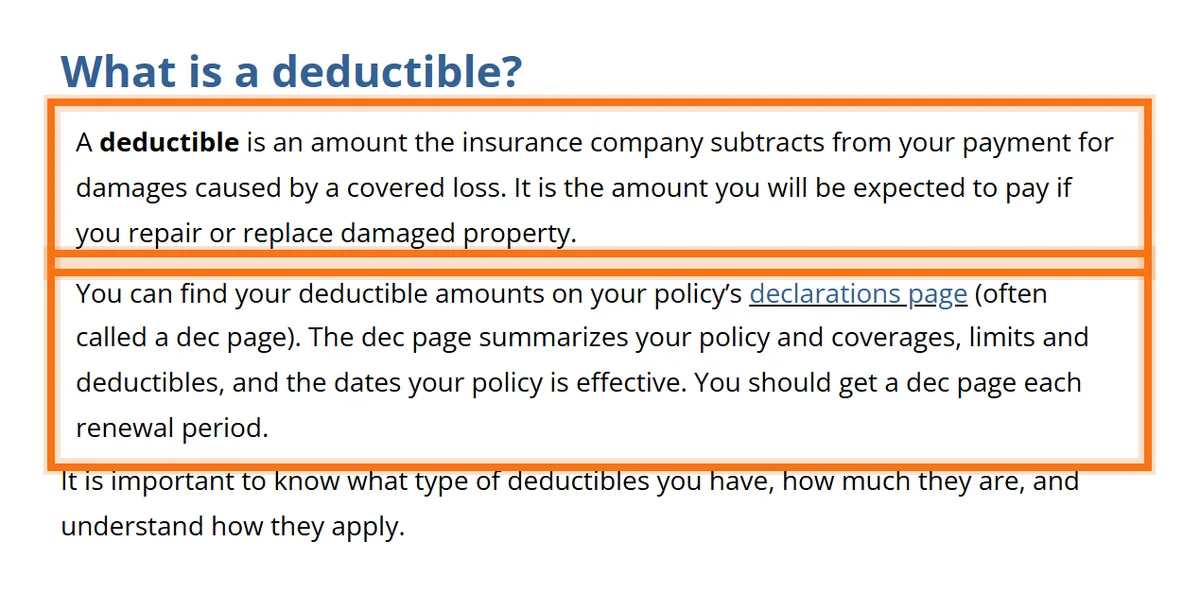
The Texas Office of Public Insurance Counsel (OPIC) defines a deductible as the amount the insurance company subtracts from your payment for a covered loss: the amount you will be expected to pay if you repair or replace damaged property. A deductible is either a flat dollar amount or a percentage, and OPIC is specific that a percentage deductible is calculated on the amount of insurance on the home, not on the amount of the claim.
OPIC's own example shows why this matters: on a home insured for $200,000 with $7,000 of hail damage, a 1% deductible leaves you paying $2,000, a 3% deductible leaves you paying $6,000, and with a 5% deductible you pay the full $7,000 because the deductible is higher than the claim. Find your deductible on the declarations page, check it again at every renewal, and hold that amount in cash. More on roof claims is in hail and roof damage on a Texas rental.
The manager's reserve is not your reserve
If you hire a manager, the management agreement will name a working reserve the manager holds for your property, so that a plumber can be paid without waiting for next month's rent or a call to you. The amount is set in the agreement. It is your money, not the manager's: under Texas Occupations Code 1101.652(b), a broker can be disciplined for commingling money that belongs to another person with the broker's own, or for failing to account for it within a reasonable time. Ask how it is shown on your statement and how it is returned when the agreement ends.
It is not a substitute for your own reserve. It covers the small, frequent repairs between disbursements. It does not cover a compressor, a roof deductible or two months of vacancy. When a large repair is approved, the manager either draws it from rent before the disbursement or asks you to fund it, and that is when your own reserve is needed, often on the same day.
How the manager's reserve works and how it is refilled is explained in owner reserves and disbursements and how much a manager keeps as a maintenance reserve. The practical rule: the manager holds enough to keep the house running, you hold enough to keep it owned.
Where the money should sit
The reserve has three jobs: be there, be reachable within a day, and not be spent on anything else. That rules out most of the places owners keep it.
- Not in your checking account, where it blends into household spending and disappears by spring.
- Not in the stock market or anything that can be down the week you need it.
- Not in the property's equity. A line of credit is a backup to a reserve, not a reserve; it depends on the lender on the day you need it, and drawing it adds a payment.
- Not with the manager beyond the working reserve in your agreement. That is your money, but it is not earning anything for you and it is not the manager's job to be your bank.
What works is a separate savings account in your name, ideally one that pays some interest, labeled for the property, with online transfer to your operating account. One account per property is tidy; one account for a small portfolio with a spreadsheet behind it is fine. The point is a wall between the reserve and everything else.
Building it when you do not have it yet
Many owners start a rental with the make-ready costs just paid and no reserve at all. The answer is not to skip it but to build it on a schedule and to protect the property in the meantime.
A workable sequence: fund the operating reserve first, from every month's cash flow until it is full, because a vacancy is the most likely near-term event. Then redirect the cash flow into the capital reserve, starting with the system closest to failure. If cash flow is thin, decide in advance what you will do for a large repair before the reserve exists, whether that is a credit line, savings elsewhere or a conversation with a contractor about staged work, so the decision is not made at midnight with the tenant on the phone.
While the reserve is building, prevention does more than at any other time. A serviced HVAC system, a flushed water heater and a checked drainage grade are small bills that postpone the large ones. Our maintenance page explains why planned attention to aging HVAC, water heaters and roofs beats emergency pricing, and a routine documented inspection is how a slow leak gets found before it is a subfloor. If a large repair arrives before the reserve is ready, see what happens when there is not enough in the reserve.
Refill after every draw, revisit every year
A reserve that is drawn and not refilled is a reserve that existed once. After any draw, the first job of the next months' cash flow is to put it back. After a system is replaced, the capital reserve for that item resets to near zero and starts building again toward the next one, while the newly replaced system drops to the bottom of the risk list.
Once a year, walk the list again. Systems aged a year. Rent may have changed, which changes the operating reserve. Insurance deductibles may have moved at renewal. A year with no large repairs is not a reason to lower the number; it is a year the reserve did its job by existing. Owners who skip this review end up with a reserve sized for the house they bought, not the house they own now.
Can the reserve be too large?
Yes, and the cost is quiet: money that could be working elsewhere sits in a savings account earning little. Once the operating reserve is full and the capital reserve is funded for the systems nearest failure, additional cash flow can go to paying down the loan, improving the property in ways that raise rent, or toward the next property.
The test is whether the two reserves together would carry the house through a bad year: a turnover plus the single most expensive likely repair, with the mortgage paid throughout. If they would, the reserve is sized. If they would with room to spare, the extra is capital you are not using. How that extra fits into a second purchase is covered in using equity to buy your next rental. A CPA or financial advisor can fit this to your own situation. This is general information, not financial, insurance or tax advice.
How Perpetual handles this
Perpetual Property Management is broker-owned, with our office at 5755 Rufe Snow Dr in North Richland Hills, and we manage homes in Keller, North Richland Hills, Fort Worth and nearby. Whether a working reserve is held for your property, and how much, is not a published number: it is set in your management agreement and confirmed in writing before you sign, along with the spending limit you pre-approve. If a fee is not in the agreement, you do not pay it.
The process around it is on our site. Routine repairs under your pre-approved limit get fixed without waiting; anything larger comes to you with a description, photos and a recommendation, which is the moment your own reserve is needed. Maintenance coordination is 5% of the repair cost on Full Service and 4.9% on Standard, the vendor's original invoice is always in the owner portal, and every completed repair over $500 comes with photo or video proof under The Perpetual Promise, subject to its Guarantee Addendum.
Rent collected is disbursed by the 10th, or that month's management fee is waived, so you can plan refills around a known date. Every plan includes an annual property inspection, which is where an aging system gets noticed before it fails. See the written guarantees and pricing and fees, or ask what the reserve would be for your house: call 682-593-7033.
The takeaway: Size the reserve from the systems in your own house and the cost of your own turnover, keep it in its own account, refill it after every draw, and the property stops being able to surprise you.
Questions owners ask
How much should I set aside for repairs and vacant months before renting out my house?
Build two reserves from your own house rather than a rule of thumb. The operating reserve covers a vacant month, a late payment and a turnover's make-ready, sized from your own mortgage, tax and insurance payment for the months you want covered. The repair reserve is sized from the age and replacement quote of the HVAC, roof, water heater, foundation and sewer line, plus your insurance deductible, funding the system closest to failure first. Both should exist before the first tenant moves in, in a separate savings account in your name.
What is the difference between a property manager's reserve and my own?
The manager's reserve is a small working balance held for your property to pay routine repairs between disbursements. Its amount is set in the management agreement, and it is your money. Your own reserve is the larger fund for vacancies, major systems and the insurance deductible, held in your own account, and the manager's balance does not replace it.
Where should I keep my rental property reserve?
In a separate liquid savings account in your name, labeled for the property, reachable within a day and walled off from household spending. Not in checking, not in investments that can be down when you need them, and not in home equity, which is a backup rather than a reserve.
Can I use a home equity line of credit as my rental reserve?
As a backstop, not as the reserve itself. A line of credit depends on the lender on the day you need it, and drawing on it adds a monthly payment. Owners who rely on one still need cash on hand for a same-day HVAC approval or a vacant month.
What is a maintenance reserve for a rental property?
It is money set aside in advance for repairs, so a broken air conditioner or a leaking water heater is paid for without borrowing. Owners use the terms repair reserve, maintenance reserve and reserves for rental property for the same idea. It has two parts: the small working reserve a manager holds for routine repairs, and your own larger fund for major systems and the insurance deductible.
How much does Perpetual hold as a repair reserve?
The amount is not published on our site. It is set in your management agreement and confirmed in writing before you sign, together with the spending limit you pre-approve for routine repairs. Anything above that limit comes to you with a description, photos and a recommendation before the money is spent. Call 682-593-7033 and we will tell you the figure for your house.
Does landlord insurance replace a repair reserve?
No. Insurance pays for covered losses only, and even then the deductible is subtracted first. The Texas Office of Public Insurance Counsel notes that a percentage deductible is based on the home's insured value, not the claim, so on a home insured for $200,000 a 1% deductible is $2,000. Whatever insurance does not pay comes from your reserve.
Related services
Property management in Keller, North Richland Hills and Fort Worth. How full-service management works in Tarrant County →