Key takeaways
- The owner pays for HVAC repair and replacement. The tenant's part is the filter, clear vents and reporting problems early.
- No Texas statute names air conditioning. The duty is a diligent effort to repair conditions that materially affect health or safety (Property Code 92.052), with seven days presumed reasonable and severity weighed (92.056(d)).
- ENERGY STAR recommends a cooling check-up in spring, a heating check-up in fall, and checking the filter once a month.
- ENERGY STAR suggests considering replacement once an air conditioner or heat pump is more than 10 years old.
- National Weather Service records put the average first 100-degree day at DFW on July 1 and the last on August 27. Plan replacements outside that window.
On a rental in Keller, North Richland Hills or Fort Worth, the air conditioning system is the expense owners least often plan for. Roofs get a line in the budget because the insurer talks about them. Water heaters are small enough to absorb. The AC fails in the hottest week of the year, the owner pays for the repair, the tenant has a right to expect a diligent response, and the bill lands in the same month as everything else.
This guide covers who does what, what Texas law says about repair timing, what filters and seasonal service prevent, how to budget, how to make the repair-or-replace decision, and what the tenant is responsible for.
HVAC on a Texas rental: who does what, and when
Here is each HVAC task on a rental home, when it happens, who is responsible and where the timing comes from:
| Task | When | Who | Source |
|---|---|---|---|
| Inspect, clean or change the air filter | Once a month | The tenant, under most leases | ENERGY STAR maintenance checklist |
| Cooling system check-up | Spring, before contractors get busy | Owner or manager schedules a contractor; owner pays | ENERGY STAR maintenance checklist |
| Heating system check-up | Fall | Owner or manager schedules a contractor; owner pays | ENERGY STAR maintenance checklist |
| Report weak airflow, warm air, ice or water at the unit | Right away | The tenant | The lease |
| Repair a system that stopped cooling or heating | A diligent effort after notice; seven days is presumed reasonable and severity is weighed | The owner pays, unless the tenant caused it | Texas Property Code 92.052, 92.056(d) |
| Consider replacement | Air conditioner or heat pump more than 10 years old; furnace more than 15 | The owner decides | ENERGY STAR, "When is it time to replace?" |
How to read this table: the first four rows are cheap and scheduled, and they exist to make the last two rows rare and planned. If nobody owns a row on your rental today, that is the row to fix first.
Why AC is the repair North Texas owners feel most
A North Texas air conditioner runs for a large part of the year, with the outdoor unit in full sun and much of the rest in a hot attic. National Weather Service records for Dallas/Fort Worth put the average first 100-degree day on July 1 and the average last one on August 27, and the record year, 2011, had 71 of them. Capacitors fail, contactors pit, condensate lines clog, coils freeze when airflow drops, and compressors eventually wear out. None of that is unusual; it is the normal life of the equipment.
Three things make it expensive for rental owners in particular. You do not live in the house, so a struggling system runs until it quits instead of being noticed early. Failures cluster in summer, when vendors are busiest and after-hours rates apply. And a home without cooling in a July heat wave can be a health and safety condition, so the owner is not in a position to wait for a better quote. Rental maintenance emergencies covers how those calls are handled.
What Texas law says about AC repair in a rental
The Texas Property Code does not mention air conditioning by name in the landlord's duty to repair. Section 92.052 says a landlord must make a diligent effort to repair or remedy a condition the tenant has given notice of, if the tenant is current on rent and the condition materially affects the physical health or safety of an ordinary tenant. Whether a failed AC meets that test depends on the heat and who lives in the home, which is why a July outage is treated as urgent.
On timing, section 92.056(d) creates a rebuttable presumption that seven days is a reasonable time to repair, and says the severity and nature of the condition and the availability of materials, labor and utilities must be considered. Seven days is a ceiling for ordinary problems, not a target for a house with no cooling in a heat wave.
Cooling does appear once in the statute. Under section 92.0561, a tenant who has followed the notice steps may repair and deduct when the landlord agreed in the lease to furnish heating or cooling equipment, the equipment is producing inadequate heat or cooled air, a local housing, building or health official has notified the landlord in writing that it materially affects health or safety, and the landlord has not repaired it within three days of the tenant's notice of intent. The deduction is capped at one month's rent or $500, whichever is greater.
The landlord has no duty to repair a condition the tenant caused, unless it is normal wear and tear (92.052(b)). Some cities add their own housing standards; confirm any minimum-temperature or cooling rule with the city where the home is located. Broken AC response time in a Texas rental and Texas landlord repair obligations go deeper. This is general information, not legal advice.
The filter program
The cheapest thing an owner can do for an AC system is make sure the filter is changed on time, every time. A clogged filter restricts airflow, which can freeze the evaporator coil and stop the cooling, and the service call ends with a technician holding up a black filter. ENERGY STAR's guidance is to inspect, clean or change the filter once a month, and it warns that a dirty filter can increase energy costs and damage the equipment, leading to early failure.
Leases assign filter changes to the tenant, and tenants forget. The fixes that work take the remembering out of it: filters of the correct size delivered to the home on a schedule, written move-in instructions that show where the filter goes, and a look at the filter during every inspection. The cost is small and it removes the most common cause of avoidable AC failures. Can a property manager arrange regular HVAC servicing and filter changes? covers how that is set up.
Spring and fall tune-ups
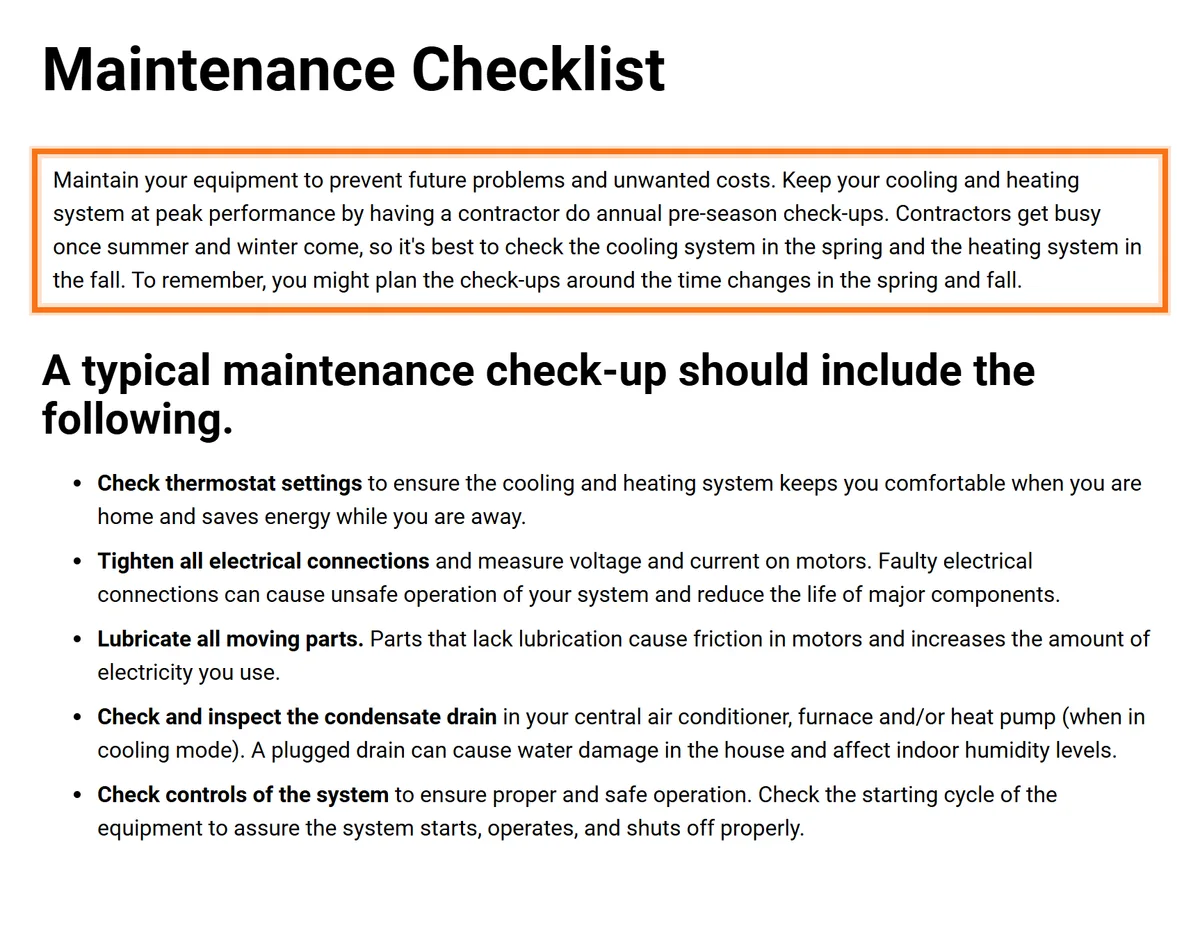
A spring AC tune-up catches the parts that are about to fail. A technician checks refrigerant charge and looks for leaks, tests the capacitor and contactor, cleans the condenser coil, clears the condensate drain, checks the blower and the thermostat, and reports the system's condition with a recommendation. A weak capacitor found in April is a small part replaced on a scheduled visit. The same capacitor in July is a no-cool call at an after-hours rate.
The fall visit does the same for the heating side: gas connections, gas pressure, burner combustion and the heat exchanger, which ENERGY STAR lists because a dirty burner or cracked heat exchanger makes a furnace less safe. Together, the two visits also give the owner something no emergency call provides: a written condition history of the system, year over year, which is what makes replacement planning possible. The preventive maintenance calendar puts both visits in context with the rest of the year.
Repair or replace: how to decide
Every AC owner eventually faces a repair estimate that is large enough to raise the question. The factors that decide it:
- Age. ENERGY STAR suggests considering replacement when an air conditioner or heat pump is more than 10 years old, or a furnace more than 15. A major repair on a unit past that point deserves a second look.
- Refrigerant. The EPA states that no new HCFC-22 (R-22, often called Freon) has been made or imported since January 1, 2020. Existing R-22 systems may still be used and serviced with reclaimed refrigerant, and the EPA does not require replacing them, but ask the technician to find and repair a leak instead of topping it off.
- History. A third repair in two summers is a pattern, and the next one is coming.
- Efficiency. ENERGY STAR says a correctly installed high-efficiency unit can save up to 20 percent on heating and cooling costs. On a rental the tenant usually pays the electric bill, so the benefit to you is at renewal.
- The estimate itself. A common rule of thumb compares the repair cost against the age and replacement cost together; a large repair on an old system usually loses.
What helps most is the condition history from the check-ups and more than one written estimate for both the repair and the replacement, so you are deciding with information instead of under pressure. Asking for a second quote before a major repair explains when that is worth the delay.
Planning the replacement instead of waiting for it
The difference between a planned replacement and an emergency one is mostly price and timing. A planned replacement happens in a shoulder season when HVAC companies are hungry for work, with competitive bids, the right equipment for the home, permits pulled and a proper installation. An emergency replacement happens in the heat with whoever can come this week, at whatever the price is that week, often with portable units running in the house in the meantime.
The planning steps are simple:
- Know the age and condition of the system from the tune-up reports.
- Set aside a reserve for it, or at least know the number you will need. Owner reserves and disbursements explains how a reserve is held by a manager.
- When the system reaches the end of its expected life, get written estimates in the fall or early spring and schedule the work. There is no standard flat rate for HVAC replacement on rental properties: the price depends on the size of the system, the ductwork and the equipment chosen, so compare quotes for the same scope.
- Pair the replacement with a renewal if you can; a new system is a reason a good tenant stays.
On billing, ask how your manager handles vendor estimates and whether anything is added to the invoice; maintenance markups explained shows what to look for. With us, maintenance coordination is a stated percentage of the vendor's invoice, and the original invoice is always in your owner portal.
What should a landlord budget annually for plumbing, HVAC and electrical maintenance on a rental home in Texas?
There is no official Texas figure, and we will not quote an "industry average" we cannot source. The honest answer is built from your own house in three steps:
- Routine service. Add the yearly cost of the spring and fall HVAC check-ups and a year of filters, at your contractor's actual prices.
- Replacement set-aside. For each major system (air conditioner, furnace, water heater, electrical panel), get a written replacement quote and divide it by the years you expect it to last. Use the equipment's age and its service reports, not hope.
- Repairs. Look at what the house actually cost in plumbing, HVAC and electrical repairs over the last two or three years, and assume the next year looks similar or slightly worse as the systems age.
A worked example, illustrative only and not a quote: if a replacement air conditioner is quoted at $9,000 and the current unit is 9 years old with perhaps 3 good years left, the set-aside is $3,000 a year for that one system. The same unit at 2 years old would need far less per year. The age of the equipment drives the number more than the size of the house.
The water heater belongs in the same plan, because Property Code 92.052 puts a device that supplies hot water at 120 degrees or more inside the landlord's duty to repair. How much reserve to hold per rental covers where that money sits, and the rental maintenance guide covers the rest of the house.
What the tenant is responsible for
The lease and the tenant handbook should set out the tenant's part clearly:
- Changing the filter on schedule, or installing a delivered filter when it arrives.
- Keeping the thermostat at a reasonable setting and not switching the system off and on constantly or setting it far below what the system can deliver on a hot day.
- Keeping vents and returns clear of furniture and the condenser outside clear of plants, debris and fence boards.
- Reporting problems right away: weak airflow, warm air, ice on the lines, water around the indoor unit, unusual noises. A system reported early is a small repair.
- Not attempting repairs or hiring their own technician.
Damage caused by a tenant's neglect, such as a coil that froze because the filter was never changed when the tenant was responsible and filters were supplied, can be billed back under the lease with documentation. Property Code 92.052(b) also says the landlord has no duty to repair a condition caused by the tenant, unless it is normal wear and tear. In practice bill-backs are rare when filters are supplied and checked, which is the point of doing both.
Property management and HVAC repair in Texas: what a manager does
Property management HVAC repair in Texas comes down to four jobs an owner usually cannot do from a distance. Taking the tenant's call and sorting an emergency from a problem that can wait until morning. Sending an HVAC company that already works for the manager, instead of whoever answers in July. Reading the estimate against what the same repair cost on other homes. And keeping the calendar: check-ups booked before the season, the filter looked at during inspections, and the replacement conversation started before it has to happen.
If you own a rental here and have never seen a written condition report on its HVAC system, that is the first thing to ask for. If you are weighing management for the first time, a free rental analysis gives you the rent range, make-ready guidance and a written management quote, and it is the place to ask how HVAC would be handled on your home.
How Perpetual handles this
Tenants in the homes we manage report HVAC problems through their portal with photos, which creates a dated record and lets us triage before anyone is sent. We use plumbers, electricians, HVAC companies and general trades we work with repeatedly. No AC in extreme heat and no heat in winter are on our published list of emergencies and follow our 24/7 process, which every plan includes.
Repairs under the spending limit you pre-approve get fixed without waiting on you. Anything larger, which usually includes a replacement, comes to you with a description, photos and a recommendation, and the decision is yours. Maintenance coordination is a percentage of the vendor's invoice (5% on Full Service, 4.9% on Standard), the original invoice is always in your owner portal, and every completed repair over $500 gets photo or video proof under The Perpetual Promise, subject to its Guarantee Addendum.
Much of the housing in Northeast Tarrant County is 30 to 50 years old, and planned attention to aging HVAC, water heaters and roofs beats emergency pricing. Every plan includes an annual property inspection. Whether seasonal check-ups and filter deliveries are set up for your home, and what they cost, is confirmed in writing before you sign; ask us.
We are broker-owned, with our office at 5755 Rufe Snow Dr in North Richland Hills, and we manage homes in Keller, North Richland Hills, Fort Worth and nearby. Our maintenance service describes the process and our pricing page lists every fee. To talk through the HVAC on your rental, call 682-593-7033.
The takeaway: Treat the AC as the planned expense it is, with the filter checked monthly, a check-up each spring and fall and a replacement scheduled before it fails, and the least-planned repair on a Texas rental becomes a predictable one.
Questions owners ask
Who pays for AC repair in a rental in Texas?
The owner, in almost every case. The AC is part of the home's systems, and keeping it working is the owner's responsibility under the lease and, when the lack of cooling materially affects health or safety, under Texas Property Code 92.052. The exception is damage caused by the tenant, which the landlord has no duty to repair (92.052(b)) and which can be billed back with documentation.
How long does a landlord have to fix the air conditioning in Texas?
Texas law does not name air conditioning or set a number of hours. Property Code 92.052 requires a diligent effort to repair a condition that materially affects health or safety after the tenant gives notice, and 92.056(d) presumes seven days is a reasonable time while weighing the severity of the condition. A home with no cooling in extreme heat should be treated as an emergency and dispatched right away. This is general information, not legal advice.
Is it the tenant's job to change the AC filter?
Usually yes, under the lease, but relying on it is a mistake. ENERGY STAR advises checking the filter once a month. Filters of the right size delivered to the home on a schedule, with a look at the filter during inspections, is the practical way to make sure it happens and to protect the system.
When should I replace the AC in my rental instead of repairing it?
When the system is past the age where replacement is worth considering (ENERGY STAR says more than 10 years for an air conditioner or heat pump), runs on R-22 refrigerant, has needed repeated repairs, or faces a repair estimate that is large relative to replacement. The best decisions come from check-up reports and competing written estimates, made in fall or early spring and not in a July emergency.
Can a property manager arrange regular HVAC servicing and filter changes?
Yes. A manager can book the spring cooling check-up and the fall heating check-up with an HVAC contractor, arrange for filters of the correct size to reach the home on a schedule, and confirm the filter was changed during inspections. Each contractor visit should produce a written condition report, which is what makes the repair-or-replace decision possible later. Ask any manager what is included in the fee and what is billed separately. With Perpetual, that is confirmed in writing before you sign.
What should a landlord budget annually for plumbing, HVAC and electrical maintenance on a rental home in Texas?
There is no official figure. Build it from the house: the yearly cost of spring and fall HVAC check-ups and filters, plus a replacement set-aside for each major system (a written replacement quote divided by the years the equipment has left), plus what the home actually cost in repairs over the last two or three years. The age of the air conditioner, furnace and water heater moves the number more than anything else.
Is there a flat rate for HVAC replacement on rental properties?
Not a standard one. The price of a replacement depends on the size of the system, the condition of the ductwork and the equipment chosen. Get at least two written quotes for the same scope, ideally in fall or early spring when contractors are less busy, and check that the quote includes the permit where the city requires one.
Is HVAC maintenance different for a short-term or vacation rental?
The equipment and the check-ups are the same: cooling in spring, heating in fall, and the filter checked monthly. The difference is who does the filter. Guests in a short-term rental will not change it, so the owner or manager has to put it on the cleaning or turnover checklist. Perpetual manages long-term residential rentals.
Related services
Property management in Keller, North Richland Hills and Fort Worth. How full-service management works in Tarrant County →