Key takeaways
- The duty covers conditions that materially affect the physical health or safety of an ordinary tenant, plus a working water heater that reaches 120 degrees (Property Code §92.052).
- It starts when the tenant gives notice where rent is paid and is not behind on rent; the notice must be written if a written lease requires it.
- Seven days is presumed a reasonable time to repair; severity and the availability of parts and labor can move it either way (§92.056(d)).
- If the landlord fails, the tenant may end the lease, repair and deduct up to one month's rent or $500, whichever is greater (§92.0561), or sue for a civil penalty of one month's rent plus $500 and damages (§92.0563).
- The tenant pays only for what the tenant caused, and a lease can shift other costs only within §92.006, in bold or underlined, specific terms.
Texas landlords must fix anything that materially affects the physical health or safety of an ordinary tenant, within a reasonable time after the tenant gives notice, and the law presumes seven days is reasonable. Cosmetic items and conditions the tenant caused are not part of that legal duty, although the lease may still cover them. That is the standard we run for homes in Fort Worth, Keller and North Richland Hills.
Most repair disputes are not about an owner refusing to fix something. They are about slow responses, informal communication and nobody writing anything down. This guide covers what the law actually requires, who pays for which repair, how notice works on both sides, what counts as a reasonable time, and the process that keeps a routine repair from turning into a legal problem.
The duty: conditions that affect health or safety
The statutory duty is narrower than most tenants assume and broader than most owners hope. A landlord must make a diligent effort to repair or remedy a condition if the tenant gives notice, the tenant is not behind on rent when notice is given, and the condition materially affects the physical health or safety of an ordinary tenant (Texas Property Code §92.052). The statute also names one item specifically: a device that supplies hot water of at least 120 degrees Fahrenheit.
In a North Texas single-family rental, the conditions that clearly meet that standard look like this:
- No heat during cold weather, or a furnace that is producing a gas or carbon monoxide hazard.
- Sewage backing up into the home, or a plumbing failure that leaves the tenant with no working toilet or no water.
- A roof leak that is actively bringing water into living space.
- Exposed wiring, a panel that trips repeatedly, or outlets that spark.
- An exterior door that will not lock, or a broken window that leaves the home open.
- No hot water.
A scuffed wall, a slow bathroom drain, a dishwasher that runs loudly or a fence board that fell in the wind do not rise to that level under the statute. Your lease may still obligate you to handle them, and a good manager will, but the legal exposure is different.
What counts as notice from the tenant
The repair clock does not start when the problem begins. It starts when the tenant gives notice to the person or place where rent is normally paid. If the lease is in writing and requires repair requests to be in writing, which a well-drafted Texas lease does, then the tenant's notice needs to be in writing (§92.052(d)). Before the tenant's remedies apply, the tenant generally must also give a second written notice after a reasonable time, unless the first notice went by certified mail or another tracked mail service (§92.056(b)).
That requirement cuts both ways. It protects you from a tenant who mentioned a drip to a lawn crew and later claims you ignored it for a month. It also means you need a single, documented channel for requests and a habit of responding in writing every time. A text to the owner's personal phone that gets buried is the worst of both worlds: it may count as notice, and nobody can prove what was said.
If the tenant is behind on rent when they give notice, the statutory duty generally does not attach until they catch up. That is not a license to ignore a gas smell. Health and safety hazards get handled regardless, because the liability for an injury is a far bigger problem than a rent dispute.
How fast is fast enough
Texas law gives the landlord a reasonable time to make the repair, and what is reasonable depends on the severity of the condition, how hard it is to get parts or a qualified contractor, and the circumstances around it. Property Code §92.056(d) creates a rebuttable presumption that seven days is a reasonable time; the date the landlord received the notice, the severity of the condition and the availability of materials, labor and utilities are what can move it.
In practice I sort requests into three buckets:
- Same day: no water, sewage, gas odor, electrical hazard, a home that cannot be secured, no heat in freezing weather.
- Within a few days: no hot water, a major appliance that came with the home, a leak that is contained but ongoing, a failed air conditioner.
- Scheduled: cosmetic items, minor fixtures, anything the tenant agrees can wait for the next routine visit.
Whether a failed air conditioner is a health and safety condition is argued constantly. In a North Texas August I treat it as urgent regardless of the legal answer, because an elderly tenant or a newborn in a home that is well over ninety degrees inside is a liability conversation nobody wants, and the argument costs more than the repair. Our guide on air conditioning in Texas rental property covers how to keep that call from happening in the first place.
What the tenant can do if you do not repair
If a landlord fails to make a diligent effort after proper notice and a reasonable time has passed, Texas law gives the tenant a set of remedies. The tenant may terminate the lease, have the repair done and deduct the cost from rent, up to one month's rent or $500 in a month, whichever is greater (§92.0561), or sue for an order to repair, a rent reduction, a civil penalty of one month's rent plus $500, actual damages and attorney's fees (§92.0563). The process usually involves the tenant giving a second notice after the first one went unanswered, which is why the paper trail matters so much.
Texas also prohibits retaliation. If a tenant in good faith requests a repair and you respond by raising rent, cutting services, filing an eviction or giving notice to leave within six months afterward, that is prohibited retaliation under Property Code §92.331 and the tenant can recover against you. An owner who wants a difficult tenant out needs to separate that decision cleanly from any repair request, with dates and reasons that stand on their own.
The repair-and-deduct remedy is the one owners fear most, and it is the one that almost never happens when requests are answered promptly in writing. Tenants reach for it when they feel ignored. A response the same day, even one that says the part is on order and gives a date, removes the reason.
What you are not required to fix, and what the lease adds
The statute does not require a landlord to repair a condition caused by the tenant, a member of the tenant's household or a guest, unless it was caused by normal wear and tear. A toddler who flushed a toy, a dog that chewed through a screen door, or a grease fire from an unattended pan are the tenant's cost. Your lease should say so and should spell out how those charges are billed.
The statute also does not require you to repair things that do not affect health or safety. That is where the lease takes over. Nearly every residential lease used in Texas obligates the landlord to keep the home in the condition it was leased, including appliances that came with it, and most owners want that anyway because a well-kept home keeps a good tenant. The guide on what a Texas residential lease must cover walks through those clauses.
One thing a lease generally cannot do is waive the health and safety duty. Language like "tenant accepts the home as-is and landlord has no repair obligation" does not remove the statutory duty and can create problems of its own. Lease a home you are willing to maintain, and put the standard in writing.
Who pays for which repair in a Texas rental
The question behind most repair arguments is not whether something gets fixed but who pays. Here is how Texas law and a typical lease split it:
| Situation | Who pays | Rule |
|---|---|---|
| A health or safety condition from age, wear or the home itself (roof leak, no hot water, failed wiring) | Owner | Property Code §92.052; cannot be waived except under §92.006 |
| Damage caused by the tenant, a household member or a guest, other than normal wear | Tenant; the owner may repair first and bill it | §92.052(b) and the lease |
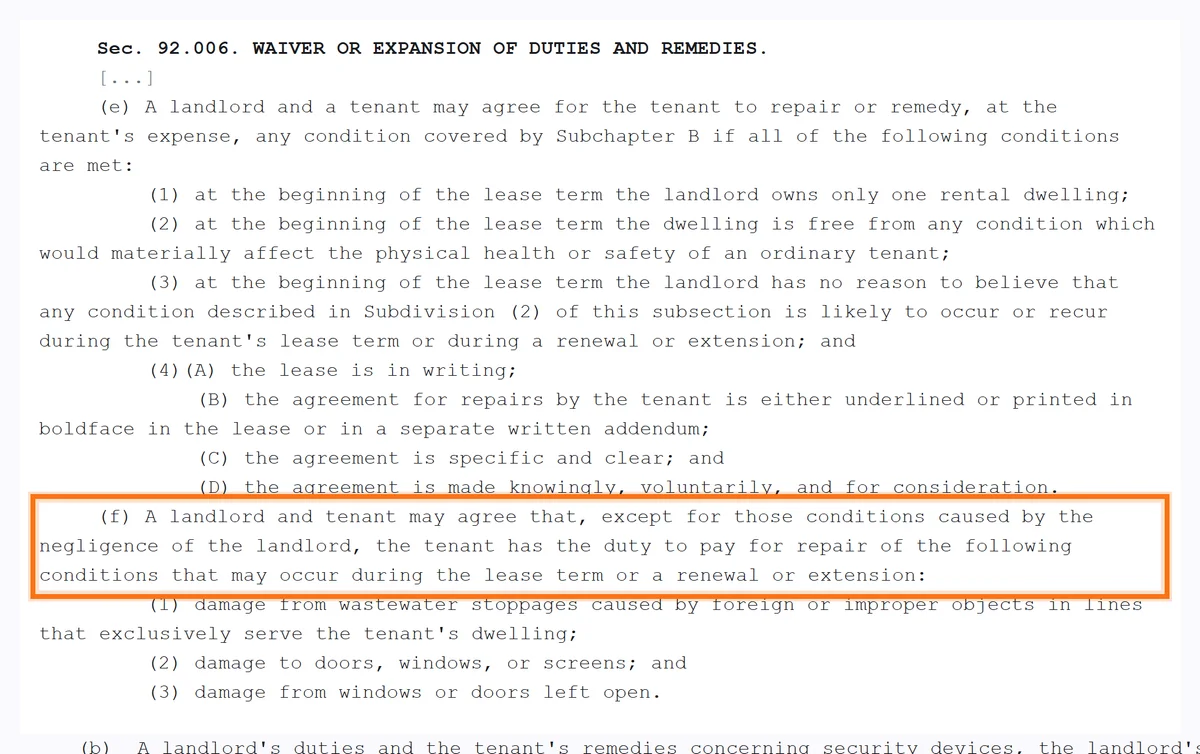
| Drain stoppage from foreign or improper objects, broken doors, windows or screens, damage from windows left open | Tenant, if the lease says so in bold or underlined, specific terms | §92.006(f) |
| Stoppage from roots, ground movement, faulty construction or failed equipment | Owner, whatever the lease says | §92.006(f) |
| Cosmetic items and appliances that do not affect health or safety | Whatever the lease says; usually the owner for items supplied with the home | The lease |
| Tenant repair-and-deduct after the owner failed to act | Owner, through a rent deduction of up to one month's rent or $500, whichever is greater | §92.0561 |
How to read this table: start with the cause, then the lease. If the home or time caused it and it touches health or safety, it is the owner's cost and a lease cannot change that except in the narrow §92.006 cases. If the tenant caused it, the owner can still make the repair to protect the home and bill the tenant, which is usually faster than waiting for the tenant to arrange it.
When the tenant is responsible, who decides the price?
When a repair is the tenant's cost, the owner does not need the tenant to agree on the price before a reasonable repair is made, but the charge has to be the real, reasonable cost of the repair. In practice we send our own vendor to protect the home, then bill the tenant the invoice amount with the vendor's report and photos showing the cause. A tenant who disputes it can see exactly what was done and what it cost.
If the lease lets the tenant arrange tenant-caused repairs themselves, set the standard in writing: licensed and insured vendors for plumbing, electrical and HVAC work, and the owner's approval before anything structural. The reverse situation has its own rules. When a tenant uses the repair-and-deduct remedy after the landlord failed to act, §92.0561 requires the work to be done by an independent company, contractor or repairman, licensed where the city requires it, and caps the deduction at one month's rent or $500, whichever is greater.
The repair process that holds up
This is the sequence we run on every request at Perpetual, and it is the sequence I recommend to any owner who self-manages:
- The tenant submits the request through the portal with a description and photos. That single channel is the written notice.
- The request is acknowledged in writing the same day with a category and an expected timeline.
- A vetted vendor is dispatched. For anything that could be a hazard, the vendor is contacted the same day regardless of what the owner's approval threshold says.
- The vendor reports back with photos of the completed work and an invoice.
- The tenant confirms the issue is resolved, or the ticket stays open.
- The whole record, including dates, photos and cost, lands on the owner's monthly statement and stays in the file.
That file is what protects you if the tenant later claims you ignored them. It is also what tells you, two years on, that the water heater has been patched three times and should be replaced. Our maintenance coordination service is built around that record, and handling after-hours emergencies covers the same-day bucket in detail.
Mistakes that turn a repair into a dispute
Owners rarely get in trouble for a repair they refused. They get in trouble for these:
- Silence. A request that sits unanswered for a week while the owner gets quotes. Say what you are doing and when.
- Telling the tenant to "just handle it and send me the bill." You have lost control of the vendor, the cost and the quality, and you have invited the repair-and-deduct remedy.
- Doing electrical, gas or plumbing work yourself to save money. In Texas much of that work requires a licensed trade, and an unlicensed repair that later fails is on you.
- Sending a handyman who patches the symptom. A leak under a sink that is tightened instead of replaced will be back, with a damaged cabinet floor.
- Holding a repair hostage to a rent dispute. Even where the statute lets you, it rarely ends well.
- Letting a repair request and a non-renewal decision land in the same week with no documented reason for the non-renewal.
Each of these is avoidable with one written response and a vendor you trust. A manager's job is to keep that bench of vendors ready before the call comes.
Approvals, reserves and emergency authority
Speed depends on who can say yes. If every repair over a small amount needs the owner's approval, and the owner is in a meeting, on a flight or in another time zone, the reasonable-time clock is running while nobody acts. The management agreement should give the manager authority to approve routine repairs up to a stated limit and to act without approval on anything that threatens health, safety or the structure.
That authority only works with money behind it. A reserve held in the trust account lets the vendor be paid on completion rather than after the owner wires funds. The guide on how the owner reserve works covers what a sensible reserve looks like and how it refills.
If you are weighing whether to keep handling this yourself, a conversation with Perpetual about full-service management is the fastest way to see what the process looks like with a manager in the middle.
This article is general information, not legal advice. Confirm the details of your situation with a Texas attorney.
The takeaway: Answer every repair request in writing the same day, fix anything that touches health or safety within days, and keep the record, because the law punishes silence far more often than it punishes cost.
Questions owners ask
How long does a landlord have to fix something in Texas?
Texas Property Code 92.056 presumes seven days is a reasonable time after the landlord receives the tenant's notice. The severity of the problem and the availability of parts, labor and utilities can make it shorter or longer. A hazard such as no water, sewage inside the home or a gas odor should be handled the same day.
Does a Texas landlord have to fix the air conditioning?
The statute speaks of conditions that materially affect health or safety rather than naming air conditioning, and whether a failed system qualifies depends on the circumstances. Most Texas leases obligate the landlord to maintain the system that came with the home anyway, and in summer heat the practical answer is to treat it as urgent.
Can a tenant withhold rent for repairs in Texas?
Texas does not give tenants a general right to withhold rent. After proper notice and a reasonable time, a tenant may be able to use the repair-and-deduct remedy within limits set by statute, terminate the lease or sue. A tenant who simply stops paying is in breach, which is why a clear written record of your response matters.
Does a landlord have to repair damage the tenant caused?
The statutory repair duty generally does not cover conditions caused by the tenant, a household member or a guest, unless the cause was normal wear and tear. The landlord can still choose to make the repair and bill the tenant under the lease, which is usually the fastest way to protect the home.
What happens if a landlord retaliates against a tenant for requesting repairs?
Texas Property Code 92.331 bars a landlord, for six months after a tenant's good-faith repair request or complaint, from retaliating by filing an eviction (except on grounds the law allows), cutting services, raising rent or ending the lease. The tenant can recover damages and attorney's fees, so any decision not to renew should be documented on its own merits.
How does a property manager decide whether a repair is the tenant's responsibility?
The manager starts with the cause, then the lease. Under Texas law the landlord's repair duty does not cover conditions caused by the tenant, a household member or a guest, unless the cause was normal wear and tear, so a toy flushed down the toilet or a screen door chewed by a dog is the tenant's cost. The lease then allocates what the statute does not reach, such as filter changes, lawn care and drain clogs. The vendor's report with photos settles the question by stating what failed and why. Perpetual usually makes the repair first to protect the home, then bills the tenant where the vendor's finding supports it.
If the tenant is responsible for a repair, does the landlord have to agree with the tenant on the price?
The landlord does not need the tenant's agreement on price before a reasonable repair is made, but the tenant can only be charged the real, reasonable cost, backed by the invoice and the vendor's report on the cause. If the lease lets the tenant arrange the repair, it should require licensed, insured vendors for trade work. When a tenant uses repair-and-deduct after the landlord failed to act, Texas caps the deduction at one month's rent or $500, whichever is greater.
What repairs is a landlord required to make in Texas?
Any condition that materially affects the physical health or safety of an ordinary tenant, such as no water, sewage backing up, a roof leak into living space, dangerous wiring or a door that will not lock, plus keeping a water heater that reaches 120 degrees. The duty applies after the tenant gives notice and while the tenant is current on rent, and it does not cover damage the tenant caused.
Property management in Keller, North Richland Hills and Fort Worth. How full-service management works in Tarrant County →