
Key takeaways
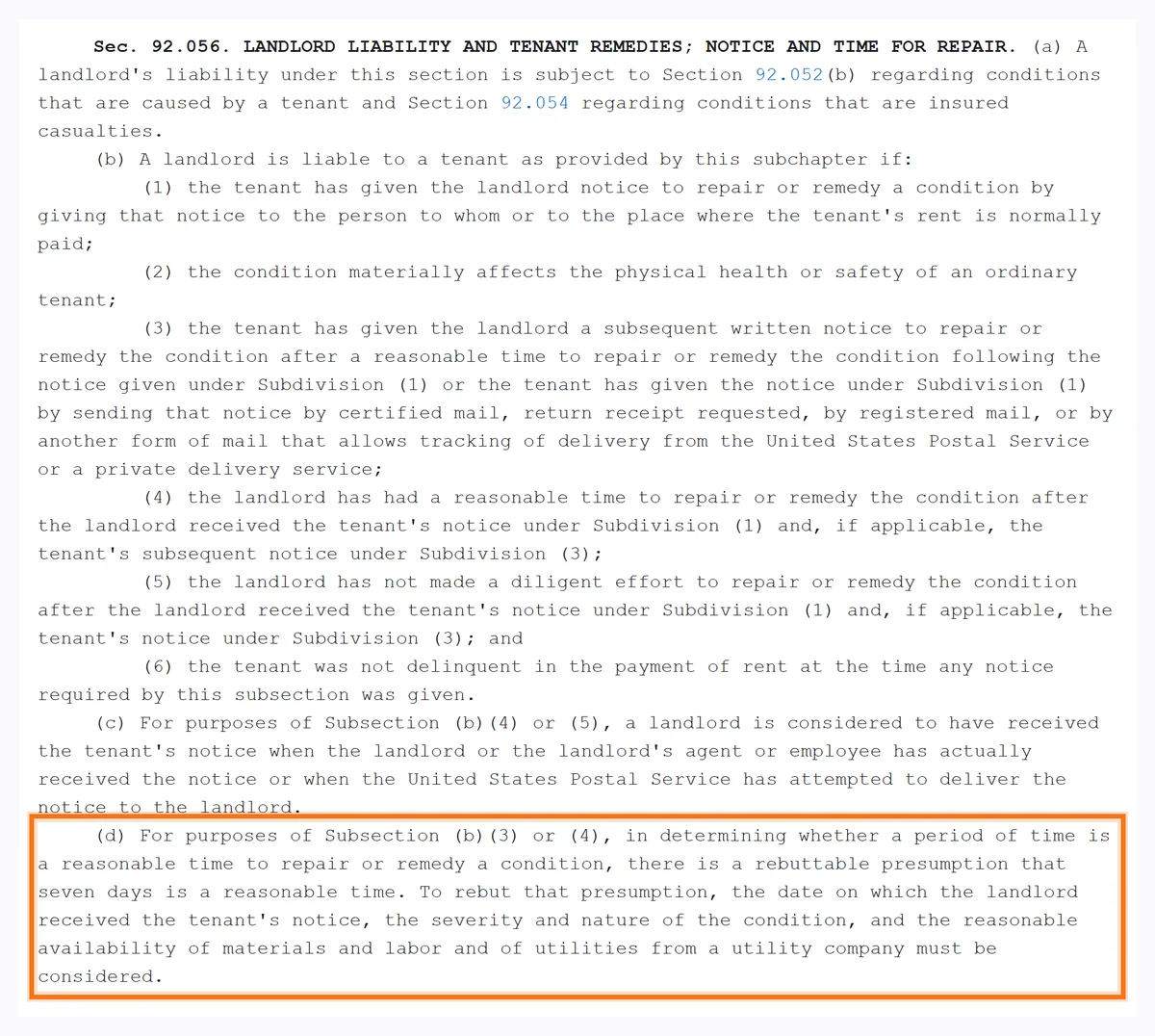
- Texas has no AC-specific repair deadline; Property Code 92.056 presumes seven days is a reasonable time to repair after notice.
- That presumption can be rebutted by the severity of the condition, and a dead AC in a North Texas summer is severe.
- The standard to expect: a person responds within hours, a technician the same day or next morning, a repair-or-replace decision the same day.
- If the landlord fails, the tenant's remedies include repair and deduct up to one month's rent or $500, whichever is greater (92.0561).
- We treat no AC in extreme heat as an emergency on our 24/7 process, on every plan.
How long does a landlord have to fix AC in Texas? The Property Code does not name a number of days for air conditioning. Section 92.056 requires a diligent effort to repair a condition that materially affects the physical health or safety of an ordinary tenant once the tenant has given notice, and it presumes that seven days is a reasonable time, a presumption the severity of the condition can rebut. In practice, in Fort Worth, Keller or North Richland Hills between May and September, a broken AC is a same-day problem: respond within hours, have a technician on the way the same day or first thing the next morning, make the repair-or-replace decision the moment the diagnosis is in, and keep the tenant informed until the house is cool.
This guide sets out what Texas law says, the response standard by stage, the triage that resolves some calls without a truck, and how the dispatch and decision should run so you are not the bottleneck.
The response standard: respond in hours, dispatch in a day, restore as parts allow
"Fixed" is not one event, so set expectations for each stage:
- Response: the tenant hears from a person, not just an auto-reply, within a few hours of reporting, at any hour in summer. The response includes what happens next and when.
- Dispatch: an HVAC technician is scheduled the same day in hot weather, or the next morning if the call comes in late evening. In mild weather, next business day is acceptable.
- Diagnosis and decision: the tech reports the fault and the cost the same visit, and the repair-or-replace decision is made within hours, not days.
- Restoration: a repair with a stocked part is often completed on the first visit. A part that has to be ordered, or a full system replacement, takes longer, and the tenant is told the realistic date.
The number that matters most is the gap between the report and the first technician visit. Everything after that is governed by parts and the owner's decision speed. A manager who cannot get a tech out within a day in summer does not have enough vendors.
Broken AC in a Texas rental: the response, stage by stage
This is the timeline we hold ourselves to on a summer AC call, next to what Texas law sets as the outer limit:
| Stage | What should happen | Target in hot weather | Texas law |
|---|---|---|---|
| Tenant reports no cooling | A person answers, runs the triage questions and asks who is in the house | Within hours, at any hour | The tenant's notice starts the clock (92.056(b)) |
| Technician dispatched | Licensed HVAC vendor with the symptoms, system age and access details | Same day, or first slot the next morning | Diligent effort required after notice |
| Diagnosis and decision | Fault, repair quote and, if needed, a replacement quote with our recommendation | Same visit; owner decision within hours | Severity and parts availability are weighed (92.056(d)) |
| Cooling restored | Repair with a stocked part, or a scheduled replacement | Often the first visit; a replacement in days | Seven days is presumed reasonable, not a target |
| Long outage | Portable or window units and daily updates while parts are on order | From day two of a summer outage | Tenant remedies if the landlord does not act (92.056(e), 92.0561) |
How to read this table: the third column is the standard a good manager meets, and the last column is the legal floor. The gap between them is the point: a landlord who waits until day seven in July may be inside the presumption on paper and still losing the argument about severity, the tenant and the renewal. The number that matters most is the time between the report and the first technician visit; everything after that depends on parts and on how fast the owner decides.
What Texas law expects of you, in general terms
Texas does not have a statute that says "air conditioning must be repaired within X days." What it has is a general repair duty in Property Code Sections 92.052 and 92.056: once a tenant gives notice, the landlord must make a diligent effort to repair a condition that materially affects the physical health or safety of an ordinary tenant. Section 92.056(d) presumes that seven days is a reasonable time to repair, and says the presumption is rebutted by looking at when the notice arrived, the severity and nature of the condition, and the availability of materials, labor and utilities. Heat in a closed house in August is about as severe as a condition gets.
If the landlord does not act after the notices the statute requires, the tenant has remedies that can include terminating the lease, repairing and deducting the cost from rent (capped by Section 92.0561 at one month's rent or $500, whichever is greater), or suing for damages and penalties. Some Texas cities also have ordinances that set minimum indoor cooling requirements or specific repair windows, so the local rules can be stricter than the state baseline. Your lease may add its own promise, and a lease that lists AC as a provided system makes the obligation clearer still.
The practical reading for an owner: treat a summer AC failure as a health condition with a short clock, keep a record of every step, and never let the tenant's notice sit unanswered. Repair duties more broadly are covered in Texas landlord repair obligations. This is general information, not legal advice; confirm the specifics with your lease and an attorney.
Why heat makes this different from any other repair
A broken dishwasher is an inconvenience. A broken AC in a Texas summer is a safety issue for infants, older tenants, anyone with a heart or respiratory condition, and pets left home during the workday. Indoor temperatures in a closed house climb past the outdoor reading by afternoon. That is the reason the response standard is hours, not days, and the reason a manager should ask on the first call who lives in the house.
The house suffers too. Humidity rises without the system running, which swells wood floors and doors, and condensation shows up where it never did. A tenant who sweats through a week without cooling also tends to leave at renewal, and in this market the cost of a turnover dwarfs the cost of a fast service call.
There is also the liability side. A documented, prompt response is your defense if a tenant later claims harm or withholds rent. The documentation is not a formality; it is the whole case.
The first hour: triage by phone before the truck rolls
A surprising share of "AC is dead" calls can be resolved or at least narrowed by a few questions and photos. A good manager walks the tenant through, in this order:
- Thermostat: is it on, set to cool, and set below the room temperature? Does it have batteries that may be dead? Is the screen blank?
- Breaker: is the AC breaker tripped in the panel? Reset it once. If it trips again, stop and wait for the tech.
- Filter: when was it last changed? A clogged filter can freeze the indoor coil. If there is ice on the indoor unit or the copper line, switch the system to off and the fan to on to thaw it for a few hours.
- Drain line: many systems have a float switch that shuts the unit down when the condensate drain backs up. Water in the pan near the air handler points there.
- Outdoor unit: is the fan spinning? Is the disconnect in place? Is the unit covered in debris?
None of this replaces a technician. It gets the right information to the technician, sometimes restores cooling for the night, and catches the cases where the fix is a filter the tenant should have changed. The manager notes every answer in the work order so the tech arrives knowing what has been tried.
Dispatch: what the manager tells the vendor, the tenant and you
Once triage is done, the manager opens a work order and sends it to a licensed HVAC vendor with the symptoms, the system's age if known, the tenant's availability and the access arrangement. In summer the request is explicit: same-day if possible, first slot tomorrow if not. A manager with a bench of vendors can shop the slot; an owner with one contractor waits for that contractor.
The tenant gets the vendor's name and the arrival window, plus interim advice: keep blinds closed, run fans, avoid the oven, and call back if anyone in the house is unwell. If the household includes someone vulnerable, that is the moment to escalate to the first available tech from any vendor, not the cheapest one.
You, the owner, get a notice that an AC call is in progress and, if the management agreement sets an approval threshold, a request to approve the diagnostic visit if it exceeds it. Most agreements let the manager authorize an emergency diagnostic without waiting. How emergencies are defined and handled outside business hours is in after-hours emergencies and property management, and the broader call handling is part of our maintenance service.
Repair or replace: the decision that should not sit overnight
The technician calls in from the roof or the attic with a diagnosis and a number. Common faults are a failed capacitor, a bad contactor, a seized fan motor, a refrigerant leak or a failed compressor. The first few are cheap and quick. A leak or a compressor on an aging system raises the real question: put money into this unit or replace it?
The manager should give you a recommendation on the spot, with the system's age, the refrigerant type, the repair quote, a replacement quote or range, and the tenant's situation. A rough rule many owners use: if the repair costs a large fraction of a replacement and the system is past the midpoint of its expected life, replace. The longer view on planning for the system is in HVAC in a Texas rental.
What matters most for speed is that the decision is made within hours. A replacement ordered Tuesday afternoon is usually installed within days; the same replacement ordered the following Monday after a week of deliberation has cost the tenant a week and you some goodwill. If you know you will be hard to reach, give the manager a written authority limit for exactly this situation.
Keeping the tenant reasonable while they wait
If the fix will take more than a day in hot weather, do something visible. Portable AC units or window units in the bedrooms, delivered by the vendor or the manager, keep the household safe and buy patience. Some owners offer a modest rent credit for a multi-day outage; it is far cheaper than the dispute it heads off, and it reads well in a file if the matter is ever reviewed.
The other half is communication. A daily update that says "part arrives Thursday, install Friday morning" is worth more than any credit. Tenants escalate when they feel ignored, not when they are informed.
What the owner sees afterward
When the job closes you should be able to see, in the owner portal, the tenant's original request with its timestamp, the triage notes, the dispatch time, the technician's diagnosis, the invoice, and photos of the work, including the model and serial plate of any new equipment. That record proves response time if it is ever questioned and gives you the system's history for the next decision.
If the call revealed a filter that had not been changed in a year or a drain line nobody had flushed, the record should also say so, because that is where the prevention conversation starts. A spring tune-up, a drain line flush and a filter schedule prevent a share of summer failures, and they cost less than one emergency visit.
How Perpetual handles this
For the homes we manage in Keller, North Richland Hills and Fort Worth, a summer AC call is handled as an emergency from the first message. The tenant reaches a person, we run the triage questions, and if the system is truly down we dispatch a licensed HVAC vendor from our vetted bench the same day whenever a slot exists, with the tenant's arrival window confirmed in writing. We ask on that first call who is in the house, because a household with an infant or an older adult gets the first available technician, not the first available from one company.
When the diagnosis comes in, you get a repair-or-replace recommendation the same day with the age of the system, the quotes and our reasoning, and the decision is yours. Everything, from the tenant's timestamped request to the invoice and the photo of the new unit's data plate, is in your owner portal and on your monthly statement. The emergency authority limit and every maintenance fee are in your written quote before you sign. To see how this compares with your current manager, ask us.
The takeaway: A broken AC in Texas heat is a same-day problem, and the only parts of the fix that should ever wait are the ones that depend on parts, not on people.
Questions owners ask
How quickly should a property manager respond when the AC stops working in Texas?
Within hours, with a real person and a plan, and with a technician dispatched the same day or first thing the next morning in hot weather. Texas Property Code Section 92.056 requires a diligent effort to repair a condition that affects health or safety after notice and presumes seven days is a reasonable time, but the severity of a summer AC failure can make a shorter time the reasonable one. The repair-or-replace decision should be made the day the diagnosis arrives.
Is a landlord required to provide air conditioning in Texas?
State law does not list air conditioning as a required amenity, but once a home has AC and the tenant relies on it, Texas's general duty to repair conditions affecting health or safety applies when it fails, and some cities add specific cooling requirements. In practice, every lease in North Texas treats AC as part of the home. Confirm your lease language and local ordinances with an attorney.
Can a tenant withhold rent if the AC is broken in Texas?
Simply withholding rent is not a recognized remedy in Texas and can put the tenant in default. If the landlord fails to make a diligent repair effort after proper written notice, the tenant may have remedies such as repair-and-deduct within statutory limits, lease termination or a court claim. A prompt, documented response from the manager avoids all of it.
Who pays for a hotel if the AC is out in a rental?
Usually no one is required to, unless the lease says so or a court orders it. Many owners provide portable units or a rent credit for a multi-day summer outage because it keeps the tenant safe and reasonable and costs less than a dispute. Ask your manager what their standard practice is before summer arrives.
Should I replace an old AC before it fails in a rental?
Often yes, if the system is well past the midpoint of its expected life and has needed repairs. A planned replacement in spring is scheduled around the tenant and priced without emergency pressure, while a July failure is installed on the vendor's timeline with a tenant in a hot house. Your manager's inspection reports and the system's repair history should drive the call.
How long does a landlord have to fix AC in Texas?
There is no AC-specific deadline. Property Code Section 92.056(d) presumes seven days is a reasonable time to repair a condition affecting health or safety after the tenant's notice, and that presumption can be rebutted by the severity of the condition and the availability of parts and labor. A dead AC in summer heat should be answered the same day; waiting a week is a risk, not a right.
Related services
Property management in Keller, North Richland Hills and Fort Worth. How full-service management works in Tarrant County →