Key takeaways
- Most property managers use an online owner portal for statements, invoices, documents and inspection reports; ours runs on AppFolio.
- Phone and email are for decisions and problems: an answer within one business day is a fair standard, and ours is in writing.
- A repair above your approval limit should arrive with a description, photos and a recommendation.
- Monthly: a statement and a payout on a stated date. We disburse collected rent by the 10th of each month.
- Bad news should reach you the day it happens, before it is resolved, with a plan.
Property managers use an online owner portal for the routine (statements, invoices, documents, inspection reports) and phone or email for anything that needs your decision. For a rental in Fort Worth, Keller or North Richland Hills, expect an answer within one business day, repair approvals with photos and a recommendation, a statement every month, a photo report after every inspection, and bad news the day it happens.
Most complaints about property managers are complaints about communication: the call that was not returned, the repair approved without asking, the statement that arrived with a surprise. A good manager communicates to a standard, and the standard can be stated before you sign. This guide sets it out, with our own written commitments as an example.
The standard in one paragraph
You should hear from the manager when something needs your decision, when something has changed about your home or your tenant, and on a fixed monthly rhythm. You should hear back within one business day on anything routine and the same day on anything urgent. You should never learn something important from a statement, a tenant or a court notice that the manager could have told you earlier. And you should hear less over time, not more, as the manager absorbs the routine.
Everything else in this guide is detail on that paragraph. Hold any manager to it, including us.
Response times: what fast means for each kind of message
One response time for everything is the wrong standard, because a question about a line on the statement and a call about water through the ceiling are not the same message. A workable set of expectations:
- Emergency at the property (active leak, no heat in a freeze, no air conditioning in summer heat, security breach): you are told the same day, after the manager has already dispatched someone. You do not need to approve an emergency response; you need to know it happened.
- A decision you must make (repair above the threshold, renewal terms, a tenant request): the request reaches you within a business day of the manager knowing, with what you need to decide.
- A routine question from you: a reply within one business day, even if the reply is "looking into it, answer by Thursday."
- A problem with the tenant (late rent past the grace period, a lease violation, a notice sent): you are told when it happens, not when it is resolved.
Ask a manager for its stated response times before signing. A company that has them written down has thought about this. A company that says "we always get back to people quickly" has not.
What to expect, message by message
Here is a practical standard for each kind of owner communication, next to what Perpetual commits to in writing:
| Kind of message | A fair standard | What we commit to |
|---|---|---|
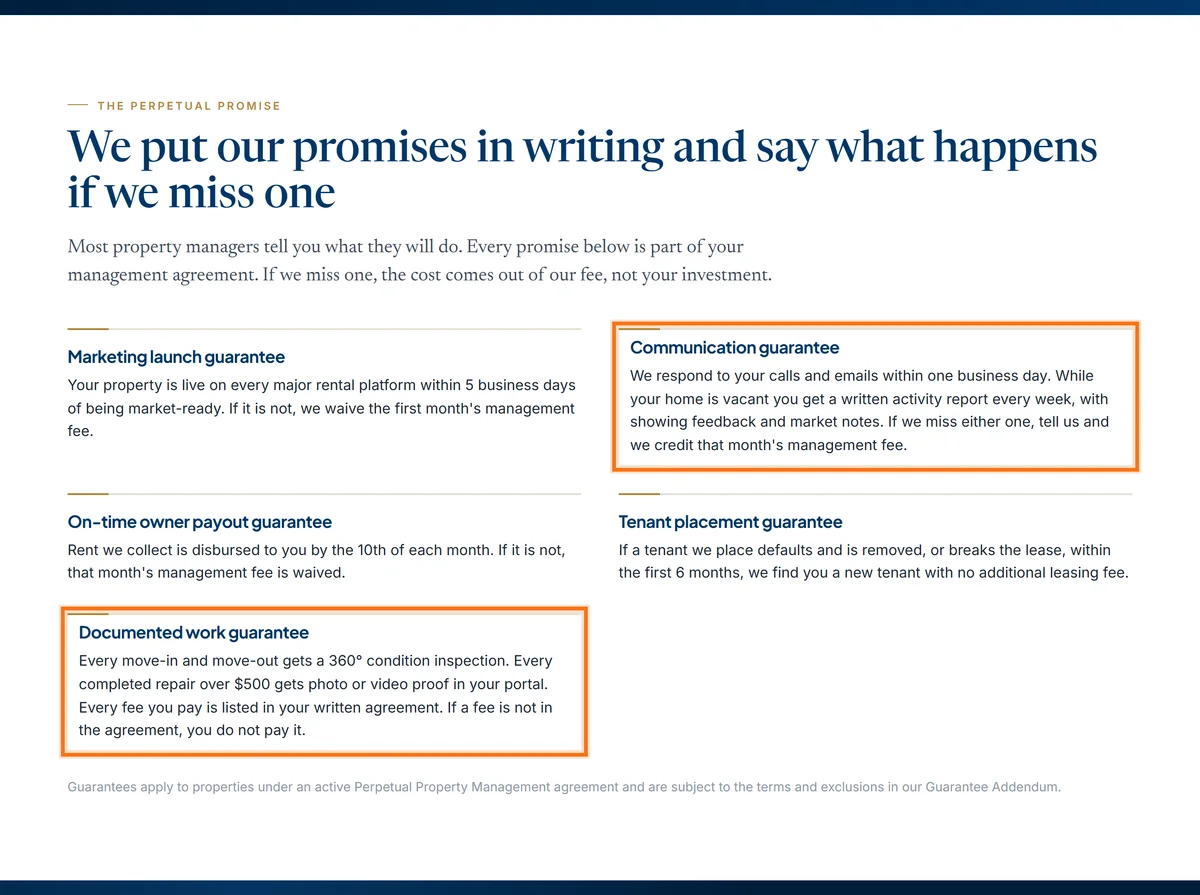
| Your call or email | An answer within one business day | A response within one business day, or that month's management fee is credited (communication guarantee) |
| Your home is vacant | Regular updates on showings and interest | A written activity report every week with showing feedback and market notes |
| A repair above your limit | A request you can decide on without a phone call | A description, photos and a recommendation; repairs under your pre-approved limit are fixed without waiting |
| A completed repair | Proof the work was done | Photo or video proof in your portal for every repair over $500, plus the original invoice |
| Monthly money | A statement and payout on a stated date | Collected rent disbursed by the 10th of each month, or that month's fee is waived; statements in the owner portal |
| An inspection | A report you receive, not one you must request | A photo report in your owner portal with condition notes and recommended actions |
How to read this table: the middle column is what to ask of any manager you interview. The right column is ours, taken from our guarantees and service pages; the guarantees are part of every management agreement and each states what we do if we miss it. A manager with nothing written down in that column is asking you to rely on its word.
What a proper repair approval request contains
The approval request is where owner communication is tested most often, and where a weak manager wastes the most of your time. A good request lets you decide in two minutes without a phone call. It contains:
- What the tenant reported and what the vendor found, in a sentence or two.
- Photos of the problem.
- The recommended fix and its cost, and where the job is large, a second option or a second bid.
- What happens if the repair is deferred, in plain terms.
- Whether the item is a habitability issue under Texas law, which changes how long it can wait.
- Whether the tenant is responsible for any of the cost under the lease.
- A deadline for your answer, and what the manager will do if it does not hear from you.
Compare that to "the AC guy says it needs a new capacitor, OK to proceed?" which is the same decision with none of the information. How the manager chooses and prices the vendor behind the request is covered in how property managers handle vendors, and the policy we work to is on the maintenance page.
What you should not have to hear about
Communication quality is as much about what is filtered as what is sent. A manager who forwards every tenant message, every vendor scheduling note and every routine repair under the threshold is not being transparent; it is making you do the job. The owner portal exists so the routine is visible without being sent.
You should not need to be told about: repairs under your approval threshold, routine tenant questions, vendor scheduling, rent that arrived on time, a renewal notice going out on schedule, an inspection being booked. All of that should be findable in the owner portal when you want it, with the statements, documents and disbursement history in one place. Ours runs on AppFolio, and you can share statements with your CPA from it.
The test of a manager's filter is simple. After the first two months, you should be receiving a statement, the occasional approval request and an inspection report, and almost nothing else. If your inbox is full, the manager is passing work through rather than doing it.
The monthly rhythm: statement, disbursement and a line of context
Once a month, on a stated date, three things should happen without you asking: the disbursement lands, the statement is posted, and anything on the statement that is not routine gets a sentence of explanation. Our date is in writing: collected rent is disbursed by the 10th of each month. A maintenance line for a water heater should not be the first time you hear of a water heater.
The statement itself should reconcile to the previous month and to the lease, with every fee matching the schedule you signed. If something is unusual, the better managers add a short note: rent arrived late and the late fee is shown, the reserve was topped up after the plumbing repair, the tenant has given notice. Reading a statement is explained line by line in the owner statement explained; what matters here is that the statement is confirmation of things you already knew, never the source of news.
Inspection reports: delivered, not available on request
Every inspection the manager performs should produce a report that is sent to you, or posted with a notification, within a few days of the visit. The report is the manager's eyes on your home and the only way you see it between visits of your own. A manager who inspects and does not report has done half the work; a manager who reports only when asked has done the work for the file, not for you.
Expect the report to come with a short cover note: the home is in good shape, or here are the two things that need attention and here is what I recommend. If the inspection found something that needs money, the approval request should arrive with the report, not a month later when the item has become a repair.
What the report must contain, and how to tell whether an inspection actually took place, is in inspection fees: included or extra.
Bad news early: the rule that defines a manager
Here is the single most important thing in this guide. A manager earns trust by delivering bad news the day it happens, before it is resolved, with a plan. Rent is late and the notice went out today. The tenant has given notice and marketing starts next week. The vendor found a slab leak and here are the options. A tenant has complained about the neighbor and here is what the lease allows.
Managers avoid this because owners react badly to bad news, and it is easier to wait until there is good news to pair with it. The cost of waiting is yours: a late rent you hear about in month two is an eviction that starts a month later than it should have, and a leak you hear about after the repair is a decision you never got to make.
Test for this before you sign. Ask the manager to describe the last time it had to tell an owner something they did not want to hear, and how soon after the event. The answer will tell you more than the brochure. A manager that is comfortable with that question is one that will call you on the bad day. A broker-owned company has a particular reason to: the broker's own license and reputation sit behind every account, which is a different kind of accountability than a call center. Who stands behind ours is on the about the broker page.
Channels: set your preferences once, in writing
Owners differ. Some want a text for anything over a few hundred dollars and nothing else. Some want an email for everything and a call for emergencies only. Some travel and want a second contact listed. The manager cannot guess, so the onboarding should include a short conversation that records your preferences: which channel for which kind of message, who else can approve in your absence, your approval threshold, and your quiet hours.
Then the manager should use them. If you asked for email and get calls, or asked for a text on anything over the threshold and find a repair on the statement you were never texted about, raise it once, in writing. A good manager corrects it the same week. A manager who cannot keep a communication preference is unlikely to keep track of a lease date.
One more preference worth stating: how you want to be told about rent. Some owners want a note when rent arrives; most prefer to hear only when it does not. Either is fine. Silence that means "all good" only works when both sides agreed that is what it means.
How to test a manager's communication before you sign
You can measure this before there is anything at stake. Send the manager an email with three specific questions on a weekday afternoon and note when the answer arrives and whether it answers all three. Call the main line and see whether a person answers and whether they can tell you who would handle your account. Ask for a sample approval request and a sample inspection report, and look for the elements described above.
Ask the question about bad news. Ask what their stated response times are. Ask how an owner reaches someone after hours if a tenant calls them directly with an emergency, which happens. Then ask to speak to one current owner, and ask that owner only one thing: when something went wrong, how soon did you hear?
The signals you are looking for are the ones listed in property management red flags, read in reverse. If you would like to run that test on us, the easiest way is to send three questions and time the reply.
The takeaway: Expect a manager to answer within a day, ask with photos and a price, report every month and every inspection, and tell you bad news the day it happens.
Questions owners ask
How often should a property manager communicate with the owner?
On a fixed monthly rhythm with the statement and payout, whenever a decision is needed, and the same day anything important changes about the home or the tenant. While a home is vacant, a weekly written report is a fair standard; we send one. Beyond that, less is better: routine activity belongs in the owner portal, not in your inbox.
How quickly should a property manager respond to an owner?
Within one business day on routine questions and the same day on anything urgent. Emergencies at the property should be handled first and reported the same day. Ask a manager for its written response time before signing; ours is one business day, backed by a credit of that month's management fee if we miss it.
What should a repair approval request from a property manager include?
What was reported and found, photos, the recommended fix and cost with a second bid on larger work, the consequence of deferring, whether it is a habitability issue, whether the tenant is responsible for any cost, and a deadline for your answer.
Should my property manager tell me when rent is late?
Yes, when it passes the grace period and a notice goes out, not when it is finally paid. Late rent is a decision point for the owner because the eviction timeline starts from the first missed payment, and hearing about it late costs weeks.
What is a sign of poor communication from a property manager?
Learning something from the statement, the tenant or a court notice that the manager could have told you earlier. Also an inbox full of forwarded routine messages, approval requests without photos or costs, and inspection reports that only appear when you ask.
What do property managers use for owner communication?
Most use an online owner portal for monthly statements, invoices, documents and inspection reports, and phone and email for decisions such as repair approvals, renewals and problems with a tenant. Our owner portal runs on AppFolio, and calls and emails get a response within one business day.
Related services
Property management in Keller, North Richland Hills and Fort Worth. How full-service management works in Tarrant County →