Key takeaways
- Every owner on title signs the management agreement, and one owner is named in writing as the person whose instructions the manager follows.
- There are three ways to distribute rent to owners automatically: a joint account, a standing bank transfer by percentage, or separate disbursements by ownership share.
- Fees and repairs come out before the split, so each owner bears expenses in the same proportion as income.
- IRS Publication 527: an owner of a part interest reports their part of the rental income and deducts expenses they paid according to their percentage of ownership.
- A short written agreement between the owners, prepared by an attorney, settles repairs, funding and exit before they become disputes.
A property manager can work with two owners of one house, and it runs smoothly when three things are settled at the start. If you co-own a rental in Fort Worth, Keller or North Richland Hills, every owner signs the management agreement, one owner is named in writing as the person whose instructions the manager follows, and the two of you have a written understanding about money, repairs and what happens when one of you wants out.
This guide covers who signs, how to distribute rent to the owners automatically, how the IRS treats each owner's share, and the scenarios that cause trouble when nothing was written down. It applies to spouses, siblings who inherited, friends who bought together and partners in a small deal.
How to distribute rent to owners automatically
These are the ways the monthly rent on a co-owned rental reaches each owner without anyone writing a check by hand:
| Method | How it works | Who does the split | What to settle first |
|---|---|---|---|
| One payment to a joint account | The manager sends the net rent to one bank account that both owners hold | The owners, whenever they choose | Who can draw on the account, and how much stays in it for repairs |
| Joint account plus a standing transfer | The manager pays the joint account; the bank sends each owner a fixed percentage on a set day every month | The bank, automatically | A transfer date after the manager's disbursement date, and a buffer left in the account |
| Separate disbursements by ownership share | The manager sends each owner their percentage of the net rent to their own account | The manager, automatically | That the manager offers it, the percentages in writing, and which owner each tax form goes to |
| One payment to the entity | An LLC or partnership owns the house; the manager pays the entity's account | The entity, under its own agreement | Who is authorized to sign for the entity |
How to read this table: the second and third rows are the fully automatic ones. The second works with any manager, because the split happens at your bank. The third depends on the manager, so ask before you sign and get the percentages into the agreement.
Two owners, one authorized decision-maker
The manager's problem with two owners is not two signatures; it is two sets of instructions. A tenant with a broken water heater cannot wait while the manager tries to reach both of you and reconcile a yes and a maybe. So the agreement names one owner as the authorized contact for decisions: repair approvals above the limit, rent pricing, renewal terms, and whether to accept an application that needs a judgment call.
The other owner is not shut out. They should see the same statements and invoices and can be copied on every approval. What they give up is the ability to countermand the decision-maker, and that is the point. The manager follows one voice, and the two of you decide between yourselves who it is and how it changes.
Choose the decision-maker on availability, not on who owns more.
Who signs the management agreement on a co-owned Texas rental
Expect every owner on title to sign. A manager who accepts an agreement from one of two owners on the deed is taking instructions from someone who may not have authority over the other's interest, and a lease signed as that owner's agent is open to the same question. The manager will ask for a copy of the deed and list every owner in the agreement.
If the house is held in an LLC, a trust or a partnership, the entity is the owner and signs through whoever its documents authorize. That is often the cleanest arrangement for co-owners, because the entity's own agreement already answers who decides, how money splits and how an owner exits. How a manager handles a rental owned by an LLC covers the paperwork.
Where one owner cannot sign easily, for example a sibling in another state, a power of attorney covering the property lets one owner act for the other. Have an attorney prepare it. One Texas point: Real Estate Commission rule 535.5 says a joint owner who acts as agent for the other owner for compensation must hold a real estate license unless an exemption applies. Managing your own half is not the issue; being paid to manage your co-owner's half is.
How the money is split: one month, worked through
Rent comes into the manager's trust account, the management fee and any repairs are deducted, and the balance is disbursed. Because expenses come out first, the split of the balance is also the split of the costs. Here is one month, with an assumed rent of $2,400, our Standard plan at 9% of monthly rent, one $300 plumbing invoice with 4.9% maintenance coordination, and owners holding 60% and 40%. Illustrative only, not a quote:
- Rent collected: $2,400.00
- Management fee, 9%: $216.00
- Plumber's invoice: $300.00
- Maintenance coordination, 4.9% of $300: $14.70
- Net to the owners: $2,400.00 minus $530.70 = $1,869.30
- Owner with 60%: $1,121.58. Owner with 40%: $747.72.
The 40% owner has paid 40% of the plumber without sending anyone money. A reserve, where the agreement provides for one, is normally held once for the house, not per owner. How reserves work in general is in owner reserves and disbursements.
One rule to set in writing: who funds a shortfall. If a roof repair costs more than the rent and the reserve cover, the manager will ask the decision-maker for funds. Whether both owners contribute by share, or one advances the money and is repaid from future rent, is a question for your co-owner agreement, not for the manager.
How the IRS treats rent split between co-owners
The tax side follows ownership, not the bank account the rent lands in. IRS Publication 527 says that if you own a part interest in rental property, you must report your part of the rental income, and you can deduct expenses you paid according to your percentage of ownership.
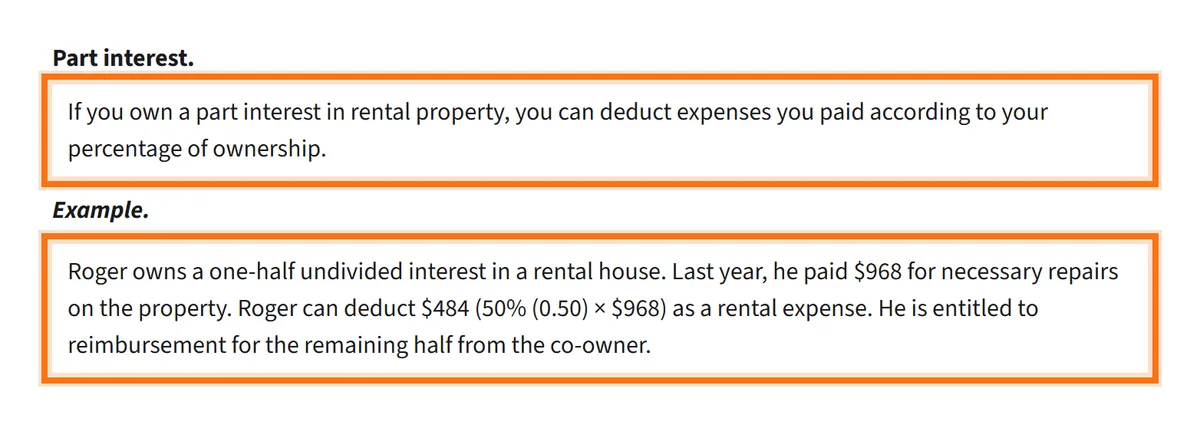
That example is the reason to let fees and repairs come out of the rent before the split. When the manager pays the plumber from the rent, each owner has paid their share and nobody is chasing a reimbursement.
Three more points from irs.gov to raise with your CPA:
- Co-owning is not automatically a partnership. Publication 541 says co-ownership of property that is maintained and rented is not a partnership unless the co-owners provide services to the tenants.
- If the rental activity is a partnership, Publication 527 says to use Form 1065, the partnership return. That includes a partnership with your spouse unless it is a qualified joint venture.
- Spouses who are the only members, file a joint return and both materially participate can elect qualified joint venture treatment. The IRS says a business held through an LLC does not qualify, and mere joint ownership of property that is not a trade or business does not either.
One form involves the manager. The instructions for Form 1099-MISC say a property manager must use that form to report the rent paid over to the property owner, and for tax years beginning after 2025 the reporting threshold is $2,000. With two owners, decide whose name and taxpayer number each form carries. This is general information, not tax advice. Your CPA decides how your co-ownership is reported.
What both owners can see
Both owners should be able to see the same records: every monthly statement, every vendor invoice and the history of what was disbursed and when. Transparency between co-owners is the cheapest conflict prevention there is. An owner who can open the plumber's invoice does not have to take the other's word for what the repair cost.
Ask the manager three things before signing: can each owner have a separate owner portal login, does each receive the statement directly instead of through the other, and can the non-deciding owner be copied on repair approvals. Ask too what happens if the two of you disagree and both call. The right answer is that the manager follows the decision-maker on routine matters and waits on discretionary ones until you agree. How to read an owner statement shows what the monthly report contains.
The written co-owner agreement that prevents conflict
The management agreement governs the manager. It does not govern the two of you. For that you need a short written agreement between the owners, prepared or at least reviewed by an attorney, that answers the questions the manager will eventually force:
- Who is the decision-maker, and how is that changed?
- What repair amount requires both owners to agree, and what happens if one does not respond within a set number of days?
- How are capital items (roof, HVAC, foundation) funded: by share, or by one owner with repayment from rent?
- When can the house be sold, who can force a sale, and does the other owner have a right to buy first, and at what price?
- What happens on the death, divorce or bankruptcy of one owner?
This is general information, not legal advice; the agreement itself should come from an attorney.
The four scenarios that cause trouble
Managers see the same disputes between co-owners repeatedly. Each one is avoidable with a sentence in the agreement above.
- One owner wants to sell, the other does not. Without a buyout clause, the house sits, the relationship sours, and the argument can end up in court. With a clause, one owner buys the other out at an agreed method of pricing, or the house goes on the market.
- One owner wants to raise the rent at renewal, the other wants to keep the tenant. The decision-maker decides, with the manager's renewal recommendation as the basis, and the agreement says so.
- One owner wants to place a relative as the tenant. The manager's written screening criteria apply to the relative like anyone else, and the relative pays market rent, or the other owner is subsidizing them.
- One owner stops contributing to a capital expense. The agreement says what happens: the other advances and is repaid from the first owner's share of rent, or the shares adjust.
In every case the manager's role is to run the house and follow the decision-maker. The manager does not referee.
If you inherited the house together
Sibling co-ownership is the most common two-owner case and the one with the least paperwork, because nobody chose it. Before a manager can accept the house, the question of who holds title and who may sign has to be settled, which is a job for the estate's attorney. Then everything in this guide applies, with one addition: decide early whether this is a long-term hold or a house you will sell in a few years, because that changes how much to spend getting it rent-ready.
The sequence of calls after an inheritance is in inherited a house and never been a landlord.
How Perpetual handles this
Perpetual Property Management manages single-family homes, townhomes and small multifamily properties in Keller, North Richland Hills, Fort Worth and nearby, and a house with two owners is run the same way as any other. Rent we collect is disbursed by the 10th of each month, or that month's management fee is waived, under the Perpetual Promise and subject to its Guarantee Addendum. You receive monthly statements, and the AppFolio owner portal holds your statements, documents and disbursement history. When we coordinate a repair, the original vendor invoice is in the portal.
For repairs, the owners set a pre-approved spending limit; anything larger comes with a description, photos and a recommendation. Our plans are 10%, 9% or 7% of monthly rent, and if a fee is not in your management agreement, you do not pay it. Tax treatment is your CPA's call; our role is to provide the records that support it.
How the monthly disbursement is divided between co-owners, whether each owner gets a separate portal login and whose name each year-end tax form carries are confirmed in writing before you sign. The free rental analysis comes with a written management quote. To talk through a co-owned rental, call 682-593-7033.
The takeaway: Two owners can share a managed rental without friction if one of them decides, both of them can see everything, and the rules for money and exit are written down before the first repair.
Questions owners ask
Can a property manager work with two owners who share a rental property?
Yes. Every owner on title signs the management agreement, one owner is named in writing as the decision-maker whose instructions the manager follows, and both owners should see the same statements and invoices. Fees and repairs come out of the rent before it is divided. A written agreement between the owners about repairs, funding and sale keeps the manager out of your disputes.
Can a property manager split the rent between two owners?
Many can, by sending the net rent to two accounts in the percentages set in the agreement. Others pay one account and the owners divide it, which a standing bank transfer can do automatically. Either way, fees and repairs are deducted before the split, so each owner's share of expenses is automatic. Ask before you sign and get the method in writing.
Does every co-owner have to sign the property management agreement?
Expect the manager to require it, or a power of attorney from the other owner that covers the property. A manager acting on one owner's signature alone is taking instructions from someone who may lack authority over the other's interest. If the house is in an LLC or trust, the entity signs through whoever its documents authorize.
What happens if co-owners disagree about a repair?
The manager follows the named decision-maker on routine repairs up to the pre-approved limit. For larger or discretionary items, a careful manager waits until the owners agree, which is why your co-owner agreement should set an approval rule and a deadline for responding. Emergencies that threaten health, safety or the house itself are dealt with first and reported right away.
Should co-owners put a rental property in an LLC?
An entity gives co-owners one owner on title, an agreement that settles decisions, shares and exits, and a single account for the disbursement. It also has costs and tax consequences: the IRS says a business held in the name of a state-law entity such as an LLC does not qualify for the qualified joint venture election, so ask your CPA how that applies to you. It is a question for an attorney and a CPA, not a manager.
How do I distribute rent to owners automatically?
Pick one of three setups. Have the manager pay one joint account and add a standing bank transfer that sends each owner a fixed percentage every month. Or ask the manager to send separate disbursements by ownership share. Or hold the house in an entity and let the manager pay the entity's account. In each case fees and repairs come out first, and the percentages belong in writing.
Do co-owners of a rental house have to file a partnership tax return?
Not automatically. IRS Publication 541 says co-ownership of property that is maintained and rented is not a partnership unless the co-owners provide services to the tenants. Publication 527 says each owner of a part interest reports their part of the income, and that Form 1065 is used if the rental activity is a partnership. This is general information, not tax advice; your CPA decides which applies.
Related services
Property management in Keller, North Richland Hills and Fort Worth. How full-service management works in Tarrant County →